

You sit down for japa with sincere intent. Then a notification, a remembered disagreement, or an unfinished task catches the mind. The mantra continues, but your attention is somewhere else. Concluding that your mind is simply weak is too crude a diagnosis to help.
A more useful approach separates the senses, mind, intelligence, and action. Once you see where order was lost, you can apply the right discipline: regulate sensory input, return attention, exercise discernment, and carry the result into compassionate conduct. That is what makes yoga workable beyond the practice seat.
The mind is the junction, not the final authority

The senses bring sights, sounds, tastes, sensations, and other impressions into awareness. The mind attends to them, connects them with memory and desire, and turns them into an immediate inner experience. Intelligence then has the capacity to judge what the experience means and whether its proposed action should be followed.
This makes the mind a pivotal interface. It is not the whole self, and it is not an enemy that can be defeated once and discarded. It can carry an impression upward toward discernment, or it can carry an impulse directly into speech and action before discernment has been allowed to operate.
Intelligence in this setting does not mean academic ability, quick calculation, or skill in argument. It means viveka: the capacity to distinguish what is merely attractive from what is beneficial, what is impulsive from what is dharmic, and what serves the ego from what serves a higher purpose. A person can be clever and still let desire dictate every important choice.
When you regret a reaction, trace it through four questions:
- What entered through seeing, hearing, or another sense?
- What did the mind repeat, exaggerate, anticipate, or demand?
- What did intelligence already recognize as the better course?
- At what point did the impulse become speech or action?
The answers tell you what to train. If the problem began with constant stimulation, strengthen pratyahara, or regulation of sensory input. If the mind kept replaying an impression, train the return of attention. If you knew the right response but ignored it, the neglected faculty was discernment. If you understood the right response but did not enact it, your practice did not yet cross into conduct.
Concentration alone is not the goal. Anger, envy, and fear can also become intensely one-pointed. Yogic discipline seeks attention governed by intelligence, grounded in ethics, and directed toward devotion and compassionate action.
Use a practice sequence instead of a burst of willpower

Yoga brings several disciplines into one working sequence. Yama and niyama establish the ethical ground. Pratyahara reduces the senses’ power to drag attention in competing directions. Sravanam gives the mind worthy content through attentive hearing. Japa repeatedly returns attention to sacred sound. Dhyana steadies contemplation. Bhakti gives the entire process its devotional purpose.
These are not sealed compartments that must always occur separately. Bhakti can infuse every stage, and discernment must remain active throughout. The sequence matters because trying to force concentration while leaving conduct and sensory habits untouched usually places the entire burden on willpower.
- Set conduct before concentration. Choose one ethical boundary for the period surrounding your practice. It might be refusing retaliatory speech, keeping the phone away during japa, or declining entertainment that you already know will agitate the mind. Ahimsa becomes practical when it governs the next response, not merely your ideals.
- Make pratyahara physical. Remove notifications and unnecessary media from the immediate environment. Do not begin japa in the middle of scrolling and expect the senses to become quiet on command. Withdrawal does not mean hatred of the senses; it means reducing competing claims on them.
- Begin with sravanam. Listen carefully to the sacred name, a recitation, or a scriptural teaching. After hearing, state its central instruction in your own words. If you cannot identify what you heard, you were exposed to the sound, but you were not yet attending to it.
- Practice japa through hearing. Follow the mantra as sound rather than allowing the mouth to continue while the mind conducts another conversation. When attention leaves, return to the syllable presently being uttered. Do not turn the previous lapse into a second distraction by arguing with yourself. This repeated return is abhyasa.
- Let dhyana narrow the field. Remain with one sacred name, form, quality, or instruction rather than piling several subjects into the same sitting. When contemplation quietly becomes planning or fantasy, return to the heard mantra.
- Complete the sequence with viveka. Before returning to ordinary activity, identify one decision the practice should govern: a measured reply, an act of service, a restraint, an apology, or a duty that should no longer be postponed. This is where inner discipline becomes dharmic action.
Do not judge a sitting only by whether attention remained uninterrupted. Also notice how quickly distraction was recognized, whether you returned without resentment, and whether the practice changed the next choice you made. A clean return is part of the discipline, not evidence that the discipline failed.
Diagnose the failure at the right layer
- If the environment repeatedly captures you, repair the pratyahara conditions before changing the mantra or abandoning the practice.
- If japa continues mechanically, bring hearing back to the present mantra and reconnect it with the purpose of remembrance.
- If concentration improves but speech remains harsh, return to yama, niyama, and viveka. Attention has sharpened, but conduct has not yet been purified.
- If practice produces a peaceful interval followed by the same habitual reactions, make the final action explicit before leaving the practice seat.
- If discipline produces superiority toward others, the devotional orientation has been displaced by self-importance.
Fix the first broken link you can identify. You rarely need to redesign your entire spiritual life because of one distracted sitting.
Let Aniruddha turn restraint into sacred responsibility

Within the Gaudiya Vaishnava account, the mind of the living entity is identified with Lord Aniruddha, the supreme ruler of the senses, whose form is described as bluish-black. This is a theological claim belonging to a particular Vaishnava framework, not a generic psychological definition that every dharmic school states in the same way. In Gaudiya Vaishnava theology, especially as articulated through Srila Prabhupada’s purports, it changes the meaning of mental discipline.
If you treat the mind only as private property, self-control can become a contest between ego and appetite: your will must overpower your desires. Recognition of Aniruddha places both the senses and mind within a sacred order. The practical question changes from how you can dominate the mind to how this entrusted faculty should be governed and offered.
Before japa or contemplation, you can establish that orientation with a simple intention: may hearing, speech, and attention be governed by dharma and directed toward service. The words are less important than the shift they create. You are no longer demanding that the mind perform so that you can feel accomplished; you are inviting it to participate in remembrance.
Devotion and intelligence should correct each other. Viveka without devotion can be recruited to justify self-importance. Devotional feeling without disciplined attention can become an unexamined routine. Keep them in the same loop: remember, discern, act, and review.
Look for progress in conduct rather than dramatic inner experiences. Useful signs include noticing an impulse before the hand or tongue obeys it, returning from distraction without hostility toward yourself, pausing before avoidable conflict, and becoming more available for compassionate service. Mastery of the senses is incomplete if it makes you rigid, proud, or indifferent to other people.
Learn across dharmic traditions without erasing differences
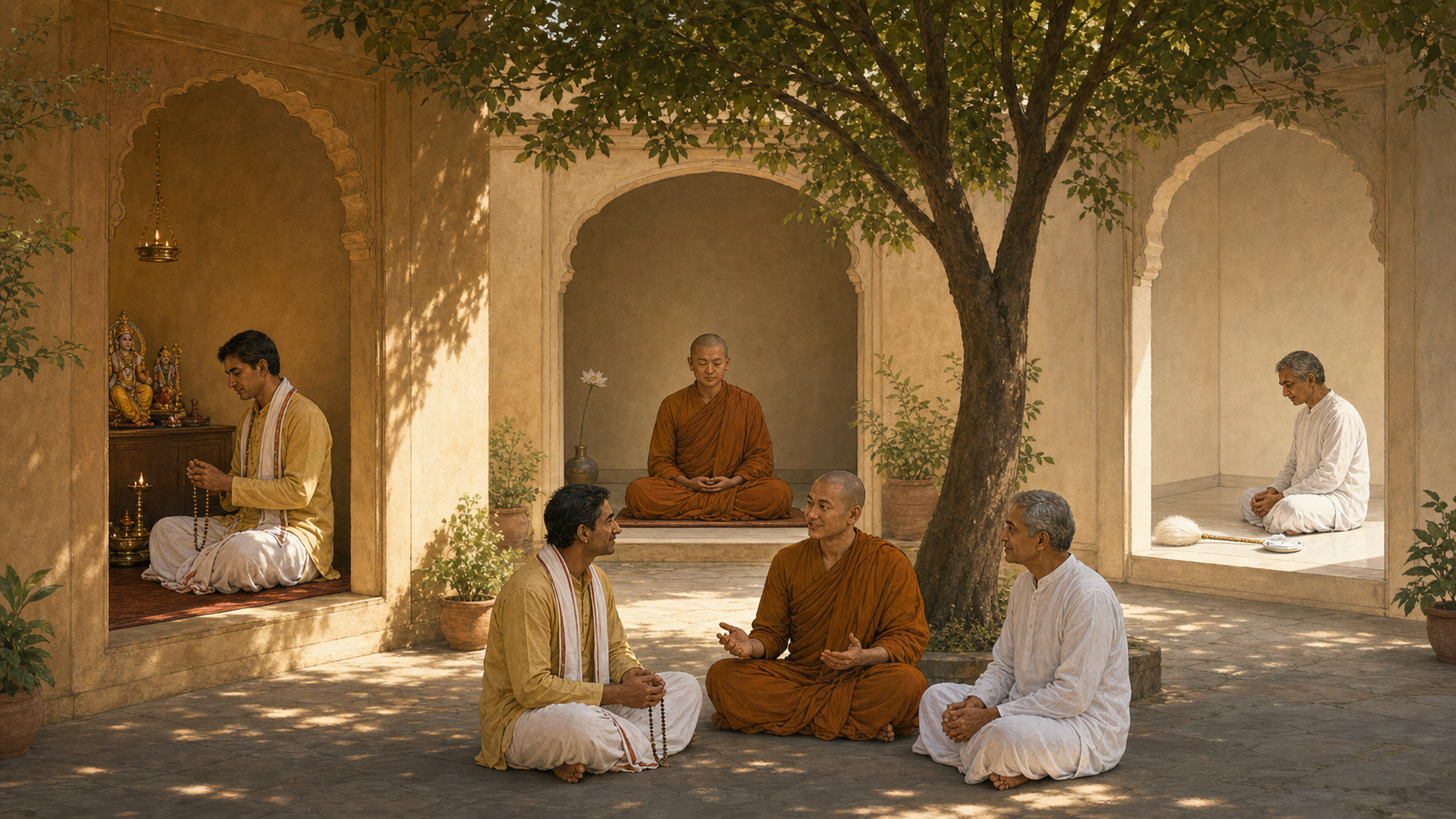
Dharmic unity is strongest when related disciplines are placed beside one another without claiming that their doctrines are identical. Hindu, Buddhist, Jain, and Sikh traditions do not use one metaphysical vocabulary. They nevertheless give sustained practical attention to the training of the mind, ethical responsibility, freedom from automatic impulse, and the movement from inner practice to humane conduct.
| Dharmic setting | Named disciplines | Immediate practical emphasis |
|---|---|---|
| Gaudiya Vaishnava and wider Hindu practice | Sravanam, japa, dhyana, bhakti-yoga | Direct the senses and mind toward sacred remembrance, devotion, discernment, and service. |
| Buddhist practice | Mindfulness and non-clinging awareness | Notice experience without automatically grasping at every thought, feeling, or impression. |
| Jain practice | Samayik and Pratikraman | Examine conduct, renew ethical awareness, and strengthen restraint through deliberate self-scrutiny. |
| Sikh practice | Simran and Shabad Kirtan | Centre awareness in remembrance and carry that remembrance into service. |
What you can carry across these traditions is a discipline of questioning, not a claim that all their answers are interchangeable. What are you repeatedly feeding your attention? What attachment is governing the present reaction? What conduct requires honest review? What form of service should follow remembrance? If you are anchored in a lineage, answer those questions within its vocabulary and guidance.
This approach protects both unity and integrity. Shared civilizational values become visible in disciplined attention, non-harm, self-examination, remembrance, and service. Theological differences remain real, while plurality becomes a resource for mutual recognition rather than a reason for fragmentation.
Key takeaways for your next practice
- Treat the mind as the junction between sensory impressions and intelligent judgment, not as the final authority and not as an enemy.
- Use viveka to distinguish an attractive impulse from a dharmic response; intelligence here means discernment, not intellectual speed.
- Build practice in a workable order: ethical conduct, sensory regulation, attentive hearing, japa, contemplation, and a specific action.
- When attention wanders, return to the present mantra. The repeated return is abhyasa, not a reason to condemn the whole sitting.
- Within the Gaudiya Vaishnava framework, remembrance of Aniruddha turns sense restraint into participation in divine governance.
- Measure progress by earlier awareness of impulses, steadier returns, more careful speech, and greater readiness for compassionate service.
- Learn from neighboring dharmic disciplines without pretending that Hindu, Buddhist, Jain, and Sikh teachings are doctrinally identical.
At your next sitting, begin with four concrete moves: remove one competing stimulus, state one ethical restraint, hear the mantra deliberately, and name one dharmic action that should follow. Repeat that sequence consistently before adding complexity. A trained mind is built each time attention returns, intelligence judges clearly, and conduct follows.
References
