

Your body is at your desk, in the kitchen or beside someone you love, but your mind is replaying yesterday or negotiating with tomorrow. You may know that you should return to the present. The harder question is what to do once you return.
Dharmic practice gives a demanding answer: become attentive enough to recognise your duty, then perform it without being ruled by fear, regret or attachment to the result. Presence is not an escape from life. It is the condition in which you can meet life truthfully.
The present is a place of duty, not an escape
Present-moment practice is often reduced to feeling calm. Calm can help, but it is not the standard by which the practice succeeds. You can feel calm while avoiding an apology, ignoring an obligation or remaining silent when truth requires speech. You can also act with genuine presence while experiencing grief, urgency or uncertainty.
The practical test is not whether an unpleasant feeling disappeared. Ask instead: Can I see what is happening without immediately turning it into a story, and can I respond in accordance with dharma?
This is why attention and right action belong together. Attention reveals the situation in front of you. Dharma gives that attention a moral direction. Without attention, you react from habit. Without ethical direction, awareness can remain passive or self-absorbed.
- Presence is not a blank mind. A thought about the past or future can arise without carrying you away. Notice it, determine whether it requires action and return to what is here.
- Non-attachment is not indifference. Karma Yoga asks you to perform the right action carefully while releasing anxious possession of its outcome. Quality of effort still matters.
- Equanimity is not moral neutrality. A steady mind should make non-harm, truthfulness and responsibility easier to enact, not easier to evade.
- Planning is not absence from the present. Planning becomes unhelpful when imagined outcomes replace the action available now. A clear plan made and executed attentively is itself present action.
When you are unsure whether you are practising presence or merely seeking relief, use a sharper question: What is dharma now? Sometimes the answer is to wait. Sometimes it is to listen, speak, repair, refuse, serve or begin the work you have postponed.
Four traditions, four distinct doorways into now
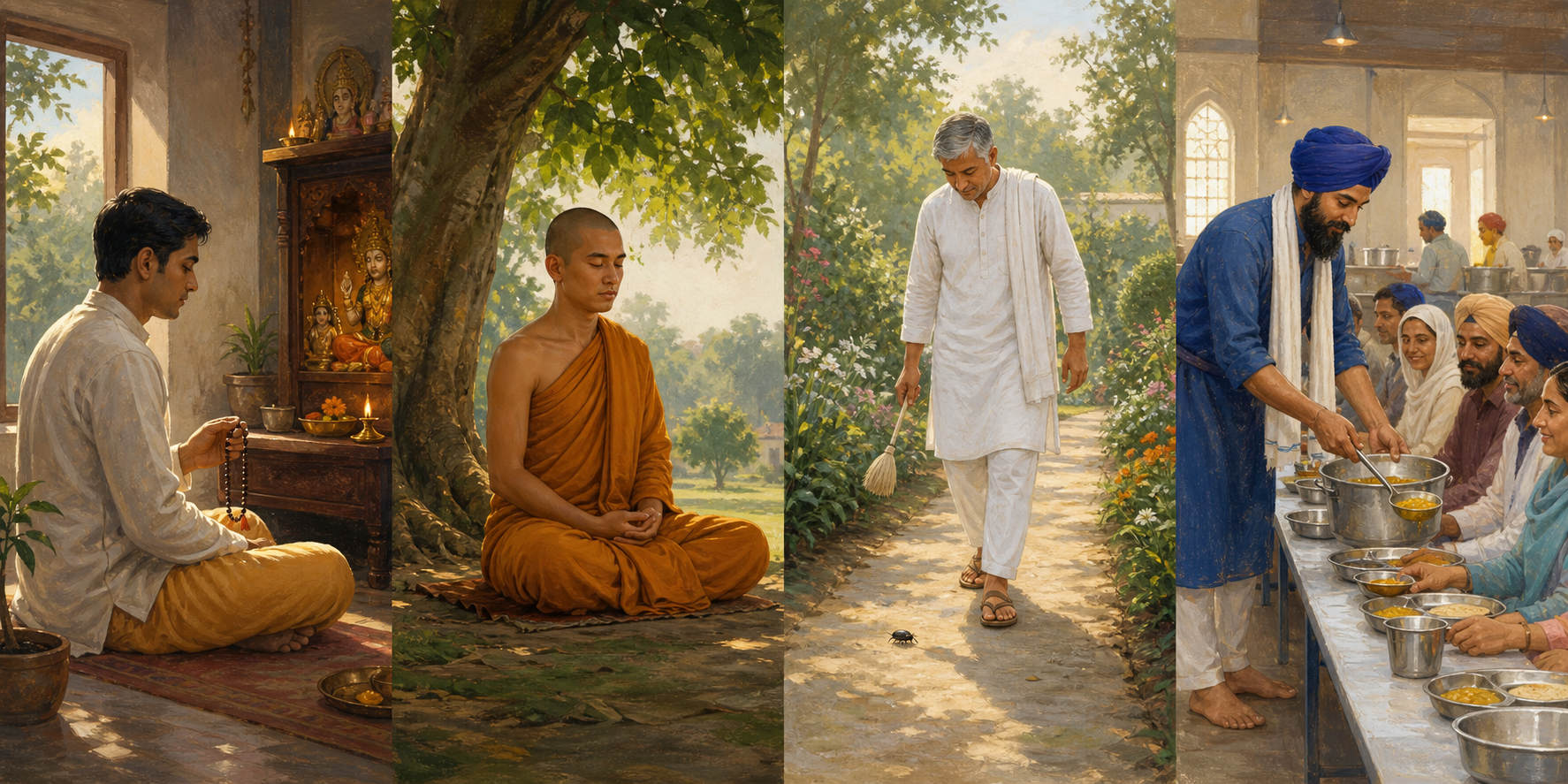
Hinduism, Buddhism, Jainism and Sikhism do not become interchangeable because they share disciplines of attention. Their vocabularies, devotional forms and philosophical aims retain their integrity. What they offer together is a practical pattern: gather a scattered mind, see more clearly and let that clarity shape conduct.
| Tradition | Present-moment doorway | What it trains you to do | A question for practice |
|---|---|---|---|
| Hindu traditions | Karma Yoga, dhāraṇā, dhyāna, breath awareness, japa or attention to a mūrti | Steady attention and right action without anxious attachment to results | What action is mine to perform, and what result am I trying to control? |
| Buddhist traditions | Mindfulness and close attention to present experience | Notice sensations, thoughts and reactions without immediately judging or obeying them | What is actually being experienced before I add preference or story? |
| Jain traditions | Samayik and the cultivation of equanimity | Interrupt partial, reactive conduct and return attention to restraint and non-harm | Which response reduces harm rather than multiplying it? |
| Sikh tradition | Simran, remembrance of the Divine | Collect attention through remembrance so that daily action is not severed from the Divine | What changes in this action when I perform it in remembrance? |
These are entry points, not complete descriptions of the traditions. Choose the doorway that belongs to your path. If you already receive guidance within a sampradaya, sangha, Jain community or Sikh sangat, let that discipline determine the form. The goal is not to collect techniques. It is to become faithful to a practice deeply enough that it begins to govern ordinary conduct.
If you do not yet have an established discipline, begin with breath awareness because it requires no elaborate setting. Then connect it to the ethical or devotional language that is meaningful to you. A Hindu practitioner may move from breath to japa and Karma Yoga. A Buddhist may return from breath to direct observation. A Jain may use the pause to restore equanimity. A Sikh may let the pause open into simran. The physical interruption may look similar, while the inner orientation remains distinct.
Use the three-breath return when the mind is pulled away

You do not need to wait for ideal meditation conditions. A three-breath return can be used before speaking, sending a message, entering a meeting, answering a difficult question or deciding what to do next.
- Stop adding momentum. Put down what can safely be put down. Do not type, argue or make the decision while trying to centre yourself.
- Feel three natural breaths. Follow the movement from the navel toward the chest and back. Keep the breath steady rather than forcing it to become dramatic.
- Separate experience from interpretation. Notice what is directly present: tightness, warmth, rapid thought, an urge to defend yourself, or uncertainty about the next step. Do not turn a sensation into a verdict about yourself or another person.
- Return through your chosen doorway. Use the breath, a mantra, japa, Divine remembrance, bare attention or a deliberate return to equanimity.
- Ask what dharma requires now. Look for the caring, truthful and responsible action available in the present situation.
- Complete the immediate action. Send the necessary reply, make the apology, begin the assigned work, state the boundary or continue listening. Release the demand that this action must control everything that follows.
The pause works only when it leads back into life. If you keep repeating a centring exercise because you do not want to make a difficult but necessary decision, the practice has become another form of delay.
When worry is about the future
Future-oriented anxiety often fuses several possibilities into one overwhelming problem. After the three breaths, distinguish the part that can be acted on from the part that cannot yet be known. Then take the available dharmic step: gather the missing information, prepare what is yours to prepare, ask for help, communicate a risk or set an appropriate limit.
You are not being asked to stop caring about consequences. You are placing effort where it can operate. Once the immediate action is complete, return to the duty in front of you instead of mentally rehearsing every possible result.
If anxiety is persistent, overwhelming or interfering with sleep, work, relationships or safety, use contemplative practice as support while seeking qualified professional care. Meditation and breath awareness should not be treated as substitutes for mental-health treatment.
When regret is about the past
Presence does not require you to pretend that the past is irrelevant. It changes your relationship to it. Memory can become instruction when it leads to a present correction; it becomes captivity when it produces repeated self-condemnation without repair.
After acknowledging the feeling, ask which response is still possible. If you caused harm, the present may require a truthful apology or restitution. If you failed to protect a legitimate limit, it may require a compassionate boundary. If no corrective action remains available, carry forward the lesson without continually staging an inner punishment that helps no one.
When another person provokes you
Begin with what you actually know. Separate the words or action you witnessed from the intention you have assigned to the other person. Notice the urge that is forming in you. Then test your response against both ahimsa and satya: does it avoid needless harm, and does it remain truthful?
This does not require passivity. A firm refusal can be more dharmic than resentful compliance. Silence can prevent an impulsive injury, but silence can also conceal cowardice or permit harm. Presence gives you the interval needed to tell the difference.
Make ethics the proof of your attention

It is easy to mistake intensity for depth. A powerful meditation, emotional devotional experience or unusually quiet mind may be meaningful, but daily conduct remains the more reliable test. Are you becoming less careless with speech? More able to admit an error? More capable of acting without demanding praise? More attentive to the effects of your choices?
The yamas and niyamas turn awareness into discipline. Ahimsa keeps the present response from multiplying injury. Satya prevents peace from becoming a polite name for avoidance. Self-observation helps you notice when anger is disguising pride, when attachment is disguising responsibility, or when fear is disguising prudence.
Before a consequential action, examine it through a compact ethical filter:
- Truth: Am I responding to what occurred, or to an assumption I have not examined?
- Non-harm: Is the harm necessary to uphold a legitimate duty, or am I discharging agitation onto someone else?
- Responsibility: What part of this situation genuinely belongs to me?
- Attachment: Can I act carefully without making my inner stability depend on a particular response?
- Compassion: Does the action recognise the dignity of everyone involved, including my own?
No formula can remove the need for judgment. Duties can conflict, facts can be incomplete and traditions can apply principles differently. The value of the filter is that it exposes the motive from which you are about to act. If the answer reveals vanity, vengeance or avoidance, pause before giving that motive a voice.
Reflective study, or svādhyāya, strengthens this judgment. Reading the Bhagavad Gita, the Upanishads or the texts and teachings central to your own tradition gives the mind a standard deeper than its passing preference. Do not read only to accumulate concepts. After a brief passage, ask where its demand meets your current duties. Carry that question into work, family life and service.
Build a rhythm that survives an ordinary day

A practice used only during crisis will feel unfamiliar precisely when you need it. Continuity, expressed in the principle of nairantarya abhyāsa, matters more than waiting for an impressive session. Build a rhythm around moments that already exist in your day.
- Morning: Before entering the flow of messages and obligations, feel the breath and establish your anchor. Bring to mind the duty that deserves unfragmented attention.
- During the day: Use three conscious breaths at a natural transition, especially before speech or action that could carry anger, fear or haste into another person’s life.
- Evening: Review where you acted with awareness and where habit took over. Identify any apology, restitution, boundary or unfinished duty that should become action rather than rumination.
Keep the review factual. Do not award yourself a spiritual identity for a good day or condemn yourself for a distracted one. The useful question is what you noticed and how tomorrow’s conduct should change. This turns self-examination into training rather than self-absorption.
Key takeaways
- Presence is successful when it improves the action you take, not merely the feeling you have.
- Use the practice native to your tradition instead of flattening Hindu, Buddhist, Jain and Sikh disciplines into a generic technique.
- When attention scatters, stop, feel three steady breaths, observe what is present, ask what dharma requires and perform the immediate right action.
- Treat future worry as a prompt for preparation, and past regret as a prompt for repair, restitution, a boundary or learning.
- Measure contemplative depth through truthfulness, non-harm, responsibility, compassion and decreasing attachment to recognition or control.
- Anchor practice in morning attention, pauses during the day and evening reflection so that it becomes available under pressure.
Begin at the next real transition in your day. Take three breaths, return through the doorway your tradition gives you, and identify the action that belongs to this moment. Then do it fully. The present becomes a spiritual discipline when remembrance, clarity and duty meet in the same act.
References
