

You have enough material to begin, yet the page stays blank. You revise the opening before the thought has formed, compare your unfinished work with someone else’s finished work, or keep gathering information because one more input might finally make you feel ready.
At that point, another productivity technique can become another form of pressure. Santosha offers a different move: establish a sense of enoughness before asking the mind to invent. The aim is not permanent serenity. It is attention that can be used for the work in front of you.
Your creative block may be an attention problem

Some blocks come from a real constraint. You may lack a necessary fact, tool, skill, permission, or period of uninterrupted work. Other blocks arise because part of the mind is demanding certainty, recognition, superiority, or protection from criticism before it will permit you to proceed. Those demands cannot be satisfied in advance. Trying to satisfy them consumes the attention needed to create.
In the Yoga Sutras, Santosha is a core niyama, or personal observance. It is not merely a pleasant mood. It is a discipline of meeting the present without making inner stability depend on the next result.
This matters because creative insight requires you to notice what is actually present: an overlooked relationship, a faulty assumption, an unnecessary complication, or a possibility that does not resemble the first answer. When your attention is occupied by what you must acquire or avoid, those quieter patterns are harder to see.
The Dharmic language of raga-dvesha names the pull of attraction and aversion. In creative work, attraction can fasten the mind to praise, novelty, status, or a perfect result. Aversion can fasten it to embarrassment, uncertainty, revision, or the ordinary awkwardness of a first attempt. Santosha loosens this push and pull so that more attention remains available for observation, association, and judgment.
Use a simple diagnostic at the exact moment you get stuck. Complete this sentence: I believe I cannot proceed until ______. Then ask whether the missing thing is a material constraint or an emotional demand.
- If it is a material constraint, name the next action that can resolve it: obtain the fact, ask for access, learn the technique, reduce the scope, or reserve the necessary time.
- If it is an emotional demand, acknowledge it without negotiating with it. You do not need certainty to draft, admiration to explore, or immunity from error to test an idea.
This distinction prevents spiritual language from hiding a practical problem. Santosha does not make missing information appear. It helps you stop treating an unmet emotional demand as if it were missing information.
Contentment changes the source of your ambition

Contentment is often misread as permission to lower the standard. That confuses acceptance of the present with refusal to act. Santosha accepts the starting point; dharma governs the next action.
You can therefore hold two judgments at once: what is here is sufficient for inner steadiness, and the work still needs revision. The first judgment prevents the draft from becoming a verdict on your worth. The second keeps you responsible to truth, craft, and the people affected by what you make.
| Creative moment | Scarcity-driven reflex | Santosha-grounded response |
|---|---|---|
| Facing a blank page | The opening must prove that the work will be impressive. | The available material is enough to write the clearest next line. |
| Receiving criticism | This objection must be defeated before it diminishes me. | The feedback can be examined without turning it into a judgment of identity. |
| Seeing another person’s success | Their achievement reduces the value or possibility of mine. | Their result can reveal a useful pattern while my own duty remains distinct. |
| Approaching completion | More features, words, or ornament will make the result feel safer. | The work is finished when it serves its purpose honestly, not when anxiety runs out of additions. |
Notice what changes across the table. The standard does not disappear. The work simply stops carrying the impossible task of repairing the creator’s sense of insufficiency.
This is how Santosha refines ambition rather than extinguishing it. Scarcity asks the result to complete you. Dharmic ambition asks what careful action the situation requires. The latter can still be demanding, disciplined, and technically exact. It is less likely to become frantic, imitative, or cruel.
A repeatable Santosha practice for difficult creative work

Do not wait for contentment to arrive as a feeling. Treat it as part of the way you enter, conduct, and close a creative session.
Before you begin: reduce claims on your attention
- Gather only the references and tools genuinely required for the next stage. Then close feeds, messages, and unrelated material. This practical form of pratyahara withdraws attention from nonessential input without rejecting the world around you.
- Let the breath settle before opening the work. If it belongs to your practice, use quiet japa: repeat a sacred name or mantra without demanding that it produce an idea. Breath awareness, pratyahara, and reflective japa prepare attention by reducing its scattering.
- Take an honest inventory of what is already sufficient to begin: the question, the material, the skill you possess, the help available, and the limits you must respect. Do not pretend that an absent resource is present. Name what is enough for the next action.
- State the dharmic purpose of the work. Identify what it should clarify, whom it should serve, or what unnecessary harm it should prevent. This gives ambition a direction beyond applause.
- Choose the next visible action. Draft the plain opening, sketch the structure, test the weakest assumption, simplify the crowded passage, or make the rough prototype. A visible action returns attention to reality.
Begin before searching for more reassurance. Additional input is useful when it answers a defined question. It becomes avoidance when its real purpose is to postpone exposure to an imperfect attempt.
When you get stuck: locate the attraction or aversion
Pause when you notice that you are rereading without seeing, adding complexity without purpose, switching tools, or imagining the audience instead of examining the work. Ask where raga or dvesha has taken hold.
- What result am I trying to possess before the work is ready?
- What discomfort am I trying not to feel?
- What fact in the work becomes visible when praise and blame are set aside?
- What is the smallest honest operation now: connect, remove, test, clarify, or rest?
Do not demand that the pause deliver a finished answer. Its function is to restore observation. Sometimes the next insight is an addition. Just as often, it is the recognition that an assumption, ornament, or entire line of effort can be removed.
Do not turn calmness into a new performance standard either. If you become preoccupied with whether you feel sufficiently peaceful, the grasping has merely changed costume. Santosha includes the imperfect state of your own mind. Notice the agitation, stop feeding it, and return to the task.
When you stop: close the loop without carrying the work all day
End the session deliberately. Record what became clearer, what remains unresolved, and the next visible action. Then make a brief gratitude reflection: acknowledge the people, teachings, materials, circumstances, and effort that made the work possible. Reflection on sufficiency at the end of the day helps prevent unfinished work from becoming a continuous claim on attention.
Measure the practice by changes you can notice in conduct. Can you return to the problem with less bargaining? Can you revise without treating revision as humiliation? Can you choose a simpler solution when complexity would display more cleverness? Can you collaborate without needing every useful thought to be yours? These are more meaningful signs than whether every session feels inspired.
Creative insight must still answer to dharma
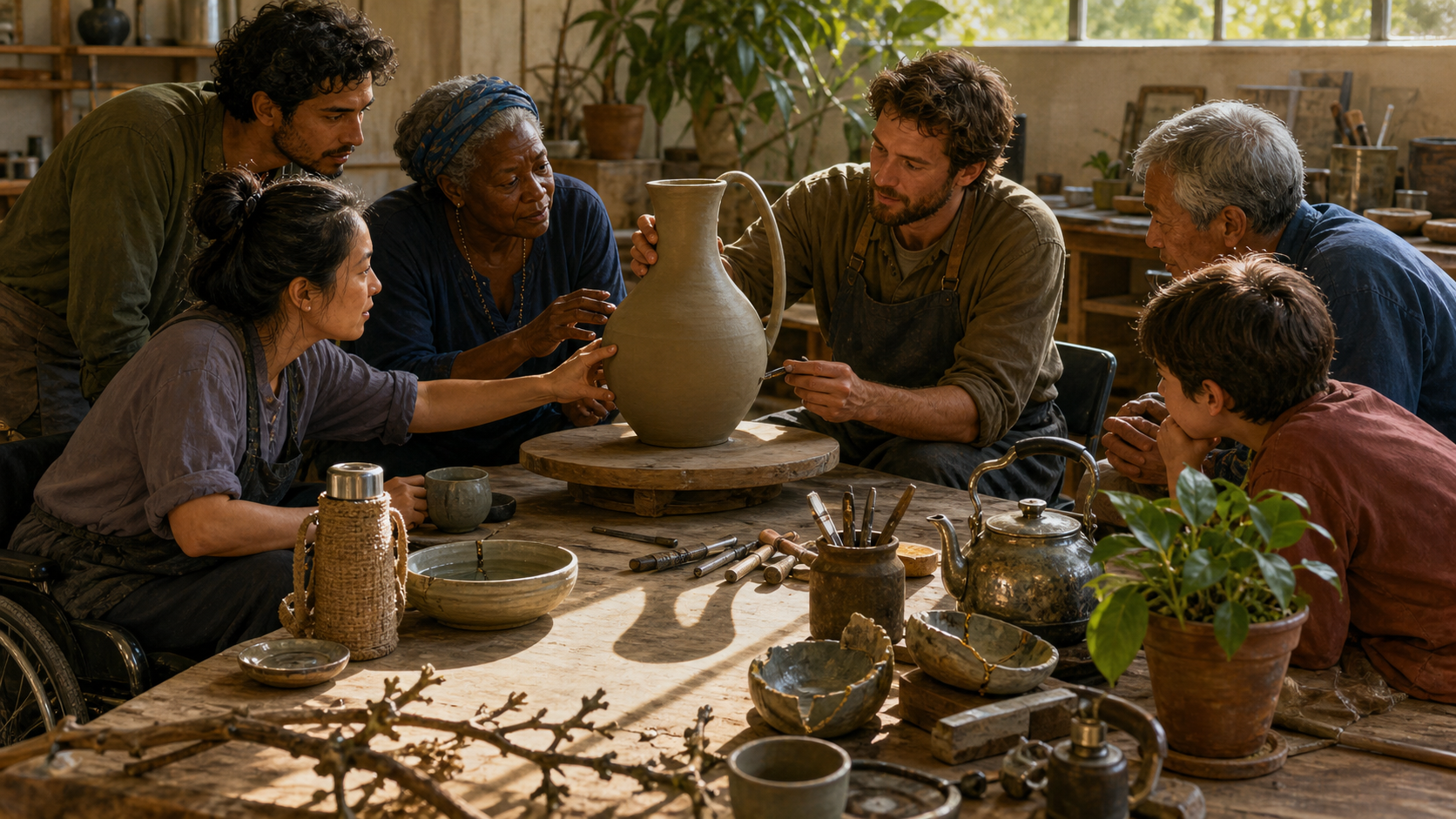
A quiet mind can produce an idea, but novelty alone does not make that idea wise. Creative excellence in a Dharmic frame includes intention, consequence, restraint, and responsibility. The question is not merely whether an idea works. You must also ask what it serves and what kind of person its pursuit asks you to become.
This concern is not confined to one Dharmic path. Buddhist upekkha emphasizes equanimity and clear presence. Jain aparigraha disciplines possessiveness. Sikh Santokh joins contentment with remembrance and right action. These teachings are not interchangeable, but they converge on the practical value of reducing grasping so that perception and conduct are less distorted by inner scarcity.
Before committing to an apparently brilliant idea, put it through a dharmic filter:
- Does it clarify something true, or is it engineered mainly to seize attention?
- Does it solve the stated problem without avoidable harm to people, community, or the wider conditions on which they depend?
- Is complexity serving the work, or displaying the creator?
- Does the idea depend on hoarding credit, access, information, or status?
- Can its purpose and likely effects be explained without deception?
- Would you still consider it worthwhile if someone else received the praise?
Santosha strengthens this examination because it reduces the need to defend an idea merely because it is yours. You can release a clever solution that violates the purpose, accept a colleague’s better suggestion, or stop adding to work that is already complete. In that sense, contentment improves not only the generation of ideas but also their selection.
Key takeaways
- Santosha is not passivity. It establishes inner sufficiency so that action can be guided by dharma rather than fear, comparison, or the hunger for recognition.
- When you are blocked, distinguish a real material constraint from an emotional demand for certainty, praise, or protection from error.
- Reduce unnecessary input before creative work, notice raga-dvesha during moments of strain, and close the session with a clear next action and gratitude.
- Judge progress by steadier attention, cleaner revision, simpler solutions, and kinder collaboration rather than by a constant feeling of inspiration.
- Test every promising idea for truthfulness, avoidable harm, possessiveness, and service. A novel idea is not automatically a dharmic one.
On your next blocked task, do not wait to feel inspired. Close the unnecessary inputs, complete the sentence about what you think you still need, and identify whether the answer is a real constraint or a demand born of scarcity. Establish what is already enough, then do the next honest piece of work. Insight may not arrive on command, but your attention will be less occupied when it does.
References
