

You sit down to eat, but the meal is already crowded. The mind is bargaining, replaying what you ate earlier, demanding a particular snack, or promising that stricter rules will begin tomorrow. A screen may be filling the remaining silence. By the time the plate is empty, you may barely remember tasting it.
You do not need to win an argument with every food thought. You need a reliable way to notice physical hunger, make room around an urge, and eat with enough attention that nourishment feels complete. A short sacred routine can provide that structure without turning the meal into another test of purity or willpower.
Key takeaways
- Physical hunger usually speaks through bodily sensations and energy; food chatter is more likely to feel urgent, repetitive, specific, and connected to stress, fatigue, boredom, or another cue.
- If your body is hungry, eat. The pause described here is for recovering choice around a non-hunger urge, not for postponing needed nourishment.
- Marking the beginning of a meal with a screen-free boundary, gratitude, a mantra, or a symbolic water circle helps turn eating from a reflex into a deliberate act.
- When chatter appears, name it, pause briefly, identify the actual need, and answer distorted claims in calm language.
- A sacred meal should cultivate gratitude, ahimsa, restraint, equality, and care. If it produces fear, shame, compulsive restriction, or distress, it has ceased to serve those purposes.
First determine whether you are hearing hunger or chatter

The first act of viveka, or discernment, is to separate a bodily signal from the commentary surrounding it. Physical hunger and food chatter can occur together, so this is not a rigid either-or test. It is a way to ask what requires care before you act.
| What to notice | Physical hunger | Food chatter |
|---|---|---|
| Where it appears | Stomach sensations, reduced energy, or another bodily sense of needing nourishment | Repetitive thoughts, mental bargaining, images of a particular food, or a demand for immediate relief |
| What surrounds it | The body is asking for food | Stress, fatigue, boredom, habit, a screen, or an environmental cue may have activated the urge |
| How it sounds | A need that can be acknowledged and fed | Urgent rules such as “now or never,” “the day is ruined,” or “tomorrow will be different” |
| Most fitting first response | Eat an adequate meal or snack | Pause, name the underlying need, and then make a conscious choice |
The urgency of a thought does not prove that the body needs food, but the presence of emotion does not prove that it does not. You can be stressed and physically hungry at the same time. Ask these questions in order:
- What is my body reporting? Notice stomach sensations and energy before interpreting them.
- What happened just before this thought? Look for stress, tiredness, boredom, conflict, advertising, the sight of food, or the end of a familiar activity.
- What is the thought promising? Is it offering nourishment, or instant distraction, comfort, numbness, and release?
- What response would actually meet the need? The answer may be food. It may also be rest, movement, emotional support, quiet, or a break from the situation.
A repeated stress-snacking-relief sequence can become a learned loop. The mind starts proposing food because eating previously changed the emotional state, even briefly. That mechanism is not evidence of bad character. It is a habit that becomes easier to examine once you can name it.
Do not use this distinction to distrust every appetite. If you have been restricting food, if food thoughts are persistent and distressing, or if eating involves bingeing, compensatory behavior, or fear that interferes with daily life, speak with a physician, qualified mental-health professional, or registered dietitian experienced in eating disorders. A mealtime ritual can support awareness, but it is not a treatment for an eating disorder.
Build a sacred boundary around one ordinary meal
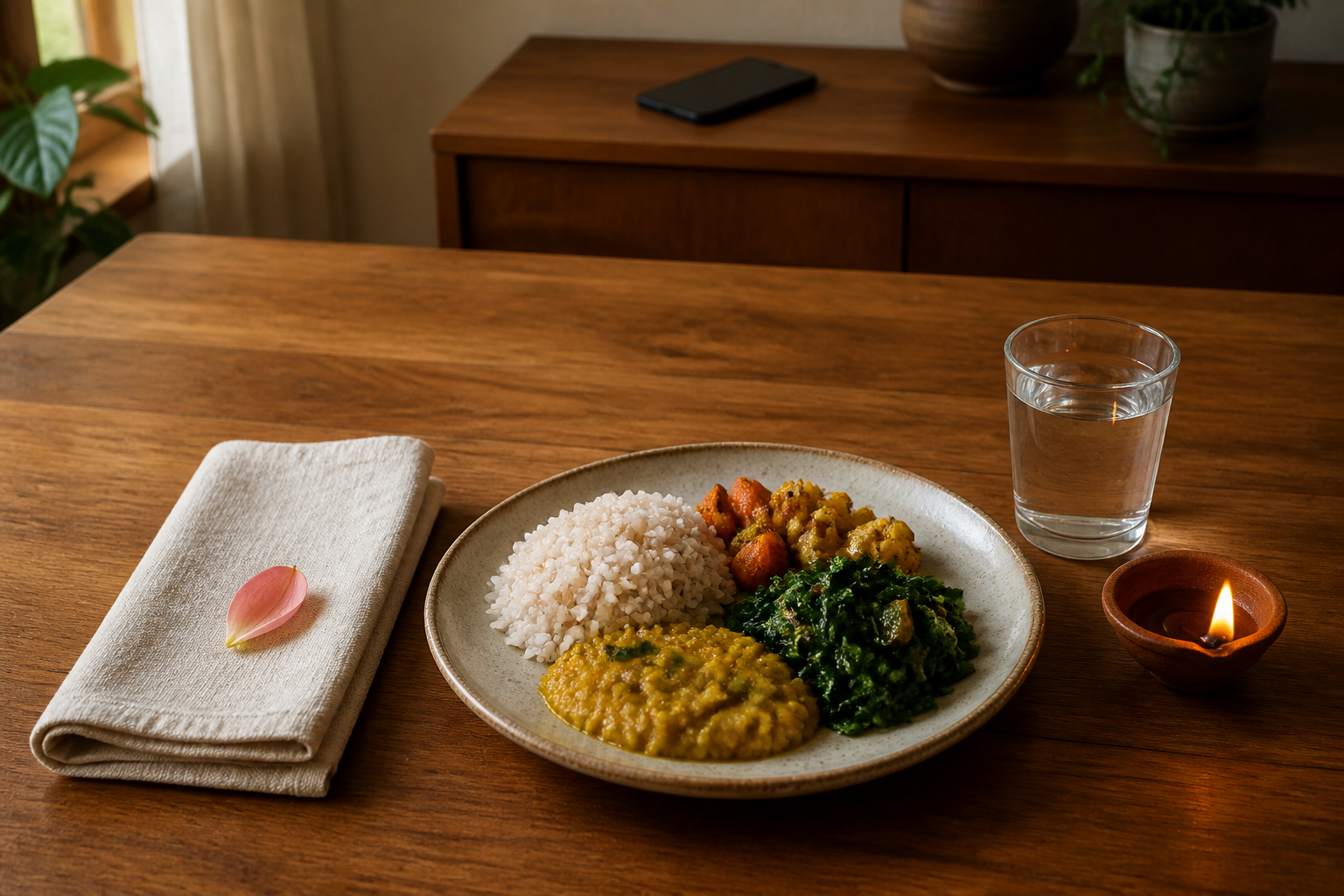
A ritual is useful because it gives the transition into eating a visible form. Instead of hoping that the mind will suddenly become calm, you perform the same small sequence until sitting, pausing, and attending begin to belong together.
Start with one meal that is usually under your control. Do not redesign your diet, kitchen, and family life at once. Repeat this sequence:
- Sit down and place the screen beyond reach. Face-down on the table is often still an invitation. Put the device where you cannot answer it automatically.
- Mark the eating space. If it belongs to your family practice, sprinkle a few drops of water around the plate. This traditional water boundary can signify maryada, purity, gratitude, and care for the lives involved in nourishment. Where water is impractical, trace the boundary symbolically or simply place both hands near the plate and become still.
- Offer gratitude in the language of your path. You might silently acknowledge the people, soil, water, plants, animals, labor, and grace that made the meal possible. In a Hindu home, this may take the form of remembering annam brahma, regarding food as sacred, or reciting “Brahmarpanam brahma havir…” from the Bhagavad Gita. Use a practice you understand rather than performing unfamiliar liturgy mechanically.
- Take a few unforced breaths. Let the body register that work, argument, travel, or scrolling has paused. If you are hungry, this is a settling moment, not a demand to delay eating.
- Attend to the first bite. Notice aroma before contact, then temperature, texture, and the first emergence of taste. You do not need to narrate every sensation. The purpose is to arrive at the meal.
- Pause around the middle. Put down the utensil, breathe, and ask whether hunger is still present, whether you are comfortably satisfied, and whether chatter is trying to hurry or judge you. Continue eating if you need or want more; stop if you are comfortably finished.
- Close the meal deliberately. Notice what remains, store usable food, and clear the eating space. This small act joins gratitude to reduced waste rather than leaving reverence at the level of words.
Water is not magical, and the geometry of the circle is not the main point. The gesture creates a threshold: outside it are alerts, arguments, haste, and acquisition; inside it is the food presently entrusted to you. When a household custom specifies a mantra or method, follow that lineage. When it does not, preserve the ethical core without pretending that a personal adaptation is a universal rule.
This is pratyahara in an everyday form: attention is withdrawn from competing stimuli. Dharana follows as attention rests on the meal. Sustained presence can then become a modest form of dhyana. You are not escaping the senses. You are recovering them from fragmentation.
That recovery matters because screen-filled meals dull awareness of aroma, texture, taste, pace, and satiety cues. A program playing in the background may appear harmless, yet it continually offers the mind somewhere else to go. If a completely screen-free meal is not yet realistic, protect the opening portion of the meal first. Attention is trained by a repeatable boundary, not by an ambitious rule that collapses after one evening.
Answer food chatter without arguing with yourself all day

Trying to forbid a thought often gives it more importance. A steadier method is to label the experience, pause, and answer only the claim that is pulling you toward an automatic response.
Begin with a neutral sentence: “This is food chatter; I still need to check whether I am hungry.” That wording creates distance without assuming the conclusion. A thought has appeared. It is information, not an instruction.
If you find a clear bodily need for nourishment, eat. If the body is not asking for food and the urge is seeking immediate emotional relief, take the two-minute pause: sip water if you are thirsty, stretch, step outside, or breathe without the food in your hand. The pause is successful when it restores choice. The urge does not have to disappear.
Next, answer the distortion plainly. A refutation should be believable enough to use when you are tired. Grand affirmations usually fail at that moment; precise replies are easier to trust.
- Chatter: “I ate more than planned, so the whole day is ruined.”
Reply: “One eating decision does not define the day. My next choice can be ordinary.” - Chatter: “I must compensate by skipping the next meal.”
Reply: “Punishment keeps the conflict alive. I can respond to hunger normally when it returns.” - Chatter: “I will deal with this tomorrow.”
Reply: “I do not need a perfect new day. I can make the present choice consciously.” - Chatter: “I deserve this food after what happened.”
Reply: “I deserve care. Let me identify whether care means nourishment, pleasure, rest, comfort, support, or a change in the situation.” - Chatter: “If I still want it, the pause failed.”
Reply: “The purpose was to choose with awareness, not to erase desire.”
Food can provide pleasure and comfort; neither is morally suspect. The problem is not that a meal changes your mood. The problem is losing the ability to notice what is happening and believing that only one response is available. Sometimes you will pause and still choose the food. Make that choice seated, without the screen, and without pretending it happened outside your agency.
If the same urge returns frequently, keep a brief record of the trigger, the bodily signal, the need you identified, the choice you made, and how you felt afterward. Do not turn the record into a calorie ledger or a scorecard of virtue. Its job is to reveal patterns. You may discover that the loudest food chatter arrives after conflict, during exhausted evenings, or while watching a particular program. Once the cue is visible, you can address it earlier.
A lapse does not require a dramatic restart. Say, “This is difficult, and I am still learning the pattern.” Then return at the next available choice. Ahimsa applied inwardly is not indulgence; it prevents shame from becoming the next trigger in the loop.
Let dharma guide the meal without policing the plate

Sacred eating is larger than private appetite control. Food connects you to other lives, to labor, to the household, and to the conditions that made nourishment possible. The Dharmic traditions express that relationship in distinct ways, and their differences should not be flattened. They nevertheless offer several compatible disciplines for the table:
- Hindu practice can receive food as prasad, treat eating as an offering, and use mantra or a water boundary to establish gratitude and restraint.
- Buddhist sati trains awareness of sensation, desire, grasping, and satisfaction without requiring every impulse to become an action.
- Jain ahimsa brings carefulness to food selection, preparation, waste, and the effects of consumption on living beings.
- Sikh langar joins nourishment to seva, remembrance, and equality by serving people together without social distinction.
These orientations move the central question from “Have I controlled myself perfectly?” to “How am I receiving and using what has been given?” That shift matters. Perfectionism keeps attention fixed on the self. Gratitude widens attention to relationship and responsibility.
Ayurvedic language about sattvic, rajasic, and tamasic qualities can help you notice how different foods and patterns affect clarity, activity, or heaviness. It should not become a hierarchy of human worth. A person is not spiritually superior because of a label attached to a plate, and anxiety around “pure” eating is not the same as sattva. Use the framework for observation and wise adjustment, never for humiliating yourself or another person.
The same test applies to family meals. A mantra followed by arguments, body criticism, or pressure to ignore hunger has preserved the shell of ritual while losing its dharmic function. Keep devices away, let people take an appropriate portion without commentary, speak without shaming bodies, and make room for gratitude. When children participate, give them a small action they can understand: placing the water, naming something for which they are thankful, helping serve, or storing leftovers.
Diaspora households do not need a full ceremonial setting to keep the meaning alive. A few drops of water or a symbolic gesture can preserve the intentional pause in an apartment, workplace, school, or shared home. The faithful part is the return to sanctity, gratitude, restraint, and ecological care.
At your next ordinary meal, choose one boundary you can repeat: put the phone outside reach, make the offering, and attend fully to the first bite. When chatter enters, check the body before obeying the story. That small space between impulse and action is where a meal begins to become sadhana.
References
- Tiny Buddha – What Finally Helped Me Break Free from Constant Food Noise
- DharmaRenaissance Blog – Modern Screens Numb the Sacred Tongue: Dharmic Wisdom to Reclaim Mindful Eating Today
- DharmaRenaissance Blog – Sacred Water Circles at Mealtime: The Hindu Ritual Uniting Mindfulness, Ahimsa, and Ecology
