

If you learned of H.H. Badrinarayan Swami only after his departure, you may wonder how to honor a teacher you never met. If you received his guidance, the same question may feel more personal: how do you keep remembrance from fading into affectionate but inactive praise?
The most faithful answer is to notice what his service consistently joined: loyalty to guru and shastra, accessible teaching, disciplined sadhana, humane leadership, and cooperation among devotees. His legacy becomes useful when those connections begin shaping your own study, service, and decisions.
Parampara was the foundation, not a ceremonial label

The letters ACBSP after Badrinarayan Swami’s name identify him, in ISKCON usage, as a disciple of A.C. Bhaktivedanta Swami Prabhupada. That is more than biographical shorthand. It locates his teaching within guru-shishya parampara, the disciplic transmission through which knowledge is received, understood, embodied, and passed onward.
Parampara can be misunderstood in opposite ways. One mistake reduces fidelity to repetition: if the correct words have been spoken, the teacher’s duty is considered complete. The other mistake treats relevance as permission to detach spiritual instruction from its received foundation. Badrinarayan Swami’s example points through this false choice. His presentation was firmly rooted in Srila Prabhupada’s teachings, yet it remained intelligible to people facing ordinary problems of attention, conduct, service, and community life.
This gives you a practical test for any teaching offered in the name of tradition:
- Text: Can you identify the scriptural teaching or instruction on which the claim rests?
- Meaning: Can it be explained clearly without weakening or exaggerating it?
- Embodiment: What would change in your conduct if you accepted it?
- Transmission: Are you passing on what you received, or using a revered name to lend authority to a private preference?
The last question is especially important. Fidelity is not proved by how frequently a guru’s name appears in a discussion. It is proved by whether the guru’s priorities govern the conclusion. Before invoking parampara in a disagreement, identify the relevant principle, explain its connection to the issue, and ask whether your manner of speaking reflects Vaishnava conduct. A sound conclusion reached through contempt still reveals a failure of formation.
This is also how you can approach Badrinarayan Swami’s teachings without turning him into a personality detached from his lineage. Begin with the text being explained. Mark the principle he draws from it. Then observe how that principle is brought into sadhana, relationships, or service. The movement from received wisdom to lived responsibility is where his legacy becomes visible.
Philosophical clarity was meant to change daily practice

Badrinarayan Swami’s classes were known for being text-centered, precise, and accessible. In teaching the Bhagavad-gita and Srimad-Bhagavatam, he connected philosophy with attentive japa, kirtana, Vaishnava etiquette, and practical seva. Devotees also remember the combination of seriousness and gentle humor with which he made demanding ideas easier to retain.
That combination matters because information alone does not produce spiritual formation. Siddhanta establishes what is true. Sadhana repeatedly turns your attention toward that truth. Seva gives the truth a social form by changing how you treat Krishna, other devotees, and those placed within your care.
At your next class or study session, do not leave with a page of undifferentiated notes. Capture the teaching under these headings:
- Siddhanta: State the central truth in plain language. If you cannot state it clearly, return to the text before arguing about its implications.
- Sadhana: Identify the practice that trains you to remember or embody that truth. Keep this concrete: attentive chanting, careful hearing, or restraint in speech is more useful than a vague promise to become spiritual.
- Seva: Name the person, responsibility, or community need that should receive a different response from you.
- Obstacle: Admit what is likely to prevent application. A divided schedule, defensiveness, desire for recognition, and avoidance of a difficult conversation require different remedies.
Suppose you hear a compelling explanation of humility. The application is not merely to agree that humility is a virtue. In japa, it may mean protecting your chanting from avoidable distractions. In kirtana, it may mean joining the congregation rather than treating participation as a performance. In a disagreement, it may mean representing another devotee’s position fairly before answering it. In seva, it may mean completing an unnoticed duty without converting the service into a claim for status.
Gentle humor has a place within this pattern as well. Devotional seriousness does not require severity. If an explanation produces fear of asking honest questions, contempt for newcomers, or an atmosphere in which every correction becomes a contest, rigor has been confused with harshness. Clarity should make practice more responsible and more approachable at the same time.
You can therefore evaluate spiritual learning by its residue. After the inspiration has passed, are you chanting with greater attention? Is your speech more disciplined? Has an avoided service been completed? Is another devotee safer bringing a concern to you? Those changes are stronger evidence of learning than the ability to repeat an impressive formulation.
Servant-leadership joined principle with devotee care
Badrinarayan Swami was also respected for institutional counsel, balanced deliberation, and concern for sustainable community development. This work unfolded within ISKCON’s governance structure: the Governing Body Commission coordinates global leadership, while the North America Regional Governing Body supports regional cooperation, implementation, and devotee welfare.
An organizational role does not automatically become spiritual service merely because it belongs to a religious institution. The determining question is whether authority is exercised in sevak-bhava, the disposition of a servant. In that mode, doctrine sets the boundary, compassion shapes the process, accountability protects the community, and leadership remains answerable for consequences.
Community memories of Badrinarayan Swami emphasize shastra-yukti alongside empathy: scripturally grounded reasoning joined to attention to the people affected by a decision. Neither element should be used to erase the other. Compassion is not a license to disregard siddhanta, and fidelity to principle is not permission to become callous.
If you serve on a temple council, organize a sangha, lead volunteers, or simply carry responsibility for another devotee, put important decisions through this screen:
- Principle: Which scriptural teaching, established instruction, or agreed standard actually governs the matter?
- Human effect: Who will carry the burden of the decision? Have those people been heard without retaliation or dismissal?
- Cooperation: Will the process preserve enough trust for devotees to continue serving together after disagreement?
- Accountability: Who owns the next action, and how will the community know that it was completed?
- Sustainability: Can the people, finances, and systems available support the decision beyond its announcement?
This screen is useful during leadership transitions and interpersonal disputes, when urgency tempts a group to skip either reasoning or care. State the governing principle before debating personalities. Let affected people describe the practical cost. Record the decision, its rationale, and the responsibility for follow-through. Then revisit the outcome rather than assuming that a formally correct resolution has healed the community.
Devotee care also belongs in ordinary operations, not only in moments of crisis. A community reveals its priorities through who receives information, whether commitments are honored, how correction is delivered, and whether overburdened servants can ask for help. If these matters are dismissed as merely administrative, leadership has separated governance from sadhana. Badrinarayan Swami’s model asks leaders to bring the same humility to a meeting that they seek to cultivate before the Deity or during japa.
Vrndavana gives his departure a distinctly Vaishnava meaning

Badrinarayan Swami departed on 26 February 2026 in Sri Vrndavana Dhama. Within Gaudiya Vaishnava theology, that place is not treated as an incidental setting. Vrndavana is traditionally understood as non-different from Sri Krishna’s eternal abode and is approached as a living tirtha formed by sacred narrative, pilgrimage, parikrama, worship, and communal remembrance.
The conviction that departure in Vrndavana is supremely auspicious is a theological affirmation held within the tradition. It should be presented as such, not disguised as a claim that can be established by ordinary historical measurement. Understanding that distinction lets you respect the depth of Vaishnava faith without reducing sacred geography to scenery or pretending that every reader begins with the same metaphysical commitments.
For a practitioner, the significance of Vrndavana redirects attention from the circumstances of death to the orientation of life. The dhama embodies remembrance of Krishna; a devotee’s aspiration is therefore not simply to reach a revered location but to let hearing, chanting, service, and association form consciousness toward Krishna throughout life.
This is why grief and reverence can coexist. Separation is real for those who depended on a teacher’s presence, counsel, or voice. Gratitude is also real because the life being remembered supplied a path that can still be followed. You do not have to suppress one mood to prove the other.
At the same time, avoid turning the auspiciousness of the dhama into a ranking system for judging the spiritual standing of different devotees. The proper practical question is not, “What does this allow us to claim about someone else’s destination?” It is, “What kind of remembrance is my present life cultivating?” That question brings dhama-tattva back to sadhana.
You can use his departure as a prompt for honest examination. Notice what fills your mind when no formal program is underway. Ask whether your routines support remembrance or merely depend on occasional inspiration. Look at the unfinished duties that disturb your chanting and the relationships in which pride repeatedly overrides etiquette. These are not distractions from spiritual life; they are places where spiritual life must become operative.
Carry the legacy through a practice-based observance
A memorial is most durable when it establishes a practice that survives the event. Badrinarayan Swami’s own emphases indicate several fitting ways to continue his service: attentive japa, congregational kirtana, applied study of Bhagavad-gita and Srimad-Bhagavatam, prasadam distribution, and cooperation centered on Vaishnava etiquette and devotee care.
A practical rule of remembrance
- Protect your japa: Give chanting a defined place in your routine and remove avoidable interruptions before beginning. When attention wanders, return without turning the lapse into an excuse to abandon the effort.
- Participate in kirtana as congregational service: Listen as well as sing. Support the shared remembrance of Krishna instead of measuring the gathering by personal visibility or musical preference.
- Study for application: Read Bhagavad-gita or Srimad-Bhagavatam with a pencil, notebook, or study group. End by identifying the conduct the teaching requires from you now.
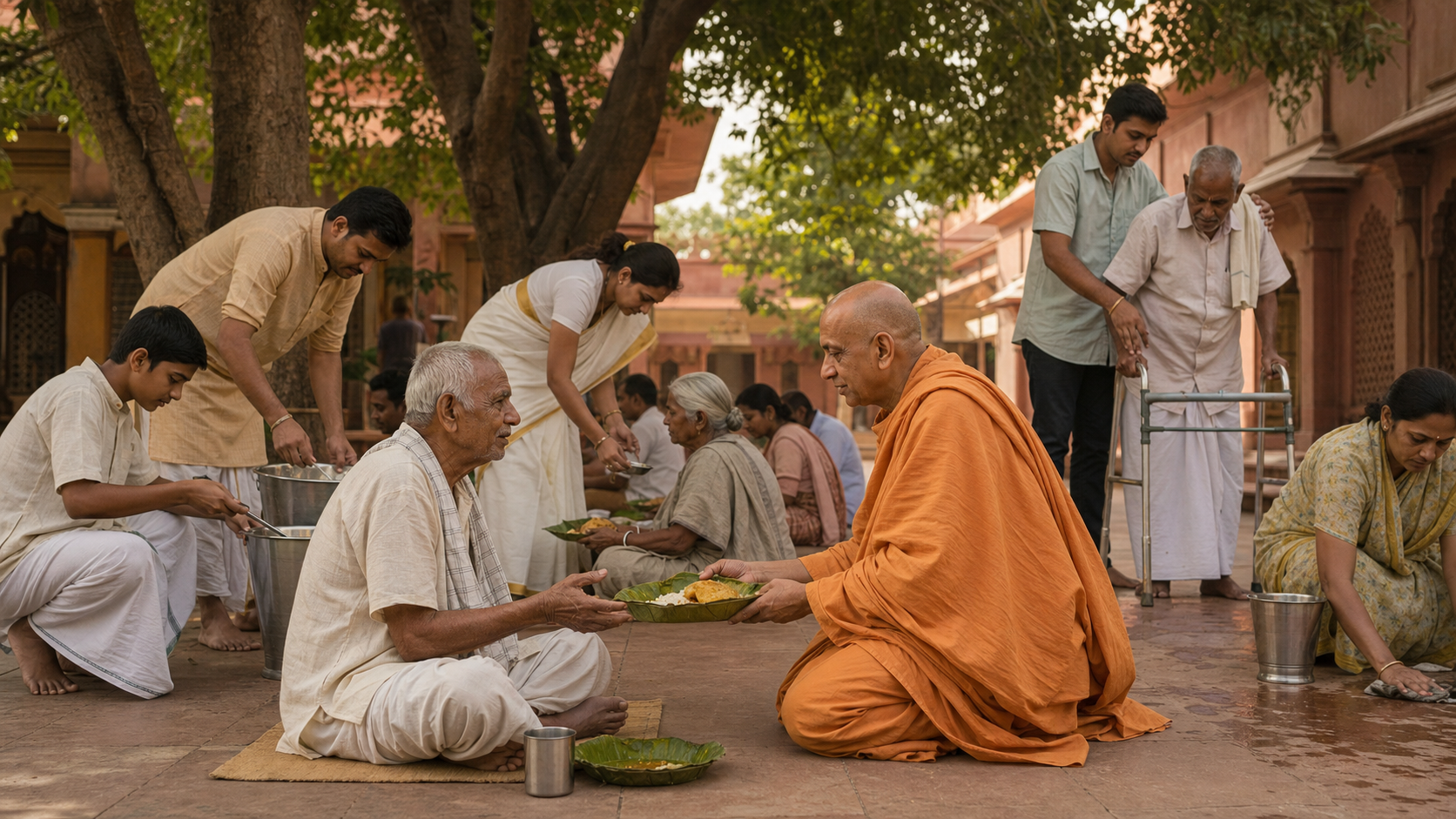
- Distribute prasadam with care: Treat distribution as an extension of compassion. Prepare, serve, and receive people with dignity; the service is not complete merely because food changed hands.
- Repair cooperation: Identify a temple, sangha, or devotee relationship in which unclear responsibility or poor etiquette is obstructing service. Offer a concrete next step and accept your share of the work.
Do not choose the practice that produces the most visible tribute. Choose the one that addresses the clearest gap in your present life. If study is already strong but relationships are strained, another lecture may be less urgent than a careful conversation and completed duty. If service is abundant but japa is persistently crowded out, adding another public responsibility may deepen the imbalance.
Communities can apply the same principle. A remembrance gathering may include chanting and accounts of a teacher’s qualities, but it should also produce follow-through. Assign responsibility for the prasadam service, devotee-care need, study initiative, or unresolved cooperative task that the gathering brings to light. Give it a clear next action. Otherwise, collective emotion can peak while institutional habits remain untouched.
What the wider Dharmic family can receive
Badrinarayan Swami’s legacy is specifically Gaudiya Vaishnava. Respecting it does not require pretending that Hindu, Buddhist, Jain, and Sikh traditions hold identical doctrines. Unity becomes meaningful only when difference is allowed to remain real.
There is nevertheless a recognizable field of shared Dharmic commitments: compassion, truthfulness, restraint and ahimsa, community expressed through sangha or sangat, and selfless seva. A reader from another Dharmic path can receive the practical challenge without appropriating Gaudiya theology: ground action in received wisdom, join conviction with compassion, and judge leadership by the quality of service it enables.
This also clarifies what inter-community cooperation should look like. It should not erase distinctive worship, vocabulary, or lineage. It should create honest opportunities to serve, learn, and protect a culture of spiritual responsibility together. Cooperation is strongest when participants know both what they share and what they do not claim to share.
Key takeaways
- Badrinarayan Swami’s authority was rooted in guru-shishya parampara and fidelity to Srila Prabhupada, not in personality detached from lineage.
- His teaching joined siddhanta to japa, kirtana, etiquette, and seva, giving you a way to test whether study has entered conduct.
- His model of servant-leadership held scriptural reasoning, empathy, accountability, and sustainable community care together.
- His departure in Vrndavana carries a specifically Gaudiya Vaishnava meaning and should deepen remembrance rather than invite speculative ranking.
- The most fitting tribute is a practice or responsibility that continues after the commemorative gathering ends.
Before your next remembrance of Badrinarayan Swami, place one concrete act in your schedule: protected japa, applied scriptural study, congregational kirtana, prasadam service, or a conversation that restores responsible cooperation. If you lead a community, pair the devotional observance with a neglected duty that receives an owner and a next step.
A Vaishnava legacy remains alive when remembrance changes what you do next. Let the next act be small enough to complete, serious enough to matter, and faithful enough to point beyond the servant to Krishna and the parampara he served.
References
- Dandavats – Honoring H.H. Badrinarayan Swami (ACBSP): A Life of Bhakti, Service, and Vrndavana Grace
