
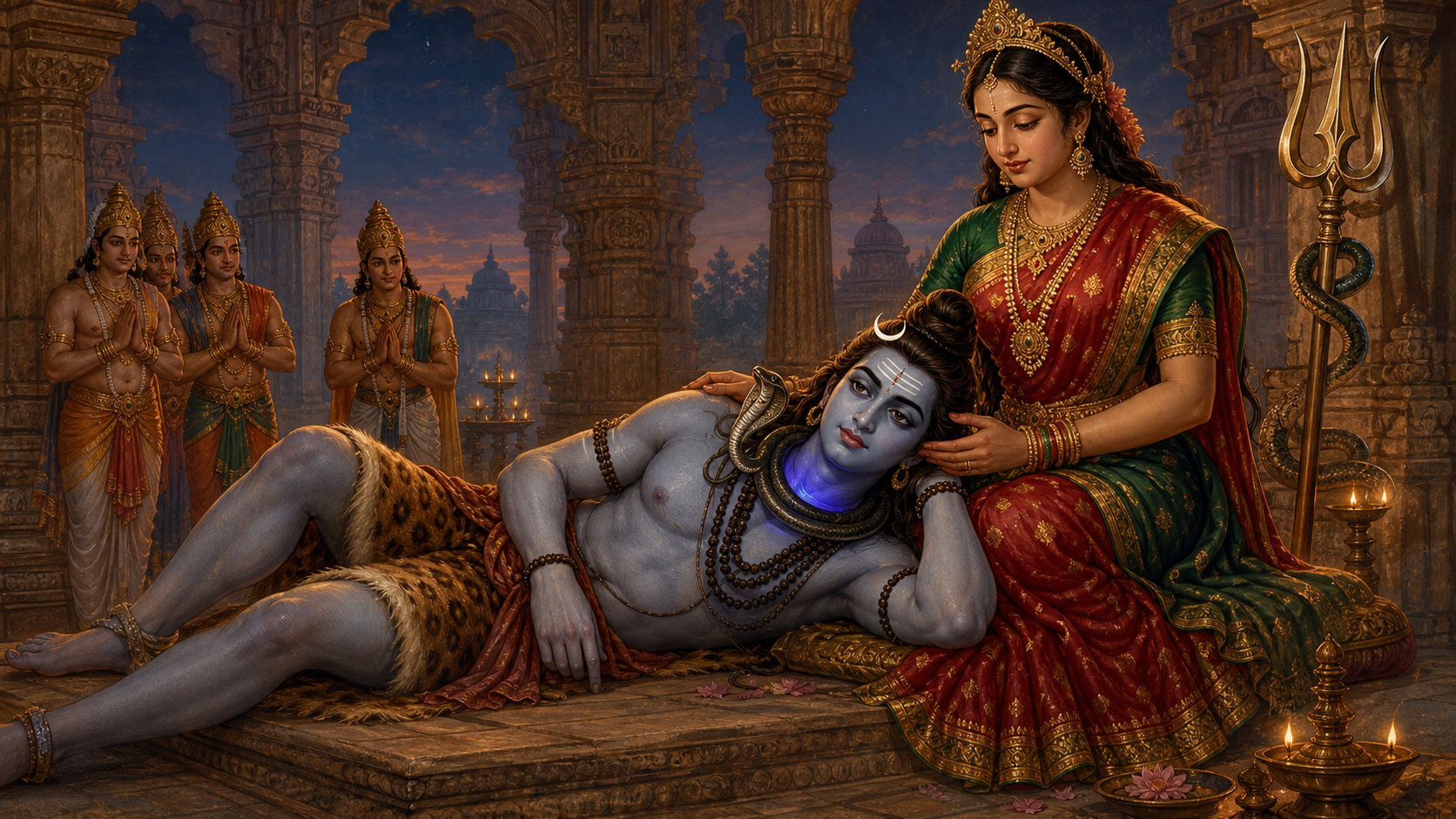
If your mental image of Shiva is the ascetic in meditation, the cosmic dancer, or the linga, Surutapalli’s reclining form can be startling. Why is the protector of creation resting with his head in Parvati’s lap, and why does this image belong to the story of poison?
The key is to ask what happened immediately before the repose. Once you see the murti as the final moment in a sequence — danger, intervention, containment, care, and renewal — it stops looking like divine inactivity. It becomes a precise teaching about what dharma requires during a crisis and after one.
Do not read this Shiva as a defeated or sleeping god
Reclining deities may immediately bring Vishnu’s sayana forms to mind. That association helps you recognize how unusual Surutapalli is, but the two forms should not be treated as interchangeable. Shiva’s posture here belongs to the aftermath of Vishapaharanam, the removal of the threat posed by the Halahala poison.
At the Palli Kondeeswarar Temple in Surutapalli, along the Chennai-Tirupati route near the Tamil Nadu-Andhra Pradesh border, Shiva reclines with his head supported by Goddess Parvati. He is worshipped as Palli Kondeeswarar, the Lord who reclined. Parvati is Sarvamangalambika, she who brings auspiciousness to all.
Three details should guide your darshan. The posture follows protective action rather than replacing it. Shiva is supported by Shakti rather than isolated in self-sufficiency. His serenity comes after contact with danger rather than from remaining untouched by it.
This is why repose does not signify defeat. It is recovery after responsibility. If you look only at the reclining body, you miss the courage that preceded it. If you look only at the heroic act, you miss the care that makes restoration possible.
Vishapaharanam is a sequence of responsibility

During the Samudra Manthan, devas and asuras churned the cosmic ocean. Halahala, a poison capable of threatening creation, emerged from that churning. Shiva intervened, consumed the poison, and held it at his throat, giving rise to the name Neelakantha.
Surutapalli enshrines the moment after this intervention. The fierce power associated with Rudra has become still, and the being who carried the danger for the world now rests in the care of the Divine Mother. Vishapaharanam is therefore not only a story about confronting poison. It is also about what must follow the confrontation.
The detail that Shiva holds the poison matters. The danger is neither ignored nor passed onward. For a human seeker, that gives the image a concrete ethical meaning: when anger, panic, resentment, or malicious speech reaches you, your responsibility is not merely to avoid creating more of it. You must also refuse to become the channel through which it spreads.
Containment may mean declining to forward a rumour, waiting before answering an inflammatory message, separating a person from the harmful act you need to challenge, or accepting responsibility for a mistake before blame travels further. These acts are less dramatic than swallowing cosmic poison, but they follow the same moral direction: prevent avoidable harm from multiplying.
Do not turn the story into a demand for limitless self-sacrifice. Shiva’s divine act is not an instruction to tolerate abuse, endanger yourself, or carry every burden alone. Human responsibility requires boundaries, assistance, and truthful recognition of our limits. The lesson is to contain the harm you can responsibly address, not to build an identity around suffering.
A useful test is to examine what happens next. If a burden you accepted causes you to discharge bitterness onto someone else, the poison has not been contained. If rest becomes a permanent excuse to abandon duty, recovery has lost its purpose. Pallikonda Shiva holds responsibility and restoration together without confusing either one with martyrdom or avoidance.
Parvati’s lap completes the theology of the image
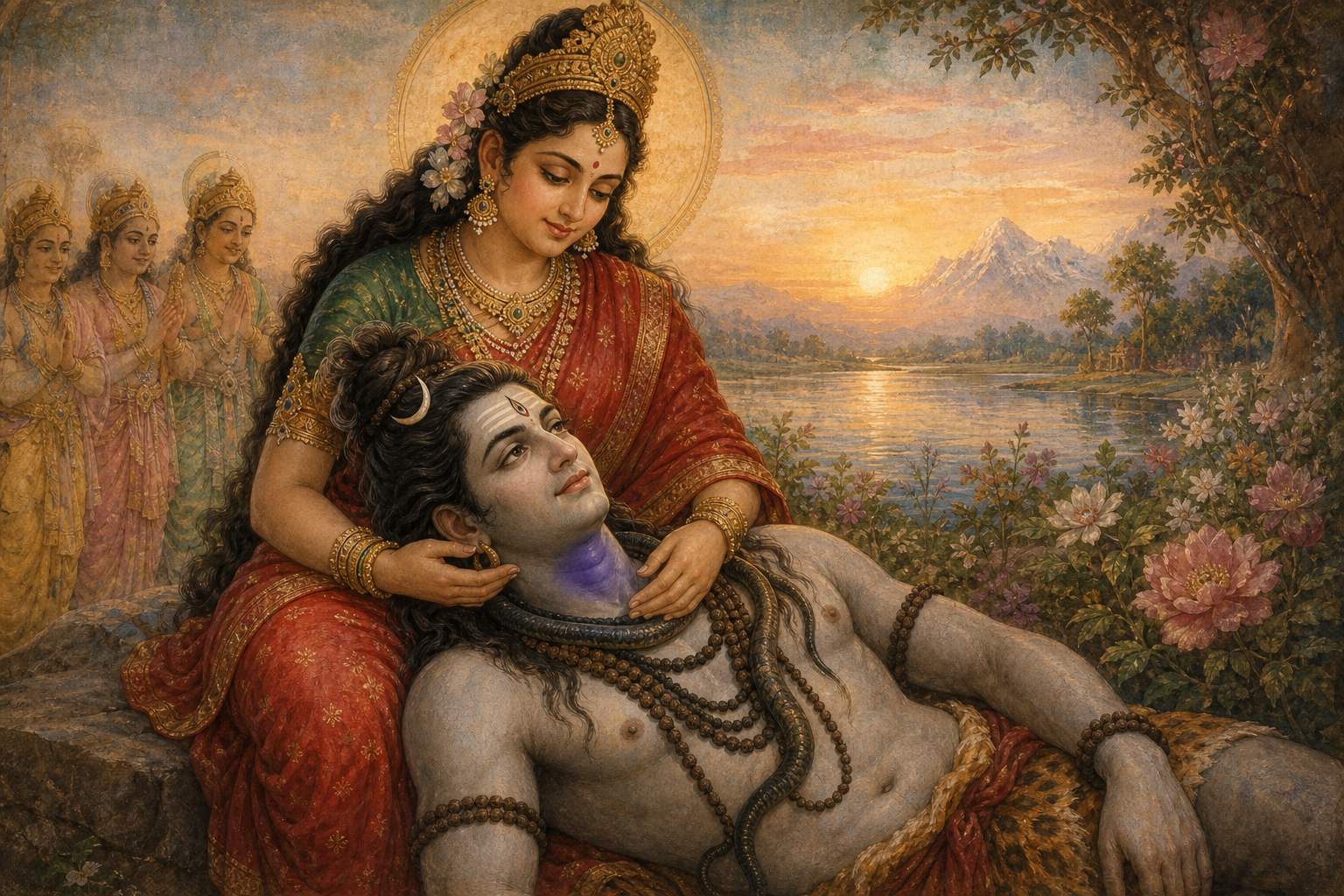
Parvati is not a decorative witness to Shiva’s achievement. Her presence changes the meaning of the entire composition. The protector of beings receives protection; the bearer of cosmic danger accepts tenderness; power permits itself to be steadied by power in another form.
This reciprocity is central to the image’s Shaiva character. Shiva and Shakti are not competing claims to supremacy. Their relationship reveals that action and care, firmness and tenderness, and protection and restoration belong within one sacred order. Sarvamangalambika’s lap does not diminish Shiva. It shows why strength that refuses all support is incomplete.
You can use that detail to examine the way you serve others. Are you willing to receive care after carrying a difficult responsibility? When another person needs recovery, can you support them without treating their need as weakness? Do you insist on being indispensable because accepting help would disturb your self-image? Surutapalli’s murti answers these questions without a lecture: even the cosmic protector is shown in relationship.
The image also carries a wider Dharmic resonance without losing its specifically Shaiva identity. Buddhist karuna, Jain ahimsa, and Sikh seva each place serious moral weight on compassion, non-harm, or selfless service. These are not identical doctrines, and they should not be flattened into generic spirituality. They do, however, help us recognize a shared ethical discipline: spiritual strength is demonstrated through the harm one prevents and the care one makes possible.
Turn darshan into a four-part practice

You do not need an elaborate private ritual to receive the teaching of Pallikonda Shiva. Keep the temple’s established customs at the centre, and use the following steps as a quiet framework for attention.
- Name the danger precisely. Before darshan, identify one form of poison active in your life. Name a pattern such as resentment after a disagreement, fear driving a decision, or speech likely to injure trust. Do not label another person as the poison; that makes honest self-examination almost impossible.
- See the whole composition. Do not look at Shiva while treating Parvati as background. Notice the repose, the support of her lap, and the serenity of the scene together. The relationship is part of the revelation.
- Reconstruct the sequence. Silently move through danger, intervention, containment, support, and renewal. Ask where you are in that sequence. A crisis demanding action is different from an aftermath demanding recovery.
- Make a paired sankalpa. Choose one act that prevents harm and one act that permits restoration. You might resolve not to forward a provocative claim and to verify it first; to complete a difficult duty and then accept help; or to apologize for harmful speech and create enough distance to avoid repeating it.
- Leave with one duty within your control. A small action performed soon after darshan is more useful than an impossible promise of heroic sacrifice. Make the overdue call, correct the false statement, thank the person who supported you, or establish the boundary that keeps resentment from spreading.
During Pradosham
Surutapalli is especially associated with Pradosham, the twilight observance connected here with grace after the cosmic crisis. Alongside the temple’s prescribed worship, let your private reflection move through three stages: gratitude for harm that was contained, honest recognition of harm you may have transmitted, and a specific resolve to restore what remains within your reach.
Twilight is useful because it is a transition rather than a conclusion. Approach Pradosham in the same way. You are not pretending that a difficult episode never happened; you are deciding what must end with it and what wiser conduct must begin.
During Mahashivaratri
During Mahashivaratri, contemplate the reclining form as stabilization after adversity. Do not force yourself to manufacture an unusual spiritual experience. Hold one practical question instead: what would a steady return to dharma look like after the turmoil I have faced?
If Surutapalli is a stop on your Chennai-Tirupati journey, resist treating the sanctum as another item on an itinerary. Give the entire composition enough attention for its sequence to become clear. The value of this darshan lies not in seeing a rare pose for a few seconds, but in letting that pose correct how you understand courage.
Key takeaways
- Shiva’s reclining posture at Surutapalli represents repose after Vishapaharanam, not defeat or withdrawal from dharma.
- Halahala teaches containment: recognize danger, accept the responsibility that is truly yours, and do not pass harm onward.
- Parvati’s lap makes divine reciprocity visible. Strength includes the ability to receive support and recover.
- Pradosham can be approached as gratitude for protection, accountability for transmitted harm, and commitment to restoration.
- The safest human application is a paired resolve: one concrete act of courage and one concrete act of care.
When you next contemplate Pallikonda Shiva, bring one real situation rather than a catalogue of abstract wishes. Identify what must be contained, whom your conduct should protect, and what support you need to accept. Then leave with two linked commitments: do the necessary thing, and make restoration part of the duty rather than an afterthought.
References
