
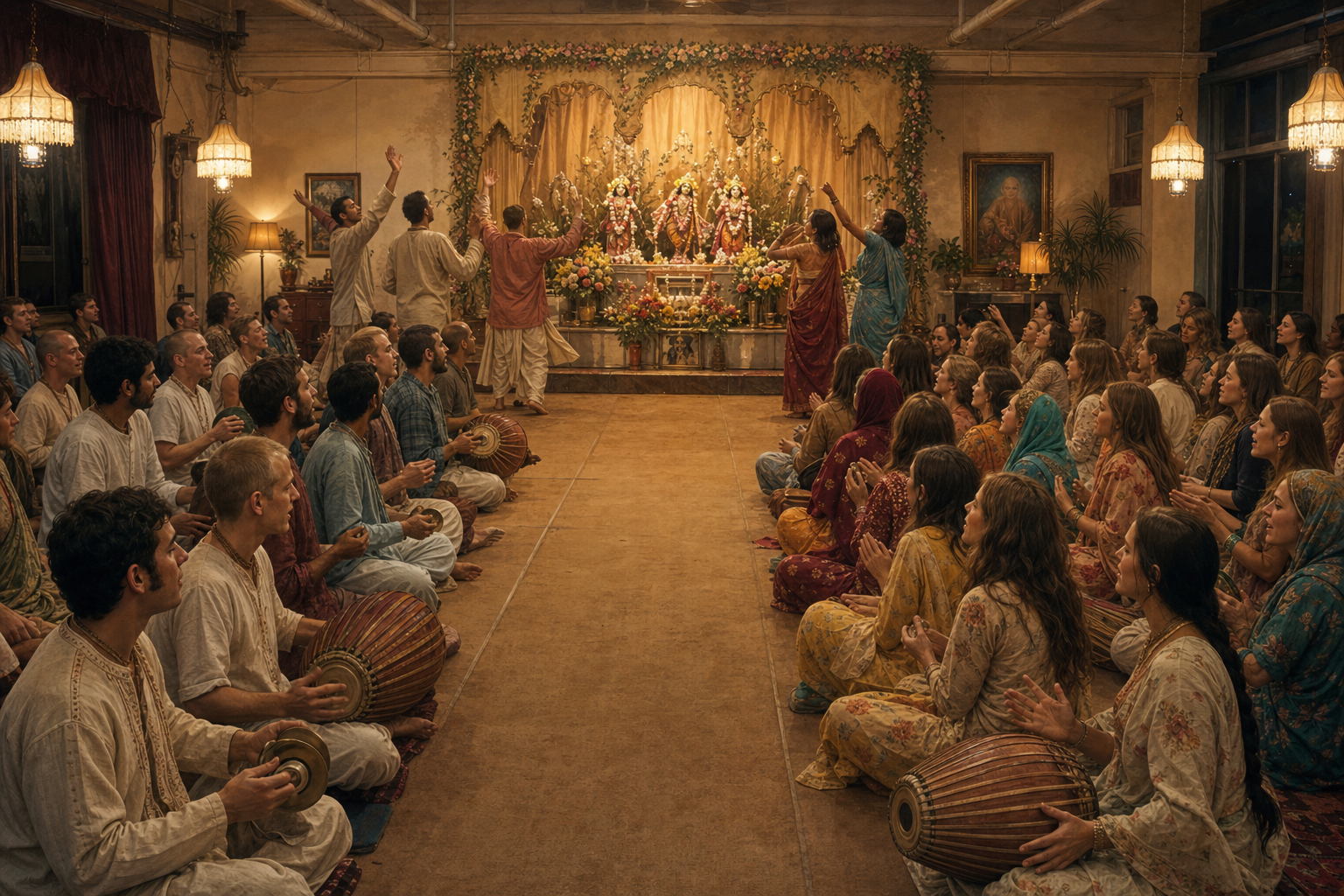
If your temple is debating whether a traditional arrangement can also be inclusive, early ISKCON offers a useful precedent. It does not give every community a floor plan to copy. It gives you better questions for judging whether a worship space protects both devotion and dignity.
In North American ISKCON temples of the early 1970s, worship rooms could be divided while giving women and men equal space. Dhotis and saris appeared within the same sacred setting, and devotees joined a common life of kirtan, japa, study, and seva under the guidance of A.C. Bhaktivedanta Swami Prabhupada. The important principle was not physical sameness. It was parity in spiritual purpose, discipline, learning, and responsibility.
Separate space was not treated as lesser space
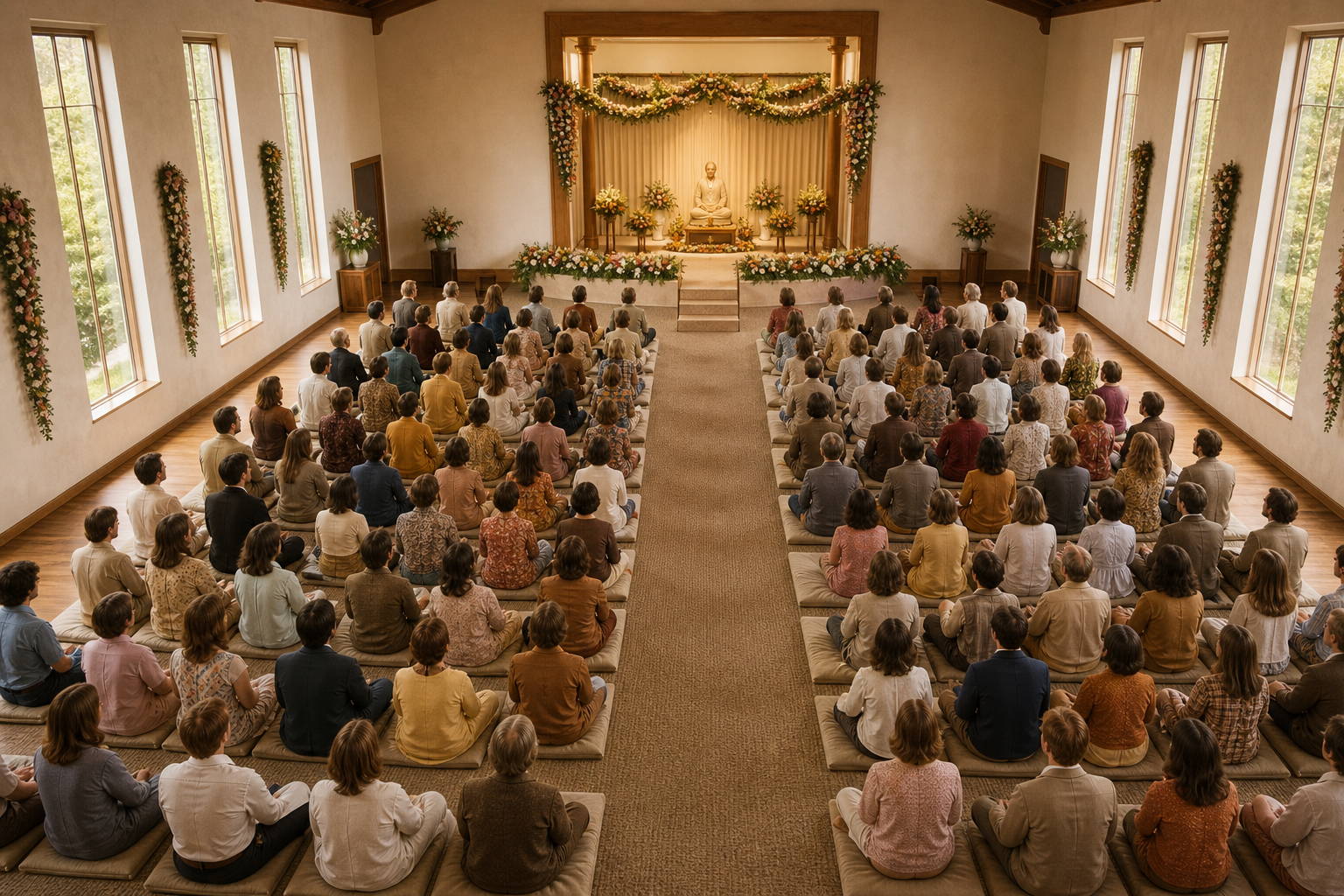
Discussions about inclusive worship often begin with the wrong shortcut. One side assumes that any separation proves inequality. The other assumes that a traditional arrangement must be fair simply because it is traditional. Neither conclusion is reliable.
A boundary may support concentration, safety, and decorum without creating a hierarchy. It becomes exclusionary when it gives one group worse access, less room, weaker participation, or fewer opportunities to learn and serve. Equal floor space, meanwhile, is not enough if only one side is treated as spiritually capable or institutionally responsible.
The early ISKCON arrangement joined distinction to parity. Men and women occupied separate areas, but both remained full participants in the same devotional society. That changes the question you should ask about a temple room. Do not stop at, Are people separated? Ask whether the arrangement makes anyone secondary.
- Does each group receive genuinely comparable sacred space, rather than a nominal area with poor visibility or difficult access?
- Can everyone participate meaningfully in kirtan, scriptural study, and appropriate seva?
- Are the expectations for attention, discipline, and conduct applied consistently?
- Does each devotee have a real path from attendance to learning, service, and responsibility?
- Do the boundaries protect everyone, or do they mainly control one group for the convenience of another?
These tests are more exacting than either approving or rejecting separation in principle. They reveal what the physical arrangement actually does.
Inclusion extended across the whole devotional day

A welcoming place to stand during kirtan is only the first layer of belonging. A bhakti community forms people through a repeated rhythm: congregational chanting, personal practice, study, and cooperative service. Inclusion weakens when access disappears at any point in that sequence.
Someone may be visible during worship yet absent from serious learning. Another person may receive instruction but never be trusted with meaningful service. A third may perform necessary work without any route to greater responsibility. In each case, outward welcome conceals an inner limit.
Early ISKCON communities made kirtan, japa, scriptural study, and cooperative seva the shared substance of community life. Participation therefore meant more than occupying the room. Devotees encountered common practices and standards, while service created a practical route for contributing to the mission.
This is where seva becomes an institutional safeguard. When responsibility follows sincere devotion, preparation, and dependable service, status has less room to depend on social privilege. That does not require every person to perform an identical task. It requires the reasons for assigning a task to be spiritually and practically defensible.
If you help organise a temple, trace what happens after a newcomer enters the room. Who explains the practices? Who can join study? How does someone find suitable seva? What must a devotee demonstrate before receiving responsibility? If those routes are clear for one group and informal or closed for another, the problem is not merely spatial. It is structural.
Dhotis and saris made a larger principle visible
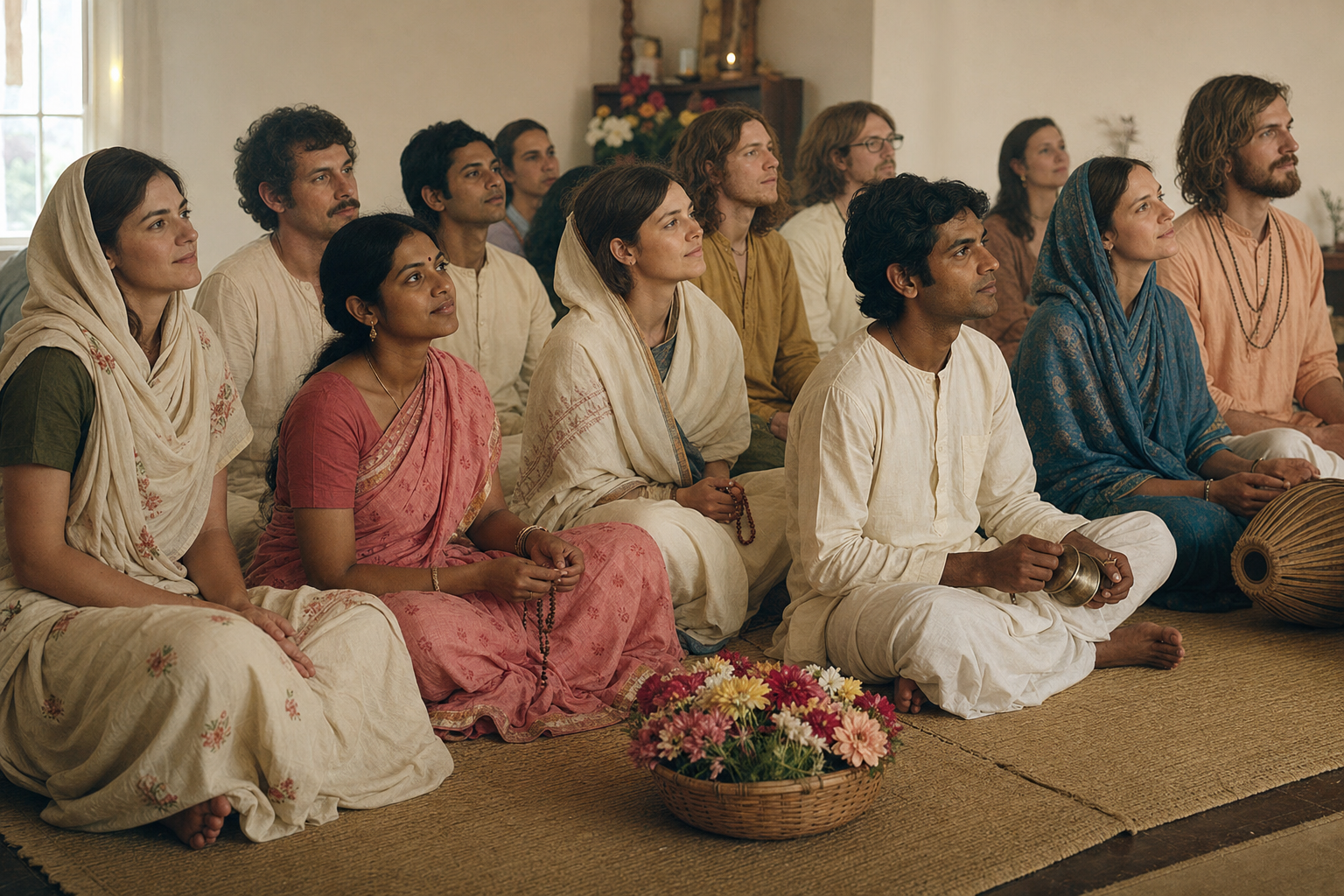
Traditional clothing did not prove equality by itself. Its significance came from the social order around it. Dhotis and saris appeared together in balanced sacred space while their wearers shared the disciplines of bhakti. Cultural form and equitable participation were not treated as enemies.
This corrects a common misreading of tradition and modernity. A community does not become inclusive merely by abandoning traditional distinctions. Nor does it preserve Dharma merely by retaining them. The relevant test is whether a form directs attention toward worship, sustains appropriate boundaries, and honours the spiritual agency of everyone affected by it.
The same distinction helps when speaking across the wider Dharmic family. Hindu, Buddhist, Jain, and Sikh traditions are not interchangeable, and their institutions need not organise worship identically. They nevertheless share an ethical vocabulary that includes self-discipline, compassion, service, and the dignity of the practitioner. Unity in diversity does not erase distinctions. It prevents distinctions from becoming excuses for diminished dignity.
You can therefore preserve a traditional arrangement without treating it as immune from examination. Ask what spiritual purpose each feature serves. If a custom supports concentration and mutual respect while preserving equal participation, explain that purpose clearly. If it produces privilege unrelated to devotion or responsibility, calling it traditional does not settle the matter.
A five-part audit for an inclusive temple room
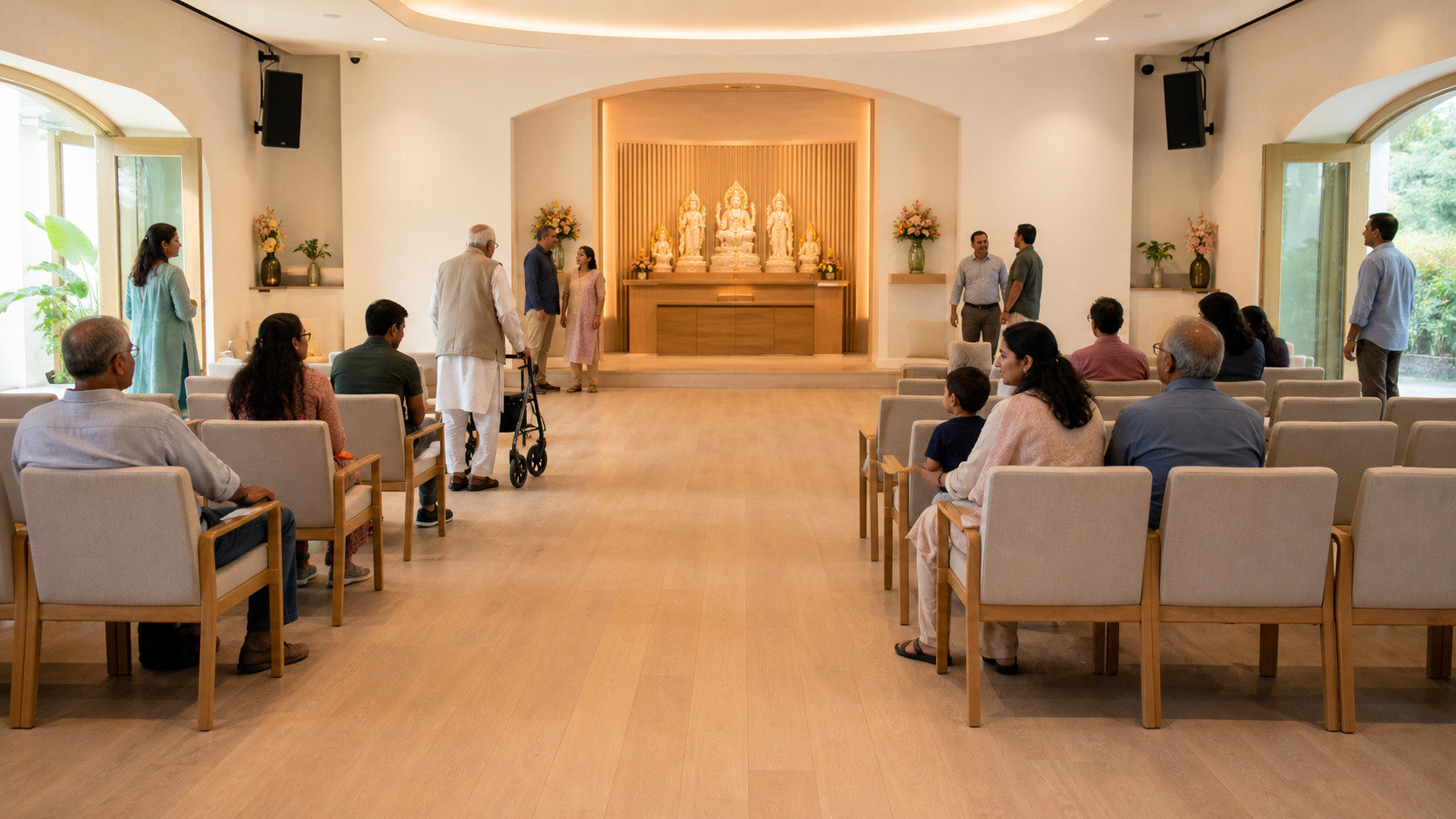
Do not copy the geometry of a 1970s North American temple without considering your own congregation. Copy the discipline of testing arrangement against purpose and parity. A temple committee can begin with five concrete steps.
- Map the room as devotees experience it. Mark entrances, available floor space, sightlines toward the altar, obstacles, and crowded passages. Two areas can appear equal on paper while functioning very differently during worship.
- Follow participation from worship to responsibility. Trace how a devotee moves through kirtan, personal practice, study, seva, and greater responsibility. Record where participation depends on an open process and where it depends only on personal familiarity.
- State the purpose of every boundary. If areas are separated, identify whether the arrangement is meant to protect concentration, safety, or decorum. Apply the resulting conduct expectations consistently. A boundary whose purpose cannot be explained deserves review.
- Define qualifications for service. List the preparation, reliability, and devotional responsibility a role actually requires. This keeps informal privilege from masquerading as spiritual qualification while still allowing different people to perform different services.
- Check the plan against lived participation. Ask people using each part of the room where visibility, access, instruction, or service breaks down. A diagram shows intention; participant experience shows whether the intention survives contact with temple life.
This audit also prevents false positives. Equal floor area cannot compensate for unequal access to study or responsibility. Conversely, separate areas should not be dismissed as exclusionary when they provide comparable access, shared standards, and real paths into seva.
Key takeaways
- Separation and exclusion are not synonyms; the decisive question is whether distinction creates lesser status or access.
- Equal space matters, but inclusion must also extend to practice, education, seva, and responsibility.
- Traditional forms earn trust when their purpose is clear and their effects are consistent with dignity.
- Service-centred responsibility gives a community a practical way to prefer devotion and accountability over privilege.
- A historical arrangement is a precedent to examine, not a template to reproduce mechanically.
At your next planning meeting, bring both the floor plan and the weekly devotional schedule. Mark where every group stands, learns, serves, and assumes responsibility. Keep the boundaries that protect bhakti and mutual respect. Change the arrangements that quietly turn difference into disadvantage.
References
