
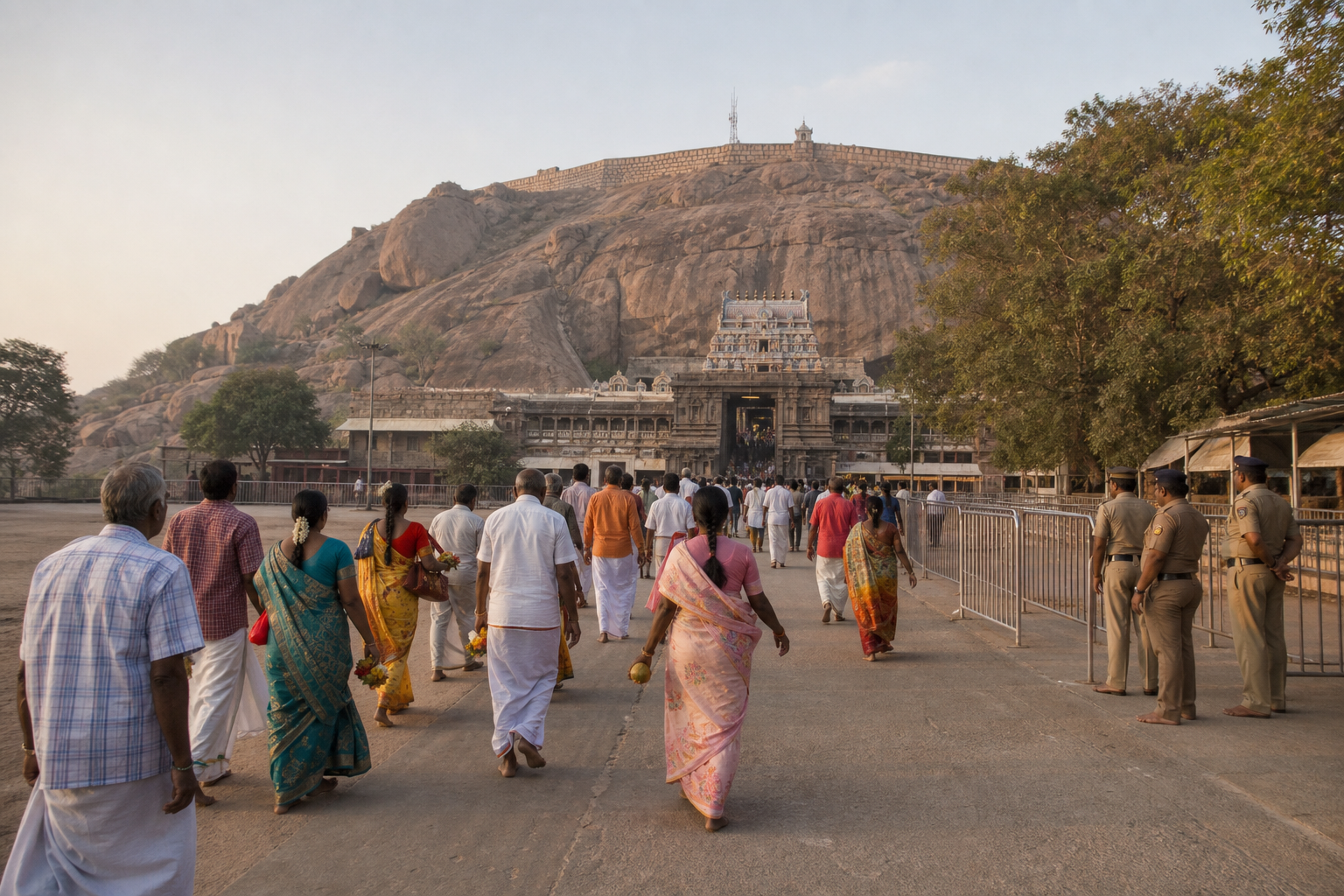
If you are planning darshan at Tirupparankundram after hearing about clashes, your immediate question is practical: can you reach the temple safely, worship, and return without being drawn into a confrontation? Do not answer that question from a forwarded message or an old video. Check the current conditions for the shrine itself.
Temple access, an organised demonstration, and a legal grievance are three different matters. Keeping them separate protects devotees while preserving the right to raise concerns about a sacred place. A temporary restriction on a congregation need not mean the abandonment of a Hindu claim, just as a religious cause does not give anyone permission to expose pilgrims and residents to avoidable danger.
Key takeaways for devotees and organisers
- Confirm the latest district and temple instructions before travelling. A restriction on rallies or large assemblies does not automatically mean that regulated darshan has stopped.
- Ask about the exact place, period, activity, route, and entry gate covered by a restriction. Do not rely on a general claim that an entire area is either open or closed.
- If you are going only for worship, stay away from designated congregation points, slogans, procession formations, and arguments at barricades.
- If you are organising, use a written route plan, time-bound permission, trained volunteer marshals, one police liaison, and one verified public-information channel.
- Record grievances precisely. Separate what you personally witnessed from what another person told you or sent to you.
- Judge both activists and authorities by the same essentials: restraint, truthful communication, protection of worship, care for bystanders, and accountability for misconduct.
Establish the facts before choosing a side or a course of action

On November 4, 2025, reported clashes between Hindu activists and police were followed by prohibitory orders in parts of Madurai. Additional personnel managed crowd movement and assembly limits near congregation points. The immediate public-order objective was to prevent further escalation while allowing darshan and routine worship where official arrangements permitted them.
That is enough to justify caution, but not enough to justify a sweeping accusation. The facts available do not establish who initiated every physical encounter, the complete sequence at each location, or whether every allegation circulating afterward was accurate. When those details are missing, do not turn an inference into a verdict.
Individuals described in local discussion as aligned with Hindu Makkal Katchi, Hindu Munnani, the Vishwa Hindu Parishad, and the Rashtriya Swayamsevak Sangh were associated with the wider mobilisation. Presence, membership, or alignment does not by itself prove that an organisation ordered a particular act or that every person present participated in it. Responsibility should follow verified conduct, not a label.
The same discipline applies to claims about the police. An order to disperse, a barricade, physical force, detention, and an unlawful assault are not interchangeable descriptions. If you witnessed an incident, note the time, precise location, visible sequence, instructions you heard, and actions you actually saw. If you did not witness it, say so before sharing it. A dharmic commitment to satya requires more accuracy when emotions are high, not less.
Residents also have legitimate interests. Traffic disruption, loud sloganeering, uncertain school access, and blocked shops can turn a temple dispute into a neighbourhood crisis. Treating those concerns as irrelevant does not strengthen the defence of the temple. It alienates the people who must live beside the sacred site after visiting crowds leave.
Read a prohibitory order narrowly and precisely
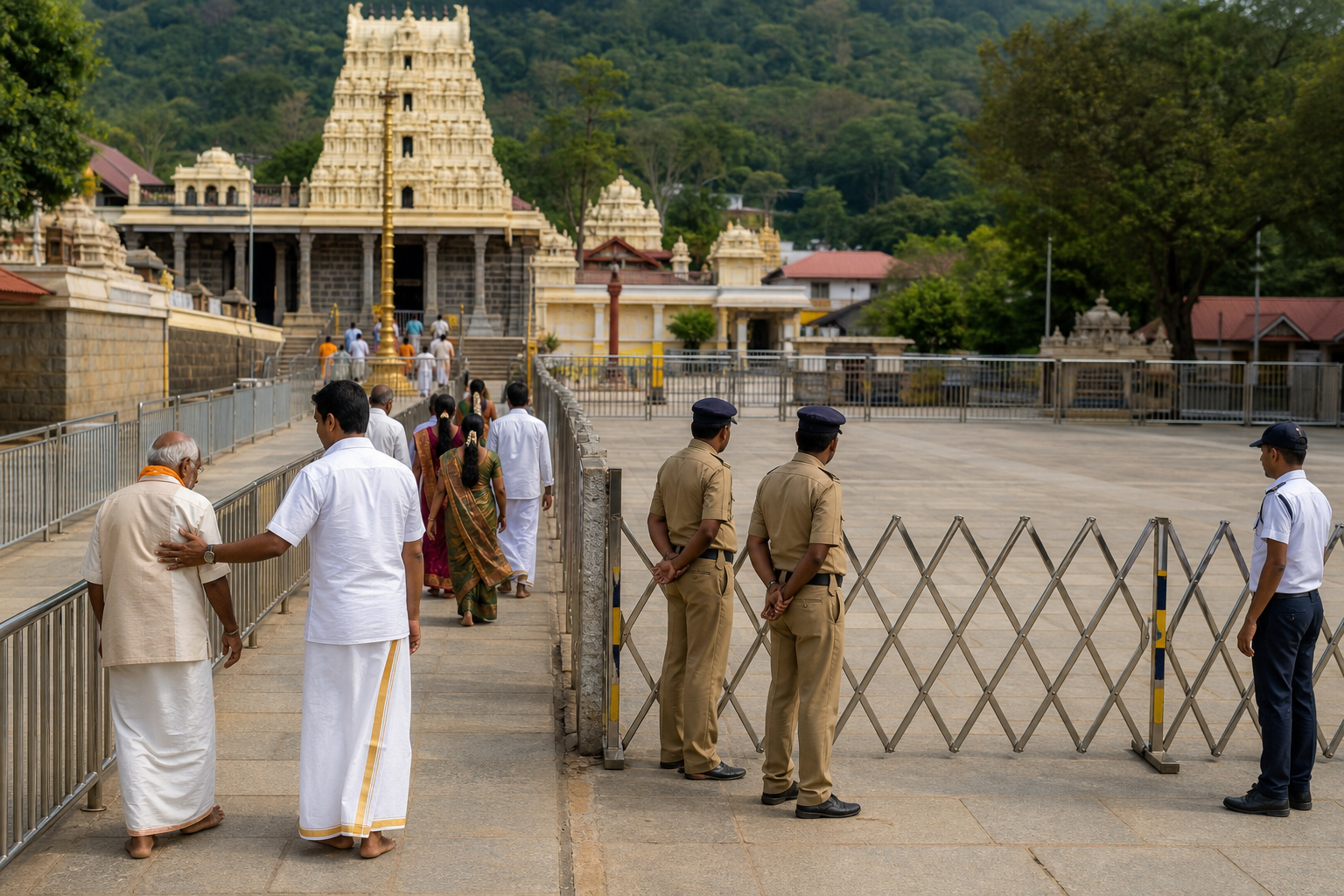
The existence of a prohibitory order does not, by itself, tell you whether darshan is closed. Such orders commonly regulate assemblies, rallies, processions, public meetings, routes, or movement in specified places. Routine religious activity may continue through controlled entry. The decisive information is the latest official instruction for the place and activity you intend to undertake.
Ask six questions before acting
- What area is covered? A named junction, procession route, congregation point, or police limit is more precise than the phrase “Madurai restrictions.”
- When does it apply? Establish the starting time, duration, and next review. Do not assume that a restriction issued in 2025 remains in force, or that an expired notice proves current access is unrestricted.
- What conduct is restricted? Ask specifically about an individual visit, family darshan, organised assembly, procession, public address, vehicle convoy, and use of loudspeakers.
- What worship remains permitted? Confirm the operating entry gate, permitted hours, queue arrangements, and any regulated-entry requirement directly through current temple or district information.
- How has travel changed? Check traffic diversions, public-transport access, parking restrictions, and the safest approach to the shrine.
- Where can a grievance be raised? Identify the designated district, police, or temple contact instead of trying to settle a disputed interpretation at a crowded barricade.
During the Tirupparankundram response, authorities indicated that restrictions would be reviewed periodically. That matters because an emergency measure should remain tied to an identifiable risk. A fair administration should communicate what has changed at each review: which limits remain necessary, which have been relaxed, and how ordinary worship will be protected.
If the written terms are unclear, or if you intend to challenge an order, obtain the current text and seek advice from a lawyer familiar with local public-order law. Do not test a legal interpretation by deliberately breaching a police line. That can expose you to legal consequences, endanger nearby devotees, and obscure the underlying temple grievance with a new dispute about crowd conduct.
A safe darshan plan during uncertain access
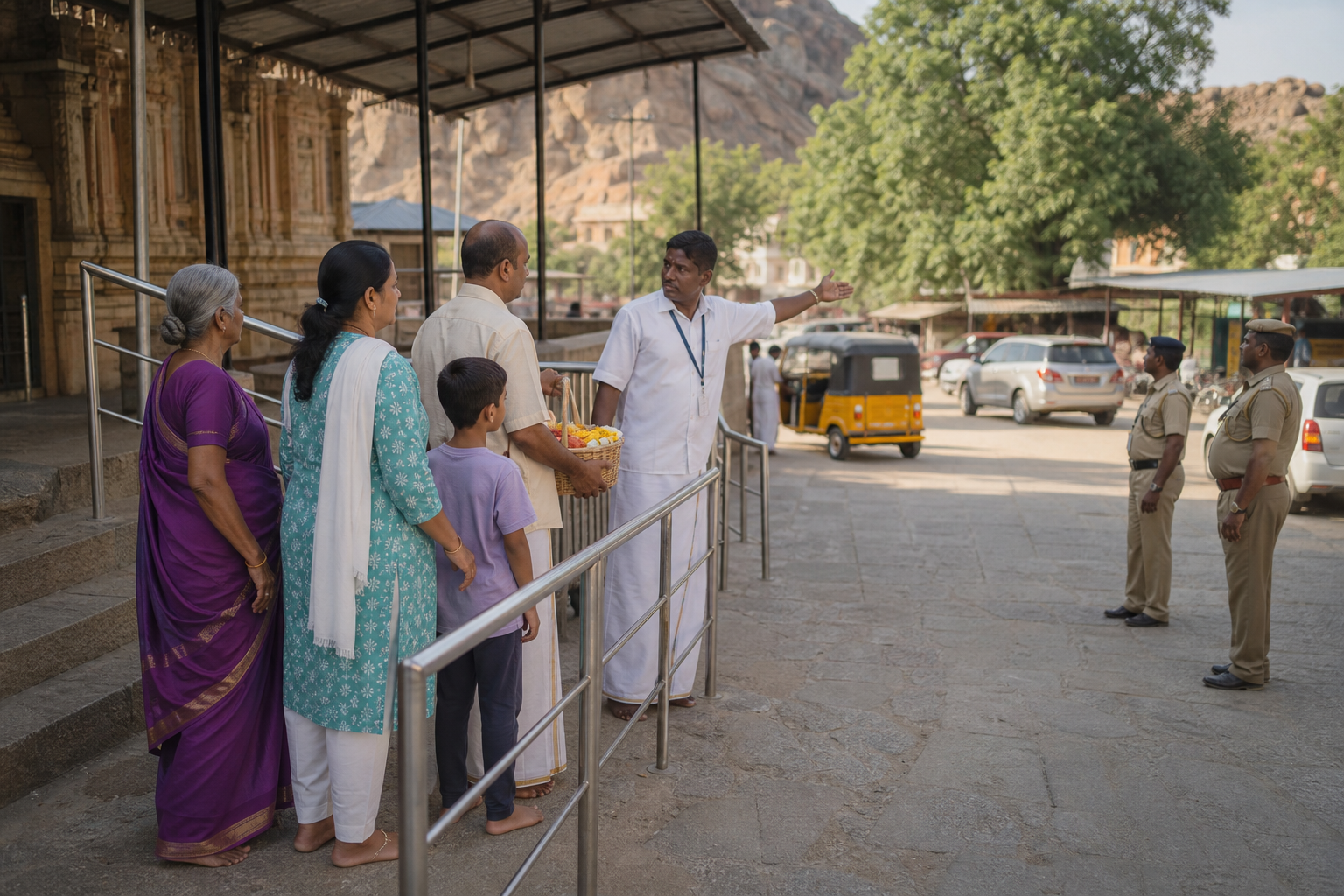
If your purpose is worship, make that purpose obvious through your preparation and conduct. A pilgrim who enters an uncertain area without checking access can unintentionally become part of a gathering. A few concrete choices reduce that risk.
Before you leave
- Check the latest advisory from the district administration and the temple authority on the day of travel. Recheck if conditions are changing quickly.
- Confirm that routine darshan is operating and identify the approved entrance. “The temple is open” is not enough if one approach road or gate is restricted.
- Review current traffic diversions before choosing a drop-off point. Do not ask a driver to enter a blocked route or stop beside a police cordon.
- Carry identification if movement checks have been announced. Keep essential items compact so that screening does not delay the queue.
- If children, older devotees, or anyone with limited mobility is travelling with you, postpone the visit when access remains uncertain. Their safety should not depend on whether a crowd stays calm.
- If you are attending only for darshan, do not carry placards, loudspeakers, flags intended for a mobilisation, or material that could confuse your purpose with participation in a prohibited assembly.
At the temple approach
- Use the designated queue and route even if another path appears shorter.
- Follow a safety direction first. Ask for clarification calmly through the designated officer or help point after you are out of the moving crowd.
- Do not stop near a congregation merely to watch or record it. A stationary cluster attracts more people and can block an evacuation or access route.
- If slogans intensify, barriers move, or people begin pushing, leave through the nearest permitted route. Do not wait to determine who is responsible while the crowd is compressing.
- Do not forward claims about closure, violence, arrest, or desecration until you can identify when and where the event occurred. Old media can trigger a new crowd around a false premise.
If something goes wrong, preserve original photographs or video without editing the sequence. Write down what happened while your memory is fresh. Keep separate notes for what you saw, what you heard from an official, and what another participant alleged. That separation makes a later complaint more credible and reduces the risk of accusing the wrong person.
Disciplined advocacy protects the temple cause
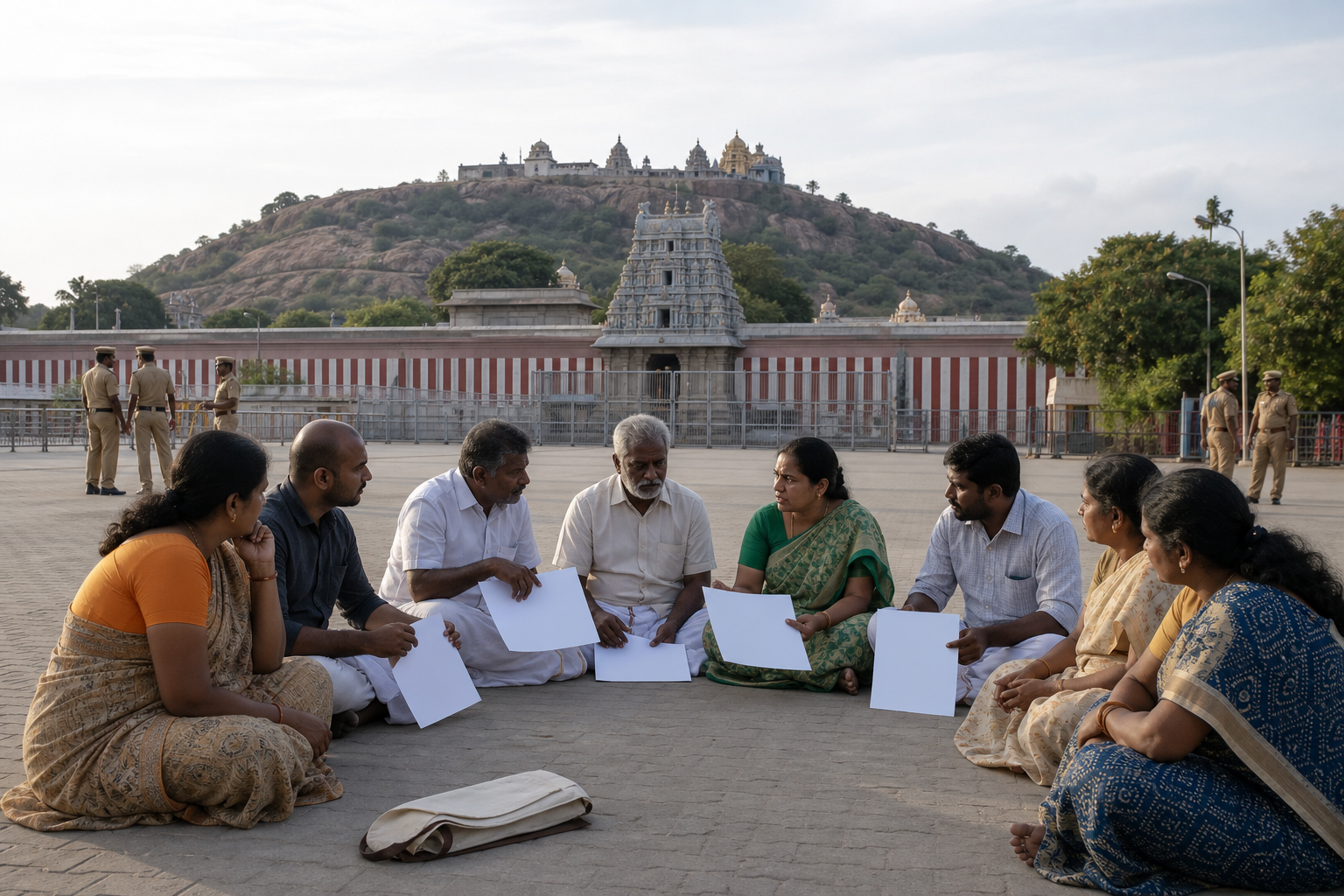
A sacred claim deserves more than an improvised crowd. If a Hindu organisation wants to hold a procession, submit a petition, or demonstrate, the operational plan should be ready before supporters are called to assemble. Public mobilisation without a confirmed route, time, permission status, and dispersal plan transfers avoidable risk to devotees, police personnel, shopkeepers, students, and residents.
Build the mobilisation around clear roles
- One authorised liaison: A named representative communicates with the district and police. Participants should not receive competing instructions from several leaders.
- A written route and schedule: Mark the assembly point, movement route, speaking location, end time, and dispersal exits. Keep worship queues and emergency access clear.
- Trained volunteer marshals: Position identifiable volunteers at the front, sides, crossings, and dispersal points. Their job is to relay instructions, prevent pushing, and move participants away from provocation.
- A real-time coordination channel: Temple administrators, organisers, and officials need a way to correct route changes, crowd estimates, and access information before rumours fill the gap.
- One verified public update channel: Publish only confirmed instructions. Date and time every update so that an expired message cannot be mistaken for a current one.
- A record keeper: Preserve permission requests, acknowledgements, route plans, official replies, and a chronological incident log. Evidence is more useful than a stream of unverified captions.
Make the grievance specific enough to answer. Identify the disputed access condition, administrative decision, route, practice, or incident. State the remedy sought and the authority expected to respond. A demand such as “publish the current entry protocol and review the restriction by the announced date” creates a basis for accountability. A vague accusation gives both officials and provocateurs room to redirect the issue.
Do not use pilgrims as the numerical base of a protest. A family arriving for darshan may not know that a gathering is restricted or that a procession route has changed. Keep the worship queue physically and organisationally separate from political or activist activity. That protects religious freedom by making it harder to treat every devotee as a participant in a mobilisation.
The administration should be assessed with equal precision. A credible public-order response is geographically limited, time-bound, periodically reviewed, and explained in language ordinary residents can understand. It preserves routine worship wherever safely possible, provides a visible grievance channel, and relaxes controls when the immediate risk falls. Vague boundaries, inconsistent instructions, unnecessary delays, or restrictions that continue without explanation warrant documented scrutiny through lawful channels.
Ahimsa in this setting is not passivity. It is disciplined strength: refusing provocation at the point where one angry act can redefine the entire cause, then pursuing the grievance with accurate evidence, organised representation, and persistence. The dharmic obligation to protect a sacred place belongs beside the obligation to protect innocent people standing in the same street.
Before your next visit or mobilisation, save the current official advisory, confirm the permitted route and activity, and decide who will communicate if conditions change. That small act of preparation gives you a better chance of protecting darshan, asserting legitimate concerns, and leaving no opening for rumour or disorder to speak in your name.
References
