

If you have heard Tarapith described as both a Shakta pilgrimage centre and a meeting point with Buddhist Tara, you may wonder what is actually being claimed. Is Tara one deity shared unchanged by two traditions, or are these unrelated figures that happen to bear the same name?
Neither shortcut does justice to Tarapith. The clearer approach is to distinguish sacred identity, ritual setting, and spiritual function. You can then honour Tara’s specifically Hindu form at Tarapith while recognizing a genuine resonance with Vajrayana Buddhism – without forcing the two traditions into sameness.
Begin with Tarapith’s own sacred geography

Tarapith is not a generic shrine that can be interpreted apart from its place. It stands in Birbhum district of West Bengal, near Rampurhat and the Dwarka River. Its identity begins with the Shakti Peetha tradition, not with a modern theory of religious fusion.
Within that tradition, Tarapith marks the place where the third eye, or netra, of Sati fell after Vishnu used the Sudarshana Chakra to bring Shiva’s cosmic grief to an end. This is a statement of sacred geography. It tells the devotee how the land is understood within Shakta memory; it should not be carelessly recast as an archaeological claim requiring the same kind of evidence as an ordinary historical event.
The distinction matters. A Shakti Peetha is not sacred merely because a temple was constructed there. The landscape itself is perceived as bearing the presence of Shakti. Shiva’s grief, Vishnu’s intervention, Sati’s body, and the sanctification of place form the narrative field in which Tara is encountered.
If you are trying to understand Tarapith, begin here. Ask what the Peetha tradition says about the relationship among body, land, loss, and divine power. Starting instead with the question of whether Tara is Hindu or Buddhist reverses the site’s own order of meaning.
At Tarapith, Tara is a Mahavidya and the Divine Mother
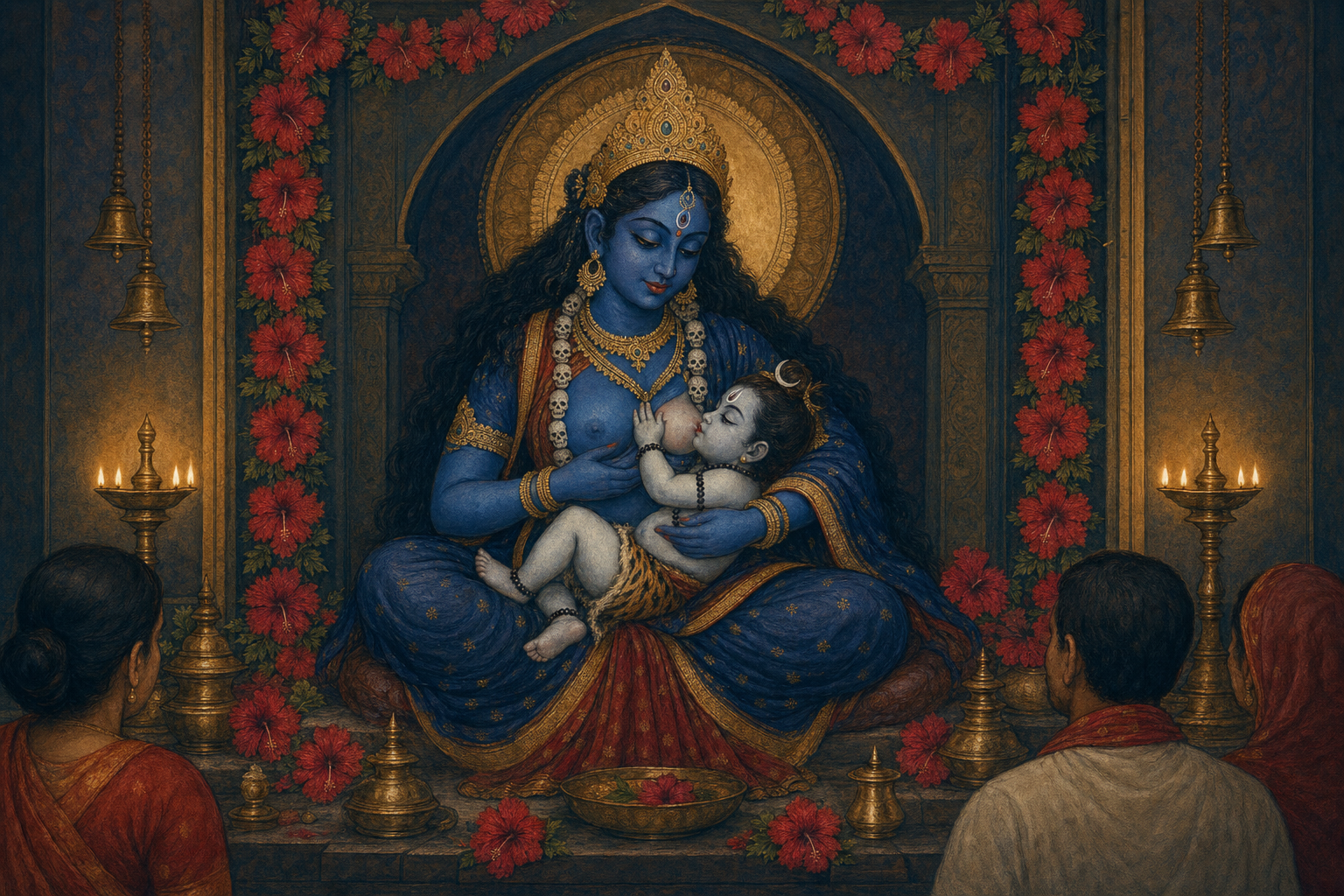
The presiding Sri Tara is revered as one of the Mahavidyas and is often identified with Nilasarasvati. These names place her within a distinctly Hindu Shakta and Tantric framework. Mahavidya is not a general synonym for every form of Tara; it identifies her as one of the great manifestations of divine wisdom within the worship of Shakti.
Tarapith’s ritual world reinforces that identity. Mantra recitation, meditative worship, devotion to the Mother, and the solemn presence of the nearby cremation ground belong to the classical Tantric idiom of Bengal. Tantra here is not an aesthetic of darkness or a collection of sensational practices. It is disciplined sadhana directed toward transformation.
The figure of Bamakhepa helps make that ethos concrete. He is remembered not simply for spiritual intensity, but for a conjunction of intense devotion and compassionate service. His place in Tarapith’s memory shows that Tantric practice and loving surrender to the Mother need not be opposites. Discipline, devotion, and grace meet in the same life.
When you encounter an account or image of Tara, look for the vocabulary surrounding it. The context usually tells you more than the name alone:
- Sati, Shakti Peetha, Mahavidya, Nilasarasvati, and Shiva place Tara in a Hindu Shakta frame.
- Temple worship, darshan, Bengali Tantra, mantra, and the cremation ground describe Tarapith’s ritual setting.
- Maternal compassion does not make the deity generically Buddhist; compassion is also central to the Hindu understanding of the Divine Mother.
- A shared name is a reason to investigate a relationship, not a licence to erase each tradition’s own theology.
Buddhist Tara reveals resonance without requiring identity
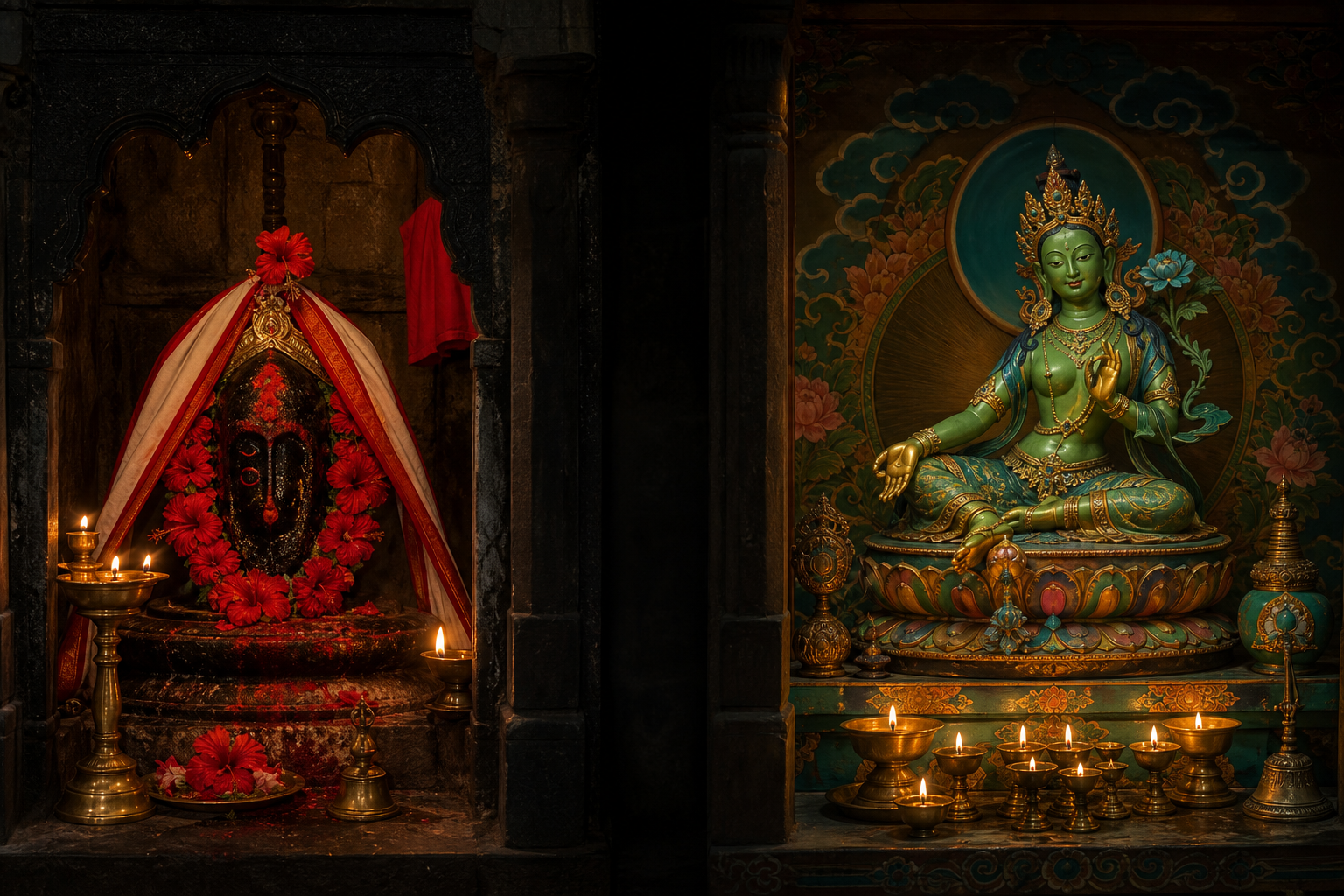
In Vajrayana Buddhism, Tara is honoured as the swift saviouress and an embodiment of boundless compassion. She responds to suffering and points the practitioner toward liberation. This makes the comparison with Tarapith meaningful: both forms place compassionate aid close to the centre of spiritual life.
But resemblance does not settle every historical or theological question. Shared compassion does not prove that two traditions mean precisely the same thing by Tara. Nor does the common name, by itself, establish a simple one-way story in which one tradition borrowed a complete deity from the other. Tarapith’s Hindu-Buddhist confluence is strongest when understood as a field of resonance rather than a claim of total equivalence.
Use three questions whenever you compare the two traditions:
- Who is being invoked? At Tarapith, Tara is Shakti, a Mahavidya, the Mother, and the presiding deity of a Shakti Peetha. In Vajrayana, Tara is approached within the Buddhist path as the swift compassionate saviouress.
- What ritual world gives the figure meaning? Tarapith belongs to Bengali Shakta worship and Tantra. Buddhist Tara belongs to Vajrayana practice. The setting determines how names, images, and mantras are understood.
- What spiritual work does the figure perform? Here the traditions come closest: Tara answers fear and suffering with compassion, encourages disciplined practice, and directs the seeker toward freedom.
The first two questions preserve difference; the third discloses kinship. That is a more durable model of Dharmic unity than declaring every deity interchangeable. Unity does not require uniformity. It requires enough confidence to see a shared spiritual horizon without denying the paths by which different communities approach it.
The cremation ground changes the question

Tarapith’s adjacent smashana, or cremation ground, is not incidental scenery. It places impermanence beside worship. The devotee does not encounter the Mother’s compassion in a world where death has been hidden; compassion is sought while mortality remains in view.
This is where the Hindu-Buddhist relationship becomes existential rather than merely comparative. Shiva contributes the motif of ascetic power. A Buddhist reading immediately recognizes the demand to face impermanence. Tara supplies the compassionate response. The traditions do not need to become one doctrine for these motifs to illuminate one another.
If you visit, resist the temptation to treat the cremation ground as a dramatic Tantric attraction. It is a sacred setting for mortality, grief, and practice. Observe local boundaries, do not intrude on rites, and let silence do more work than photography. Presence at a Tantric site does not automatically grant permission to imitate practices you do not understand.
You can use the place’s spiritual logic even without attempting an esoteric rite. Sit with three direct questions:
- What loss am I refusing to acknowledge?
- Does my idea of compassion help me avoid fear, or help me face it truthfully?
- If life is impermanent, what act of service or reconciliation should no longer be postponed?
These questions keep contemplation connected to conduct. Tarapith’s lesson is not that death should fascinate you. It is that awareness of death can strip away evasion and make compassion urgent.
How to approach Tarapith without flattening its traditions
Whether you are preparing for a pilgrimage or studying Tarapith from afar, use a sequence that lets the site speak before you impose a conclusion.
- Name your question before you begin. Decide whether you are examining sacred geography, Shakta Tantra, Buddhist resonance, devotional practice, or the experience of impermanence. Confusion usually begins when these distinct questions are treated as one.
- Learn the Peetha narrative first. Remember Sati’s third eye, Shiva’s grief, and Vishnu’s intervention. This establishes why the place is sacred within Hindu tradition.
- Identify Tara through her ritual context. At Tarapith, read her as Sri Tara, Mahavidya, Nilasarasvati, and Mother. Do not let a cross-traditional comparison replace the deity worshipped at the shrine.
- Notice practices, not just images. Mantra, meditation, japa, devotion, and service reveal what a sacred figure means to a living community. Visual resemblance alone is weak evidence for theological identity.
- Treat Tantra as a discipline. Do not improvise mantras or copy unfamiliar rites because they appear powerful. Watch respectfully, follow temple directions, and seek qualified guidance before undertaking a formal practice.
- Read festivals through their purpose. Navaratri and Amavasya nights draw pilgrims for japa, meditation, worship, and community service. If you encounter an intensified ritual atmosphere, participate through attention and respect rather than a search for spectacle.
- Carry one insight into ordinary conduct. A daily pause before reacting, an overdue act of service, or an honest contemplation of impermanence is more faithful to Tara’s compassionate horizon than collecting exotic impressions.
The same method works when you encounter Tara in a book, shrine image, or online discussion. First identify the tradition and ritual setting. Then ask what the figure does for the practitioner. Only after those steps should you make a claim about shared origins or meanings.
Key takeaways
- Tarapith is first a Hindu Shakti Peetha rooted in the sacred geography of Sati, Shiva, and Vishnu.
- Sri Tara’s identity as a Mahavidya and Nilasarasvati places her within Bengali Shakta Tantra.
- Vajrayana Tara offers a real point of contact through swift compassion and the aspiration to liberation.
- Shared functions do not make Hindu and Buddhist Tara identical in theology or ritual practice.
- The cremation ground turns impermanence from an abstract teaching into a demand for courage, compassion, and honest conduct.
- The most respectful comparison preserves each tradition’s grammar while noticing where their spiritual aims converge.
The next time you hear Tarapith invoked as proof that Hinduism and Buddhism are either completely separate or simply the same, ask the three questions: who is Tara here, what ritual world surrounds her, and what transformation is sought? Those questions will take you closer to the living sacred than a slogan from either side.
References
