

You may arrive at Sabarimala with a practical question: what should you actually be doing inwardly while you keep the vratham, carry the irumudi, wait among other pilgrims, and approach the sanctum? The answer is not to add more commentary to the journey. It is to let each outward discipline expose one inward habit.
Seen this way, the yatra is one continuous practice. Restraint at home prepares you for discomfort and delay. Care for the irumudi prepares you to approach the sacred threshold responsibly. The 18 steps give bodily form to an inner ascent. Prasadam brings the blessing back into your relationships. Treat any one of these as a ceremonial prop, and the sequence begins to fragment.
Key takeaways
- Vratham is the beginning of the pilgrimage, not merely a condition to satisfy before travelling. Use it to observe how appetite, anger, comparison, vanity, and attachment operate in ordinary life.
- The irumudi is a double-knotted offering bundle bound to preparation and responsibility. Learn its correct form and handling through the devotional tradition you are following.
- The 18 holy steps carry several respected interpretations. Choose one contemplative framework rather than insisting that every symbolic reading must be reduced to a single official code.
- Queues, chanting, designated routes, and administrative instructions are not interruptions to devotion. They test whether patience and humility survive contact with other people.
- Aravana Payasam and Appam complete the return journey when they are received gratefully, transported carefully, shared promptly, and handled without waste.
Begin the yatra before you travel
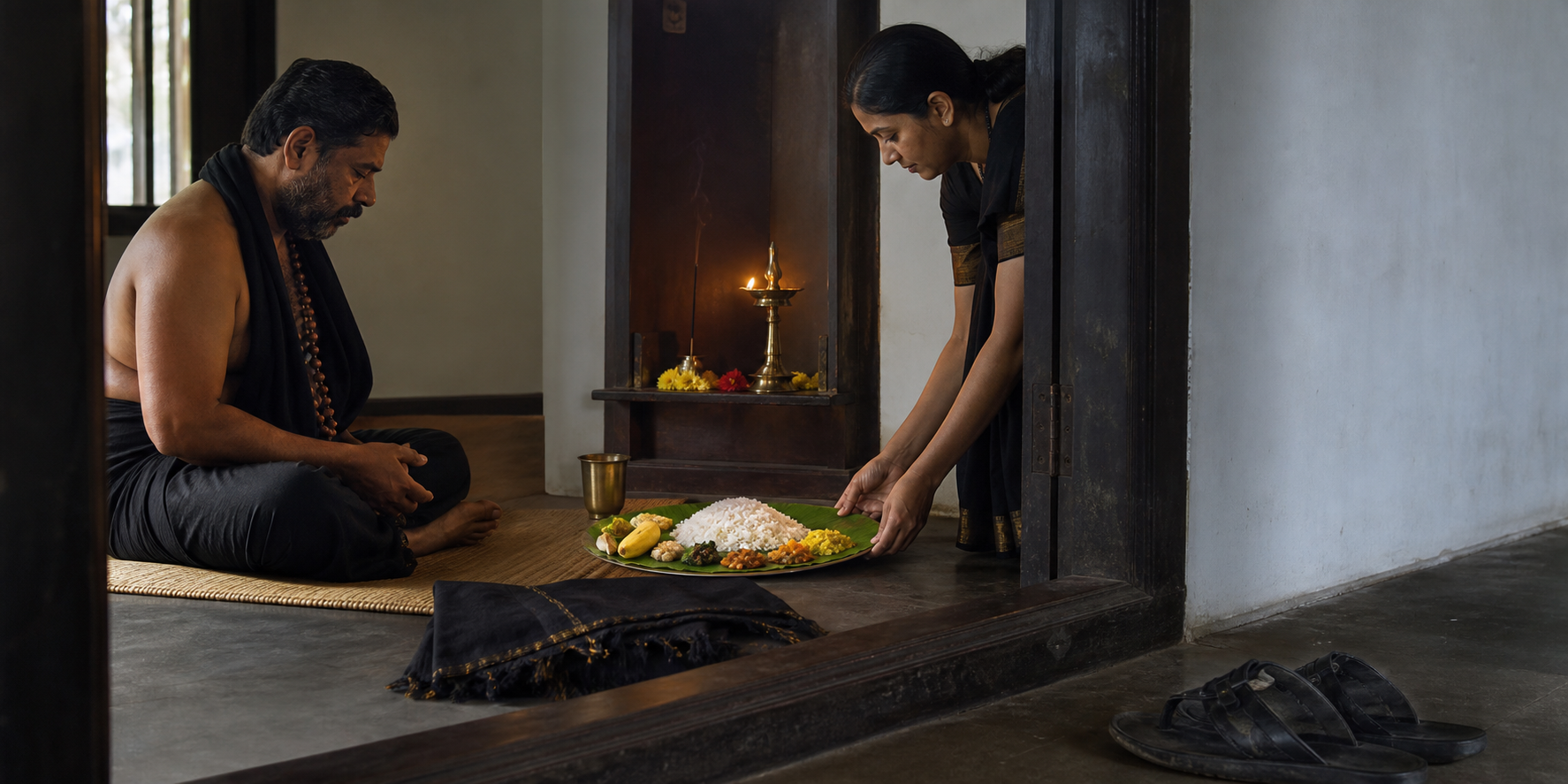
Use vratham to discover what usually governs you
The vratham centres on self-restraint, purity, simplicity, and humility. Those words can remain abstract unless you connect them to repeated choices. A restraint matters because it reveals the moment when a preference begins behaving like a command: comfort must come now, irritation must be expressed, recognition must be received, or another person’s inconvenience must matter less than your own.
Keep the formal observance you have been taught. Alongside it, use a brief daily account to notice whether its qualities are reaching your conduct. Three questions are enough:
- Senses: What did you reach for automatically, and were you able to pause before acting?
- Reactions: Where did anger, pride, greed, attachment, comparison, or the desire to appear important take control?
- Service: What did you do for another person without arranging to be noticed for it?
This reflection is not a replacement for the inherited requirements of vratham. It is a way of inhabiting them. If your food changes but your speech remains harsh, or your routine becomes austere while your need for recognition grows, the observance has identified unfinished work. That recognition is useful; it gives the pilgrimage something real to transform.
The best preparation is therefore not a dramatic spiritual mood. It is repetition. When you practise restraint during an ordinary inconvenience, you are less likely to abandon it when the journey becomes tiring. When you practise humility at home, you do not need a sacred setting to manufacture it for you.
Let the irumudi turn intention into responsibility
The irumudi is the double-knotted offering bundle traditionally carried by devotees who have observed the vratham and ascend Pathinettam Padi. Its importance cannot be reduced to the fact that it is carried on the body. It joins preparation, offering, journey, and threshold in one entrusted object.
Before preparing it, distinguish ritual knowledge from travel convenience. Learn the exact preparation and handling required by the temple tradition or knowledgeable devotional community guiding your pilgrimage. A generic packing list can tell you what fits in a bag; it cannot establish the meaning, sequence, or discipline of an offering. Know whom you are following, what each ritual action signifies, and how you will protect the integrity of the bundle without demanding special convenience from everyone around you.
The irumudi also teaches a difficult form of humility: sacred responsibility does not confer personal rank. Carrying it should make you more attentive, not more entitled. If you are not undertaking the vratham and bearing the irumudi, designated routes can facilitate darshan without erasing the discipline associated with the 18 steps. Using the appropriate route is honest participation in the tradition, not a lesser form of devotion.
Climb the 18 steps with one inner map

Pathinettam Padi is not merely the final piece of architecture before darshan. Its ritual force comes from the convergence of preparation and movement: the devotee arrives barefoot, bearing the irumudi, and ascends amid collective chanting. The climb is brief in physical distance, but the vratham gives it a much longer moral approach.
One widely shared interpretation groups the 18 steps as the five senses, eight afflictions, three gunas, and two culminating movements of insight and surrender. You can use that arrangement as a practical map:
| Steps | Contemplative meaning | What to notice in yourself |
|---|---|---|
| 1-5 | The five senses | Which sight, sound, taste, sensation, or attraction most easily commands your attention? |
| 6-13 | Kama, krodha, lobha, moha, mada, matsarya, dambha, and asuya | Where do desire, anger, greed, delusion, pride, envy, pretence, or resentment shape your conduct? |
| 14-16 | Sattva, rajas, and tamas | Is your present state clear and balanced, restless and driven, or heavy and resistant? |
| 17-18 | Spiritual insight and surrender | What result, identity, or claim to control are you still unwilling to release? |
Do not wait until your feet touch the steps to encounter these questions for the first time. During the vratham, identify one recurring pattern in each group. Perhaps comfort repeatedly governs the senses, anger dominates the afflictions, restlessness colours the gunas, and control obstructs surrender. The ascent can then gather weeks of observation into a single embodied act.
This is not the only respected reading. The number 18 is also associated with the 18 chapters of the Bhagavad Gita, the 18 parvas of the Mahabharata, the 18 Puranas, and other symbolic understandings within the tradition. These interpretations need not be forced into one allegedly definitive decoding. Sacred symbolism can carry several coherent memories at once.
If you are unsure which interpretation to hold, choose the one that best supports the discipline you have actually practised. The senses-and-afflictions framework is useful when you have been examining conduct. A scriptural framework may be more meaningful when your observance has been shaped by sustained study. The point is not to display how many meanings you know. It is to arrive with one meaning deep enough to affect your attention.
The material form offers another mnemonic. The steps are crafted in Panchaloham, joining gold, silver, copper, iron, and tin. Their symbolic qualities can be remembered as purity, clarity and receptivity, vital energy, steadfast endurance, and adaptability. A disciplined person needs the whole balance: purity without rigidity, strength without pride, receptivity without passivity, and adaptability without loss of principle.
Rehearse your inner map before entering the moving flow. On the steps themselves, remain responsive to the people and instructions around you. Barefoot movement, steady breath, and collective chanting can gather scattered attention into devotional focus. Reflection should make you more present to the ascent, not so inwardly preoccupied that you obstruct it.
Make the crowd and queue part of the vow
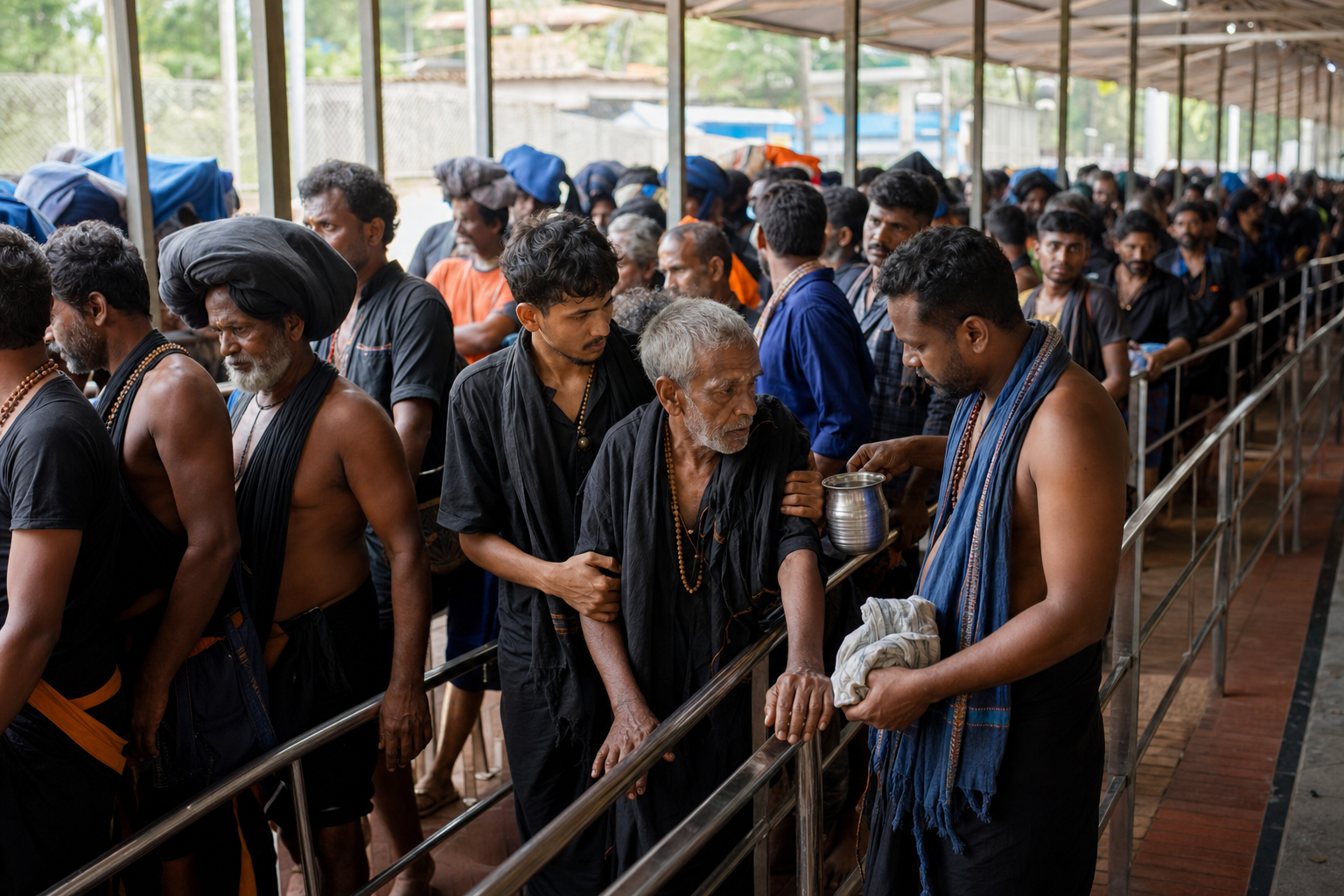
A pilgrimage shared by many people tests something private practice cannot: whether your discipline survives other people’s needs. Delay exposes impatience. Close proximity exposes the demand for personal space and control. Administrative order exposes whether you accept a rule only when it benefits you. This is where the yatra moves from intention to character.
Pilgrim flows intensify during the Makaravilakku season, while prasadam distribution can involve long queues and, at peak times, token-based arrangements. These systems have a practical purpose, but they also give you an immediate spiritual task. Instead of treating the queue as dead time between sacred events, recognise it as one of the events.
- Follow the established flow. A shortcut obtained through pressure or confusion contradicts the humility cultivated by vratham.
- Guard your speech when movement slows. The first sharp response is often the clearest measure of whether restraint has travelled with you.
- Join collective chanting as support for shared attention, not as a performance of superior fervour.
- Use the designated route or token system in operation. Order allows large numbers of pilgrims to participate without turning personal urgency into disorder.
- Follow immediate on-site directions. An inner interpretation never overrides a crowd-management or safety instruction.
The fellowship of Sabarimala is often felt most strongly when social distinctions recede in a common discipline. Equality here does not mean the absence of form. Vratham, irumudi, the conditions associated with Pathinettam Padi, designated routes, queues, and distribution systems all preserve form. What recedes is the assumption that wealth, status, region, or personal importance should purchase a different spiritual standing.
You can set a concrete measure for this part of the pilgrimage: leave no person with a heavier burden merely because you were impatient. That means not forcing movement, not abandoning packaging, not demanding an exception for convenience, and not making workers or fellow pilgrims absorb your frustration. Collective order becomes seva when you help preserve it.
Let prasadam carry the pilgrimage home
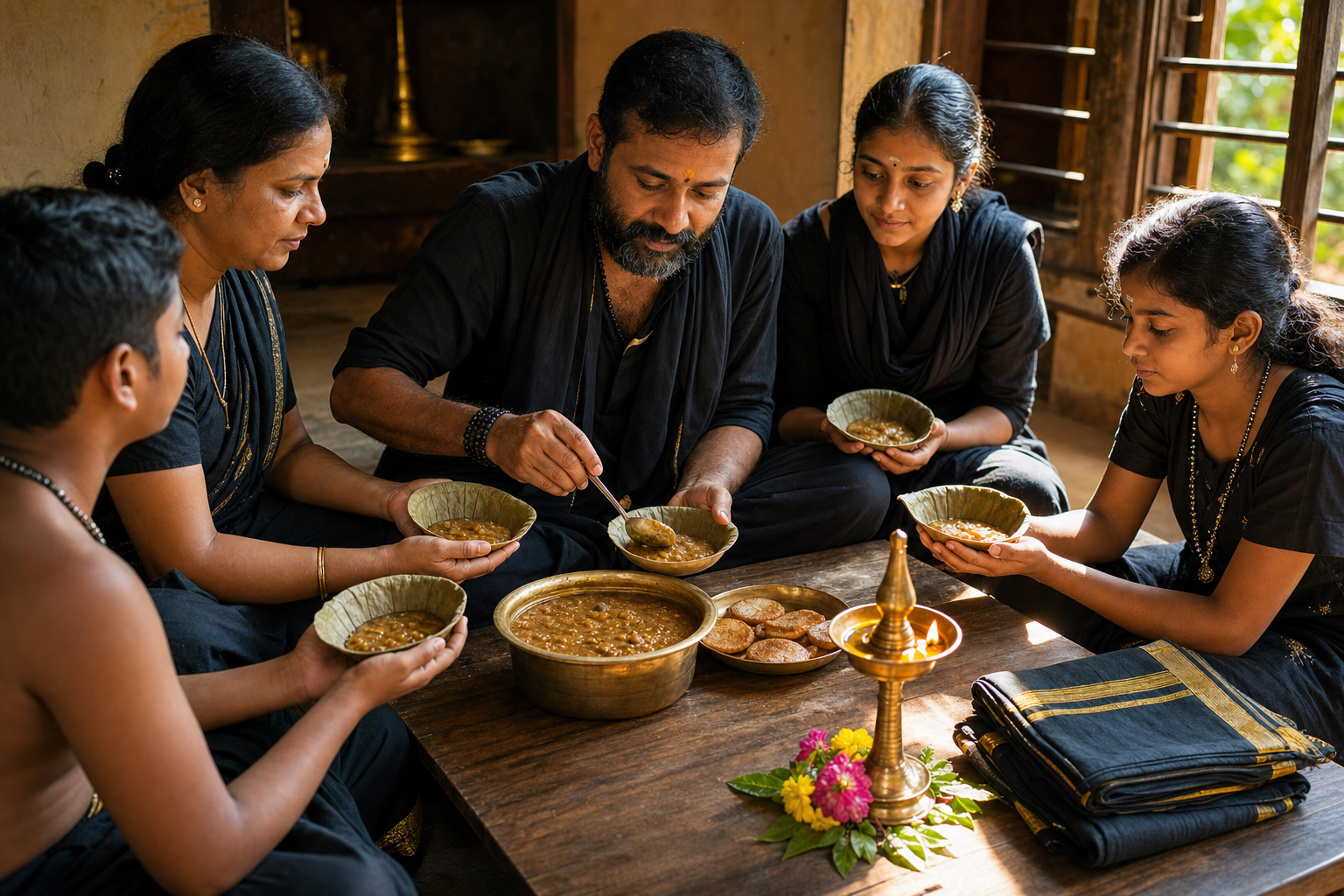
Darshan does not make everything after it spiritually incidental. Aravana Payasam and Appam are cherished as prasadam precisely because the blessing is received in a form that can leave the temple with you. The return journey therefore has its own discipline: receive carefully, transport responsibly, share gratefully, and avoid waste.
Aravana Payasam is traditionally slow-cooked with rice, jaggery, and ghee, while Appam accompanies it as another auspicious offering. The ingredients explain the physical preparation, but not the full significance. Prasadam is food that has passed through offering and reception. Calling it a souvenir misses the relationship it carries.
Make the return concrete before you reach the counter:
- Decide which family members, friends, or members of your devotional community you intend to include when you share the prasadam.
- Receive an amount you can transport and distribute responsibly. Sacred regard is not measured by accumulation.
- Carry a secure, preferably reusable bag so the containers remain manageable during the return journey.
- Consume or share the prasadam promptly rather than allowing delay to undermine its freshness.
- Reuse what can be reused and dispose of the remaining packaging in the proper place. Reverence for the offering is incomplete if its packaging becomes someone else’s waste.
Sharing also reveals a wider dharmic kinship. Hindu naivedya-prasada, Buddhist dana, Jain offerings shaped by ahimsa, and Sikh langar are not interchangeable rites; each belongs to its own theology and discipline. Yet they meet in a recognisable ethic of gratitude, service, and nourishment offered beyond the isolated self. Sabarimala’s prasadam participates in that movement from received grace to shared blessing.
Before you return to ordinary routines, choose one element of the yatra to continue: one restraint over speech, one practice of unrecognised service, one refusal to demand priority, or one habit of sharing before consuming. Attach it to a daily situation you already encounter. The pilgrimage remains transformative when the discipline of the hills changes your next ordinary decision.
References
- DharmaRenaissance Blog – Aravana Payasam at Sabarimala: A Sacred, Soul-Stirring Tradition Every Pilgrim Cherishes
- DharmaRenaissance Blog – Pathinettam Padi Revealed: 18 Holy Steps of Sabarimala and Their Transformative Meaning
