
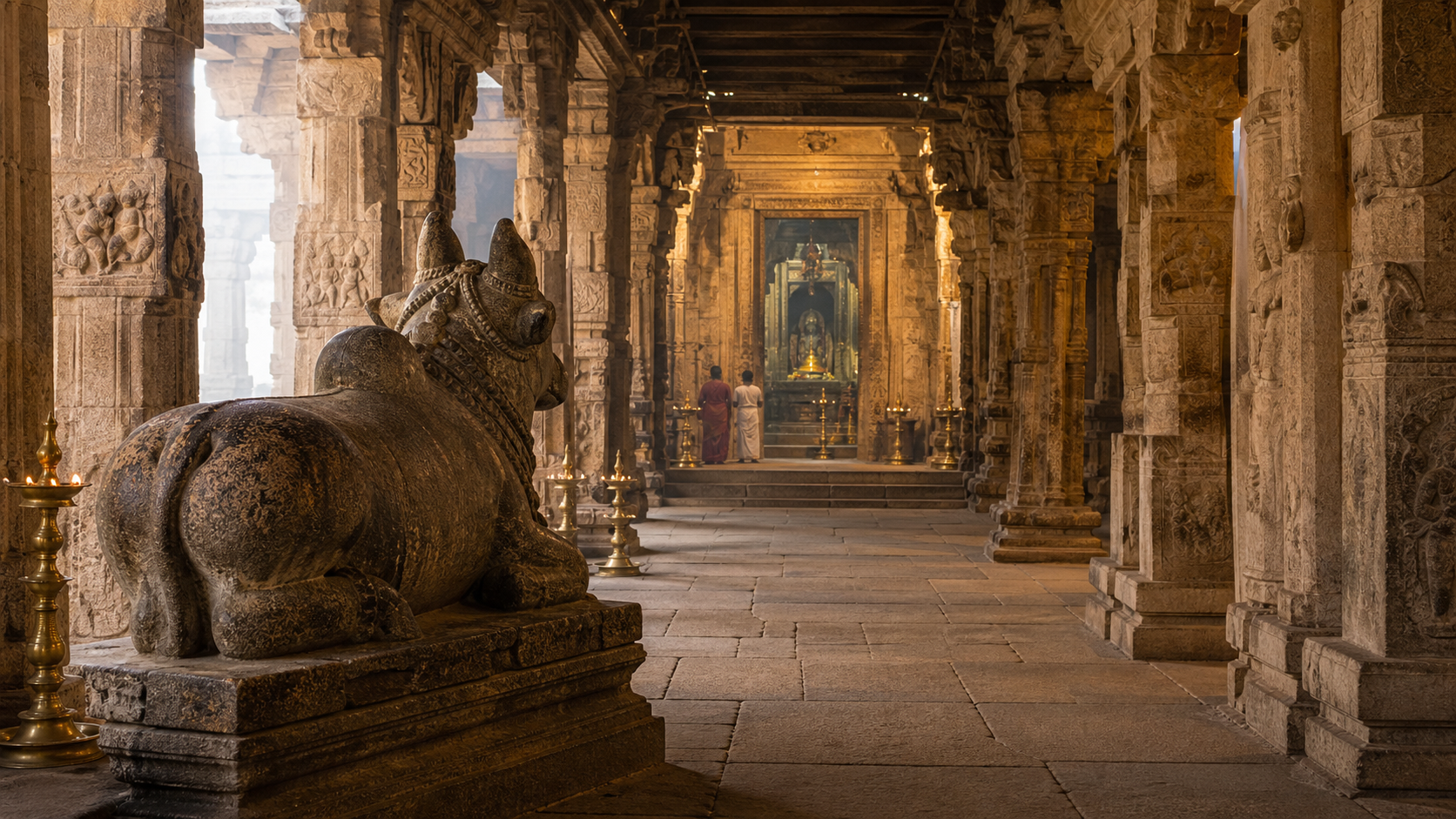
You may be planning a visit to Patteeswaram, or you may simply be wondering what people mean when they say its Nandi moved. The useful question is not how quickly a stone image could change position. It is why Shiva’s foremost attendant would yield the central line of sight to a child.
Once you understand that relationship, the unusual placement stops being an architectural curiosity. It becomes a precise lesson about darshan, humility and the purpose of devotion.
What the Patteeswaram tradition actually holds
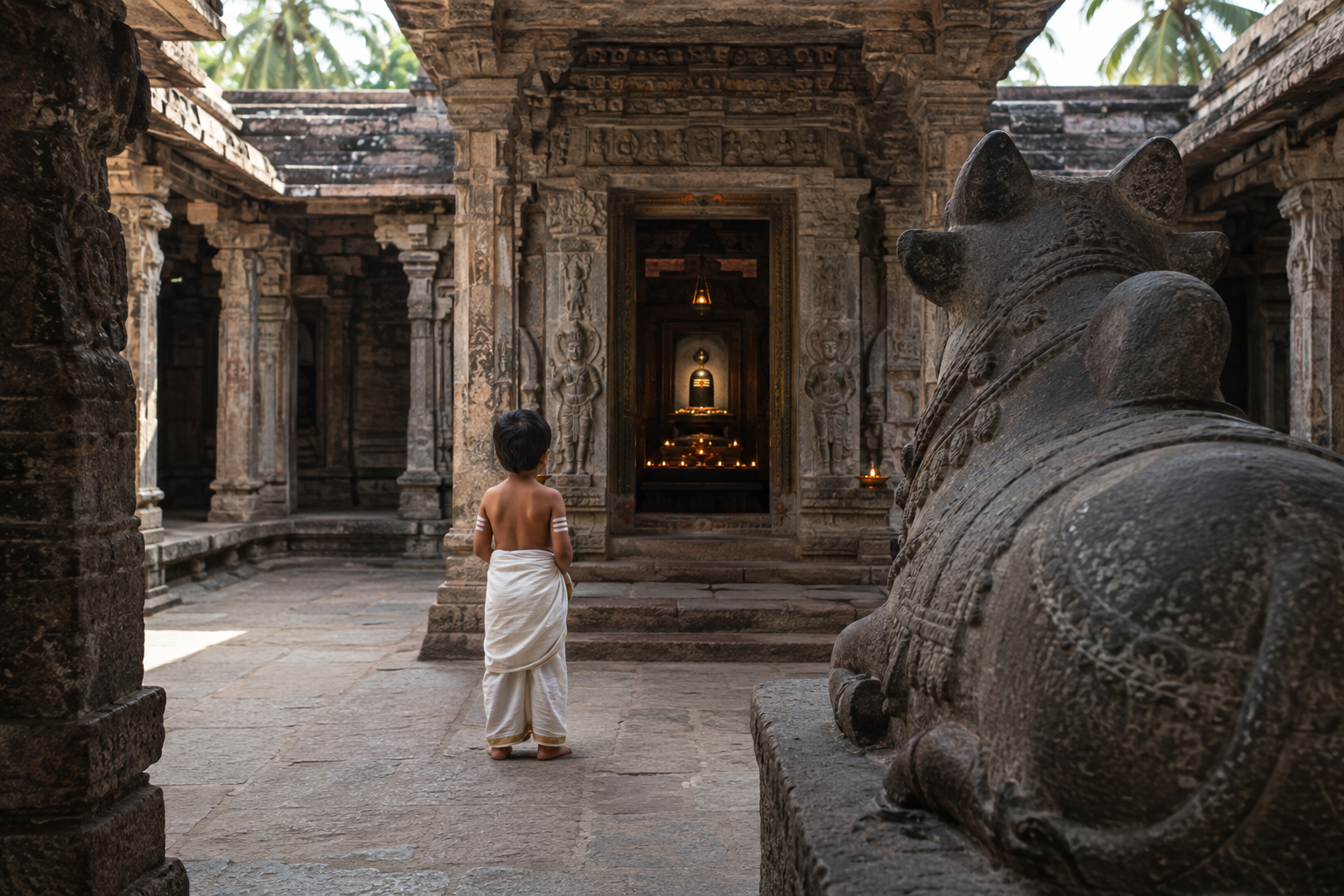
The setting is the ancient Dhenupureeswarar Temple at Patteeswaram, near Kumbakonam in Tamil Nadu. Dedicated to Shiva, it is remembered as one of South India’s distinctive Shaiva kshetras.
The temple tradition centres on a child saint who came seeking Shiva’s darshan. Nandi stood in the customary place before the Lord, but that position obstructed the child’s view. In response to the child’s devotion, Nandi stepped aside so that the young devotee could behold Shiva.
That is the claim in its devotional form: Shiva’s grace answered sincere bhakti, and Nandi participated in that grace. When you retell it, the clearest wording is that temple tradition holds that Nandi moved. This preserves the sacred claim without pretending that you personally witnessed the event or possess a modern record of it.
The miracle is therefore not only movement. It is recognition. The Lord recognises devotion in someone who might appear small or socially unimportant, and the great guardian makes room for that devotee.
Why moving aside is a profound act for Nandi
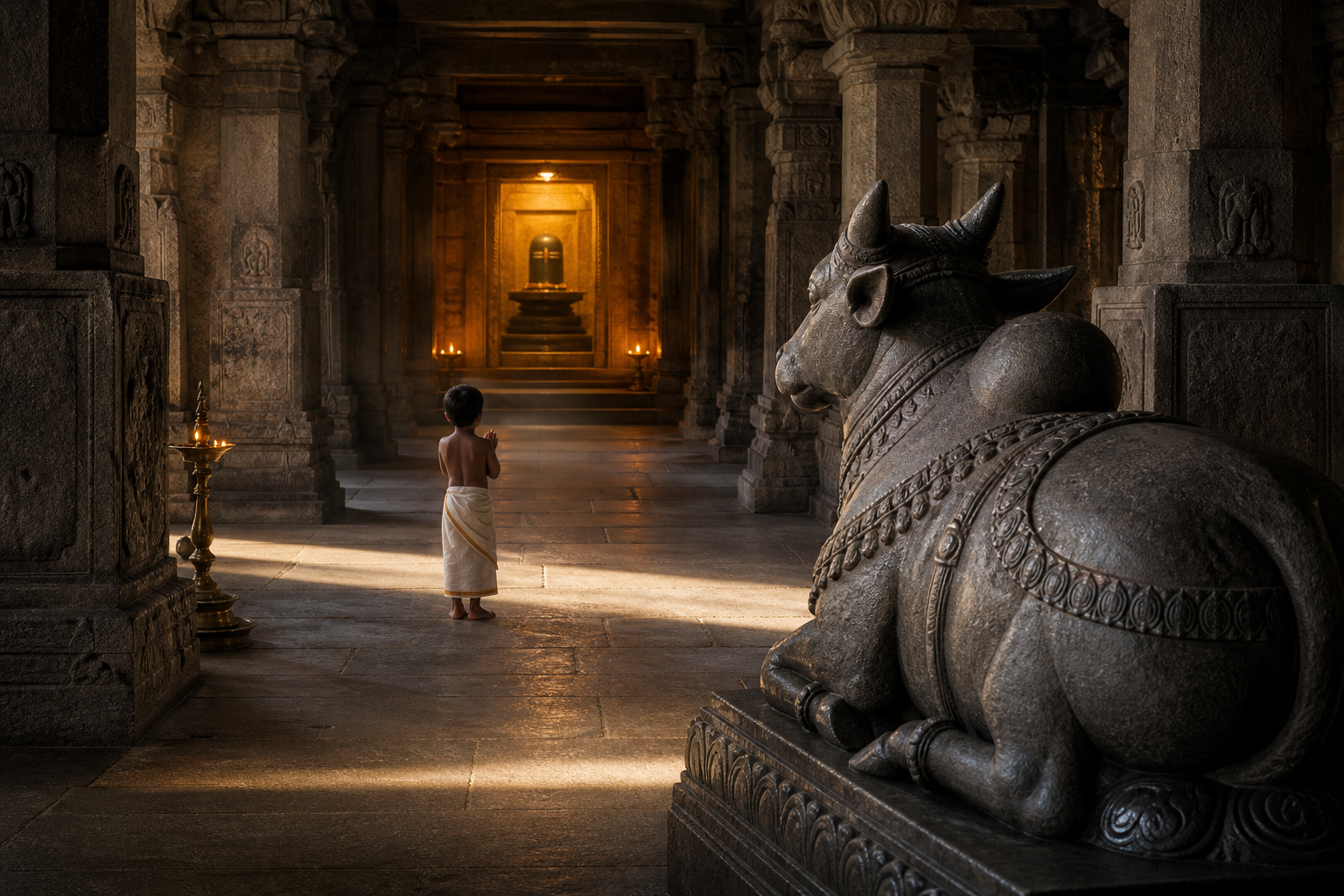
Nandi normally faces Shiva with unwavering attention. His place before the sanctum expresses constancy, discipline and complete orientation toward the divine. A visitor approaching a Shiva shrine encounters that visual teaching before reaching the sanctum: look where Nandi looks.
At Patteeswaram, the same figure teaches a second discipline. Attention to Shiva must never harden into obstruction. Nandi does not cease to serve the Lord when he makes room for another devotee. Making room is his service at that moment.
This distinction matters in religious life. A temple custom, institutional role or position of authority can guide people toward the divine. It can also become a barrier when its guardian starts treating the position itself as the goal. Patteeswaram’s Nandi offers a test you can apply: does a form of service help sincere seekers receive darshan, or does it mainly protect the servant’s place?
The tradition does not make discipline unnecessary. Nandi remains Nandi, and the sanctum remains sacred. The lesson is subtler: right order exists for dharma, and true guardianship knows when fidelity requires firmness and when it requires accommodation.
How to approach the Nandi when you visit
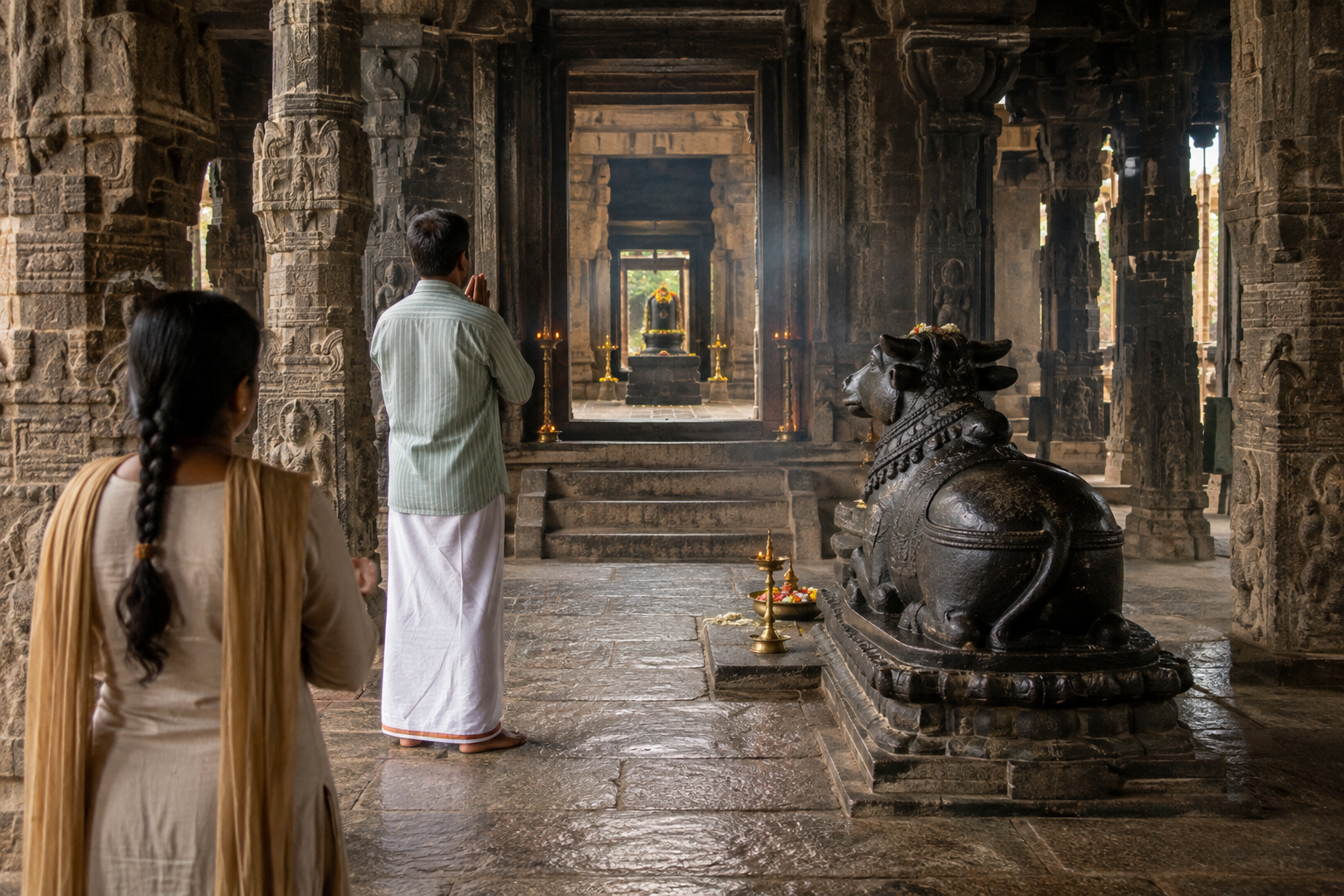
If you reach the temple concerned only with proving that an object moved, you may miss what the sacred arrangement asks you to notice. Use the visit to read the relationship among the devotee, Nandi and Shiva.
- Recall the usual visual grammar. Before studying the unusual placement, remember that Nandi ordinarily occupies the axis of attention before Shiva. The meaning of stepping aside depends on that customary relationship.
- Look from the devotee’s position. Observe how Nandi, the approach to the sanctum and the line of darshan relate to one another. Do not isolate the sculpture from the sacred space around it.
- Hold the sequence in mind. A child seeks darshan, an obstruction stands in the way, divine grace responds, and the guardian yields. Each part is necessary. Removing the child’s devotion turns the event into a curiosity; removing Nandi’s service turns it into a display of power.
- Allow a moment of stillness. Instead of rushing from the sculpture to a photograph, ask where you may be occupying space that should be opened for another sincere seeker. That question converts observation into sadhana.
- Ask locally and precisely. If an archaka or authorised temple guide is available, ask how the tradition is narrated in the temple and how the Nandi’s position should be viewed. Follow the temple’s current rules concerning movement, photography and contact with sacred images.
You do not need to manufacture an unusual experience. Darshan is not improved by exaggeration. Attend carefully to what is present, receive the tradition in the setting where it lives, and let its ethical demand accompany its miraculous claim.
How to discuss the miracle without flattening it
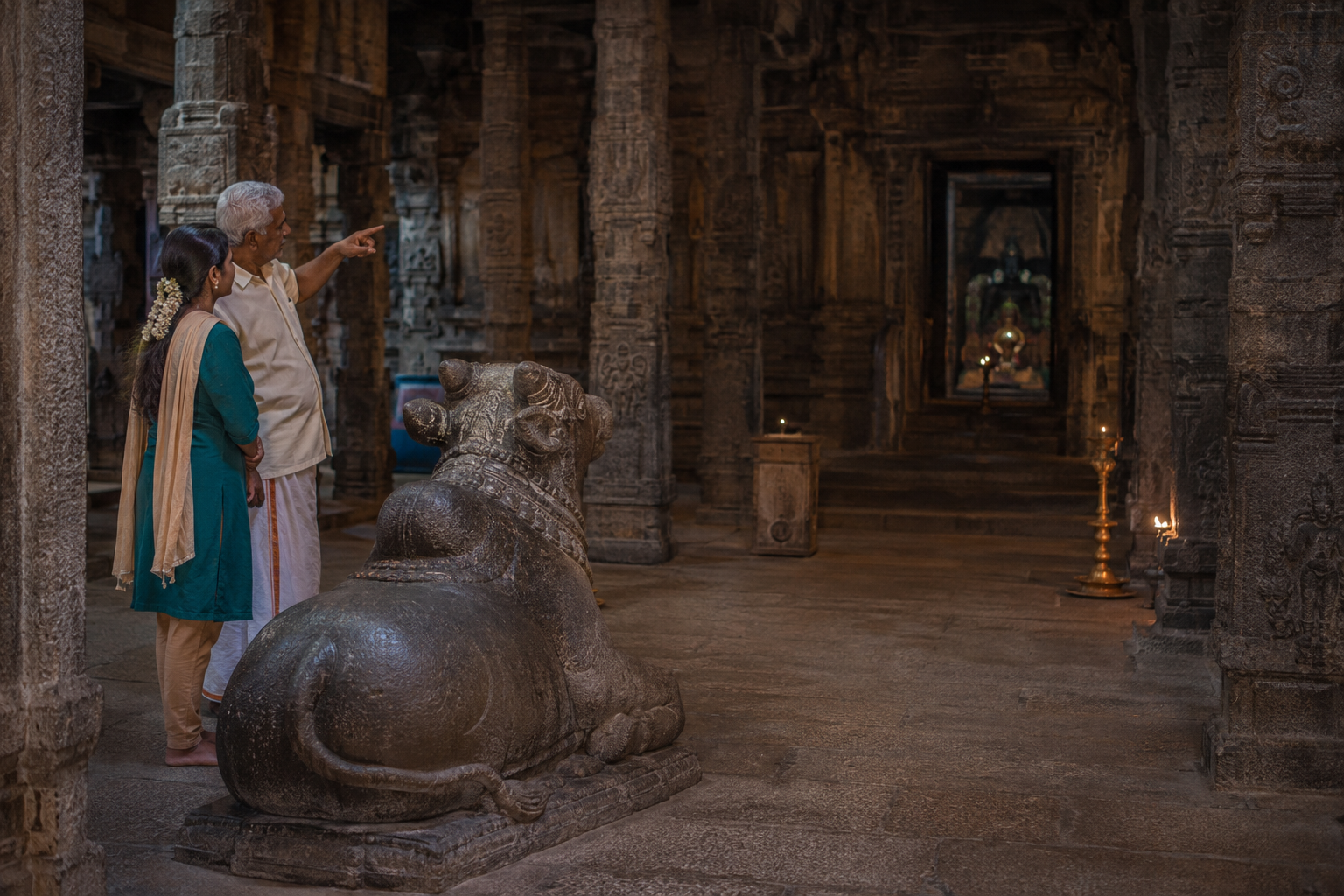
Conversations about temple miracles often become trapped between two unnecessary extremes. One person treats laboratory-style verification as the only possible measure of meaning. Another reports inherited belief as though it were a personally documented event. Neither approach helps you understand why a sacred community preserves the memory.
A clearer conversation distinguishes three levels:
- The visible feature: the placement and sightline you can observe at the temple.
- The living tradition: the inherited account that explains the feature through the child’s devotion, Shiva’s grace and Nandi’s response.
- The theological affirmation: the devotee’s conviction that divine grace can act through the sacred world and answer sincere bhakti.
These levels belong together, but they are not identical kinds of claim. Historical inquiry can examine a temple, an image, its arrangement and the transmission of a narrative. It cannot place Shiva’s intention in a laboratory. Devotion, meanwhile, can affirm divine agency without inventing measurements or eyewitness testimony that the tradition does not supply.
This distinction is especially useful when explaining Patteeswaram to a child or to someone unfamiliar with Hindu temple traditions. Begin with what Nandi ordinarily represents. Then narrate what changed and why. Only after that should you discuss whether the listener understands the movement literally, symbolically or in both senses. The meaning should not be reduced to metaphor, but neither should a demand for proof be allowed to erase the meaning before it is understood.
For a Hindu reader, reverence and precision support each other. Saying that a community preserves a miracle tradition is not a retreat from faith. It is an honest account of how sacred memory reaches us.
Key takeaways
- Patteeswaram’s tradition holds that Nandi stepped aside so a child saint could receive an unobstructed darshan of Shiva.
- Nandi’s movement signifies service, not abandonment of duty: the guardian serves Shiva by making room for sincere devotion.
- The placement should be read relationally, through the line connecting the devotee, Nandi and the sanctum.
- You can respect the miracle while distinguishing an observable temple feature, an inherited sacred account and a theological affirmation.
- The practical question is whether your own role helps another seeker approach the divine or leaves you standing in the way.
When you next stand before Nandi, do more than admire his steadiness. Remember Patteeswaram and examine whether the moment calls you to remain firm or to step aside. Devotion requires the wisdom to know the difference.
References
