

You are looking at a dark, commanding goddess image: perhaps boar-associated, perhaps many-armed, perhaps stationed near a temple entrance. Is she Nilavarahika, and what do her colour, hands and weapons actually mean? The safest answer comes from reading the whole image rather than guessing from one dramatic feature.
That method matters because Nilavarahika’s imagery is not merely decorative. It presents the Divine Mother as the power that confronts disorder, protects a rightful boundary and makes renewal possible. Once you learn that visual grammar, you can approach the image with both devotional attention and iconographic discipline.
Key takeaways
- Identify Nilavarahika through a cluster of signs: name, complexion, facial form, posture, arms, gestures, implements and shrine context.
- Read the blue-black colour as depth, vastness and primordial power, not as a decorative choice alone.
- Treat the blade, cord and shield as symbols of discernment, restraint and protection rather than indiscriminate violence.
- Notice where the murti stands. A place near an entrance or boundary strengthens the interpretation of the goddess as a vigilant guardian.
- Confirm local names and meanings before assigning a final label, because forms and ritual understandings vary across regional lineages.
Identify the form through a cluster of signs
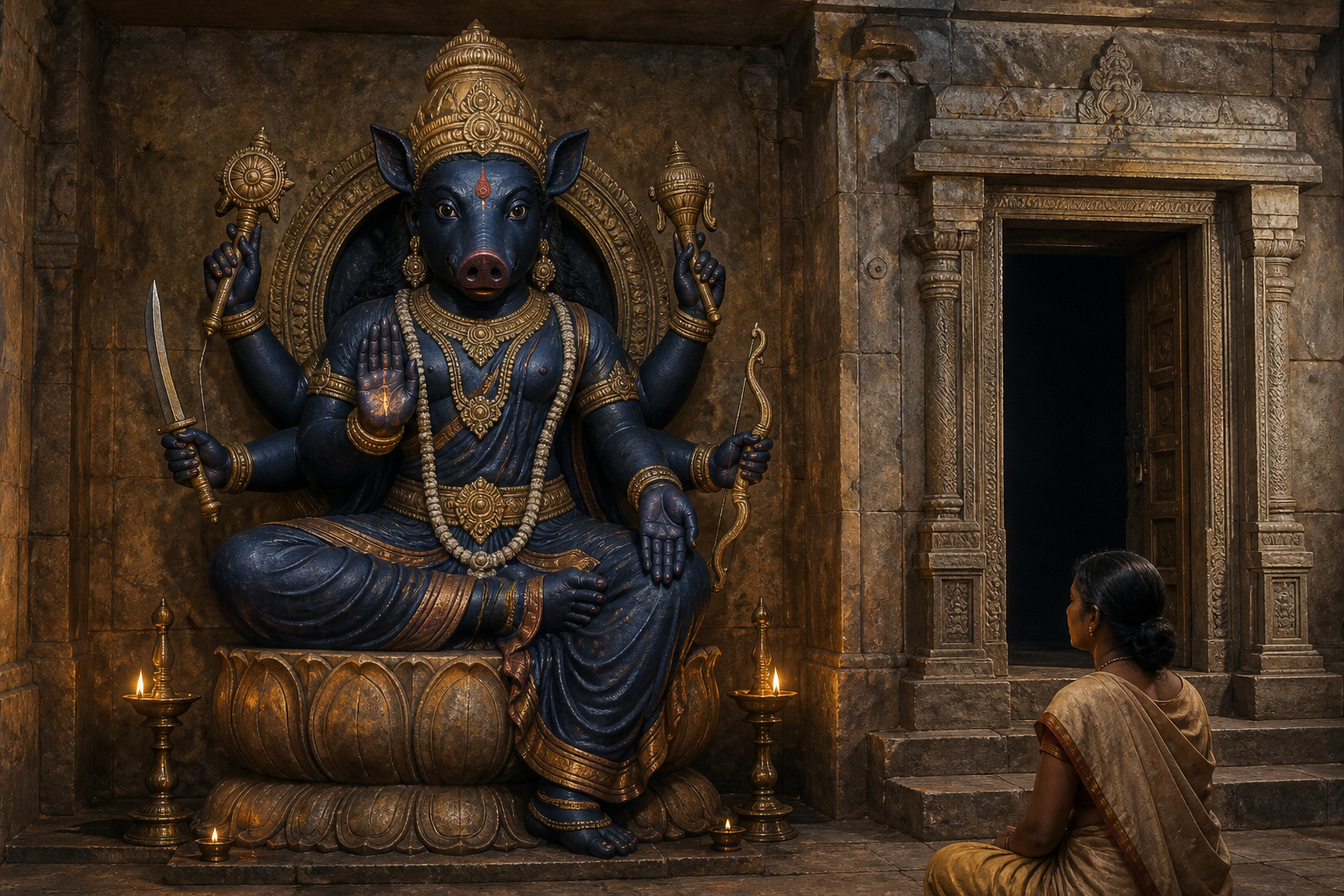
The name gives you a starting point. Nila or Neela evokes a deep blue or blue-black hue, while Varahika establishes a traditional relationship with Varahi, the boar-faced Shakti. Together, these elements point toward a protective and transformative manifestation of the Divine Mother.
That does not make either colour or a boar association sufficient by itself. Hindu sacred art contains related forms, regional adaptations and variations in material. A blue goddess is not automatically Nilavarahika, and an image related to Varahi should not be assigned a more specific name without contextual support.
When you examine a murti, relief or painting, record the visible evidence in this order:
- Look for a local name on a plaque, shrine label or liturgical reference. Record its spelling exactly, including Nila, Neela or another regional rendering.
- Observe the face before interpreting the objects. Note whether the form visibly expresses the Varahi association.
- Record the complexion or surface treatment. Distinguish a deliberately blue-black representation from the natural colour of stone, metal or wood.
- Count and describe the arms without guessing at missing or damaged attributes.
- Identify the hand gestures and implements that are actually visible.
- Observe the posture, gaze, ornaments and overall balance of the composition.
- Include the shrine’s location in your notes. An entrance, perimeter or other threshold can be part of the iconographic message.
This sequence prevents a common mistake: deciding on the identity first and then forcing every detail to fit it. Description should come before interpretation. If the local name and lineage are known, your identification can be firm. If only several visual signs align, call it probable. If you have only one sign, leave the identification open.
Read the blue-black form as a theology of depth
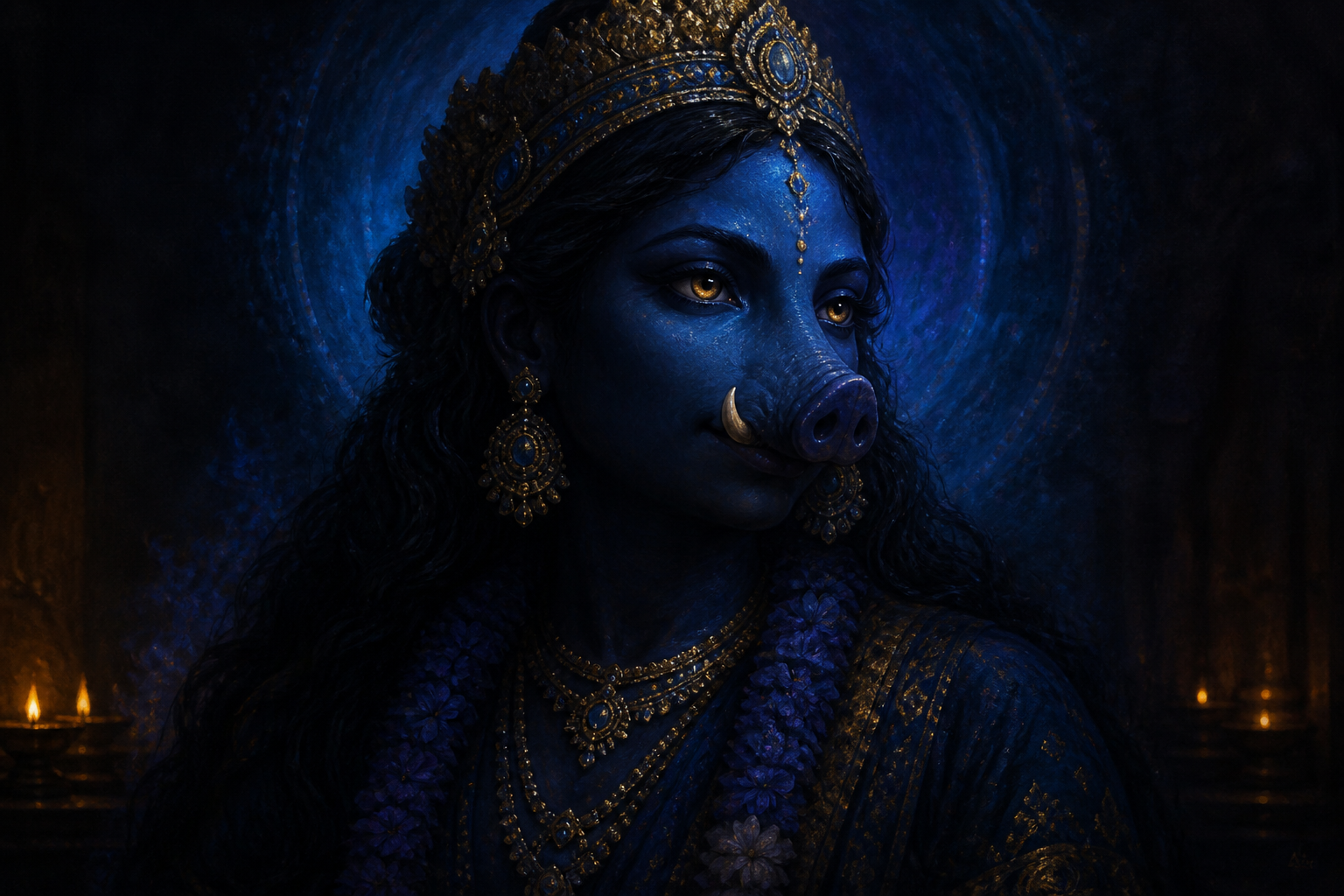
Nilavarahika’s dark-blue hue carries several connected meanings. It evokes the apparent depth of the sky and ocean, the vastness that exceeds ordinary measurement and the primordial ground from which transformation arises. The colour therefore does more than make the goddess look fierce. It places her protective action within a cosmic scale.
The Varahika association adds another layer: stability in the face of chaos. The image points toward an earth-holding resilience that raises consciousness from confusion into clarity. Read together, the colour and the Varahi relationship express a power that can enter disorder without being overwhelmed by it.
This is why destruction and renewal belong together in the iconography. Nilavarahika does not represent destruction as an end in itself. She removes what sustains adharma so that balance can be restored. For your own reading, ask a precise question: what is being defended, what must be restrained, and what new order becomes possible afterward?
Her posture and gaze help answer that question. A commanding stance communicates readiness rather than passivity. An intense gaze conveys watchfulness: danger is seen, not denied. Multiple arms indicate a capacity to protect and act on several fronts. The arrangement of ornaments and the geometry of the body keep that potency ordered, showing force under discipline rather than force released without direction.
Material also affects what you can responsibly infer. Nilavarahika murtis may be fashioned from stone, metal or wood. A form need not carry literal blue paint for the name’s symbolism to remain relevant within its tradition. If colour is absent, give greater weight to the identified name, facial form, attributes and shrine context.
Hands and implements show how divine protection works
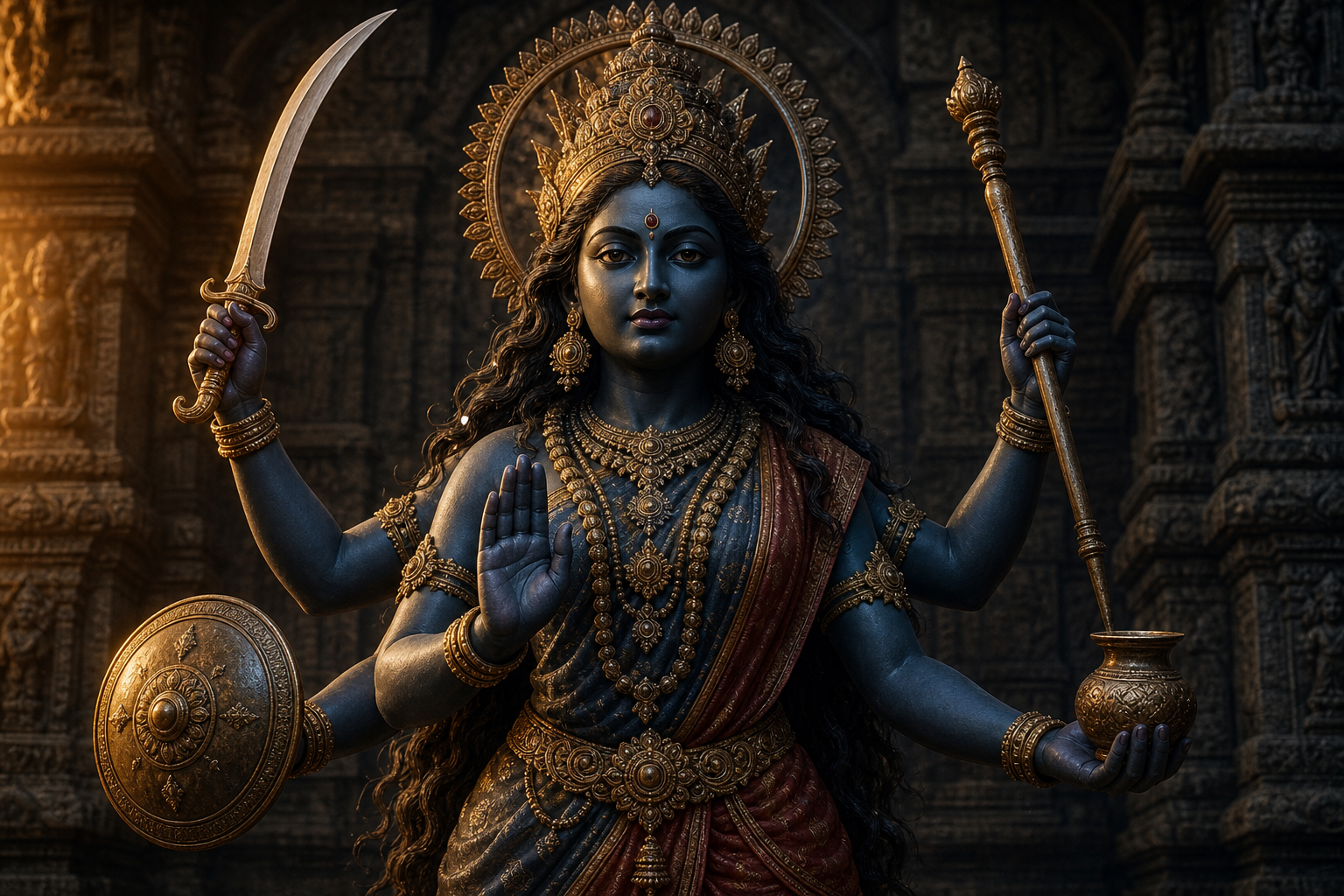
The hands often reveal the balance between ferocity and compassion. They show that protection is not only the defeat of an enemy. It can also mean reassuring the vulnerable, controlling a harmful impulse, cutting through ignorance and preserving the conditions in which dharma can endure.
- Abhaya mudra: the gesture of assurance tells the devotee not to be ruled by fear. In a guardian image, it shows whom the goddess’s fierceness serves: those who seek refuge in dharma.
- Varada mudra: the boon-giving gesture expresses grace and generosity. It prevents the warrior aspect from being reduced to aggression.
- Blade: when present, it signifies the severing of ignorance and confused attachment. Its sharpness belongs to discernment: the ability to make a necessary distinction and act on it.
- Noose or cord: this represents restraint. The symbol is especially useful when read inwardly, as the disciplined containment of impulses that would otherwise cause harm.
- Shield or protective emblem: this expresses safekeeping and the maintenance of a rightful boundary. Protection requires knowing what must be preserved, not merely what must be opposed.
- Multiple arms: these communicate comprehensive capacity. Reassurance, restraint, discernment, defence and grace can operate together rather than as competing functions.
Do not turn this list into a mandatory inventory. A regional image may omit an implement, emphasize a different gesture or express the same theological function through another visual choice. Absence is not permission to imagine an attribute that is not there. Record what you see, then consult the local tradition.
It is equally important not to interpret every weapon literally. Within this iconographic grammar, force is governed by an ethical purpose: adharma is confronted, ignorance is cut away, destructive movement is restrained and a protected space is maintained. The image asks for courage with discernment, not fascination with violence.
Let the shrine’s location complete the interpretation
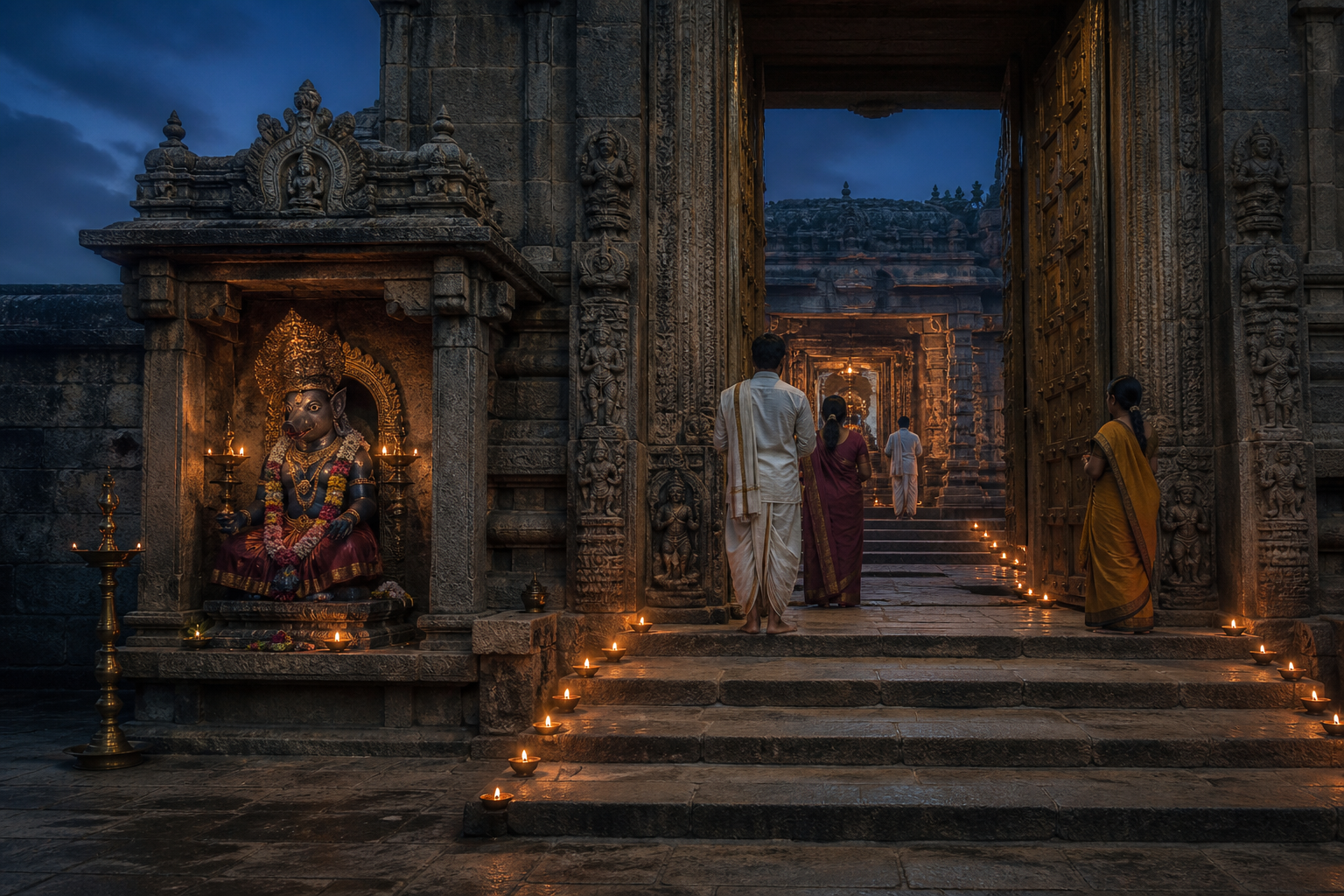
A sacred image is not isolated from the space around it. Nilavarahika’s placement near a threshold, entrance or community boundary can reinforce her guardian function. She watches the point where outside and inside meet, where movement must be assessed and where a protected order can be breached.
Threshold placement should not be mistaken for secondary status. A sentinel occupies the place where vigilance is most necessary. The spatial message is direct: protection begins at the boundary, before disorder reaches the centre. The same symbolism can extend from a temple entrance to the household and, finally, to the moral boundaries of one’s inner life.
If you are documenting Nilavarahika for study, preserve this context rather than collecting only a close-up image. Where photography is permitted, include the full shrine and its relation to doors, paths and neighbouring deities. Note the material, local name and regional setting. Ask a priest, custodian or informed practitioner how the community identifies the form. Then keep three kinds of information separate in your notes: what is visibly present, what the local lineage teaches and what you infer symbolically.
That separation is not cold academic caution. It is a form of respect. It allows regional traditions to speak in their own vocabulary and protects you from turning a living deity into a generic collection of symbols.
Bring the symbolism into a practice of dharmic boundaries
Nilavarahika’s iconography becomes personally useful when each element leads to an ethical decision. You do not need to imitate her ferocity. You need to understand the disciplined sequence represented by it: see clearly, restrain what is harmful, protect what is worthy and make space for renewal.
You can use the image as a framework for reflection:
- Name the disorder. Describe the fear, confusion, injustice or harmful habit without disguising it in vague spiritual language.
- Find the cord. Decide what must be contained before it spreads. This may be an impulse, a pattern of speech or access to a boundary that has not been defended.
- Find the blade. Identify the false belief or confusion that must be cut away. Make the distinction as cleanly as the symbol demands.
- Find the shield. State what you are protecting: a duty, a relationship, a sacred space, a community responsibility or your ability to act with integrity.
- Receive abhaya. Refuse to let fear make the decision in place of discernment.
- Extend varada. Ask how the restored boundary can support service, generosity or rebuilding rather than ending in mere opposition.
This is the core movement from destruction to regeneration. The unwanted pattern is not removed simply to leave an emptiness. Space is cleared so that a more dharmic order can be established. Protection, in this sense, is an active form of care.
The same care is needed when discussing parallels across dharmic paths. Fierce feminine wisdom and protective forms also appear in Vajrayana Buddhism, while fearlessness, compassion and justice can create meaningful points of conversation with Jain and Sikh traditions. Those resonances do not make the theologies interchangeable. Use similarity to deepen understanding, not to erase distinct doctrines or practices.
Formal worship requires the guidance appropriate to the temple or lineage; iconographic interpretation is not a substitute for that relationship. But you can begin immediately with careful seeing. The next time you encounter Nilavarahika, do not stop at the label of a fierce goddess. Look for the boundary she guards, the disorder she restrains and the renewal her power makes possible. Then decide which of those responsibilities is now yours.
References
