

You see a cherished observance upheld in court, followed by a personal campaign against a judge connected with that decision. The instinctive response may be to defend either the festival or unrestricted criticism. That is the wrong choice. You can defend Karthigai Deepam, insist on judicial accountability, and reject attempts to destroy trust through unsupported attacks.
The practical question is how. Start by separating the religious practice, the judicial decision, and the later attack on the judiciary. Each must be judged on its own facts. When they are collapsed into one political quarrel, devotees lose clarity, legitimate critics lose credibility, and public institutions lose trust.
Three different questions are hiding inside one controversy
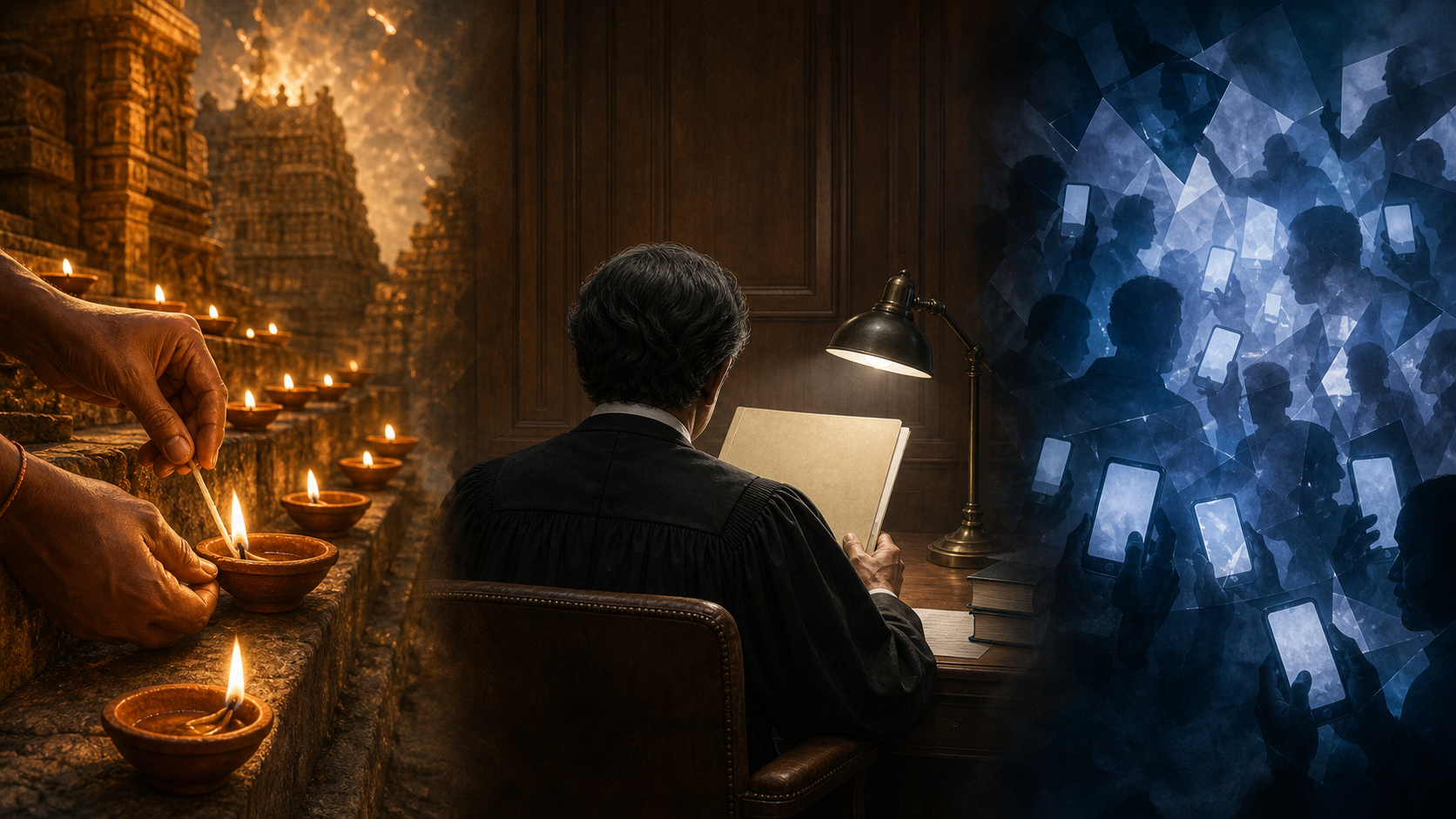
At Thiruparankundram, the immediate religious question concerned lighting the Karthigai Deepam at the stone pillar on the hilltop. An earlier judicial affirmation permitted the lamp to be lit in accordance with established norms and safety considerations. That combination matters. The ruling protected the observance, but it did not convert religious conviction into a licence to disregard administration or safety.
A later controversy concerned a book targeting a judge associated with upholding that result. The Madras High Court banned the publication and initiated contempt proceedings against its publisher, treating the attack as an attempt to erode confidence in the administration of justice.
You should therefore keep three questions separate:
- The observance: Is the Karthigai Deepam practice being conducted within the governing legal, customary, administrative, and safety framework?
- The judgment: Is the court’s reasoning correct on the record, and can it be challenged through appeal, review, scholarship, or reasoned public debate?
- The attack: Does the criticism address the judgment and evidence, or does it rely on personal insinuations intended to discredit a judge or the judicial system?
An answer to one question does not settle the others. A favourable decision does not make every argument offered by devotees correct. A questionable legal argument does not justify vilifying devotees. Disagreement with a judgment does not establish misconduct by the judge who delivered or upheld it.
There is also an important due-process distinction. The beginning of contempt proceedings is not the same as a final adverse finding against the publisher. Anyone discussing the case should describe the procedural stage accurately. Defending judicial integrity includes refusing to prejudge a person whose conduct is still being examined.
Judicial independence is not immunity from criticism

A judiciary worthy of confidence must tolerate exacting criticism. Courts exercise public authority, their reasoning affects citizens, and their judgments can be analysed, opposed, appealed, or reconsidered. Institutional dignity cannot mean compulsory agreement.
But criticism and delegitimisation are different acts. Criticism asks whether the court interpreted the record, law, history, or administrative concerns correctly. Delegitimisation substitutes allegations about a judge’s motives or character for an argument about the decision. The first can improve public understanding. The second can corrode trust without helping anyone determine whether the judgment was sound.
Use this test when you read or write commentary about a religious dispute:
- Can you identify the precise holding? Do not rely on a headline or a viral paraphrase. Obtain the operative order where possible and distinguish what the court permitted from what it merely discussed.
- Can you point to the disputed reasoning? A useful criticism names the factual finding, legal proposition, historical claim, or administrative condition it contests.
- Can you show the basis for your claim? Separate the record from your inference. If evidence is incomplete, say so.
- Are you challenging conduct or inventing motive? A conclusion you dislike is not evidence of bias, corruption, hostility, or conspiracy.
- Have you chosen a lawful remedy? Appeals, review proceedings, evidence-based scholarship, and policy dialogue address errors more effectively than personal abuse.
This boundary must not be misused in the opposite direction. A substantiated complaint about actual judicial misconduct is not automatically an attack on the institution. Accountability remains essential. The responsible course is to document the evidence, use the appropriate institutional process, and avoid asserting more than the evidence proves.
If you are a litigant, publisher, editor, or organiser considering an allegation about a judge, obtain advice from a qualified lawyer familiar with the relevant proceedings before publication. Contempt and defamation consequences depend on the exact words, evidence, context, and procedural posture. A general discussion cannot determine your individual legal exposure.
A dharmic response requires truth, restraint, and the right process
Karthigai Deepam makes light visible as a religious act. At home, in a temple, or on a hill, the deepam carries associations of remembrance, wisdom, community, and hope. Its public meaning is weakened when its defence depends on rumour, intimidation, or careless accusation.
Satya and ahimsa offer practical disciplines for this dispute. Satya requires you to distinguish a verified fact from an interpretation and an interpretation from an allegation. Ahimsa requires attention to the harm caused by false imputations, reckless amplification, and collective blame. Neither principle demands silence. Both demand responsible speech.
Apply those disciplines with three questions before speaking:
- What do I know? State the documented event, order, condition, or procedural step without embellishment.
- What am I inferring? Mark your interpretation as an interpretation, especially when discussing intention or institutional motive.
- What remedy am I seeking? Ask whether your words are meant to correct a record, change a decision, protect an observance, or merely punish an opponent.
This standard also guards against a common mistake in cultural advocacy: treating the sacredness of an observance as proof of every legal claim made on its behalf. Karthigai Deepam deserves protection because living traditions deserve fair treatment under law, not because devotees should be exempt from evidentiary and safety requirements. A strong case presents customary practice, historical material, administrative feasibility, and safety compliance with precision.
The same restraint should govern opponents of the observance. Administrative disagreement does not justify contempt for a community’s spiritual life. Rules should be explained and applied as rules, not turned into an opportunity to demean belief. That symmetry is important: devotees remain subject to law, and public power remains subject to fairness.
What to do before sharing a claim about the case

If a message, video, book excerpt, or commentary about Thiruparankundram reaches you, do not begin by asking whether it supports your side. Begin with a claim audit. The following sequence takes the heat out of the dispute without asking you to surrender conviction.
- Write the claim in one sentence. Remove slogans and identify exactly what is being alleged: a restriction on worship, a condition on the ceremony, an error in reasoning, or misconduct by an individual.
- Identify the procedural stage. Distinguish a petition from an order, an interim direction from a final decision, and the initiation of proceedings from their outcome.
- Find the controlling words. Where the legal text is available, record what the court actually permitted, prohibited, or required. If you have only a secondary account, label it as such and avoid categorical claims.
- Separate evidence from accusation. Historical records, established practice, administrative documents, safety requirements, and passages from a judgment can be examined. Assertions about hidden motives require independent support.
- Choose the correct channel. A possible legal error belongs in an appeal, review, or rigorous legal critique. A governance problem belongs in policy dialogue and administrative representation. Evidence of misconduct belongs in an appropriate complaint process.
- Remove collective blame. A dispute involving a court, publisher, official, or group of litigants does not establish guilt or hostility on the part of an entire religious or social community.
- Preserve compliance. If you help organise the observance, document adherence to the applicable norms and safety conditions. A favourable ruling should strengthen disciplined organisation, not encourage improvisation beyond what was authorised.
- Correct before amplifying. If the claim cannot survive these checks, do not forward it. If part is accurate and part is speculative, share only the supported part and state what remains uncertain.
This method is not neutrality between truth and falsehood. It is how you make a cultural argument harder to dismiss. Evidence, procedural accuracy, and measured language allow supporters of Karthigai Deepam to defend the practice without making its legitimacy depend on an attack against another person.
Key takeaways
- The Thiruparankundram controversy contains separate questions about the observance, the judicial reasoning, and the later attack on a judge.
- The earlier affirmation of hilltop lamp-lighting remained connected to established norms and safety considerations; support for the observance should preserve those conditions.
- Judgments may be criticised rigorously. Criticism is strongest when it identifies the holding, disputed reasoning, evidence, and requested remedy.
- Unsupported personal imputations do not become legitimate merely because the underlying religious or political dispute is deeply felt.
- Judicial dignity and judicial accountability are complementary: one protects decision-making from intimidation, while the other requires evidence-based scrutiny and proper process.
- Satya and ahimsa ask you to verify, distinguish, and restrain your speech without abandoning principled disagreement.
The next time this controversy appears in your feed, pause before joining its emotional rhythm. Verify the order, name the exact issue, respect every applicable condition, and direct disagreement toward reasoning and lawful remedies. That is how you help keep both the deepam and the institutions around it worthy of public trust.
References
