
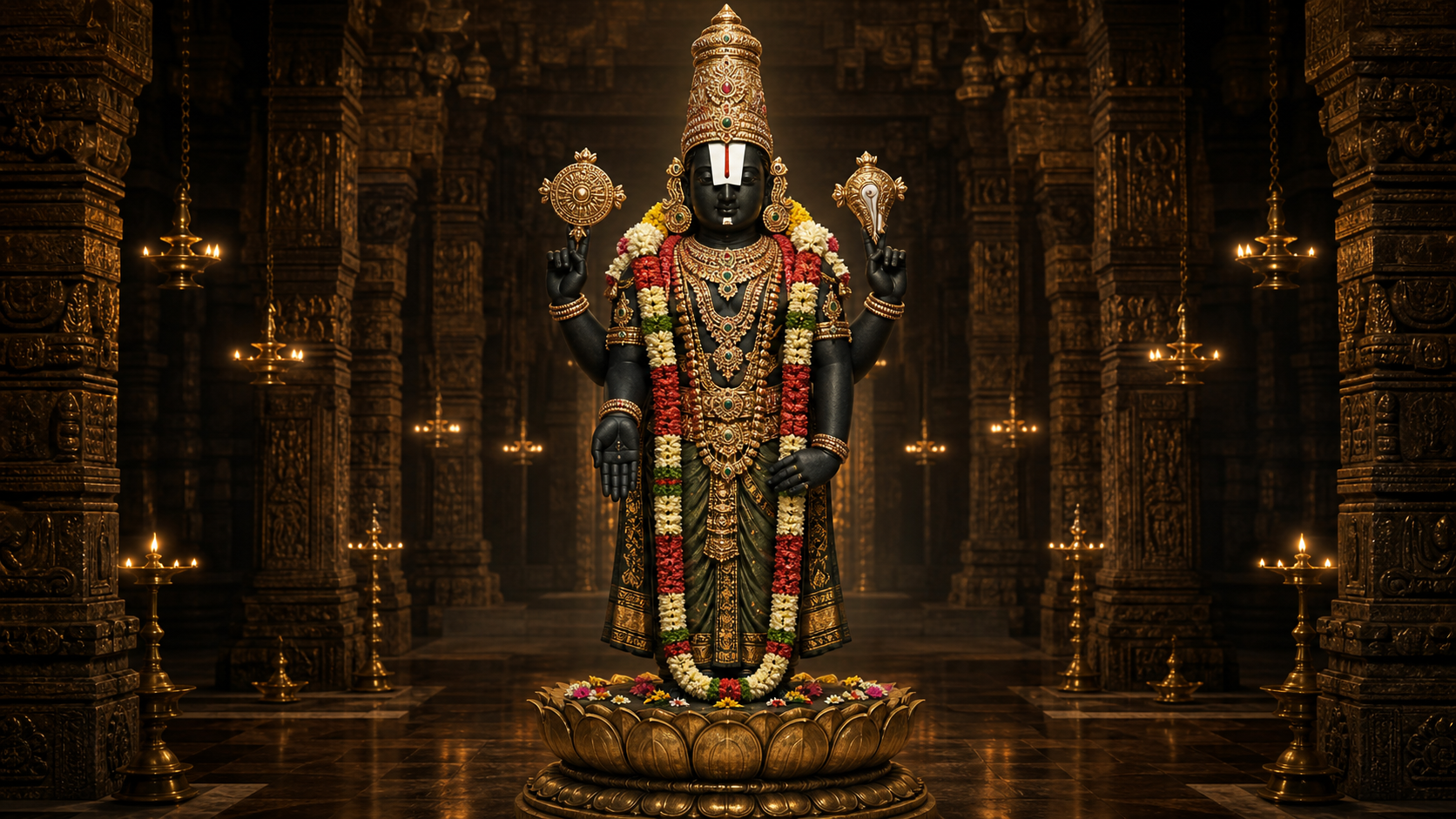
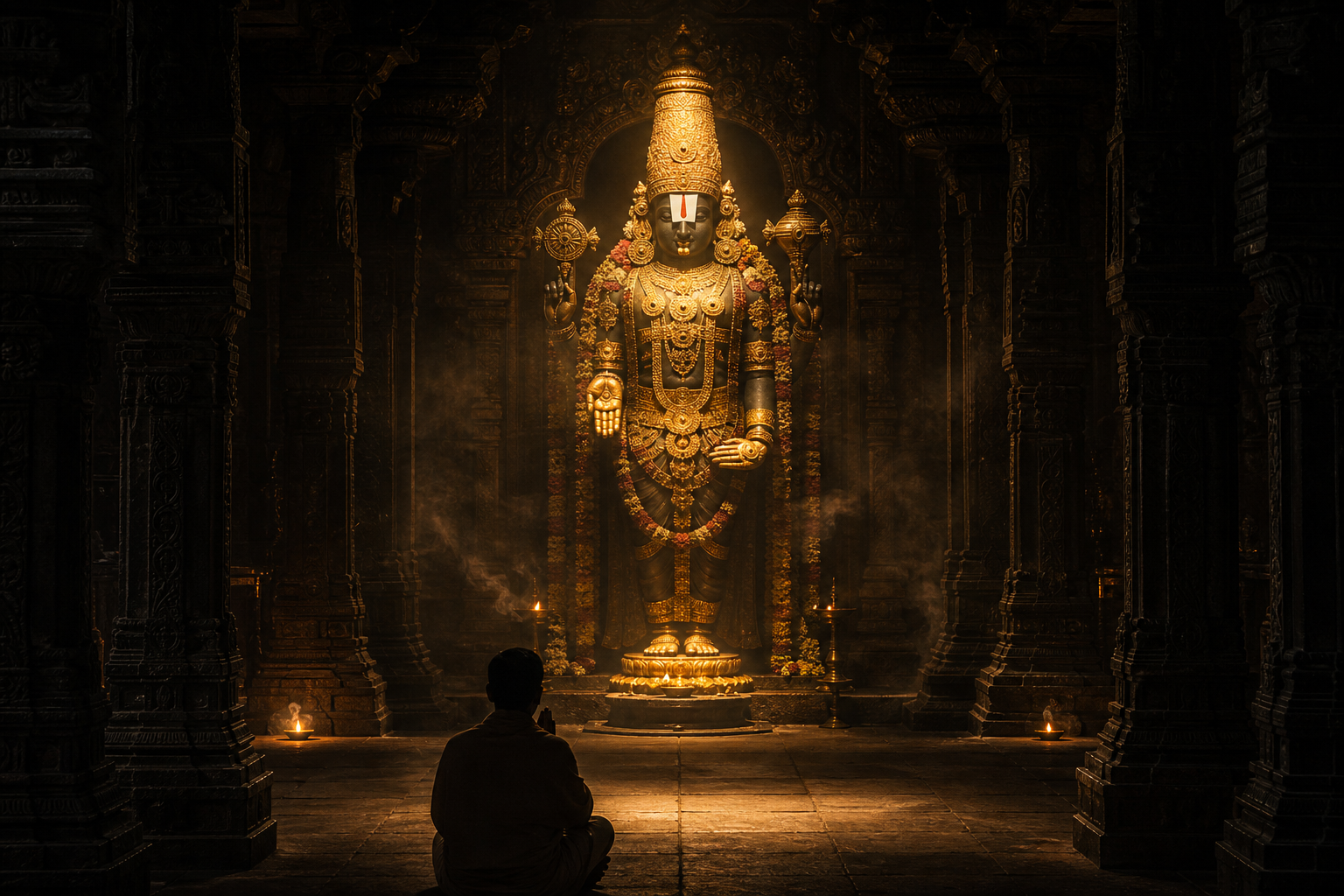
You are standing before Venkateshwara, or looking at His image, and almost everything commands attention at once: the towering crown, the dark sacred form, the bright forehead mark, the four hands, the jewels and the garlands. Where should your eyes rest, and what are you actually being shown?
Begin with structure, not decoration. Read the murti from the standing posture to the hands, then from the forehead to the chest and ornaments. That sequence reveals why Venkateshwara is worshipped at Tirumala as a manifestation of Vishnu and as the presiding deity of Kali Yuga: the form joins divine sovereignty to an immediate offer of refuge.
Start with the standing form, not the jewellery
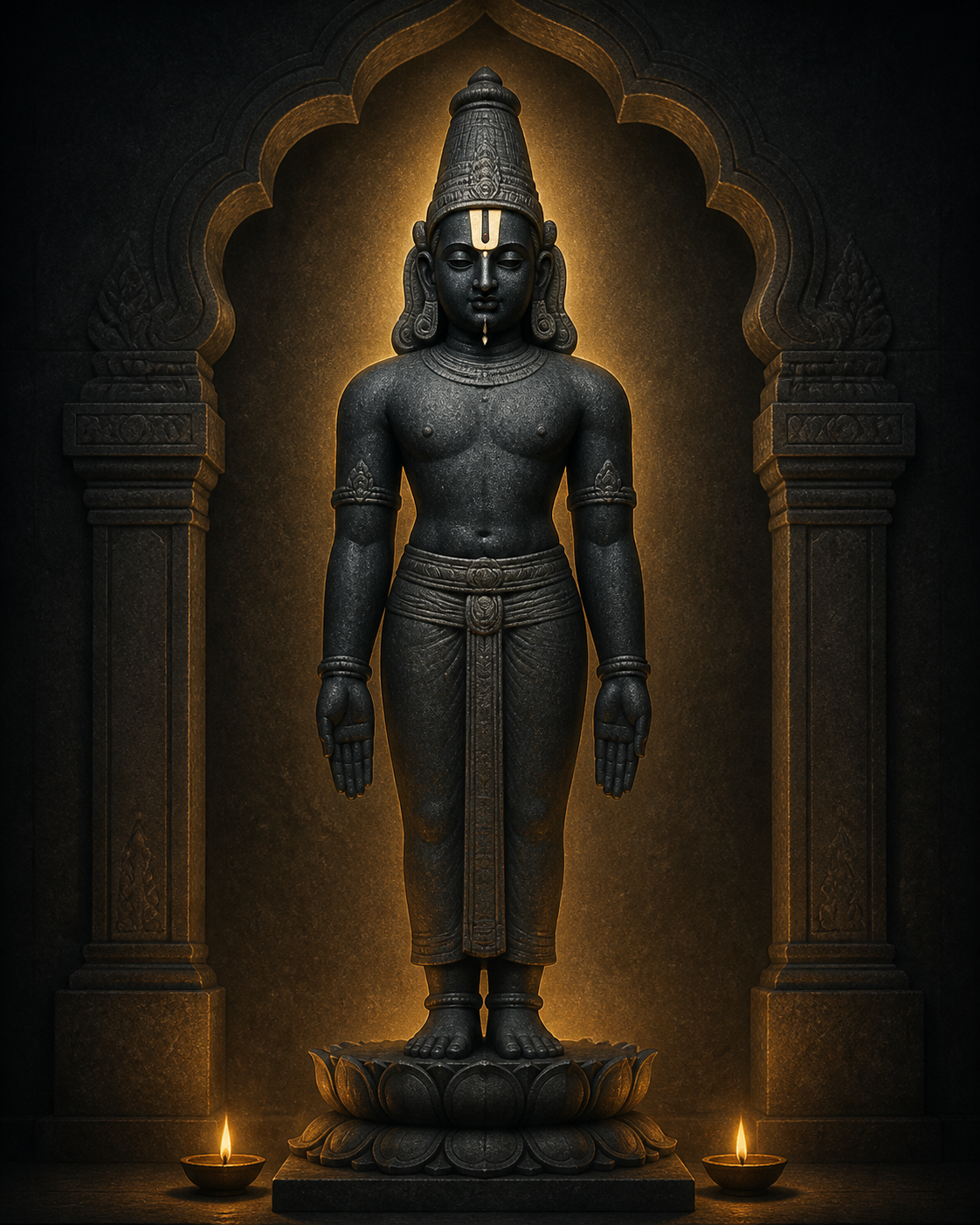
The first thing to notice is that Venkateshwara stands erect and faces the devotee directly. This is not the relaxed posture of repose, the inward posture of meditation or the dramatic movement of a battle scene. The still, frontal stance conveys presence. Bhagavan is not represented as distant or unavailable; He stands where the devotee can approach Him.
That distinction matters in darshan. A sacred image is not merely a portrait whose features you inspect for information. Darshan places you in a relationship of seeing and being seen. The murti’s stillness gives your otherwise restless attention a stable centre.
Before identifying any emblem, let your gaze travel once from the feet to the crown. The vertical movement establishes the whole theological picture. The feet are the place of surrender, the body is steadfast presence, and the crown proclaims sovereignty. You are seeing refuge and kingship in the same form.
The crown should therefore not be read as royal vanity. It identifies Venkateshwara as the supreme ruler before whom every lesser status becomes secondary. A king, labourer, scholar and child may arrive with different burdens, but all stand in the same relation to the deity. When you notice the crown, ask a practical question: what claim to control are you still unwilling to place beneath a higher order?
The designation of Venkateshwara as the Lord of Kali Yuga gives this posture added force. It is a devotional affirmation that divine access has not disappeared in an age marked by confusion and spiritual distraction. The murti does not deny the difficulty of the age. It answers that difficulty by standing visibly, steadily and openly before the devotee.
The four hands join cosmic power to personal refuge
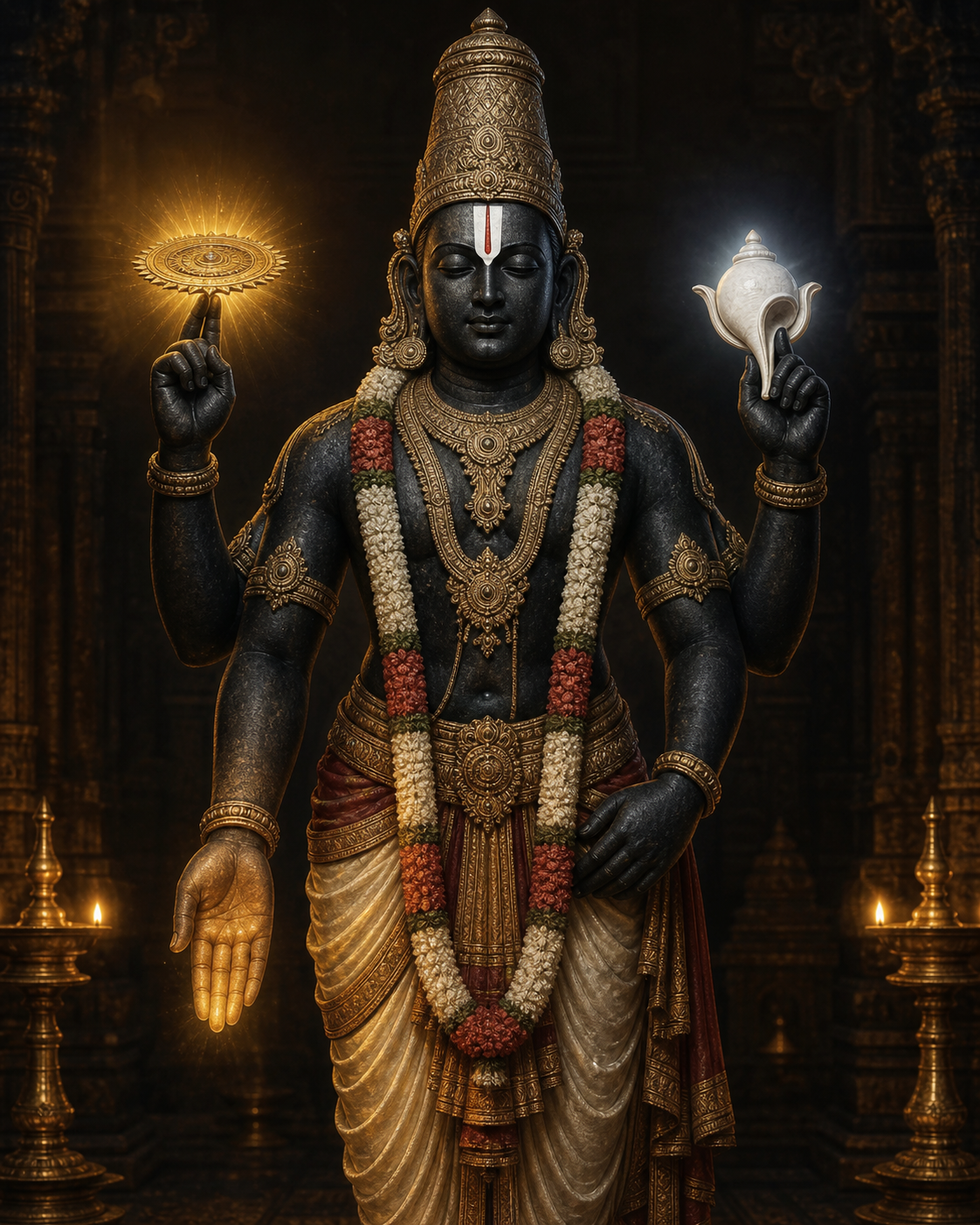
The four arms distinguish the form from an ordinary human portrait and identify Venkateshwara with Vishnu. They also divide into two complementary pairs. The upper hands bear divine emblems; the lower hands communicate directly with the devotee. Power appears above, but its meaning is brought down into protection, generosity and steadiness.
When identifying the sides, use Bhagavan’s own right and left, not yours. In a frontal image, His right appears on your left. Remembering that simple reversal prevents a common confusion when you compare temple images, paintings and explanatory diagrams.
| Position | Iconographic sign | What to notice | Devotional reading |
|---|---|---|---|
| Upper right | Sudarshana chakra | The discus identifies Vishnu’s authority and protective power. | Divine power restores order; it is not arbitrary force. |
| Upper left | Shankha, the conch | The conch evokes proclamation, sacred sound and a summons to awaken. | Before you ask to be heard, become willing to listen. |
| Lower right | Varada-hasta | The open, downward-facing gesture communicates giving and grace. | Let the gesture lead your attention toward Bhagavan’s feet and the refuge they represent. |
| Lower left | Kati-hasta | The hand rests near the hip or thigh in a composed, grounded gesture. | Protection is expressed as steadiness rather than agitation. |
The chakra is sometimes reduced to the idea of a weapon. That reading is incomplete. As Vishnu’s discus, it represents power capable of defending dharma and cutting through disorder. Its circular form also invites reflection on the movement of time and the recurring patterns in which human beings become trapped. In practical contemplation, notice the habit or confusion that needs a clean boundary rather than another excuse.
The shankha has a different function. A conch announces; it makes its presence known through sound. Iconographically, it turns your attention toward awakening, sacred communication and the call of dharma. The chakra is decisive, while the conch is invitational. One corrects disorder; the other calls the wandering mind home.
The lower right hand changes the emotional register of the entire form. Varada-hasta is the gesture of bestowal. The supreme ruler bearing the chakra is also the giver who opens His hand toward the devotee. Its downward direction is traditionally read as drawing the eye toward the divine feet. The visual movement teaches something precise: refuge begins when self-importance descends.
The lower left hand prevents surrender from being mistaken for helplessness. Kati-hasta is poised and self-possessed. Beside the giving hand, it conveys dependable support. Grace is not presented as a passing mood. It comes from One who remains perfectly steady.
Read the hands in this order during darshan: chakra, shankha, varada-hasta, kati-hasta. The sequence moves from order and awakening to gift and assurance. If time is short, that movement alone gives you a coherent way to encounter the murti.
Forehead, chest, crown and garlands complete the theology
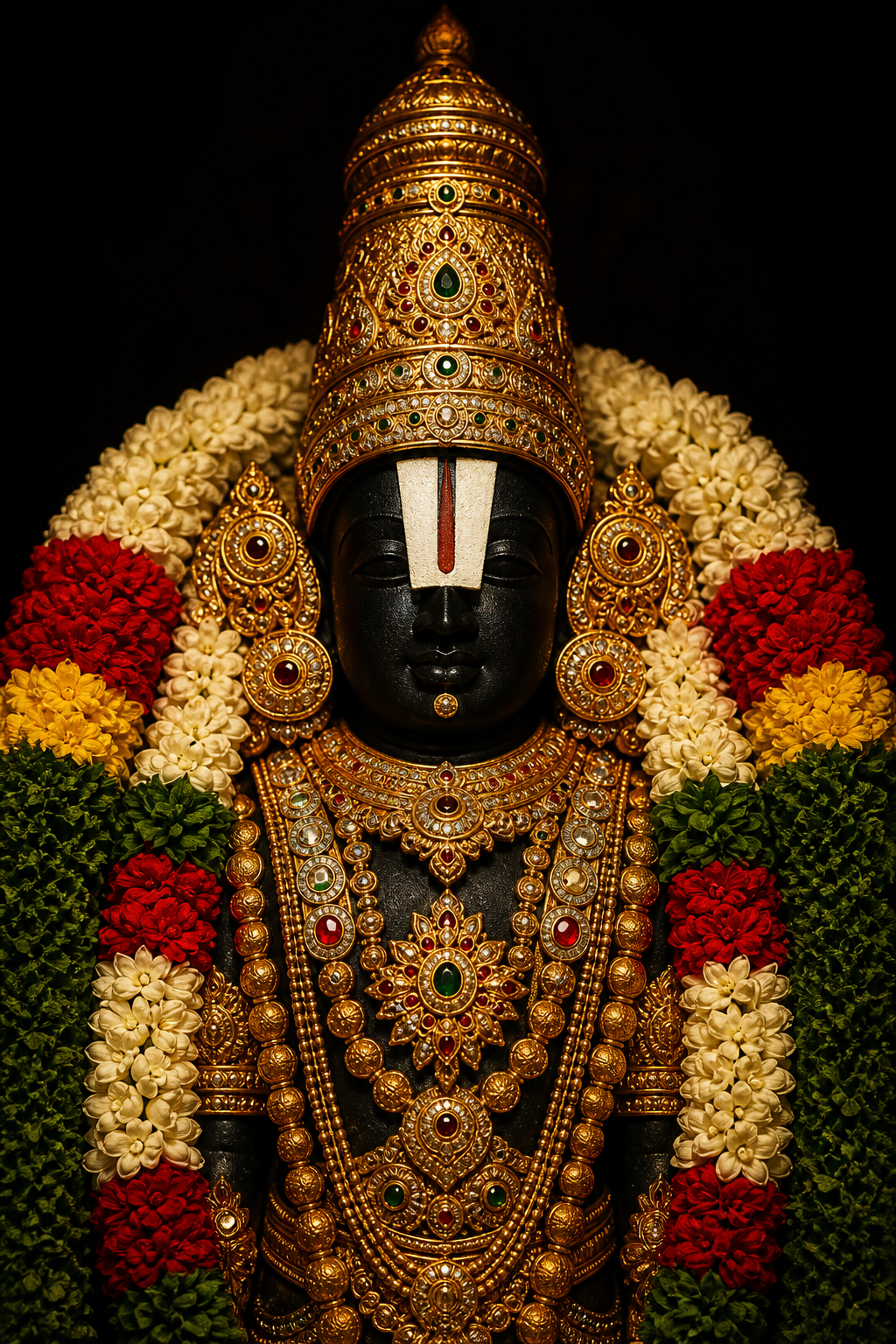
The prominent vertical mark on Venkateshwara’s forehead is a Vaishnava sign. It is not incidental facial decoration. Even before you identify the objects in the upper hands, the mark places the murti unmistakably within the worship of Vishnu.
Do not make the colours or proportions in one photograph carry more meaning than they can support. The appearance of the forehead mark can vary with ritual application, lighting, adornment and the kind of image you are viewing. The stable point is its Vaishnava identity. Look first for what the sign establishes, then learn the finer conventions of the particular temple tradition.
The chest adds relationship to identity. The name Srinivasa means the abode of Sri, or Lakshmi. It tells you that divine sovereignty is not imagined as solitary force. Sri brings the dimensions of grace, auspiciousness and sustaining abundance into the very identity of the Lord. Traditional Vishnu iconography also associates the chest with signs such as Srivatsa and the Kaustubha jewel, although heavy temple adornment may make such details difficult to distinguish in a particular view.
This is an important correction to a superficial reading of the image. Venkateshwara is not first a remote ruler who must later be persuaded to become compassionate. The name Srinivasa places Sri within His own being. Authority and grace are not competing qualities.
The ornaments and flower garlands should be understood in that same frame. They express alankara, sacred adornment offered as seva. A jewel on the deity is therefore not merely a display of material wealth. Matter has been redirected from possession toward worship. Flowers, fabric and ornaments become a visible language through which devotees honour the divine.
Separate two layers when you look at an image. First identify the enduring iconographic structure: the standing form, four arms, chakra, shankha and lower gestures. Then notice the liturgical layer: garlands, fabrics, jewels and other adornments associated with worship. The second layer may change while the first preserves the deity’s recognizable identity. This distinction lets you appreciate richly ornamented darshan without losing the form beneath it.
It also keeps you from treating adornment as visual clutter. The core form tells you who stands before you. Alankara tells you how a living community is serving and honouring Him.
Use five passes to make darshan more attentive
You do not need to decode every detail in one visit. Use the following sequence whenever you stand before Venkateshwara or contemplate a clear image of Him:
- See the complete standing form. Let its stillness settle your attention before you begin naming details.
- Orient Bhagavan’s right and left. This makes the upper emblems and lower gestures easier to remember correctly.
- Read the upper hands. Receive the chakra as ordered protective power and the shankha as a call to awaken and listen.
- Follow the lower right hand toward the feet. Let varada-hasta turn observation into surrender, then notice the steadiness of kati-hasta.
- Return to the forehead and chest. Recognize Vishnu through the Vaishnava mark and remember Sri through the name Srinivasa. End with relationship, not analysis.
This method is deliberately simple. Iconographic knowledge should deepen darshan, not crowd it with a running examination. If a single feature holds your attention, remain with it. The chakra may matter when your life lacks order; the shankha when you have stopped listening; the open hand when fear has made trust difficult; the feet when pride has become exhausting.
You can also use Venkateshwara’s names to keep the contemplation personal. Venkatesha, Srinivasa, Balaji and Govinda do not point to rival deities. They are beloved ways of approaching the same sacred presence. Choose the name already alive in your devotional tradition rather than searching for a supposedly superior formula.
Most importantly, do not stop at symbolism. The open hand is not only a concept called grace, and the feet are not only a diagram of surrender. The form asks for a response. Identify one burden, attachment or confusion you are actually prepared to place before Bhagavan. That turns iconographic recognition into sadhana.
Key takeaways
- Read the murti from the whole form inward: stance, hands, forehead, chest and adornment.
- The upper hands establish Vishnu’s cosmic authority through the chakra and shankha; the lower hands bring that authority into a direct relationship of grace and steadiness.
- Use Bhagavan’s own right and left when identifying the four hands.
- The Vaishnava forehead mark establishes identity, while the name Srinivasa reveals the inseparability of the Lord and Sri.
- Crown, jewels and garlands express kingship and devotional seva; they should not be dismissed as decorative excess.
- The purpose of learning the symbolism is a more focused darshan, not the accumulation of facts about sacred art.
At your next darshan, resist the urge to remember everything at once. Notice the standing presence, read the four hands and let the open lower hand guide your gaze toward the feet. Then bring one real concern into that movement. Venkateshwara’s iconography becomes intelligible when it leads you from seeing to refuge.
References
