
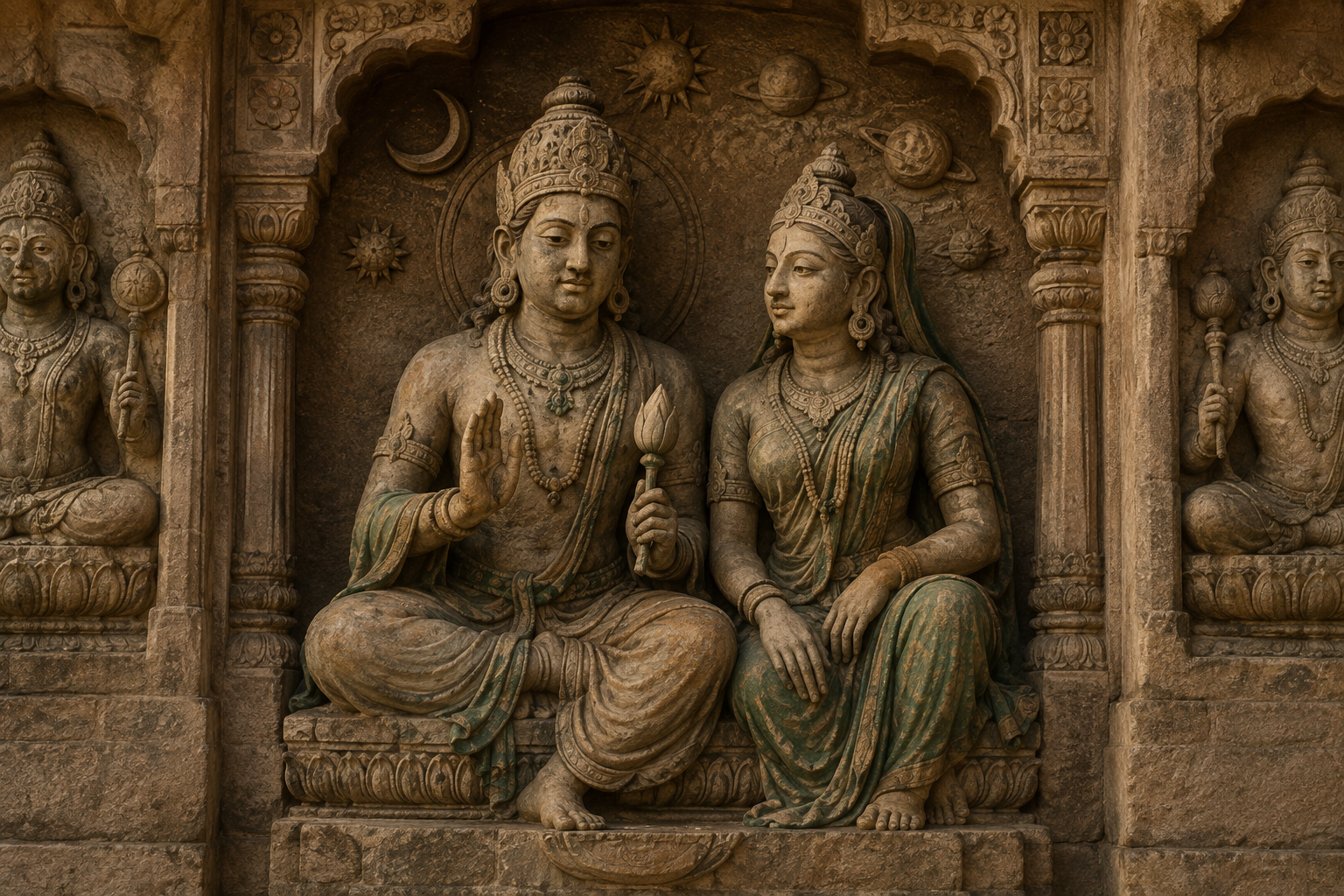
You are looking at a temple sculpture of a male deity seated beside a female figure. A label, priest, catalogue, or fellow pilgrim identifies them as Budha and Ila. Before accepting or rejecting that identification, you need to answer two separate questions: does the surrounding iconographic context support it, and what does the paired form communicate?
The essential starting point is that Budha presides over Mercury, while Ila appears with him as his consort and Jnana Shakti, the power of knowledge. Their rare paired representation therefore asks you to notice more than a planetary deity with an accompanying figure. It places intelligence in relationship with the power that makes knowledge living and effective.
First settle the name: Budha is not Buddha
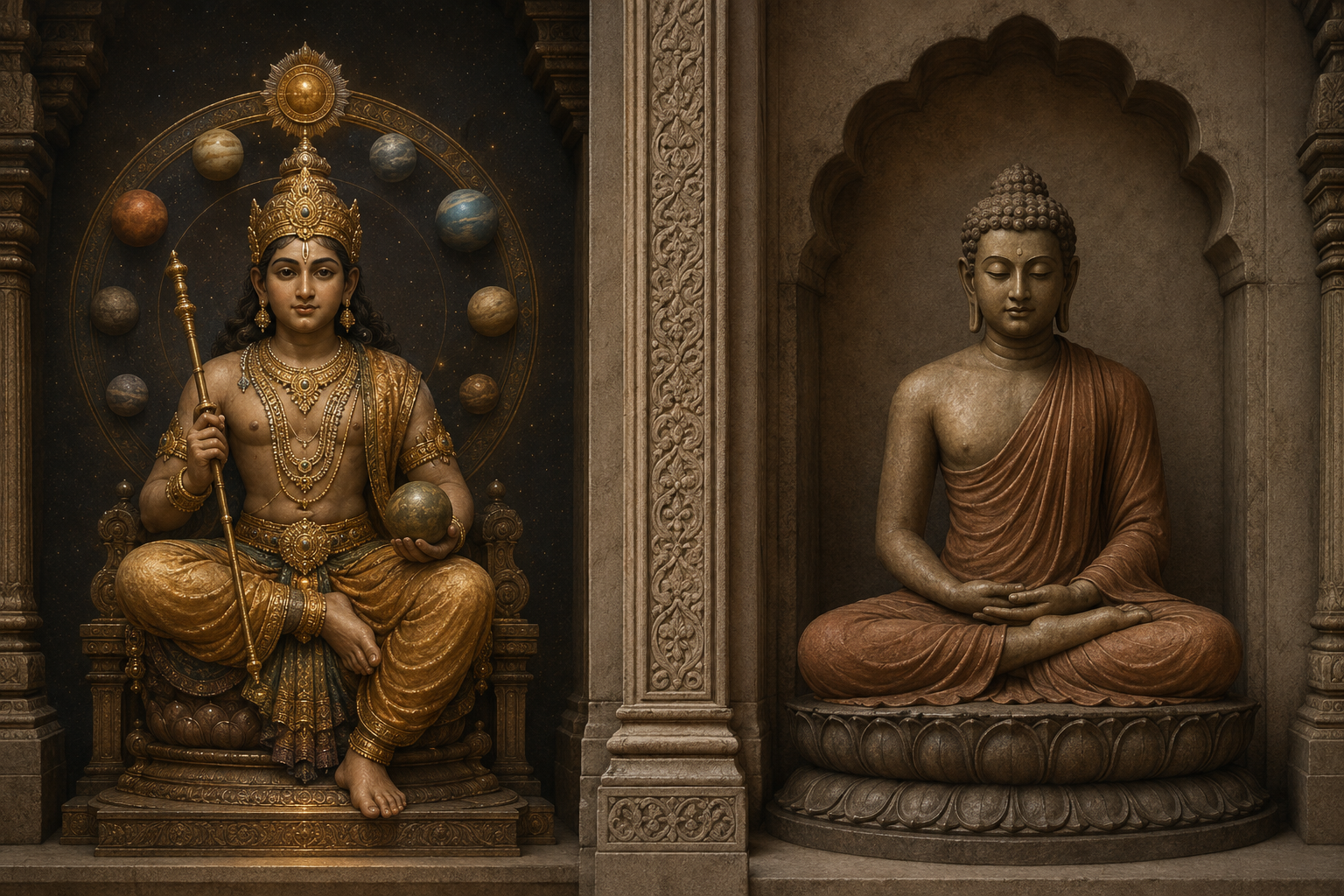
One consonant changes the entire identification. Budha, also written Budh in some English-language contexts, is the deity associated with Mercury and belongs to the Navagraha, the nine celestial deities. Buddha belongs to a different religious and iconographic context. A search engine, an informal caption, or an automatic correction can easily collapse the two spellings, but you should not.
A calm face or seated posture cannot settle the matter. Those features are too general. Use the name and the setting together:
- Copy any inscription or temple label exactly. Do not silently change Budh or Budha into Buddha.
- Check whether the sculpture belongs to a Navagraha shrine, panel, or ritual grouping.
- Look at the neighboring figures. A planetary ensemble provides stronger evidence than an isolated close-up.
- When searching a catalogue or temple archive, use combinations such as Budha Graha, Budha and Ila, and Budha Jnana Shakti. Searching only for Buddha will lead you into a different iconographic field.
- If the image has been removed from its original setting and carries no label, keep the identification provisional.
This distinction is not pedantry. If you begin with the wrong name, every later interpretation becomes an attempt to explain the wrong deity.
Build the identification from several kinds of evidence
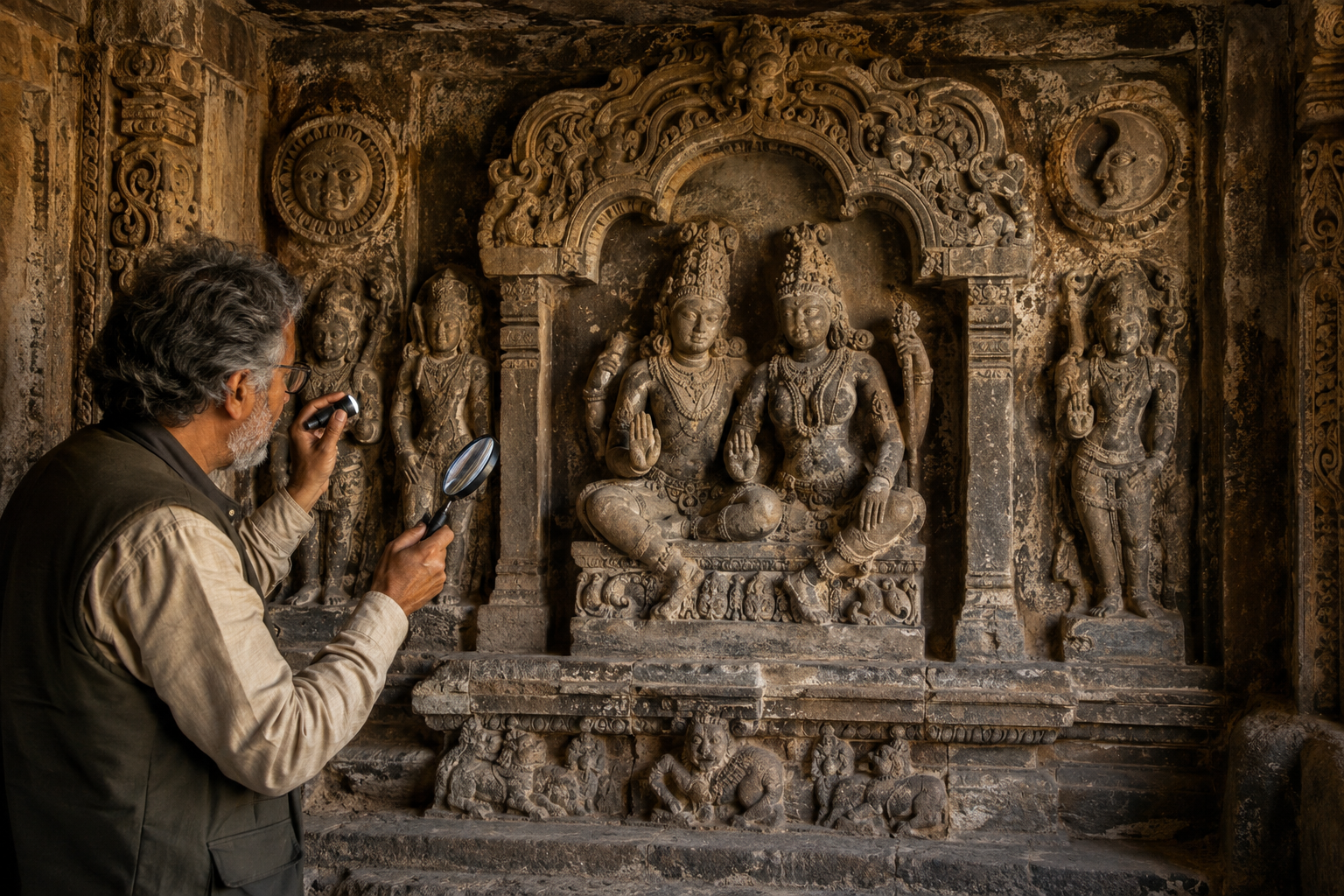
Temple images are best identified through converging evidence. A single gesture, object, color, or online caption is rarely enough, especially when weathering, repainting, repair, or an incomplete photograph has obscured part of the composition.
- Start with the whole setting. Record whether the image stands in a separate shrine, a wall niche, a larger celestial panel, or a Navagraha arrangement. Take or study a wide view before examining individual details.
- Identify the male figure independently. Ask what makes him Budha apart from the presence of a woman beside him. The ensemble, a surviving name, the temple’s ritual sequence, or a reliable local record may do more work than an uncertain attribute.
- Examine the relationship between the figures. A shared seat or base, coordinated orientation, comparable scale, and deliberate compositional balance support the reading of a pair. Mere physical proximity does not prove that the female figure is Ila.
- Seek the local name. Note how the temple currently identifies and worships the image. Keep that evidence distinct from a claim about who commissioned it, when it was carved, or whether its present location is original.
- Record damage and restoration. A missing hand cannot supply an attribute, and fresh paint may conceal carving rather than clarify it. Write down what is visible before reconstructing what you expect to see.
- Separate observation from interpretation. For example, shared pedestal is an observation; the figures form a divine couple is an interpretation supported by that observation.
You can then assign an honest confidence level. Use locally identified when a temple label or living ritual name explicitly names the pair. Use contextually probable when the Navagraha setting identifies Budha and the accompanying figure fits the paired composition, but Ila is not named. Use unresolved when the claim rests mainly on resemblance, an uncited caption, or a cropped photograph.
This method prevents two opposite errors. You will not dismiss a rare form merely because it is unfamiliar, and you will not force every adjacent male and female figure into the Budha-Ila identification.
Read Ila as Jnana Shakti, not as background decoration
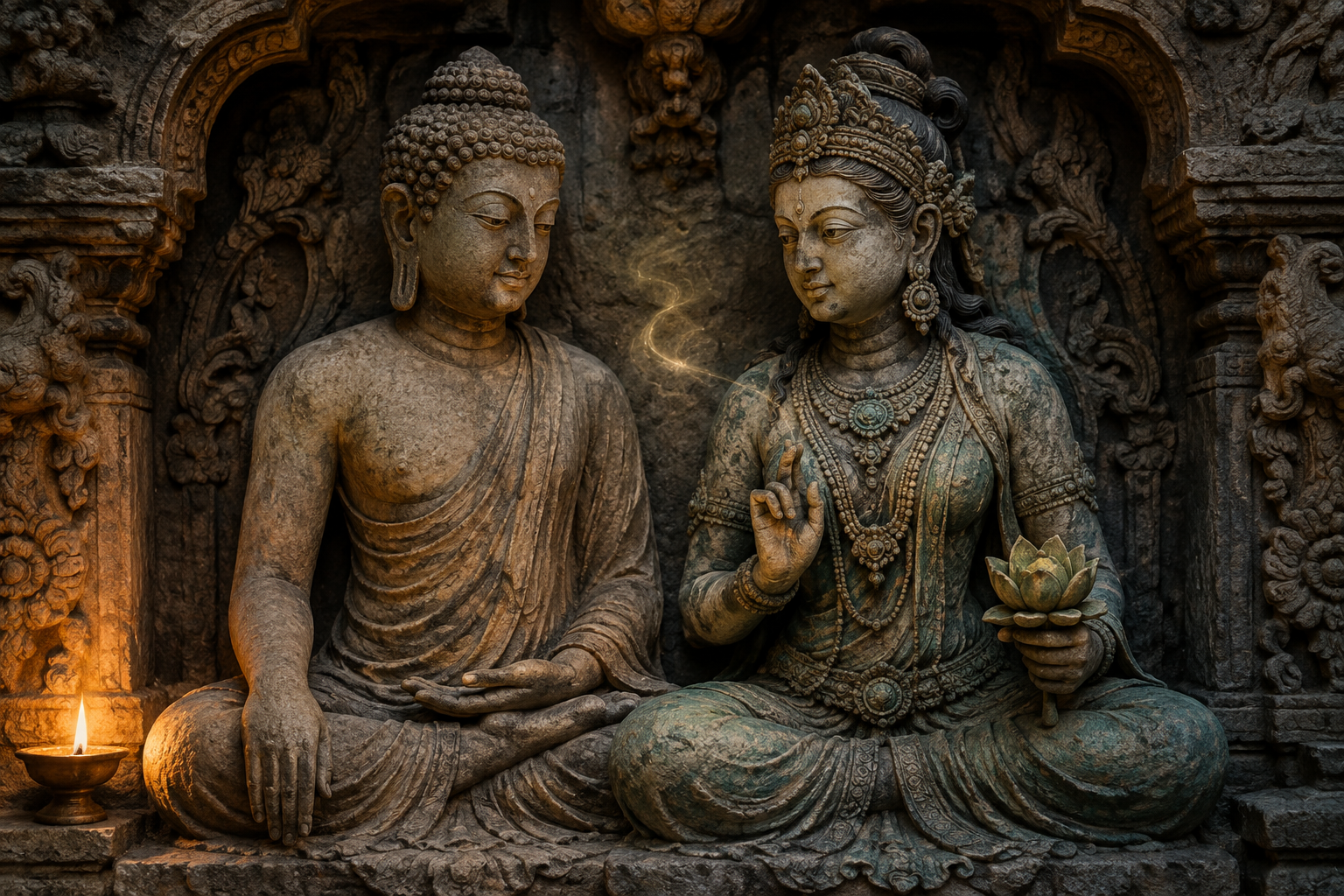
The title Jnana Shakti supplies the interpretive center of the paired image. Jnana means knowledge, while shakti is power, capacity, or operative energy. Ila’s presence therefore changes the way you read Budha. She is not a decorative addition to an otherwise complete image of the planetary deity.
A disciplined philosophical reading begins with relationship. Budha represents a celestial power marked by intellectual significance. Ila embodies knowledge as shakti. Seated together, they can be contemplated as intelligence joined to the power through which knowing becomes active rather than remaining a sterile possession.
You can read that relationship at three connected levels:
- At the iconographic level, the female figure contributes to the identity and meaning of the complete composition. Cropping her out produces an incomplete record.
- At the philosophical level, the pairing resists the idea that intellect is self-sufficient. The capacity to know must become lucid, directed, and effective.
- At the contemplative level, the image invites you to examine whether your own intelligence serves understanding or merely cleverness. Knowledge becomes dharmically valuable when it shapes attention, speech, judgment, and conduct.
Do not reduce this relationship to a modern binary in which the male figure means reason and the female figure means emotion. That opposition is not required by the sculpture and obscures the force of the word shakti. Ila’s role concerns the power of knowledge itself.
During darshan, you can make the composition concrete without inventing a new ritual. Look first at Budha, then at Ila, and finally at the space, seat, and visual rhythm that join them. Ask what kind of knowledge the pairing honors, what makes that knowledge effective, and what keeps intelligence aligned with a worthy purpose. This is a contemplative way of attending to the sculpture, not a claim that every temple prescribes those questions.
Use a field note that preserves what the temple actually shows
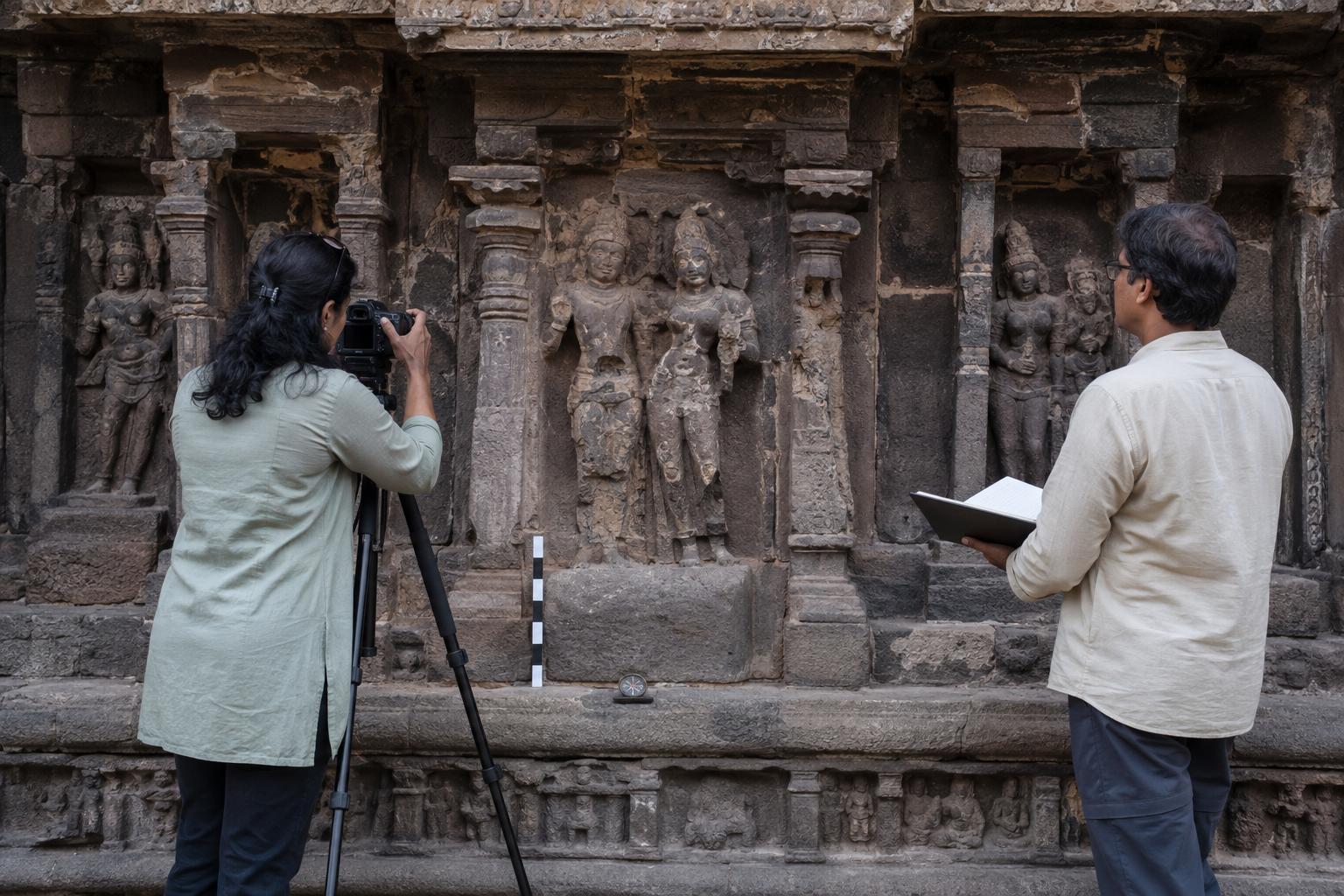
If you are documenting the image for study, pilgrimage notes, teaching, or publication, create a six-part record before leaving the temple or closing the archive file:
- Location: temple name, exact shrine or architectural position, and whether the image remains in a larger group.
- Current identification: the precise wording used by the temple, label, catalogue, or ritual specialist.
- Male figure: visible posture, surviving attributes, seat, and contextual reasons for identifying him as Budha.
- Female figure: her position, scale, posture, attributes, and physical relationship to Budha.
- Condition: broken, replaced, repainted, concealed, or uncertain features.
- Conclusion: locally identified, contextually probable, or unresolved, followed by one sentence explaining why.
Keep the uncropped view with any detail photographs. A tight image may show the carving more clearly while erasing the very ensemble that establishes its identity. Also preserve the original spelling of names in your notes; normalization can hide the Budha-Buddha distinction that future readers need.
Avoid attaching a date, dynasty, region, or universal list of attributes unless the evidence in front of you supports it. The rarity of the Budha-Ila form makes careful documentation more important, not less. It does not give us permission to fill every gap with a confident guess.
Nor should an iconographic identification be turned automatically into personal astrological advice. Recognizing Budha as the deity of Mercury and understanding Ila as Jnana Shakti explains the sacred composition. It does not, by itself, determine a person’s horoscope, prescribe a remedy, or establish the ritual practice of a particular temple.
Key takeaways
- Budha, the deity associated with Mercury, must not be confused with Buddha.
- Confirm the identification through context, local naming, the wider Navagraha ensemble, and the relationship between the two figures.
- Read Ila’s designation as Jnana Shakti as central to the composition: she embodies knowledge as active power.
- Keep observation, current temple identification, historical attribution, and philosophical interpretation in separate parts of your notes.
- When the evidence is incomplete, use a provisional label instead of converting possibility into fact.
The next time you encounter this rare pairing, begin with the wide view rather than a favorite symbol. Preserve the name, map the context, and study the relationship. That sequence will help you recognize Budha and Ila responsibly while allowing the sculpture’s deeper teaching about intelligence and living knowledge to remain visible.
References
