
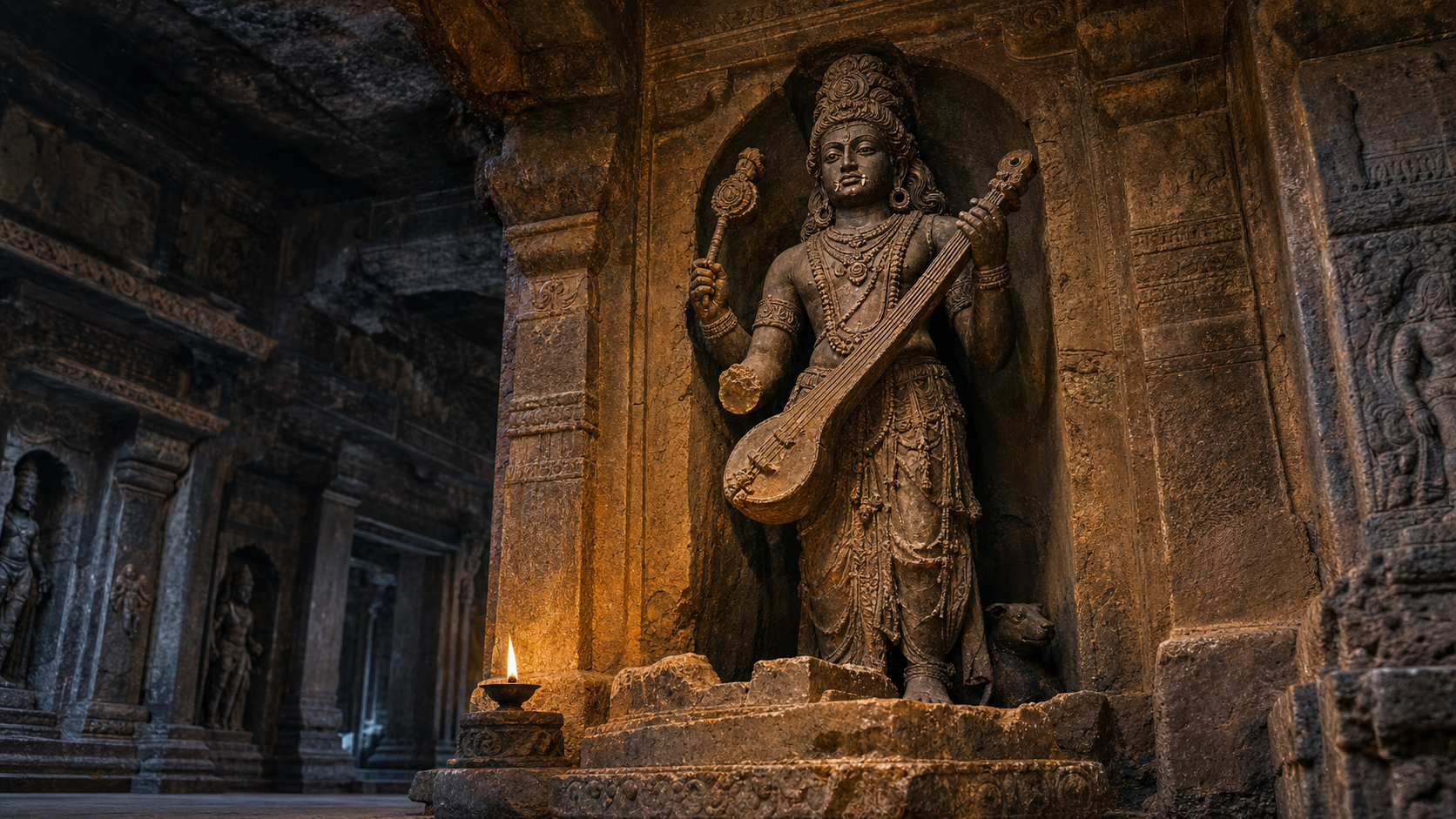
You know the figure is Bhairava, but the shrine has no readable nameplate. Perhaps one hand is damaged, the vehicle is unclear, or several guardian images look similar. In that situation, a vīṇā, a dog, or a white complexion may seem decisive. None is reliable by itself.
Ruru Bhairava is best recognized through convergence: his place in the sacred circuit, his teaching emblems, and his composed expression within an unmistakably Bhairava form. If you examine those layers in the right order, you can make a careful identification without forcing every regional image into a single template.
Key takeaways
- Begin with the shrine’s position and surrounding deities, not with one object held in one hand.
- A southeast location in an Ashta Bhairava circuit is an important clue, but regional temple practice can differ.
- A vīṇā, book, or rosary points toward Ruru’s role as a teacher of śāstra, mantra, and refined arts.
- The face is usually calmer than that of strongly wrathful Bhairava forms, while the third eye, matted hair, serpents, crescent, and skull imagery preserve his Bhairava identity.
- Arm count, complexion, vehicle, and associated Śakti vary. Treat them as supporting evidence rather than universal tests.
- For a final temple-specific identification, consult the archaka, sthapati tradition, inscriptions, or the shrine’s established liturgical sequence.
A reliable identification begins with the sacred setting
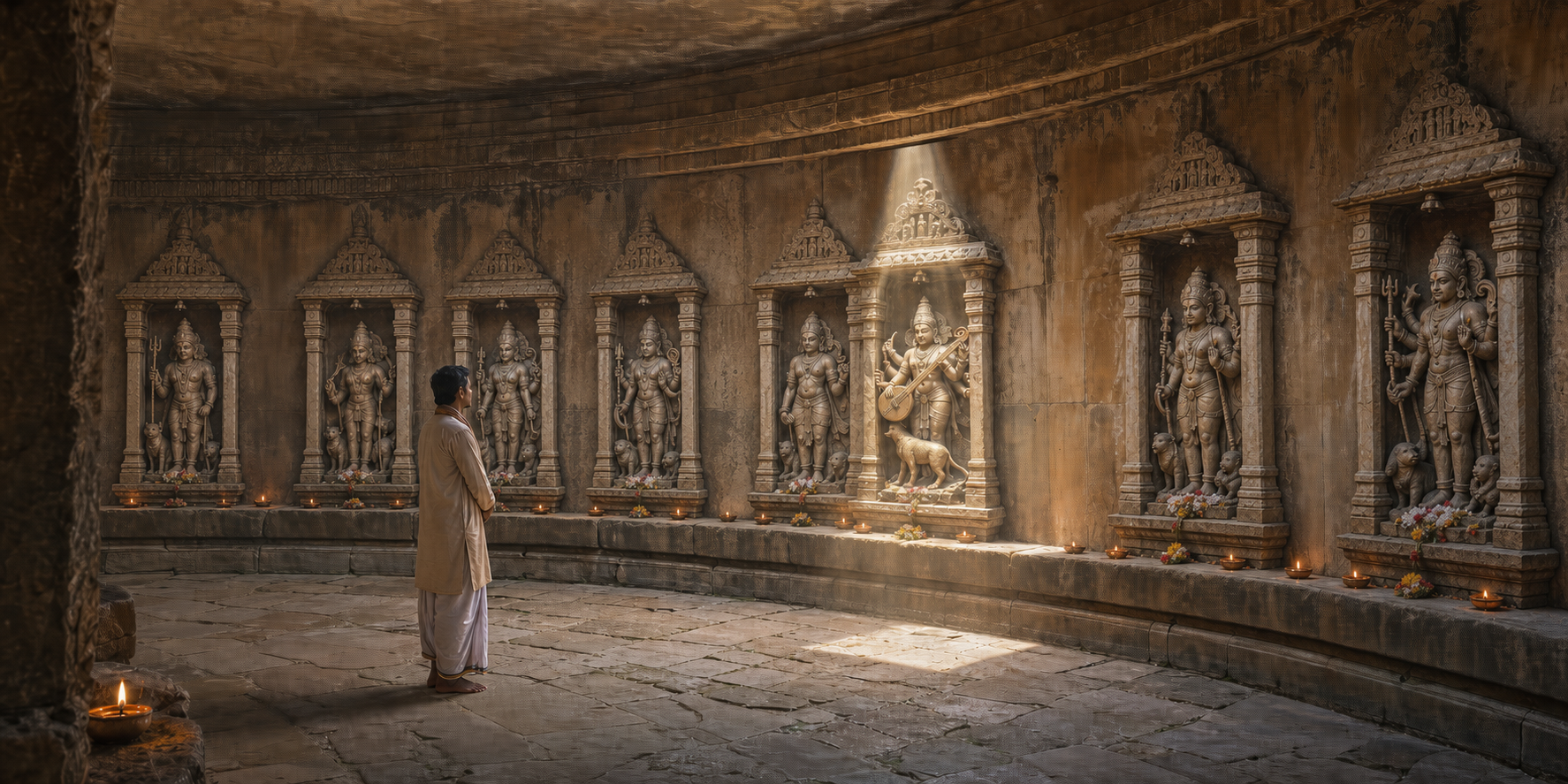
Ruru belongs to the larger family of sixty-four Bhairavas, arranged as eight groups of eight, and presides over the second octet. That position matters because a temple image is not an isolated specimen. Its neighbors, direction, pedestal, and place in the circumambulatory route can carry as much identifying information as its hands.
- Establish the group. Look for a sequence of guardian shrines, repeated Bhairava figures, directional labels, or an Ashta Bhairava arrangement. If the image stands alone, your identification must depend more heavily on attributes and local testimony.
- Find the actual southeast. Ruru is associated in many ritual arrangements with the agneya, or southeast, direction. Do not confuse the deity’s right, your right, and the temple’s geographic southeast. Use the temple plan, a trustworthy compass reading where appropriate, or the established order of circumambulation.
- Inspect the teaching attributes. A vīṇā is especially suggestive. A pustaka, or book, and an akṣamālā, or rosary, reinforce the identification by expressing learning, recitation, and disciplined attention.
- Read the expression together with the body. Calm eyes and composed lips support a Ruru identification only when the figure also retains the visual grammar of Bhairava and Shiva.
- Ask what the local tradition calls the image. An inscription, shrine register, festival sequence, archaka’s recitation, or sthapati record can settle a question that visual analysis alone cannot.
For practical fieldwork, rather than as a scriptural ranking, you can sort the evidence this way:
| Kind of evidence | What to look for | How to use it |
|---|---|---|
| Strong in combination | Southeast placement, vīṇā or book, and a comparatively serene Bhairava face | When all three agree, a Ruru identification becomes well supported. |
| Supporting evidence | Rosary, white or crystal-like presentation, blessing gestures, crescent, serpent ornaments, and balanced posture | Use these to strengthen an identification already grounded in context. |
| Shared Bhairava evidence | Third eye, matted hair, trident, drum, skull, serpents, or a dog | These establish the wider Bhairava family but seldom identify Ruru on their own. |
| Variable evidence | Two, four, or more arms; bull, deer, dog, or another vehicle; differing Śakti associations | Do not reject an image merely because one of these differs from another region’s convention. |
If several strong clues agree but the local name remains unknown, call the identification provisional. That small word preserves the distinction between what you observed and what you inferred.
Read the image as teaching power joined to protective power
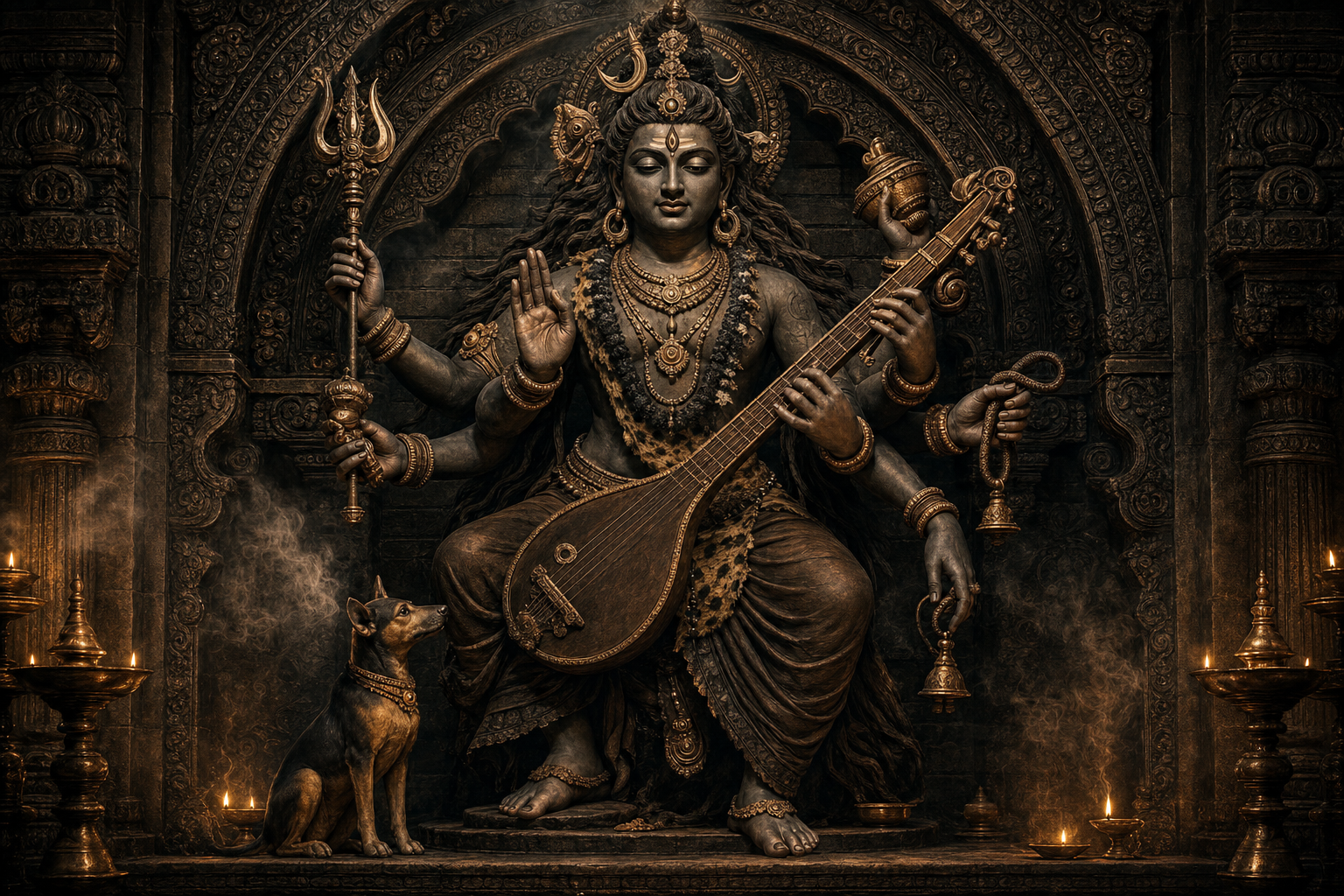
The most common mistake is to treat Ruru’s gentleness as an exception to Bhairava. It is better understood as a particular use of Bhairava’s force. The image does not abandon vigilance; it directs vigilance toward ignorance, fear, distraction, and disorder.
The teaching vocabulary
- Vīṇā: This is the clearest visual expression of disciplined art, harmony, listening, and cultivated knowledge. Its presence should make you look closely for Ruru, especially in a directional Bhairava circuit.
- Pustaka: The book points toward śāstra and instruction. It presents protection as something exercised through right understanding, not force alone.
- Akṣamālā: The rosary connects knowledge with mantra, repetition, and steady practice. It shows that insight must be cultivated rather than merely admired.
- Abhaya and varada: Gestures of assurance and benediction reveal the accessible side of the form. They do not erase discipline; they show its benevolent purpose.
These objects are not tied to one fixed number of hands. Two-armed, four-armed, and more elaborate forms occur. A damaged or regionally distinct image may therefore lack the vīṇā yet retain a book, rosary, blessing gesture, or other signs of the teaching role.
The protective vocabulary
A trishūla, ḍamaru, pāśa, aṅkuśa, or kapāla places Ruru within the broader language of Bhairava. These emblems prevent the teacherly attributes from turning the figure into a generic musician or sage. The vīṇā and book tell you how this Bhairava acts; the trident, skull, drum, and related objects tell you that he remains Bhairava.
The same pairing appears in the body. A third eye, jaṭā-mukuṭa, crescent moon, serpentine ornaments, and sacred emblems of time and mortality maintain the Shaiva identity. A serpent may form the yajñopavīta across the torso, while rudrākṣa, a skull garland, or ascetic dress can intensify the protective and death-transcending character.
Look at the stance as well as the face. Ruru can appear in balanced sama-bhaṅga or in a restrained ālīḍha posture. The first conveys composure; the second retains readiness. A calm face on an alert body is not a contradiction. It is the visual point: clarity does not require passivity.
Regional variation is part of the iconography, not an error
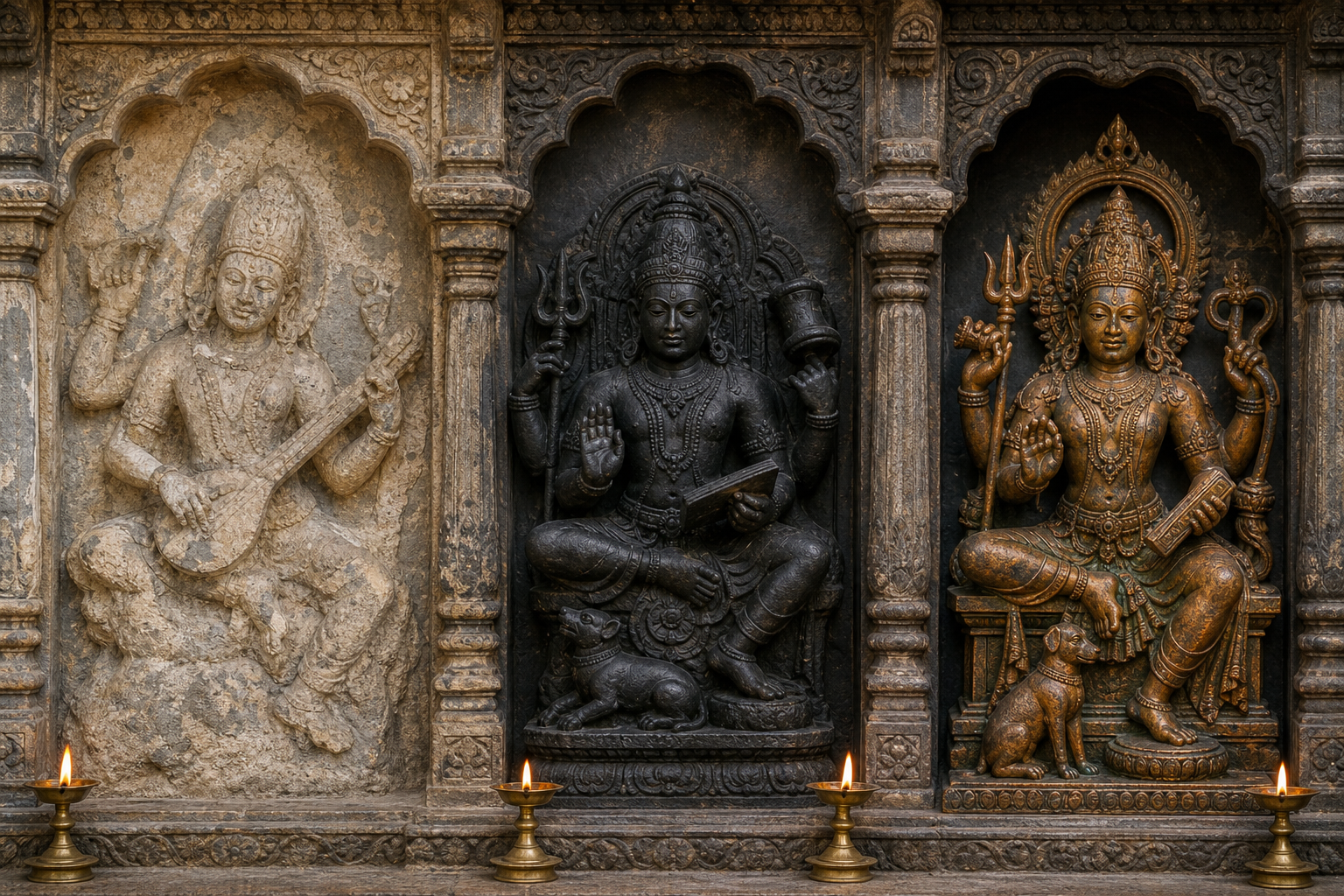
Temple iconography is transmitted through Agamic conventions, regional śilpa paddhatis, inscriptions, inherited workshop practice, and living worship. Images can therefore share a theological identity without looking identical. Ruru forms associated with Kashi, Tamil Nadu, Karnataka, or Nepal may preserve the same basic character while using different local details.
A white or crystal-like hue is often associated with Ruru’s lucidity and sattvic character. White flowers, white sandal paste, and refined textiles may extend that symbolism during alankāra. Yet color is fragile evidence. Stone may be dark, metal may determine the visible tone, paint may be renewed, and ritual adornment can temporarily change the image’s appearance. Never identify Ruru from whiteness alone.
The vehicle is even less uniform. Some traditions place Ruru with a bull, others connect him with the ruru-deer, and a dog may stand near the pedestal. The bull can align the form closely with Shiva and Nandi; the deer supports an atmosphere of alert gentleness; the dog expresses the vigilance and boundary-keeping associated with Bhairava more broadly. Because the dog accompanies many Bhairava forms, it establishes family resemblance more readily than individual identity.
Associated Śakti forms also vary. Maheshvarī or a śuddha-vidyā aspect may appear in particular traditions, but a different pairing does not automatically invalidate the Ruru identification. The same caution applies to the number and arrangement of arms.
Four shortcuts commonly produce a wrong label:
- “There is a dog, so this must be Ruru.” The dog is widely shared across Bhairava imagery.
- “The shrine is in the southeast, so no other evidence is needed.” Directional systems are powerful clues, but local layouts and later relocations can complicate them.
- “There is no vīṇā, so it cannot be Ruru.” A book, rosary, gesture, damaged hand, or local ritual identity may preserve the teaching character differently.
- “The figure looks peaceful, so it is not Bhairava.” Ruru’s composed expression is meaningful precisely because it coexists with Shaiva and Bhairava emblems.
If you are cataloguing a sculpture, record before interpreting. Note the geographic orientation, shrine sequence, arm count, surviving hand objects, mudrās, vehicle, hairstyle, third eye, ornaments, stance, facial expression, pedestal marks, and nearby inscriptions. A simple observation such as “four arms; upper-left object damaged” is more useful than silently completing the missing hand with the attribute you expected to see.
Ruru’s iconography gives you a way to practise
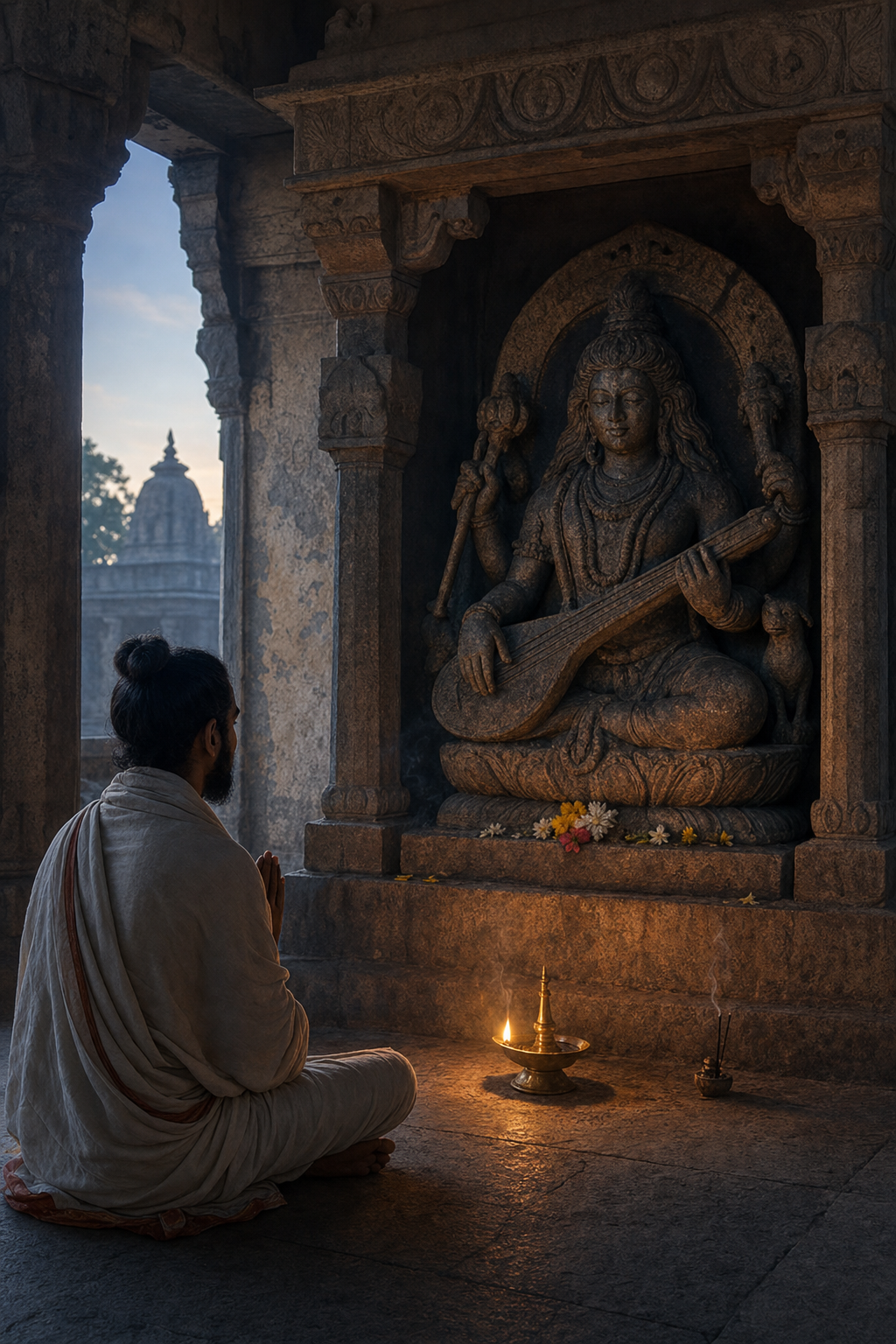
Ruru joins jñāna, the power of understanding, with kṣatra, the discipline that protects what is right. The teaching objects without the protective ones would suggest knowledge without firmness. The weapons and skull imagery without the teaching objects would suggest force without refinement. Held together, they communicate a Dharmic principle: knowledge must become courageous action, and power must answer to wisdom.
You can carry that reading into a shrine visit without inventing a private ritual:
- Observe before asking. Identify one emblem of vigilance and one emblem of learning. Let the pairing determine how you understand the form.
- Name the confusion that requires discipline. Ruru’s symbolism is especially apt when the obstacle is not a lack of information but scattered attention, fear, or unwillingness to study carefully.
- Leave with one concrete act of learning. Read the relevant śāstra with guidance, resume a neglected mantra practice, study sacred music, or take a precise question to a qualified teacher.
Public-facing worship may include ghee lamps, white flowers, Bhairava name recitation, and observance on Ashtami. A simple “Om Bhairavaya Namah” is widely accessible, while seed syllables and specialized Ruru mantras can differ by lineage. Follow the temple’s custom and your guru-paramparā rather than assembling a practice from disconnected details.
Ruru’s vīṇā also gives communities a practical direction. A music-infused satsanga, a careful śāstra study circle, or a session devoted to learning a stotra can express the form’s meaning more fully than adding another decorative element to a shrine. Worship becomes stronger when attention, instruction, and conduct move together.
The next time you encounter an unnamed Bhairava, write down the direction, hand attributes, expression, Shaiva marks, vehicle, and neighboring shrines before settling on a name. Then ask the people who preserve that temple’s worship. That combination of close seeing and living tradition is the surest way to recognize Ruru without erasing the regional richness of his form.
References
