
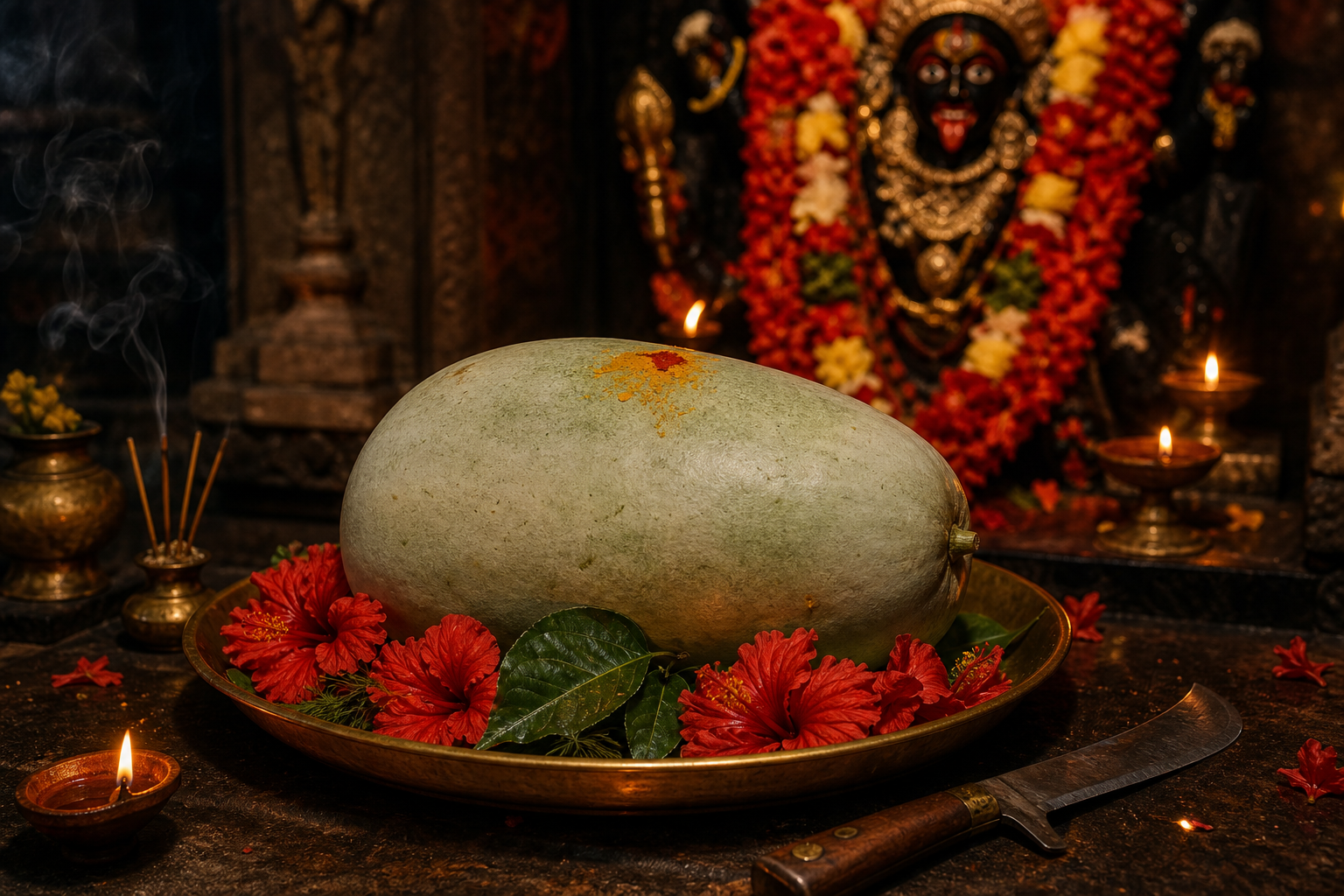
You want to worship Kali without participating in animal sacrifice, but you do not want a ritual stripped of its Shakta character. An ash gourd offering gives you a serious path between those two concerns. It retains bali, consecration, symbolic cutting and surrender while directing the force of the rite toward the devotee’s own ego and harmful impulses.
The important qualification is that Shakta practice is not uniform. An ash gourd is an established nonviolent offering in many communities, not a rule imposed upon every lineage. If you want to make such an offering, the sound approach is to understand its inner demand and then follow the procedure of the temple where you worship.
The offering preserves surrender, not bloodshed
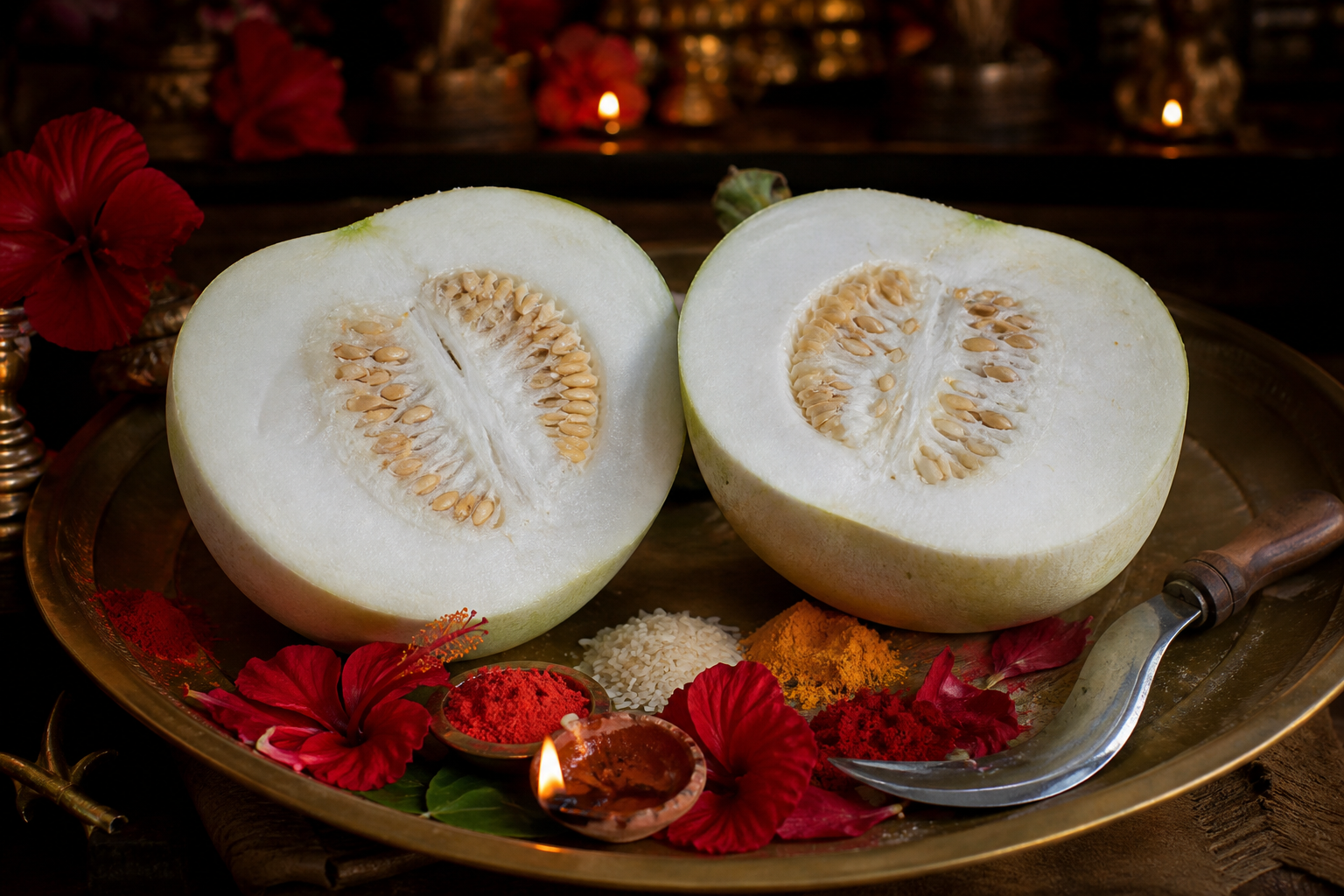
The ritual question is not simply whether an object is cut. It is what the devotee places before the Goddess and what that act is meant to change.
In many Kali temples, an ash gourd is used as phala-bali, a fruit or vegetable offering in place of animal bali. It may be called kushmanda, petha, chalkumro or kumbalanga, depending on the region. The gourd can be washed, adorned, marked with kumkum or a turmeric-lime preparation, taken around the sacred space and split at the bali-peetha. These are recognisable forms of nonviolent Kali worship, although their sequence and details vary by local custom.
The ash gourd carries the symbolism well. Its pale, unblemished surface can represent clarity and purification. Its capacity to receive markings and then be opened makes it a visible image of the limited self brought before the Mother. The cut can signify a break with anger, greed, fear, cruelty or uncontrolled desire. What is surrendered is not another creature’s life but the devotee’s attachment to the habits that obstruct dharma.
Kumkum on the gourd should not automatically be reduced to an imitation of blood. In a nonviolent interpretation, the red marking can represent agitated and dark tendencies brought under sacred discipline. The ritual does not deny Kali’s fierceness. It asks you to turn that fierceness against ahankara, confusion and harmful conduct.
This is why calling the gourd merely a replacement misses the central point. A replacement performs the same external function with a different object. A symbol redirects the meaning of the act. The ash gourd belongs to the second category when the temple presents it as self-offering and ethical transformation.
Make the inner bali specific enough to change your conduct

A symbolic offering becomes thin when the devotee cannot say what it represents. Before the ritual, name one tendency you are actually prepared to confront. Avoid offering a vague word such as “negativity.” Choose something observable: the anger that shapes your speech, the fear that prevents an honest duty, the greed behind a particular decision or the resentment you keep feeding.
- Name the inner obstruction. Complete the sentence, “Before the Mother, I am surrendering my attachment to…” Keep it to one real tendency rather than a catalogue of faults.
- Identify its outward behaviour. Anger may appear as a cutting reply; greed as withholding what is due; fear as avoiding a necessary conversation. If you cannot identify the behaviour, the symbolism will remain abstract.
- Choose the first contrary action. Decide what you will do after worship: apologise without defending yourself, fulfil a neglected obligation, refuse a cruel remark or keep silence when you would normally strike back.
- Remember the offering when the habit returns. The split gourd marks a decision, not the automatic disappearance of an old tendency. Your next moment of temptation is where the bali acquires practical meaning.
This preparation is not a substitute for the temple’s sankalpa, mantra or priestly direction. It is the ethical work you bring to them. Bhava, devotional intention, matters precisely because it makes the inherited form personally demanding. It does not mean that any improvised object or private procedure becomes ritually equivalent.
You can also resist a common misreading here. Nonviolence does not make the offering passive. Restraining cruelty, accepting correction and loosening the ego often require more courage than directing force outward. Kali’s intensity remains present, but its field of action becomes the devotee’s own character.
Follow the temple’s lineage before arranging the offering
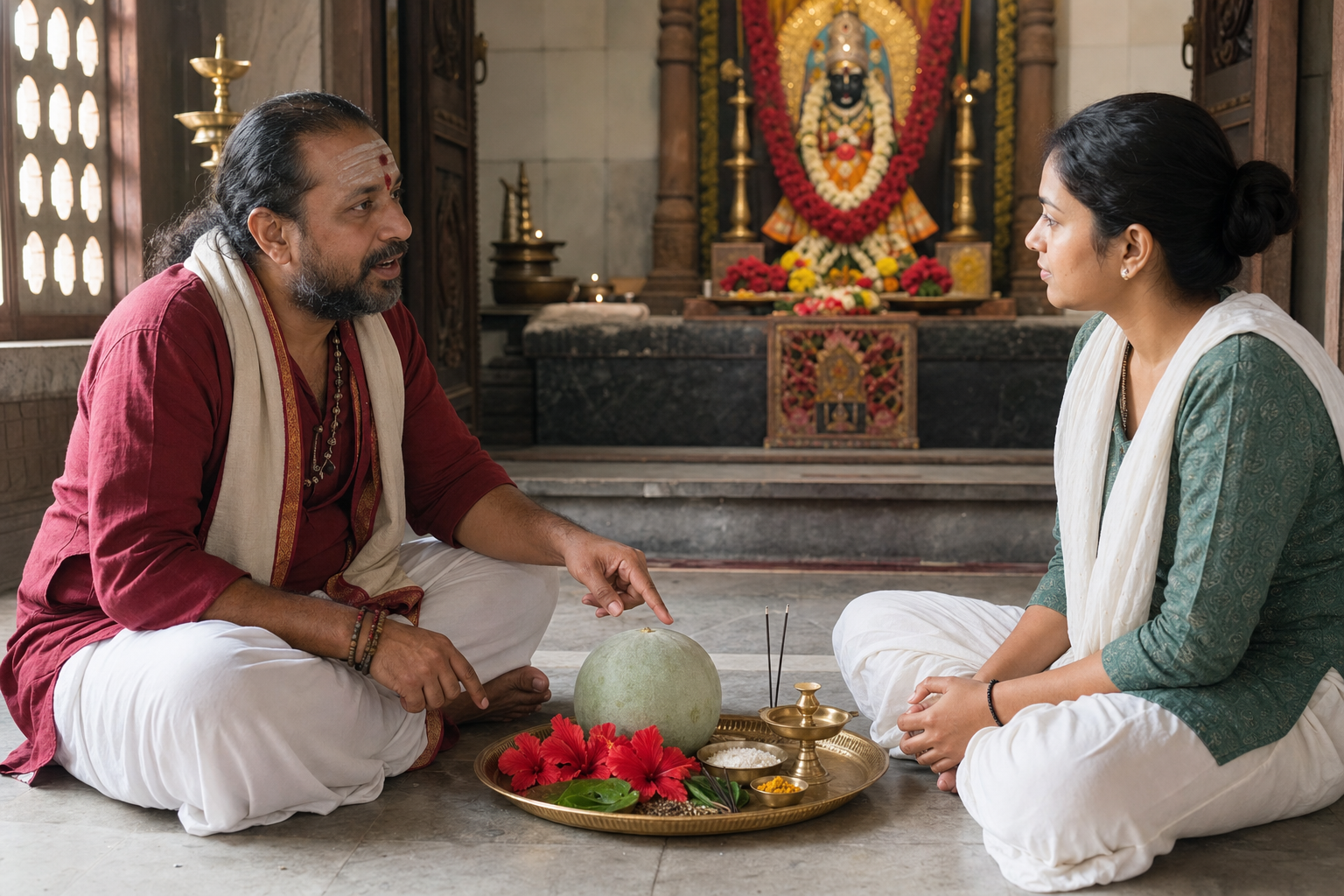
There is no single ash gourd protocol for the entire Shakta world. One temple may supply and prepare the gourd; another may allow a family to bring it. Markings, circumambulation, the person authorised to cut it and the treatment of the remains can all differ. Authenticity therefore begins with local guidance, not with copying a photograph or a procedure seen elsewhere.
Ask the archaka or temple office these questions before you purchase or prepare anything:
- Does this temple accept ash gourd or kushmanda as phala-bali?
- Is the offering available only on particular occasions, or can it be arranged during regular worship?
- Does the temple provide the gourd, or should the devotee bring one?
- Are there requirements concerning its selection, washing, wrapping, markings or other adornment?
- Who performs the consecration and the cut, and where does the act take place?
- Are the portions distributed as prasada, retained by the temple or disposed of according to another custom?
A clear request can be simple: “We would like to make a nonviolent phala-bali to Kali using an ash gourd. Does this temple follow that practice, and what should we bring or do?” This wording expresses your ethical intention without presuming authority over the temple’s ritual order.
If the rite includes a blade, leave the cutting to the person designated by the temple. Do not step into the ritual space, handle implements or attempt to reproduce the act at home merely because you have watched it. Temple guidance protects both physical safety and ritual integrity.
Do not assume that consecrated pieces are yours to cook or distribute. Some communities may treat them as prasada, while others prescribe respectful disposal. Confirm the custom before carrying anything away. What happens after the split is part of the offering, not an incidental cleanup decision.
Let ahimsa widen participation without erasing difference
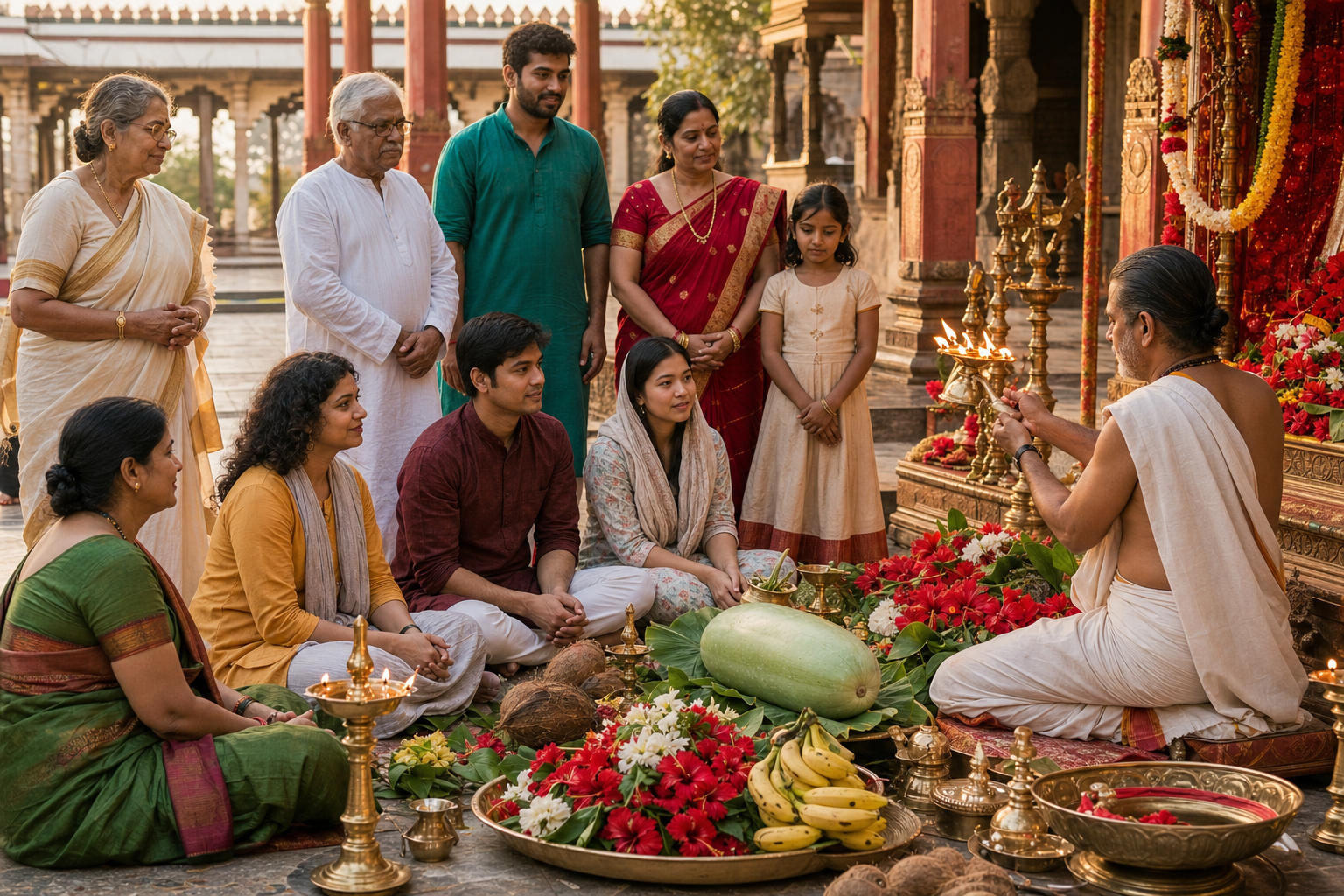
An ash gourd offering can make Kali worship more approachable to children, elders and devotees who cannot reconcile animal sacrifice with their ethical commitments. The rite can still retain drums, mantra, incense, focused silence and the decisive sound of the gourd opening at the bali-peetha. Its emotional and ritual force need not depend on an animal’s suffering.
That makes phala-bali especially useful when a temple serves a diverse congregation or when parents are deciding how to transmit Shakta worship to the next generation. Explain the meaning before the action: “The gourd stands for what we must cut away in ourselves.” A child who understands that sentence receives more than a softened spectacle. The child receives a moral vocabulary for Kali’s fierce grace.
Ahimsa should not, however, become a weapon for humiliating other Hindus or declaring every regional practice illegitimate. Shakta lineages have different histories and ritual authorities. If you are advocating nonviolent bali in a community that does not yet use it, make the case through continuity: phala-bali preserves offering, bhava, consecration and transformation while removing harm. Ask whether the lineage recognises such a form and allow its qualified custodians to address the ritual questions.
The practice can also support conversation across the dharmic family without pretending that all traditions are the same. Hindu dharma, Jain emphasis on ahimsa, Buddhist cultivation of karuna and Sikh commitment to seva retain their distinct teachings. They can nevertheless meet around a practical conviction: sacred strength need not be proved through injury. The ash gourd makes that conviction visible within an unmistakably Shakta setting.
For temple leaders, the useful test is not whether a change appears modern or traditional in the abstract. Ask whether the practice is recognised within the community’s ritual framework, whether its meaning is taught clearly and whether it deepens disciplined devotion. A gourd cut without explanation can become theatre. A consecrated offering joined to self-examination can become a durable form of religious education.
Key takeaways
- Ash gourd phala-bali offers a nonviolent form of bali in many Kali temples, but it is not a universal Shakta rule.
- The central symbolism is the surrender of ego, anger, greed, fear, cruelty and uncontrolled desire, not the simulation of animal sacrifice.
- Choose one inner tendency and one contrary action before worship so that the offering changes conduct rather than ending as spectacle.
- Ask the local archaka about preparation, markings, authorised cutting and the treatment of the remains; procedures differ by temple and region.
- Advocate ahimsa through Shakta continuity and respectful dialogue, not by dismissing the authority or history of other lineages.
Your next step is modest and concrete: contact the temple, ask whether it offers kushmanda or ash gourd phala-bali, and seek its exact instructions. Then decide what you are prepared to place before Kali in yourself. The vegetable is the visible offering; the habit you relinquish is the one that gives the rite its weight.
References
