
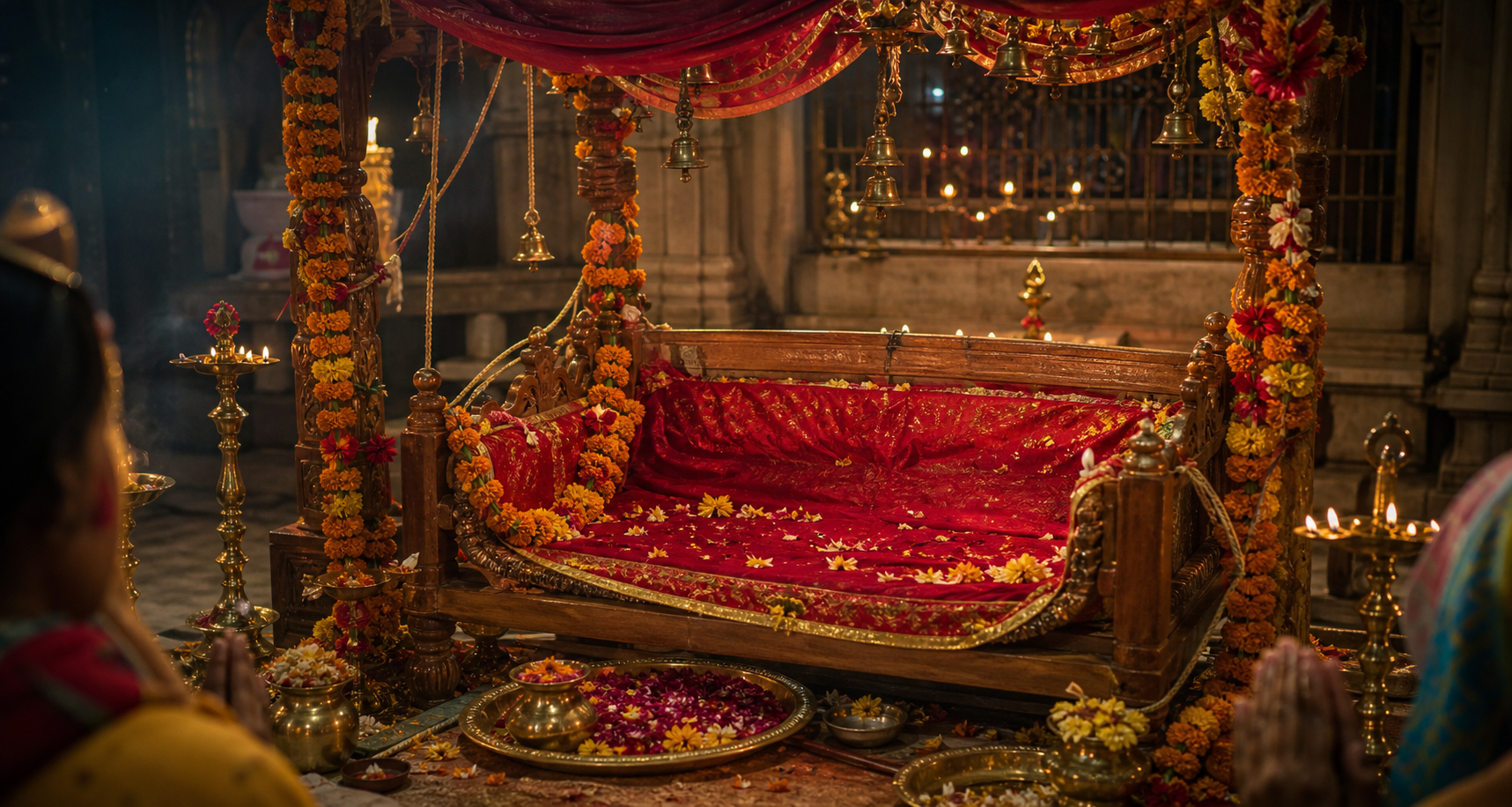
If you enter Alopi Devi Temple expecting to find a stone murti, the sanctum may initially seem to withhold the very thing you came to see. Its focus is a red-draped cradle rather than a sculpted image of the Goddess. Once you understand that this is deliberate, the visit changes: you stop searching for a missing figure and begin noticing how divine presence is established through symbol, ritual and sacred place.
That shift is the key to understanding aniconic Shakti worship. Alopi Devi is not worship without a deity, and the cradle is not a decorative substitute for a supposedly incomplete shrine. Devi is approached through a sign that reveals her intimacy while refusing to contain her in a single visible body. Knowing this helps you participate with greater attention, whether you come as a devotee, a pilgrim or a student of Dharmic traditions.
Absence is not emptiness
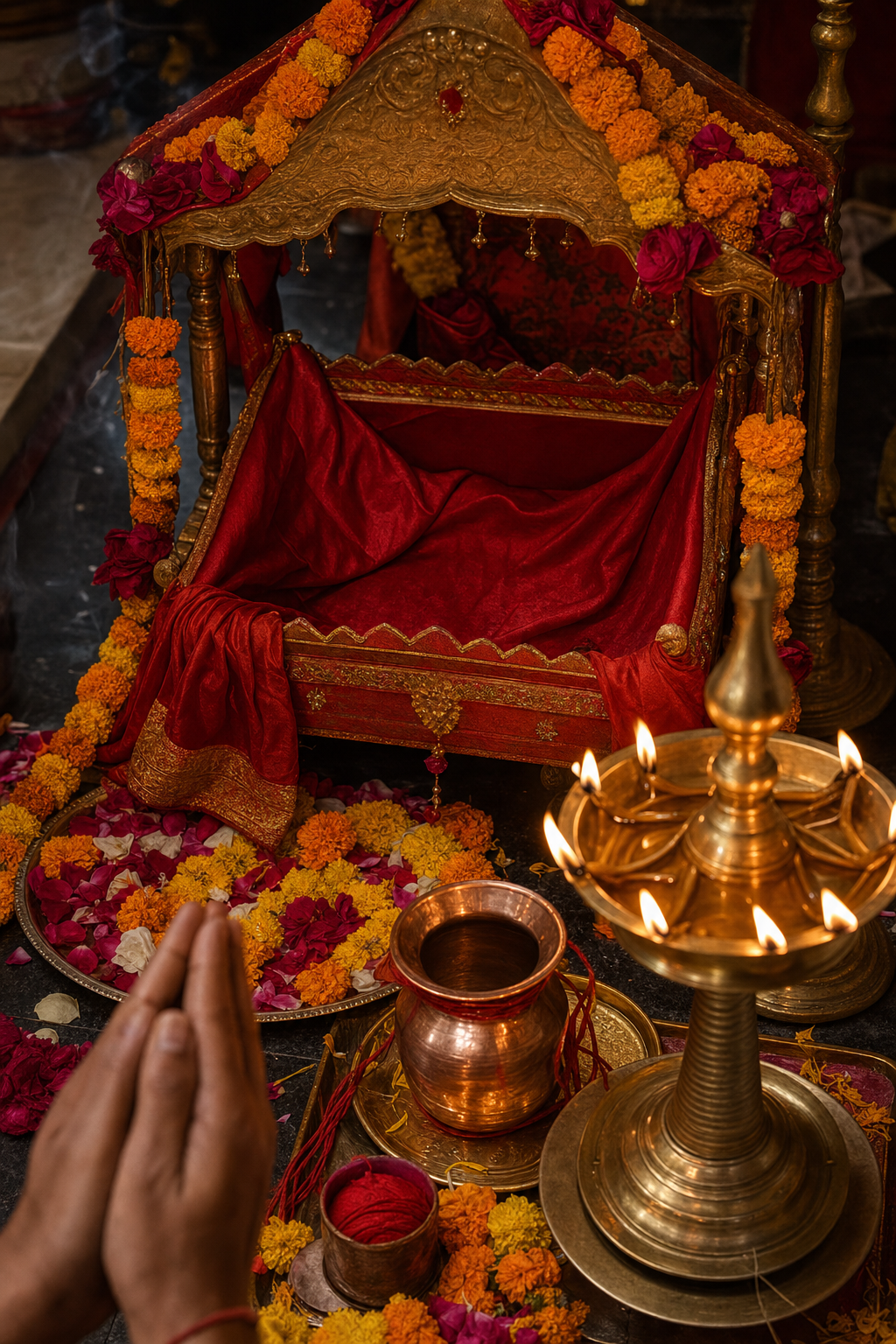
Aniconic worship uses a non-figural focus instead of an anthropomorphic or sculpted representation. It does not mean that nothing material is present. At Alopi Devi, the cradle, its red covering, the sanctum and the surrounding rites provide a clear center of devotion. Worship has a visible focus even though that focus does not depict the Goddess’s face or body.
This distinction matters because calling the temple “idol-less” can produce the wrong impression. The worship is neither empty nor merely philosophical. Devotees light lamps, ring bells, make offerings, undertake vows and circumambulate. Bhakti, seva, prasad and darshan remain recognizable parts of the encounter. The unusual feature is not the absence of Hindu ritual; it is the way familiar ritual directs attention toward a presence that is indicated rather than portrayed.
The name “Alopi” is commonly understood through the idea of disappearance. Some sacred narratives connect the site with the Shakti Peetha tradition and hold that a remnant associated with Sati disappeared here, leaving no bodily relic to represent. The important discipline is to preserve the status of that claim when you repeat it: say that local tradition holds or that a particular telling associates the site with Sati. Do not turn a living sacred narrative, which circulates in more than one form, into a falsely precise historical report.
Nor should aniconism be confused with iconoclasm. Aniconism describes devotion centered on something other than a figural image. Iconoclasm is hostility toward images. Alopi Devi does not require you to reject murti worship, and its devotees need not regard other Shakti shrines as spiritually inferior. The temple expands Hinduism’s ritual vocabulary; it does not invalidate the forms used elsewhere.
What the cradle teaches you to notice
A cradle is an especially rich sign for Shakti because its meaning is relational. It evokes the bond between mother and child, but it can place the devotee on either side of that relationship. You may approach Devi as the Mother who protects and sustains you. You may also see the cradle as a sign of nascent life, asking you to serve and protect what is vulnerable. Neither reading exhausts the symbol.
The cradle also points toward beginnings. Shakti is not simply an object inside creation; she is the power through which life, movement and renewal become possible. A cradle can therefore suggest creation continually emerging, not only the infancy of a particular divine personality. Red strengthens that association through its established connections with auspiciousness, vitality and active divine energy.
It would nevertheless be too narrow to decode the cradle as though it had one secret definition. A sacred symbol is not a puzzle that disappears once you find the answer. Its work is to organize attention. When you stand before it, notice three levels at once:
- The material level: a suspended or supported cradle, red cloth and a sanctum that establish a definite place toward which worship is directed.
- The relational level: maternal care, dependence, tenderness, protection and the devotee’s willingness to entrust a concern or vow to Devi.
- The cosmic level: Shakti as the power of emergence and renewal, present in the world but never exhausted by any single representation.
Reading all three levels prevents two common mistakes. The first is treating the cradle as an ordinary object that credulous worshippers have mistaken for a goddess. The second is making it so abstract that the actual practices of devotees no longer matter. The cradle works because a community recognizes, serves and encounters Devi through it. Material sign and devotional relationship belong together.
Saguna and nirguna meet without cancelling each other
The language of saguna and nirguna can clarify what happens at Alopi Devi, provided you do not force the shrine into a rigid philosophical category. Saguna refers to the Divine approached through qualities, names and perceivable forms. Nirguna points to the Divine beyond limiting attributes and finite representation.
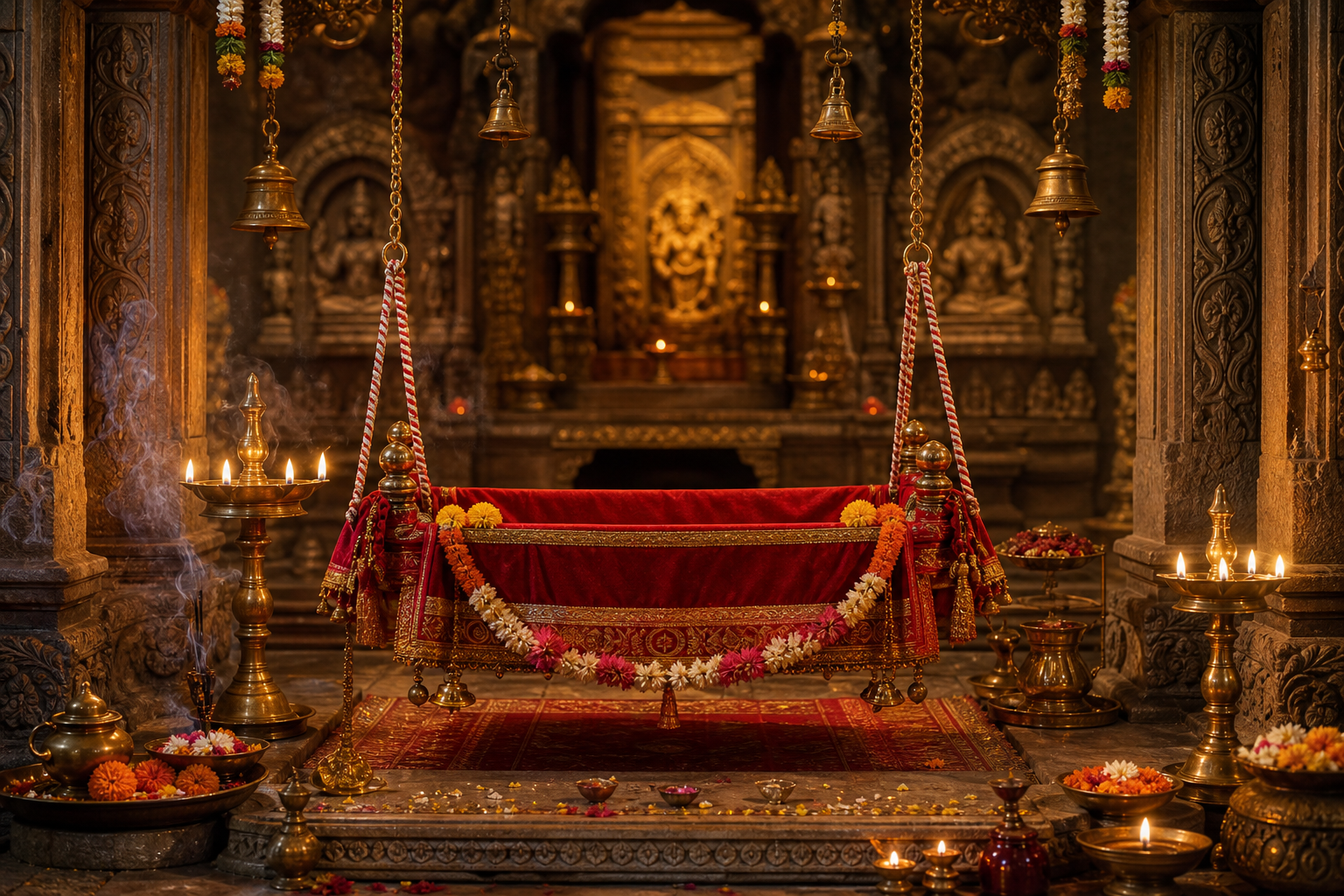
Alopi Devi is not an uncomplicated example of “formless worship.” The cradle has form. The red cloth has color. Bells produce sound, lamps produce light, offerings have texture and fragrance, and circumambulation involves the body. The entire ritual encounter is sensory. What is absent is a conventional sculpted figure that claims to show the Goddess in bodily form.
The shrine can therefore hold saguna and nirguna in productive tension. Devi is near enough to receive offerings at a particular place, under a particular name and through a particular symbol. Yet she remains ungraspable enough that no visible body defines the limit of her presence. Form carries the devotee toward what form cannot contain.
This is also why darshan should not be reduced to visual inspection. If your only question is “What image did I see?” Alopi Devi will seem deficient. If darshan is understood as entering a devotional relationship with the sacred, then the cradle is fully capable of focusing that encounter. The devotee does see something, but the seen object points beyond itself.
You need not use Alopi Devi to settle an argument about whether murti or formless worship is superior. That binary misses the temple’s more useful lesson. Hindu practice can employ a sculpted murti, a mantra, a geometric form, a natural presence or a meaningful object without claiming that the Infinite has been confined to the chosen focus. At Alopi Devi, the refusal to depict a body makes that principle unusually visible.
How to visit without missing what matters
The temple belongs to Prayagraj’s sacred geography, near the Triveni Sangam of the Ganga, Yamuna and the unseen Saraswati. Place is therefore not incidental background. The shrine’s meaning comes from the conjunction of local memory, pilgrimage, repeated worship and the larger sanctity of Prayagraj. If you treat the cradle as an isolated museum object, you remove it from the relationships that make it ritually intelligible.
A respectful visit does not require specialist knowledge. It does require you to replace the habits of sightseeing with the habits of attention:
- Release the expectation of a hidden murti. The absence of a sculpted figure is the central feature, not a problem waiting to be solved.
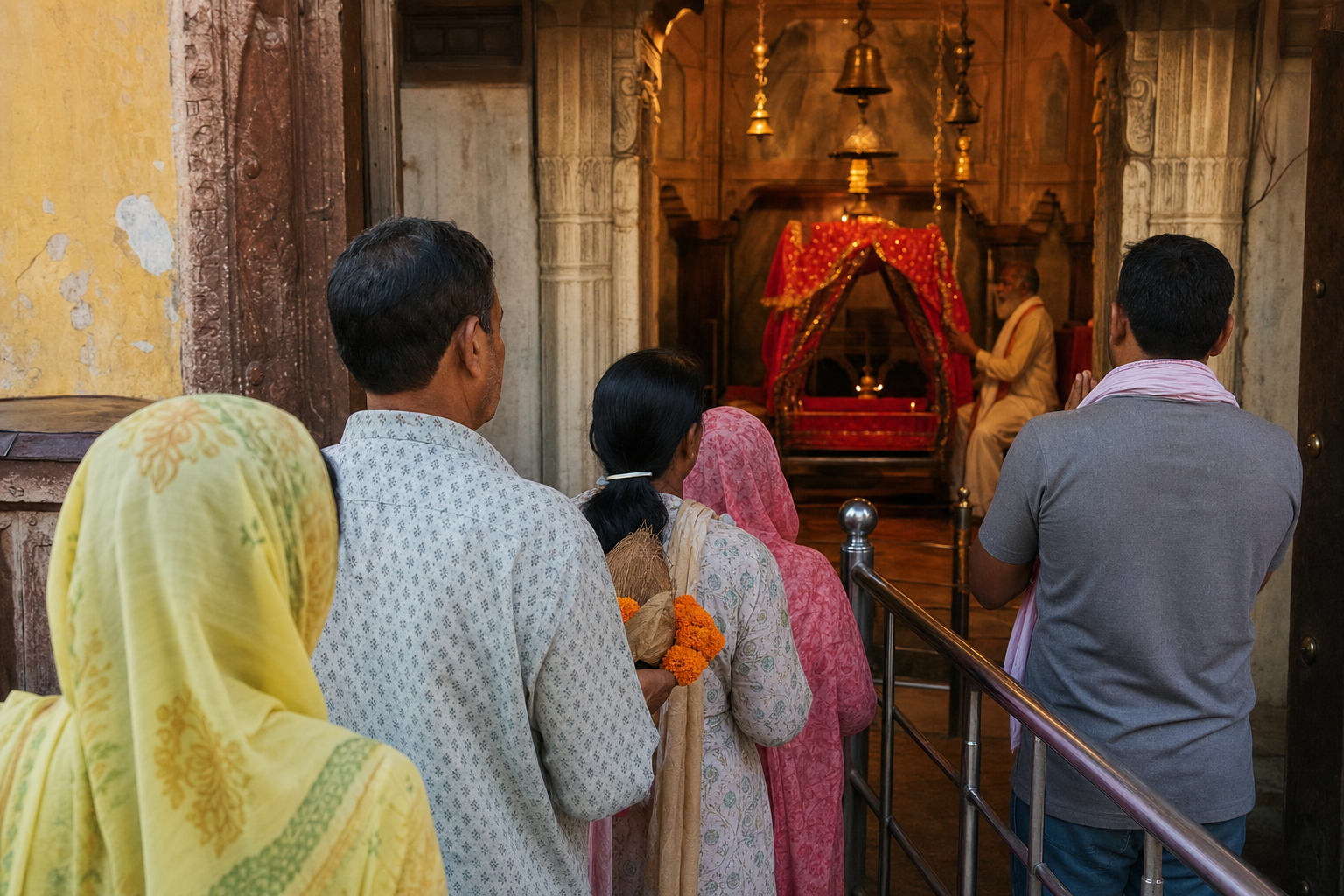
- Identify the ritual center. Watch where devotees direct their namaskar, offerings and circumambulation. Their actions show how the sacred space is organized.
- Follow local practice before improvising. If you are unsure where an offering belongs, whether something may be touched or whether photography is appropriate, ask a temple attendant rather than assuming.
- Listen for variations in the sacred narrative. More than one explanation may circulate around the name Alopi and its connection with Sati. Variation does not automatically make the tradition meaningless; it tells you that a living place carries memory through several voices.
- Allow the rite to shape your perception. Bells, lamps, mantra, red cloth and the movement of devotees are not distractions from the “real object.” Together they make the presence of Devi ritually perceptible.
Navratri and other auspicious occasions bring a more intense collective atmosphere to the temple. If you visit then, expect the communal dimension of Shakti worship to be especially prominent. Do not demand the stillness of a private meditation space from a shrine filled with shared vows, movement and devotion. Patience is part of seeing the temple on its own terms.
Key takeaways
- Alopi Devi is worshipped through a red-draped cradle rather than a sculpted figure.
- Aniconic does not mean empty, anti-image or devoid of ritual; it means that the devotional focus does not depict the deity in bodily form.
- The cradle evokes maternal protection, vulnerable beginnings, creation and continual renewal.
- The shrine can be contemplated through both saguna and nirguna: Devi is approached through tangible signs without being limited by them.
- To understand the temple, observe the relationship among symbol, ritual action, sacred geography and the community that worships there.
A wider Dharmic resonance without flattened differences
Alopi Devi becomes even more illuminating when placed beside other Dharmic uses of non-figural signs. The comparison is useful because it reveals a recurring concern across traditions: how can finite material forms direct attention toward a reality that exceeds depiction?
Early Buddhist art could evoke the Buddha through an empty throne, footprints or the Bodhi tree. The figure’s nonappearance did not make the scene meaningless. The sign directed memory and reverence toward awakening, presence and a decisive sacred event without presenting an anthropomorphic Buddha at the center.
Jain reverence for charan, or sacred footprints, similarly shows how a trace can function as an index of sanctity. A footprint is not a portrait. It indicates that a realized being stood, walked or left a path worthy of being followed. The sign draws attention away from physical likeness and toward spiritual attainment.
Sikh teaching about the One as Nirankar, the Formless, presents a different kind of resonance. It should not be treated as a parallel temple ritual or folded into Shakta theology. Its relevance lies in the insistence that ultimate sovereignty cannot be confined to a visible body. The conceptual echo is real, but the theology and devotional setting remain distinct.
These examples do not prove that Hinduism, Buddhism, Jainism and Sikhism teach the same doctrine. They show a family of Dharmic strategies for handling the limits of representation. Alopi Devi remains a Hindu Shakti shrine structured by bhakti, seva, prasad and the sacred geography of Prayagraj. Buddhist signs, Jain charan and Sikh affirmation of Nirankar do different work within their own traditions.
The responsible comparison is therefore not “all paths are identical.” Ask instead what each sign asks a practitioner to remember, how it directs reverence and what it refuses to reduce to an image. That question preserves both shared Dharmic insight and genuine difference.
When you next enter Alopi Devi Temple, do not begin by asking where the Goddess’s image has gone. Watch how worshippers recognize her presence, how the cradle gathers their attention and how ritual turns apparent absence into encounter. Carry that same attentiveness into other shrines: look not only at what the sacred resembles, but at what a community does in order to meet it.
References
