

Institutional accountability becomes most consequential when the value at risk cannot be restored by financial compensation alone. Three reported controversies in Maharashtra concern different settings—a corporate workplace, a temple donation box and a public heritage monument—but each involves something held in trust: freedom of conscience, the sacred purpose of an offering or a community’s connection to its past.
Read together, the reports show that accountability is larger than punishment after a failure. It is the work of defining prohibited conduct, assigning responsibility, preserving reliable records, enabling fair review and demonstrating that corrective action actually occurred.
Key takeaways
- Accountability begins by identifying the entrusted value: an employee’s free choice, a devotee’s offering or a city’s inherited landmark.
- Ethical commitment must be translated into controls such as confidential reporting, documented custody, maintenance schedules and independent review.
- Fairness protects both trust and truth: complainants require safe channels, while accused people and institutions require evidence-based findings and due process.
- Public confidence depends on visible follow-through, although disclosure must be adjusted for privacy, security and legal constraints.
Three institutions, three kinds of entrusted value
The workplace report says Maharashtra Chief Minister Devendra Fadnavis announced an all-women committee of legislators to examine conversion-related complaints in the corporate sector and consider changes to the state’s legal framework. The article presents the central distinction as one between voluntary religious choice and conversion allegedly obtained through coercion, fraud, inducement, manipulation or other pressure. It also argues that workplace hierarchy can complicate consent because influence may operate through professional dependency, selective advantages, isolation or fear of retaliation rather than an explicit threat.
The temple report concerns an allegation that offerings from a Shri Ram Mandir donation box were misappropriated. It says the Hindu Janajagruti Samiti called for a prompt government investigation and strict lawful action if wrongdoing is established. The report repeatedly preserves the allegation’s unresolved status. Its wider concern is that an offering carries a devotee’s intended purpose, so its diversion would represent both a possible financial offence and a breach of sacred trust.
The heritage report describes a survey of Pune’s approximately 150-year-old Zero Stone that reportedly identified vandalised statues, failed lighting and neglected surroundings. Here, accountability is neither about personal belief nor entrusted money. It concerns the continuing duty to maintain a public historical asset whose deterioration can become irreversible even when no single dramatic incident attracts prolonged attention.
These reports do not establish a common cause, and their allegations and observations should not be collapsed into one category. They do, however, reveal a common governance question: who has custody of a valued interest, what duties accompany that custody and how can outsiders determine whether those duties were performed?
The shared architecture of accountability
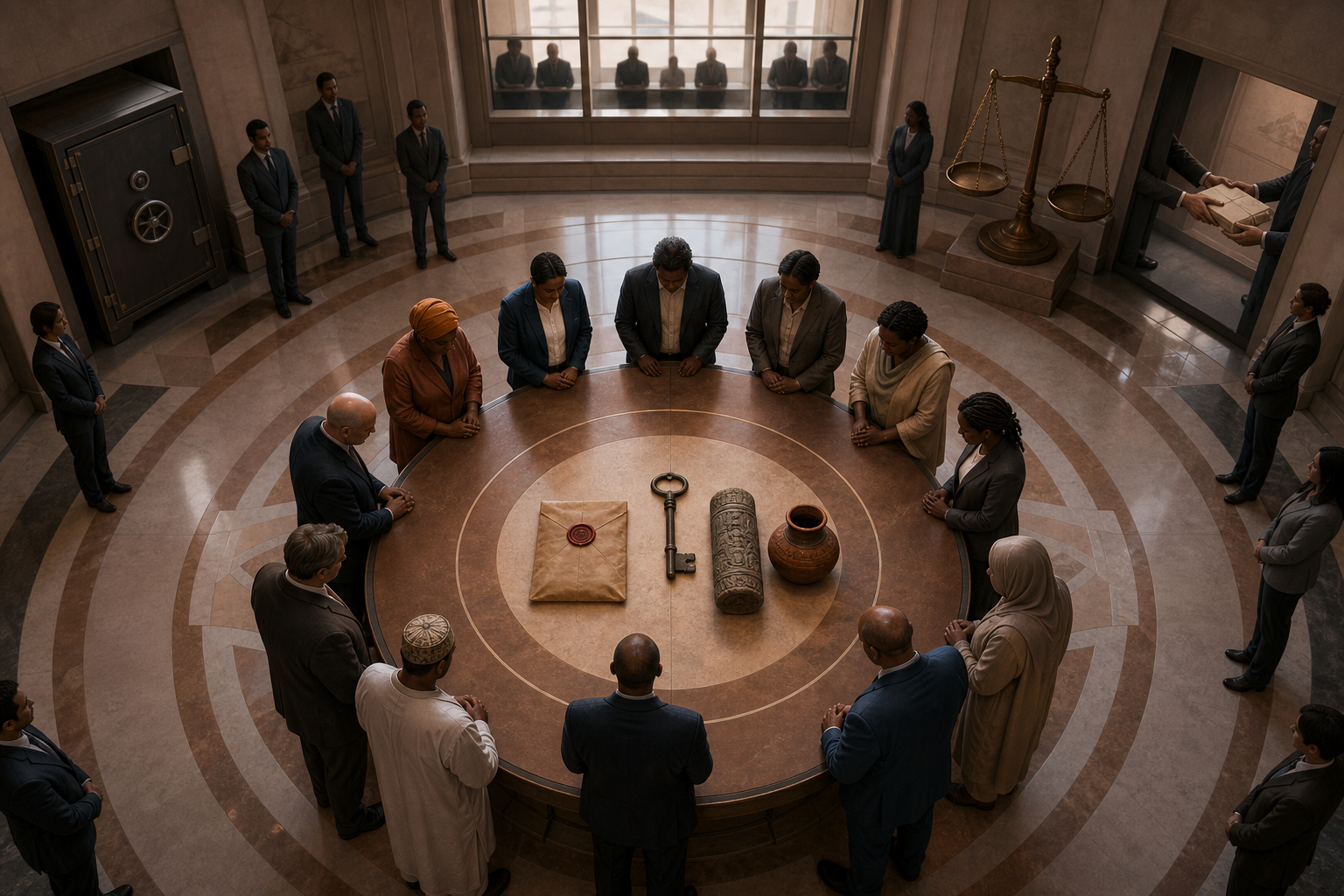
Define the breach before judging it
Clear definitions are the first safeguard against both neglect and overreach. In a workplace, an inquiry must distinguish peaceful religious discussion and voluntary association from conduct that compromises meaningful consent. The conversion-policy article specifically warns that vague concepts such as allurement, undue influence and institutional pressure can leave genuine coercion difficult to prove while also casting suspicion on innocent interaction.
For temple funds, the relevant questions are more concrete but still require written rules: who may open a donation box, who must witness the process, where the count is recorded and how the amount reaches the designated account. For heritage, a breach may appear as a missed inspection, an unresolved lighting failure, unrecorded surface damage or an unsuitable repair. A standard that exists only as a general aspiration cannot produce consistent accountability.
Create evidence before a controversy
Records should be designed during ordinary operations, not improvised after trust has been lost. The workplace article identifies messages, emails, witness accounts, meeting records, performance assessments and human-resources correspondence as possible evidence in a complaint. It also points to lessons from workplace sexual-harassment compliance—without equating the two kinds of allegation—including confidentiality, trained review bodies, documented procedure and protection from retaliation.
The temple article proposes witnessed opening and counting, cross-verification, prompt deposit, surveillance where appropriate and periodic professional audits. The heritage article recommends a baseline condition record using measured documentation, detailed photography, mapping of deterioration and, where feasible, three-dimensional scanning. Across all three settings, contemporaneous records reduce dependence on memory, rumour or selective reconstruction.
Separate custody from verification
An institution should not be the only judge of its own performance. The appropriate reviewer will vary: a trained complaint body or lawful authority for workplace allegations, qualified auditors for entrusted money, and conservation specialists for a historic structure. Independence need not mean removing every person with operational knowledge. It means managing conflicts of interest, giving reviewers access to evidence and ensuring that findings can lead to action beyond the control of the person or office under review.
Connect findings to remedy and prevention
A completed inquiry is not the same as a repaired institution. A workplace response may require protection from retaliation, correction of discriminatory employment consequences and escalation to lawful authorities where warranted. Proven diversion of offerings may require recovery, legal consequences and stronger custody controls. Heritage neglect may require technically appropriate conservation, restored lighting, safer surroundings and a recurring inspection programme. Each remedy should address the immediate harm and the process that permitted it.
Fair process is part of institutional legitimacy

The three cases also demonstrate why urgency must not displace fairness. The donation-box report explicitly treats embezzlement as an allegation until a competent authority determines responsibility. The workplace report calls for credible preliminary assessment, safeguards for complainants and accused persons, and judicial oversight when criminal consequences are possible. These are not procedural obstacles to accountability; they are what distinguishes a reliable finding from a reputational verdict.
Underreaction and overreach can damage the same public trust from opposite directions. A complaint system that exposes an employee to retaliation discourages reporting. A system that treats ordinary religious conversation as presumptively coercive threatens conscience and association. Failure to investigate a discrepancy in temple funds can deepen suspicion, while public accusation without verified evidence can unfairly harm individuals and the institution they serve.
Heritage decisions require a related form of discipline. Visible deterioration may create pressure for immediate repair, but the Zero Stone article cautions that intervention should respect original materials and avoid aggressive work that compromises authenticity. Evidence-based conservation therefore combines responsiveness with technical restraint. Public concern can prompt action, but it cannot substitute for competent diagnosis.
Transparency must likewise be proportionate. Temple income-and-expenditure summaries and public heritage maintenance schedules can make stewardship visible, as the respective reports suggest. Workplace cases generally require tighter confidentiality because belief, employment history and personal allegations may be involved. The accountable principle is not unrestricted disclosure; it is enough verifiable disclosure to show that the responsible process operated without unnecessarily exposing private or security-sensitive information.
Turning attention into durable stewardship

A practical institutional charter can be built around five questions: what is being protected, who is its named custodian, what record proves that duties were performed, who can review failure independently and what remedy follows a substantiated finding? Those questions remain stable even though their operational answers differ among an employer, a temple administration and a civic heritage authority.
For employers, that approach points toward religiously neutral policies, a confidential route for reporting pressure, documented inquiry standards and an explicit prohibition on linking professional benefits or penalties to religious participation. For temples, it points toward divided custody, witnessed counts, prompt reconciliation, qualified audits and appropriately accessible financial summaries. For heritage authorities, it points toward a documented condition baseline, named maintenance responsibility, traceable complaints, conservation-led intervention and public explanation of the site’s significance.
Community participation can reinforce each system without replacing professional responsibility. Employees must be able to report safely; devotees may seek lawful transparency and support auditable donation methods; residents and schools can help make an overlooked monument legible and valued. Yet the institution holding formal authority remains responsible for acting on warnings, maintaining records and closing the loop.
The next test for these institutions is therefore measurable follow-through: whether the announced review produces precise safeguards, whether the donation allegation receives a documented and lawful resolution, and whether the Zero Stone moves from periodic concern to scheduled care. Durable stewardship begins when responsibility remains visible after public attention has moved elsewhere.
References
- DharmaRenaissance Blog — Maharashtra’s Powerful Anti-Conversion Reform Panel: Women, Law and Workplace Rights
- DharmaRenaissance Blog — Shri Ram Mandir Donation Box Case: Urgent Call for Sacred Accountability
- DharmaRenaissance Blog — Pune’s Neglected Zero Stone: A 150-Year Heritage Warning That Demands Urgent Care