
If you need to place a puja, departure, vow, important signature or new course of study between 18 and 25 February 2026, do not begin by copying a clock time labeled “IST.” Begin with your city and the act you intend to perform. Tithi boundaries follow the Sun–Moon relationship, while sunrise-based periods such as Rahu Kalam and Choghadiya change with location.
One firm anchor helps organize the period: on Wednesday, 25 February, Shukla Ashtami ends at 4:47 AM IST and Shukla Navami follows for the rest of the civil day in most regions. For every other decision, the workflow below will help you obtain a usable local answer without pretending that one nationwide timetable fits everyone.
Key takeaways for this eight-day period
- Reset the Panchang at each local sunrise. A tithi can change at any clock time, so a civil date does not necessarily correspond to one complete lunar day.
- Use the exact city of observance. Sunrise, sunset, moonrise, Rahu Kalam, Yamaganda, Gulika, Choghadiya, Abhijit Muhurat and Lagna cannot be transferred safely from another city.
- On 25 February, the known pre-dawn transition is from Shukla Ashtami to Shukla Navami at 4:47 AM IST in most regions. Confirm the displayed local time if you live outside India.
- Routine japa, seva and study do not require an elaborate election. A vrata, samskara, property ceremony or irreversible business launch deserves a fuller check.
- Choose a primary window and a backup window. A tithi, Nakshatra, Karana or avoidance period can change inside an otherwise attractive interval.
What changes from 18 to 25 February—and what does not
The period contains eight civil dates, from one Wednesday to the next. The weekday is fixed, but the lunar factors must be read anew for the intended hour. This is the practical frame to use:
| Date | Reliable planning frame | What you should do |
|---|---|---|
| Wednesday, 18 February | Under the standard Wednesday daylight division, Yamaganda is the second eighth, Gulika the fourth and Rahu Kalam the fifth. | Calculate those three intervals from your own sunrise and sunset before selecting Abhijit or Choghadiya. |
| Thursday, 19 February | Guruvara traditionally supports learning, counsel, benefaction and sacred study, subject to the tithi, Nakshatra, Yoga and Karana active at the chosen hour. | Use the day’s character for study, teaching or consultation, but do not treat Thursday alone as a complete muhurta. |
| Friday, 20 February | The weekday changes, but no weekday label can tell you whether a tithi or Nakshatra boundary falls inside your intended window. | Open a city-specific entry for Friday rather than extending Thursday’s lunar data into the next civil date. |
| Saturday, 21 February | Shanivara emphasizes discipline, duty, patience and service in customary interpretation. | Maintenance, long-range planning, structured sadhana and seva fit the tone naturally. Check a full muhurta before a ceremonial beginning. |
| Sunday, 22 February | Ravivara is associated with clarity, vitality, purpose and Surya worship. | Surya arghya, Gayatri japa and acts requiring visibility or renewal fit the weekday, provided the local avoidance periods are clear. |
| Monday, 23 February | A new sunrise brings a new daily Panchang configuration even if a lunar factor continues from the night before. | Record the factor prevailing at sunrise and every transition that could affect your planned hour. |
| Tuesday, 24 February | This is the final civil date before the known Ashtami-to-Navami transition early on Wednesday. | Do not infer that Ashtami occupies all of Tuesday. Verify the actual tithi start and end for your location. |
| Wednesday, 25 February | Shukla Ashtami lasts until 4:47 AM IST, followed by Shukla Navami in most regions. | For a daytime act in India, begin with Navami as the likely operative tithi, then confirm local sunrise, Nakshatra, Yoga and Karana. |
A missing universal clock time is not a missing Panchang. It means the value must be generated for the place where you will actually make the sankalpa, begin the journey or perform the rite. This matters especially across India’s long east–west span and for families living outside India.
Build a correct local day sheet before choosing a time
You can reduce most Panchang confusion by writing one row for each date and filling it in the same order. Use a trusted city-specific Panchang, temple almanac or astronomical application consistent with your sampradaya.
- Fix the place of observance. Enter the city where the act begins, not the city of the family priest, the temple livestream or the person receiving your call.
- Write down local sunrise and sunset. Add moonrise and moonset when the vrata, puja or parana depends on seeing or invoking the Moon.
- Record the five limbs: Vara, Tithi, Nakshatra, Yoga and Karana. Note both the value at sunrise and every change that occurs before your planned activity ends.
- Apply the observance rule. Many daily decisions use the tithi prevailing at sunrise, but a vrata may depend on the tithi at moonrise, evening or another prescribed period. Follow the rule of the observance rather than a generic sunrise rule.
- Block Rahu Kalam, Yamaganda, Gulika and Durmuhurtham where your tradition treats them as exclusions. Also mark Varjyam and Vishti, or Bhadra, Karana when they appear.
- Identify positive working windows. Start with Amrit, Shubh or Labh Choghadiya, Amrit Kalam where published, or a permitted Abhijit interval.
- Personalize only after the general window survives. Tarabalam, Chandrabalam and Lagna refine a usable interval; they should not be the first filter.
Calculate Wednesday’s daytime exclusions correctly
Let S be local sunrise and E be local sunset. The daylight duration is E minus S. Divide that duration by eight to obtain one segment, which we can call P. On both Wednesday, 18 February, and Wednesday, 25 February, the standard assignments are:
- Yamaganda: S + P through S + 2P, the second daylight segment.
- Gulika: S + 3P through S + 4P, the fourth daylight segment.
- Rahu Kalam: S + 4P through S + 5P, the fifth daylight segment.
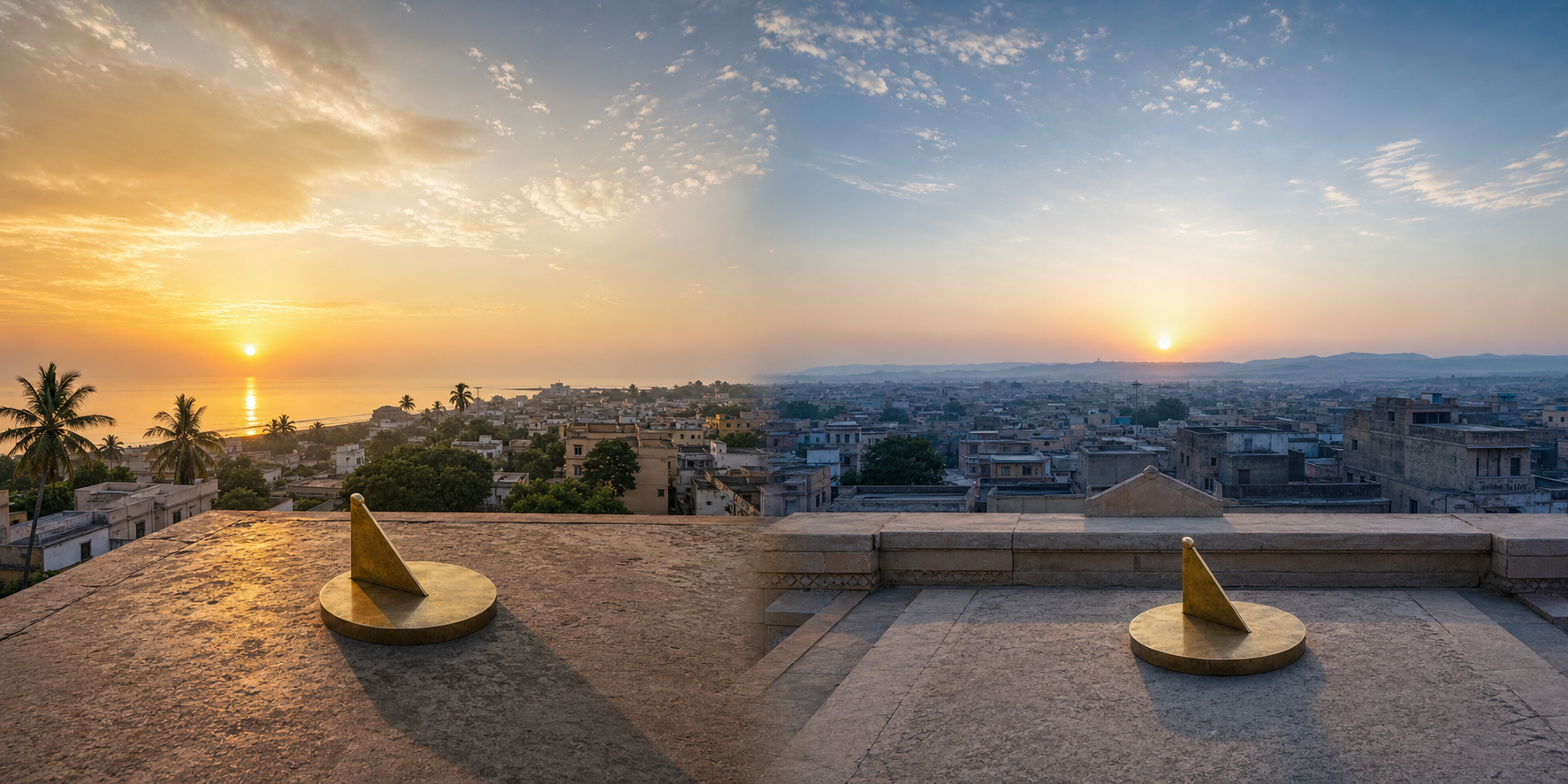
This is why a remembered “6 AM to 6 PM” schedule is unreliable. The segment length contracts or expands with the actual daylight span. Even two cities using IST can produce different clock boundaries because their local sunrises and sunsets differ.
Do not assume Abhijit automatically rescues Wednesday noon
Abhijit Muhurat is centered on the midpoint between local sunrise and sunset and lasts roughly 48 minutes, about 24 minutes on either side of that midpoint. Wednesday creates a useful caution: the fourth daylight segment ends at the midpoint and the fifth begins there. Because Wednesday assigns Gulika to the fourth and Rahu Kalam to the fifth, a midday Abhijit interval falls across those two periods under the standard calculation.
If your school excludes both Gulika and Rahu Kalam from new beginnings, do not select Abhijit merely because it carries an auspicious label. Choose a separate Shubh, Labh or Amrit Choghadiya that survives the other checks, or follow the precedence rule given by your family priest or temple Panchang. This midday overlap applies to both Wednesdays in the period.
Use Choghadiya as a practical filter, not a complete election
Day Choghadiya divides sunrise to sunset into eight parts; night Choghadiya separately divides sunset to the following sunrise. Amrit, Shubh and Labh are ordinarily preferred for beginnings. Char is functional for movement and travel. Rog, Kaal and Udveg are generally avoided for fresh starts.
Choghadiya is especially useful for a departure, purchase, application submission or first phone call when a full natal election would be disproportionate. It does not erase an unsuitable tithi, Bhadra, a vrata rule or a strong local prohibition. Treat it as a convenient shortlist, then cross-check the shortlisted interval.
Match the depth of calculation to the action
Not every act needs the same amount of astrological filtering. Over-calculating an ordinary practice can make sadhana fragile; under-calculating a costly or sacred beginning can create avoidable doubt. Use the smallest sufficient check for the decision in front of you.
| Activity | Minimum useful check | When to go deeper |
|---|---|---|
| Daily japa, meditation, darshan, svadhyaya or seva | Choose a consistent, calm time. Note the tithi if it informs your sankalpa. | Use a special window only when beginning a vrata, anushthana or formal course of practice. |
| Vrata, parana or Moon-dependent observance | Verify the exact tithi at the prescribed part of the day and obtain local moonrise when required. | Consult the sampradaya rule if the tithi touches two sunrises or changes close to the relevant period. |
| Journey, interview, purchase or application | Avoid the locally calculated weekday exclusions and select a favorable Choghadiya. | Add Tarabalam and Chandrabalam when the event is difficult to repeat or personally consequential. |
| Contract, company launch or substantial financial commitment | Check Tithi, Nakshatra, Yoga, Karana, Rahu Kalam, Yamaganda, Gulika, Durmuhurtham and the final chosen Lagna. | Use a qualified muhurta practitioner when several people, large sums or an irreversible public launch are involved. Panchang timing does not replace legal, tax or financial review. |
| Griha Pravesh, marriage, samskara or consecration | Use a city-specific election consistent with the family and ritual lineage. | Include natal compatibility, Lagna and priestly requirements rather than relying on Choghadiya alone. |
| Urgent health, safety or welfare action | Act without delay. | Prayer or sankalpa can accompany necessary action, but no muhurta should postpone medical care, emergency travel or protection from harm. |
When the indicators disagree, use a clear order of priority
- Protect dharma, health, safety, legal obligations and unavoidable deadlines.
- For a vrata or ritual, satisfy the observance-specific tithi, sunrise, moonrise, pradosha or parana rule.
- Remove the periods your lineage explicitly avoids, including Vishti or Bhadra where applicable.
- Choose an affirmative window such as Amrit, Shubh or Labh Choghadiya, Amrit Kalam or an unobstructed muhurta.
- Test the surviving options with Tarabalam and Chandrabalam.
- Use Lagna to refine the final choice when the importance of the act justifies that precision.
For Tarabalam, count inclusively from your Janma Nakshatra to the Nakshatra operating during the proposed window, then place the result in a repeating cycle of nine. Sampat (2), Kshema (4), Sadhana (6), Mitra (8) and Parama Mitra (9) are generally supportive. Vipat (3), Pratyak (5) and Naidhana (7) are usually avoided for major beginnings. Janma (1) is treated with balance rather than assumed to be universally favorable.
Chandrabalam compares the day’s Moon sign with your Janma Rashi. A common household rule treats the first, third, sixth, seventh, tenth and eleventh signs from the natal Moon as broadly supportive. When Tarabalam and Chandrabalam both support the same surviving interval, you have a stronger personal choice. When they conflict, use the less consequential window for routine action and obtain qualified help for an important election.
Lagna is the final refinement, not a substitute for everything above. Fixed signs—Vrishabha, Simha, Vrishchika and Kumbha—are commonly chosen for stability and foundations. Chara signs—Mesha, Karka, Tula and Makara—suit movement and launches. Dual signs—Mithuna, Kanya, Dhanu and Meena—fit learning and adaptable undertakings. The Ascendant and its lord must still be assessed for the exact place and time.
Plan 25 February around the pre-dawn Navami transition
The clearest date-specific instruction in this period concerns Wednesday, 25 February. Shukla Ashtami remains until 4:47 AM IST; Shukla Navami then prevails for the remainder of the civil day in most regions. If your practice begins before that transition, record Ashtami in the sankalpa. If it begins after the transition, use Navami, subject to the way your local Panchang translates the instant and determines the sunrise day.
Monthly Shukla Navami should not be confused with Chaitra Shukla Navami, Rama Navami. This February Navami is an ordinary monthly tithi. Its traditional emphasis suits consolidation, clarity, dharmic resolve, svadhyaya, sattvic vrata, daan and seva. It is better used for measured commitment than for attaching festival significance that the date does not possess.
- Before 4:47 AM IST: anyone performing a pre-dawn rite should verify whether Ashtami is still active at the exact local clock time.
- At local sunrise: confirm the tithi displayed by your city Panchang, then make the sankalpa with the locally accepted month and paksha convention.
- Around midday: remember the Wednesday overlap among Abhijit, fourth-segment Gulika and fifth-segment Rahu Kalam. Use another window if your tradition excludes both doshas.
- For a signature, departure or launch: confirm that the chosen interval also avoids Durmuhurtham, Varjyam and Vishti or Bhadra, and that the Nakshatra does not change midway.
- For study, japa, daan or seva: use a sustainable time even if no elaborate muhurta is available. These acts need sincerity and completion more than an endlessly postponed “perfect” combination.
Regional month names and observance rules may differ under Amanta and Purnimanta systems. A diaspora household should use its actual local sunrise and time zone while remaining consistent with its ancestral sampradaya or temple authority. Mixing an Indian clock table, a foreign sunrise and a third region’s festival rule creates apparent precision but not a coherent Panchang decision.
The Hindu Panchang is the direct framework for the muhurta method used here. Buddhist Uposatha, Jain Poshadha and Sikh calendrical practice express related civilizational attention to sacred time, but their rules and authorities remain distinct. Shared lunar awareness should encourage mutual understanding, not the assumption that every Dharmic tradition applies the same tithi or muhurta procedure.
For this period, prepare one local row for each of the eight dates. Mark the transitions, exclude the periods your lineage avoids, and write down one primary and one backup window beside the actual task. That single page will be more useful than a long list of attractive clock times copied from a city where you are not standing.
References
- DharmaRenaissance Blog — February 25, 2026 Panchang Guide: Shukla Paksha Navami, Auspicious Timings, Nakshatra & Rashi
- DharmaRenaissance Blog — Complete Panchang for 18 February 2026 (IST): Tithi, Nakshatra, Choghadiya & Shubh Muhurat
- DharmaRenaissance Blog — Unlock 19 February 2026 (IST) Panchang: Sacred Tithi, Nakshatra, Yoga and Auspicious Hours
- DharmaRenaissance Blog — Panchang 21 Feb 2026 (IST): Auspicious Timings, Tithi, Nakshatra, Yoga & Practical Guide
- DharmaRenaissance Blog — Comprehensive Panchang for 22 February 2026 (IST): Tithi, Nakshatra, Choghadiya, Muhurat Guide
