
If you are arranging a puja, vrata, or family observance for Friday, October 9, 2026, do not treat the civil date as one unbroken lunar day. The important change comes late in the evening, when Chaturdashi gives way to Amavasya.
You can use the timing below to distinguish the two tithis. Before fixing a ritual schedule, however, you should also confirm the time for your location and identify which part of the tithi your tradition requires.
October 9, 2026 Panchang at a glance
On Friday, October 9, Krishna Paksha Chaturdashi continues until 8:58 PM, after which Amavasya begins. Chaturdashi is the fourteenth tithi of the waning, or dark, half of the lunar month. Amavasya is the no-moon tithi that follows it.
| Period on October 9 | Prevailing tithi | How to read it |
|---|---|---|
| Before the 8:58 PM transition | Krishna Paksha Chaturdashi | The date remains in the fourteenth tithi of Krishna Paksha. |
| After 8:58 PM | Amavasya | The lunar date has changed even though the civil date is still October 9. |
This establishes when Amavasya begins; it does not establish when Amavasya ends. Do not infer its complete duration from the starting time alone.
Why the 8:58 PM transition matters
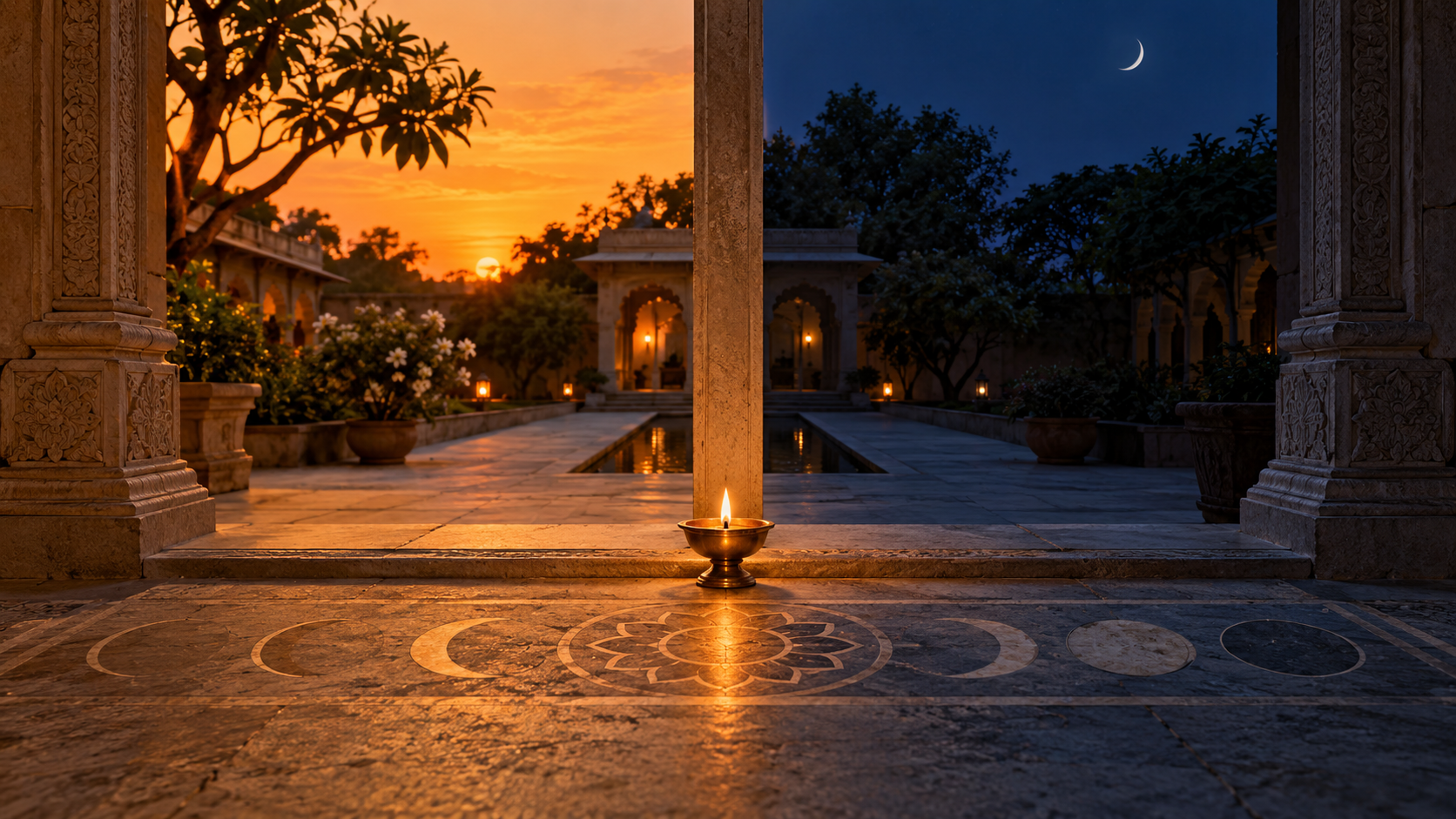
A tithi does not begin or end at civil midnight. It follows the lunar cycle and can change at any clock time. That creates a common planning error: someone sees October 9 associated with Chaturdashi and assumes that every hour of Friday belongs to Chaturdashi.
For this date, the daytime and most of the evening fall under Krishna Paksha Chaturdashi. Only the later part of the evening, after 8:58 PM, falls under Amavasya. If a ceremony spans the transition, note when its central ritual act is meant to occur rather than labelling the entire event by the civil date.
The transition does not automatically tell you which civil date should carry a vrata or festival observance. Some observances depend on the tithi prevailing at sunrise; others use sunset, Pradosha, or another prescribed ritual period. Apply the rule of the particular observance instead of using a single rule for every vrata.
The tithi change is not an auspicious-time recommendation
Do not interpret 8:58 PM as a muhurta. It marks the boundary between two tithis; it does not mean that the moment itself is especially favourable or unfavourable.
Tithi is only one part of a full Panchanga assessment. Vara, nakshatra, yoga, and karana also matter, while the purpose of the activity may introduce further rules. A wedding, griha-pravesh, samskara, or other event requiring a formal muhurta therefore cannot be scheduled from this tithi boundary alone. Nor can the change establish a nakshatra, rashi position, or a general-purpose “good time.”
The practical distinction is simple: use 8:58 PM to identify the lunar-date transition, but use a location-specific Panchang and the rules for your intended rite to select its actual time.
How to apply the date to your puja or vrata
- Confirm the city and time zone. Panchang times should be read for the place where the observance will occur. Do not carry a clock time from one country or city into another without verification.
- Name the exact observance. “Amavasya puja” or “Chaturdashi puja” may be too broad for a priest or temple calendar to resolve. State the vrata, deity, family practice, or rite you intend to perform.
- Ask which ritual period controls the date. Determine whether your tradition uses the tithi at sunrise, sunset, Pradosha, or another part of the day. This decides whether the late-evening arrival of Amavasya changes your schedule.
- Separate the tithi from the muhurta. If the activity requires an auspicious window, obtain the complete local Panchang calculation. The fact that Amavasya begins after 8:58 PM is not enough to choose that window.
- Write the schedule in two parts. Mark the earlier part of October 9 as Krishna Paksha Chaturdashi and the period after 8:58 PM as Amavasya, subject to local confirmation. This prevents household members from working from different assumptions.
If you are checking with a temple or purohit, ask one precise question: “For my city, which tithi governs this specific observance on October 9, 2026, and what ritual window should we use?” That question gives them the information needed to resolve the late-evening transition.
Key takeaways
- Friday, October 9, 2026 is Krishna Paksha Chaturdashi until 8:58 PM.
- Amavasya begins after 8:58 PM on the same civil date.
- The transition time identifies a change of tithi; it is not automatically an auspicious muhurta.
- Confirm the timing for the city where the observance will take place.
- For a vrata or festival, apply its rule for sunrise, sunset, Pradosha, or other prescribed ritual period.
Put the 8:58 PM boundary on your calendar now. Then verify the local Panchang and the governing rule of your observance before you announce a puja time to the family or community.
References

Leave a Reply
You must be logged in to post a comment.