
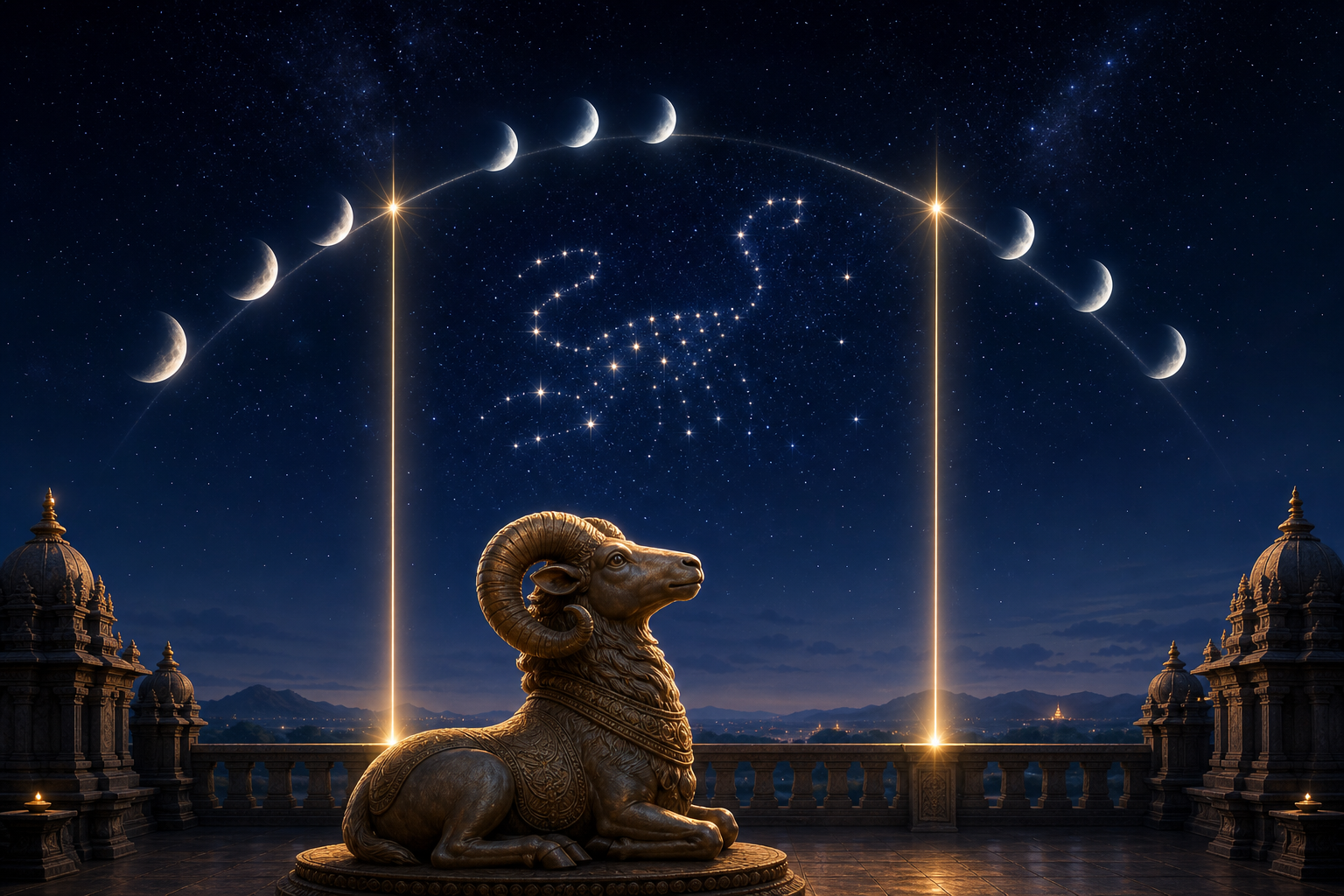
Your Panchang marks Chandrashtama, but an important journey, meeting, or decision is already on the calendar. Do you need to move it, and if so, for how long? For Mesha Rashi, the answer depends on a precise interval rather than a blanket ban covering one or more civil dates.
If your natal Moon is in Mesha, Chandrashtama begins when the transiting Moon enters Vrischika Rashi and ends when it leaves Vrischika. Check those two local timestamps first. Then distinguish between work that is important and elective, work that is routine, and obligations that would become riskier if delayed.
The Mesha Chandrashtama timing rule
Chandrashtama, or Ashtama Chandra, is the period during which the Moon transits the eighth sign from your natal Moon sign. It is based on Chandra Rashi, not automatically on your Sun sign, ascendant, name, or the sign used in a general horoscope column.
For a natal Moon in Mesha, count the signs from Mesha itself: Mesha is first, Vrishabha second, Mithuna third, Karka fourth, Simha fifth, Kanya sixth, Tula seventh, and Vrischika eighth. The Moon’s stay in Vrischika is therefore the Mesha Chandrashtama window.
You qualify as Mesha Rashi if your natal Moon occupies any pada of Ashwini, any pada of Bharani, or the first pada of Krittika. If you know only your birth nakshatra, this distinction matters: Krittika first pada belongs to Mesha, while the remaining Krittika padas do not.
The interval generally lasts about two and a quarter to two and a half days each month. That duration does not mean that every date touched by the transit is wholly Chandrashtama. If the Moon enters Vrischika during an afternoon, the morning before ingress is outside the interval. If it leaves during a morning, the remainder of that date is also outside it.
How to find the exact local start and end
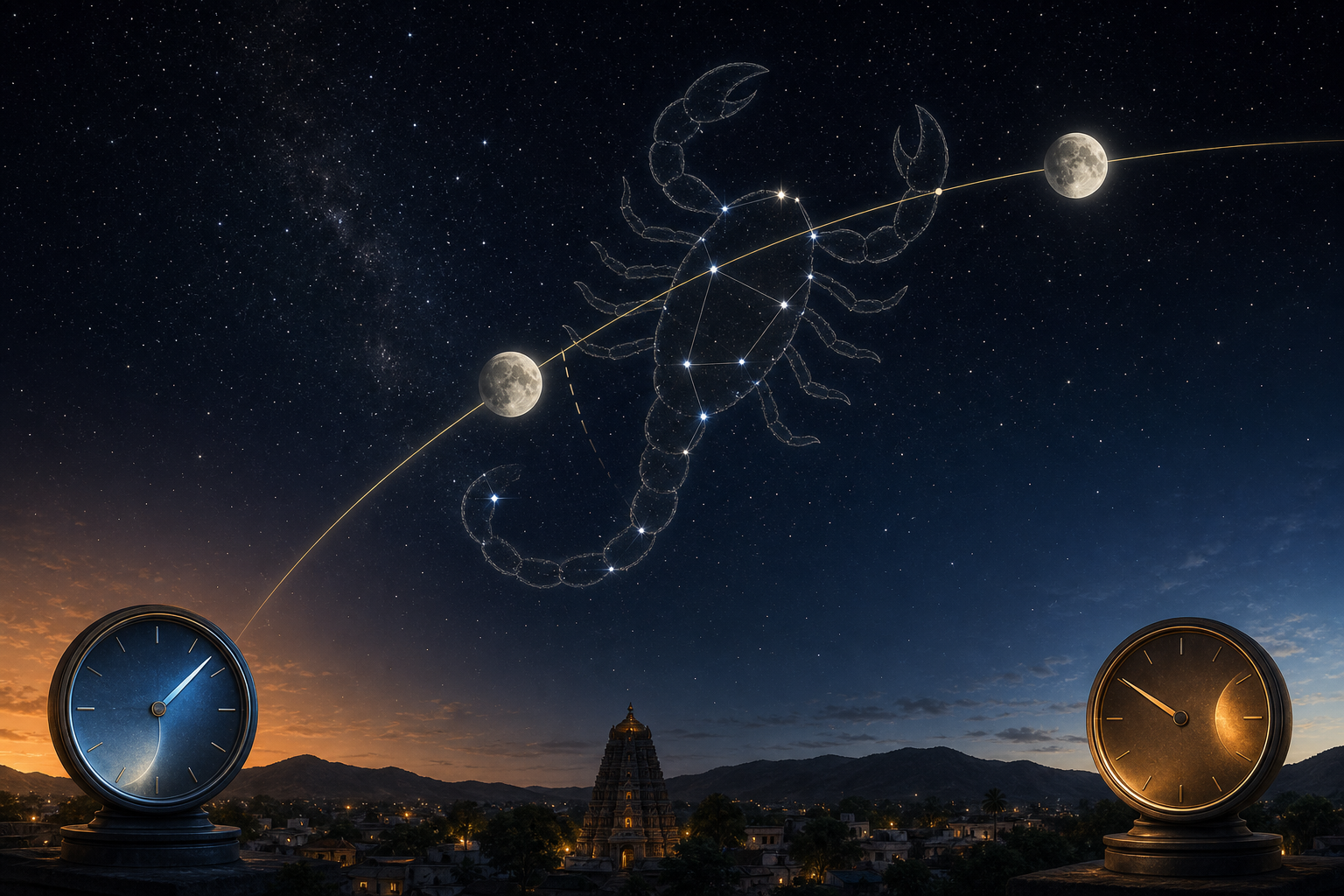
A generic list of Chandrashtama dates can help you look ahead, but it cannot replace the ingress and egress times shown for your location. Use this process whenever you need dependable 2026 timing:
- Confirm the natal Moon sign. Read the Chandra Rashi in your birth chart. Proceed with the Mesha calculation only if it says Mesha, or if the Moon is in Ashwini, Bharani, or Krittika first pada.
- Set the Panchang location. Select the city where you will be during the interval and verify its time zone. Do not assume that a date-and-time list prepared for another city is identical to your local display.
- Open the Moon-sign transit details. Look for labels such as Chandra Rashi, Moon transit, Rashi Pravesha, or Rashi change. A festival-only calendar may omit the exact transition times you need.
- Record the Vrischika ingress. The moment the Moon enters Vrischika is the start of Mesha Chandrashtama.
- Record the following egress. The moment the Moon leaves Vrischika for Dhanu is the end. Treat everything between the two timestamps as one continuous interval, even when it crosses midnight or spans parts of several dates.
- Stay with one calculation system. Panchangs using Lahiri and other ayanamshas can display differences. Use the system followed by your family, temple, or regular Panchang rather than combining the start time from one system with the end time from another.
Write the result in interval form: “starts on [date] at [time]; ends on [date] at [time].” That small habit prevents the most common practical error, which is turning a timed transit into an all-day prohibition. It also makes scheduling easier because you can see whether an appointment falls before ingress, inside the interval, or after egress.
If two calendars disagree, first check their city, time zone, ayanamsha, and whether the displayed time refers to ingress or to sunrise. Do not choose whichever time is more convenient. Consistency is more useful than switching systems from month to month.
What to postpone, and what should continue
Traditional practice treats Ashtama Chandra as a comparatively unsettled or inward-facing period. People may associate it with temporary sensitivity, lower stamina, hesitation, or delays. These are tendencies within a Jyotisha observance, not guaranteed events. Chandrashtama should guide proportionate planning, not create fear that every action will fail.
A useful decision rule is to consider rescheduling only when an activity is both consequential and genuinely elective. Common candidates include:
- Launching a major venture or making its first public commitment.
- Beginning long-distance travel when the departure can be moved without creating another problem.
- Opening a high-stakes negotiation or pressing for an irreversible answer.
- Making a major decision while already tired, emotionally reactive, or short of reliable information.
Routine responsibilities do not need to stop. Chandrashtama is well suited to reviewing documents, completing pending work, reconciling finances, checking travel arrangements, organizing records, backing up important data, correcting errors, and maintaining systems that already exist. These tasks reduce uncertainty without forcing a premature beginning.
Do not miss essential medical care, a safety obligation, a legal or financial deadline, or unavoidable travel merely because the transit is active. The cost of delay can be concrete, while the astrological guidance is meant to encourage care. When an important event must proceed, add safeguards: read documents twice, confirm times and addresses, keep decisions in writing, allow a practical buffer, and ask a trusted person to check details that are difficult to reverse.
Use the interval as a controlled pause

Mesha is associated with initiative and rapid movement. The most constructive response to Chandrashtama is therefore not passivity but disciplined deceleration. Keep necessary work moving while reducing impulsive additions, reactive messages, and avoidable commitments.
Gentle practices may help you hold that pace. Choose a familiar japa rather than collecting elaborate remedies, use unforced pranayama to settle attention, recite a Mesha Rashi stotram if it belongs to your practice, or spend time in quiet study. Seva and a simple gratitude reflection can redirect attention from self-created urgency toward useful action. These practices support steadiness; they should not be treated as transactions that promise to cancel a transit.
You can also test how useful the observance is in your own life. Over several Chandrashtama cycles, note the exact start and end times, your energy, any unusual delays, and the quality of decisions made inside the window. Keep the record brief and include uneventful periods as well as difficult ones. Otherwise, memory will naturally give more weight to the occasions that fit your expectation.
Key takeaways
- Mesha Chandrashtama applies when your natal Moon is in Mesha, including Ashwini, Bharani, and Krittika first pada.
- It starts at the Moon’s local ingress into Vrischika and ends at its egress from Vrischika; it is not automatically a set of complete calendar days.
- The monthly interval usually runs for roughly two and a quarter to two and a half days, but exact timestamps depend on location and calculation method.
- Consider moving major elective beginnings, travel, and high-stakes negotiations; continue routine, necessary, and safety-critical responsibilities.
- Use one Panchang system consistently, and support unavoidable decisions with written checks, realistic buffers, rest, and calm spiritual practice.
Before the Moon next enters Vrischika, save the local ingress and egress in your calendar as one timed block. Put elective beginnings outside it where practical, place review and maintenance work inside it, and let the boundary times guide you more precisely than a fear of the date itself.
References
