
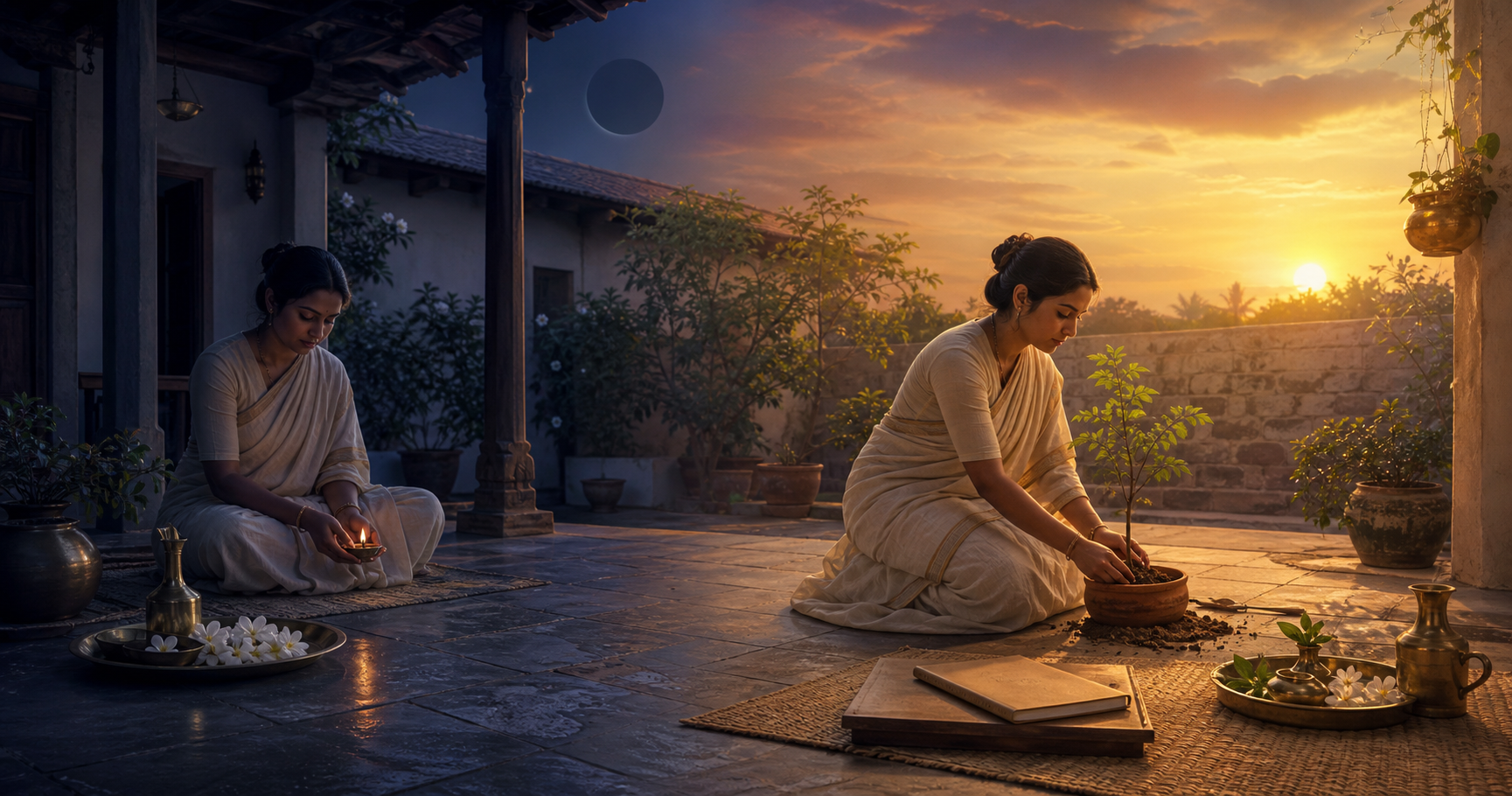
You are probably not looking for a decorative calendar entry. You need to know whether March 19 is a day for an Amavasya observance, a new beginning, or both, and which clock time should govern your decision.
Thursday, March 19, 2026 contains both phases. The general reference for the date has Amavasya continuing until about 6:40 AM, followed by Shukla Paksha Pratipada. Use the earlier phase for remembrance, completion, and inward practice. Place an ordinary new beginning after the transition, but only after checking the muhurta for your own city. The 6:40 AM boundary is not, by itself, an auspicious-time guarantee.
The 6:40 AM change is a boundary, not the whole muhurta
A tithi does not begin at midnight and remain attached to the civil date. It is determined by the changing longitudinal angle between Surya and Chandra. Each tithi covers 12 degrees of separation. Amavasya belongs to the conjunction at the end of the waning cycle, while Shukla Pratipada begins as the Moon moves into the first 12 degrees of the waxing cycle. Because the Moon does not move at a perfectly uniform rate, that transition can occur at any clock hour.
This distinction prevents the most common planning mistake. After 6:40 AM, the tithi may support a beginning, but the proposed time can still fall inside Rahukalam, Yamaganda, Gulika Kalam, or an unfavorable Choghadiya. Think of the tithi change as the first gate. A usable muhurta must pass the remaining local gates as well.
The clock time also requires a location. Tithi, sunrise, sunset, and the daylight divisions used for muhurta vary with longitude, latitude, and time zone. If you live outside India, do not merely convert 6:40 AM from an assumed Indian time zone. Confirm the tithi ending time displayed for your city. Even within India, use a Panchang calculated for the place where the activity will begin.
Use the morning in two distinct phases
March 19 becomes easier to use when you separate closure from initiation. This does not require turning every household action into an elaborate ceremony. It requires matching the purpose of the act to the lunar phase.
- Before the locally confirmed tithi transition: give priority to quiet sadhana, japa, dana, deepa-dana, and pitri-tarpana where that rite belongs to your family or sampradaya. You can also complete an end-of-cycle review, release an abandoned commitment, or finish the closing portion of a vrata.
- At the transition: treat 6:40 AM as a handoff between tithis, not as the opening of an automatically clean muhurta. Check where it falls in relation to local sunrise and the Thursday avoidance periods.
- After Shukla Pratipada begins: favor modest, constructive starts such as opening a new course of study, drafting the first page of a project, beginning a disciplined routine, or making the first formal step in a plan already considered carefully.
- For an important ceremonial beginning: do not rely on tithi alone. Verify Nakshatra, Yoga, Karana, Moon Rashi, and the activity-specific rules followed by your tradition. A general daily Panchang cannot replace a dedicated marriage or samskara muhurta.
Guruvara, or Thursday, adds a useful emphasis. The weekday is associated with Guru and Jupiter, so study, teaching, counsel, generosity, scriptural reading, and Guru-oriented worship fit the tone of the day particularly well. If you have several possible beginnings, a learning commitment or dharmic discipline is a more natural choice than starting something merely for novelty.
The threshold can also be honored without treating Dharmic practices as interchangeable. A Hindu household may choose japa, charity, lamp offering, or customary ancestral rites. A Buddhist practitioner may observe the new-moon Uposatha through meditation and ethical reflection. A Jain practitioner may emphasize pratikraman and disciplined food habits. A Sikh need not adopt lunar ritual calculations to participate in the underlying movement from remembrance to service; simran and seva provide their own coherent form. Choose the discipline proper to your path rather than assembling a generic ceremony from several traditions.
Build a Thursday muhurta from your local daylight
Rahukalam, Yamaganda, and Gulika Kalam are not fixed clock periods throughout the year. They are generated from local daylight. Start with the sunrise and sunset for your city, calculate the full sunrise-to-sunset duration, and divide it into eight equal segments. Number those segments from one to eight, beginning at sunrise.
- Record local sunrise and sunset for March 19, 2026.
- Subtract sunrise from sunset to obtain the daylight duration.
- Divide that duration by eight to obtain the length of one daytime segment.
- On Thursday, mark the first segment as Yamaganda, the third as Gulika Kalam, and the sixth as Rahukalam.
- Discard any proposed start time that falls within those segments.
- Among the remaining post-Pratipada times, prefer a favorable Choghadiya or a properly calculated Abhijit Muhurta where appropriate.
| Filter | Thursday placement or quality | How to use it |
|---|---|---|
| Yamaganda | First eighth of local daylight | Avoid beginning an important undertaking. |
| Gulika Kalam | Third eighth of local daylight | Exclude it from your preferred starting windows. |
| Rahukalam | Sixth eighth of local daylight | Do not initiate the principal action during this period. |
| Favorable Choghadiya | Shubh, Labh, or Amrit | Prefer one of these after the tithi transition and outside the three avoidance periods. |
| Char Choghadiya | Generally neutral to positive | Consider it especially for movement or travel when a stronger segment is unavailable. |
| Unfavorable Choghadiya | Rog, Kaal, or Udveg | Avoid using it for the main beginning. |
| Abhijit Muhurta | Centered on local solar noon | Use as a general fallback for suitable ordinary beginnings, not as a substitute for a marriage muhurta. |
Abhijit Muhurta lasts roughly one-fifteenth of the daylight span and is placed symmetrically around local solar noon. It can help when an urgent or routine beginning has no other clean window, but it should not be used to force every ceremony into the same rule. Marriage and other selected samskaras require their own electional criteria.
The practical method is intersection, not substitution. First require Shukla Pratipada. Then remove Rahukalam, Yamaganda, and Gulika Kalam. Next, look for Shubh, Labh, or Amrit Choghadiya among the surviving periods. Where no suitable ordinary window remains, examine the locally published Abhijit Muhurta instead of inventing a clock time from a national calendar.
Verify the month, Nakshatra, and Rashi before naming the observance
Two correct Panchangs can appear to disagree because they use different lunar-month conventions. Amanta and Purnimanta systems label the surrounding Phalguna-Chaitra transition differently. Festival practice also often depends on the tithi present at local sunrise, not simply on whether Pratipada appears somewhere within the civil date.
That sunrise rule matters for regional New Year observances associated with Chaitra Shukla Pratipada. Ugadi or Gudi Padwa may be assigned to March 19 or March 20 according to the local sunrise and the tithi prevailing then. Do not announce a universal festival date from the 6:40 AM transition alone. Check the convention used by your temple, community, or family calendar.
The broad astronomical setting places Surya in Meena, with Chandra near Surya during Amavasya and commonly in Meena Rashi around the conjunction. As the Moon advances into Shukla Pratipada, the relevant Nakshatra is likely to be in the late-Pisces sector, often Uttara Bhadrapada or Revati. That is useful context, but “likely” is not accurate enough for choosing a precise muhurta. Nakshatra boundaries and ending times must come from a city-specific calculation.
Yoga and Karana add two more layers. Yoga is derived from the combined longitudes of the Sun and Moon, while Karana divides each tithi into halves. If the activity matters enough for you to ask which Nakshatra supports it, it matters enough to inspect Yoga and Karana too.
- Confirm the city and time zone selected in the Panchang.
- Record local sunrise, sunset, and the exact Amavasya ending time.
- Check the Nakshatra and its ending time rather than relying only on its name.
- Confirm Moon Rashi, Yoga, and Karana for the intended start.
- Copy the locally calculated Rahukalam, Yamaganda, Gulika Kalam, Choghadiya, and Abhijit periods.
- For a shared community event, state which city’s Panchang governs the schedule so participants understand the calculation.
Key takeaways for March 19
- March 19, 2026 is Thursday, with Amavasya ending at about 6:40 AM in the general reference and Shukla Pratipada following it.
- Use the pre-transition phase for remembrance, completion, charity, and contemplative practice; favor ordinary new beginnings after the transition.
- Do not treat 6:40 AM as a universal local time or a complete muhurta.
- For Thursday daylight, Yamaganda occupies the first eighth, Gulika Kalam the third, and Rahukalam the sixth.
- Prefer Shubh, Labh, or Amrit Choghadiya after eliminating the avoidance periods; Char can be considered for travel.
- Use Abhijit Muhurta as a suitable general fallback around local solar noon, not as a substitute for a dedicated marriage or samskara muhurta.
- Verify the festival date, Nakshatra, Rashi, Yoga, and Karana in a Panchang calculated for your city.
Before committing to a time, write down three things: the locally confirmed tithi transition, the Thursday periods you must exclude, and the best favorable interval that remains. That small calculation turns March 19 from a vague “auspicious day” into a schedule you can follow with clarity and respect for your own tradition.
References
