
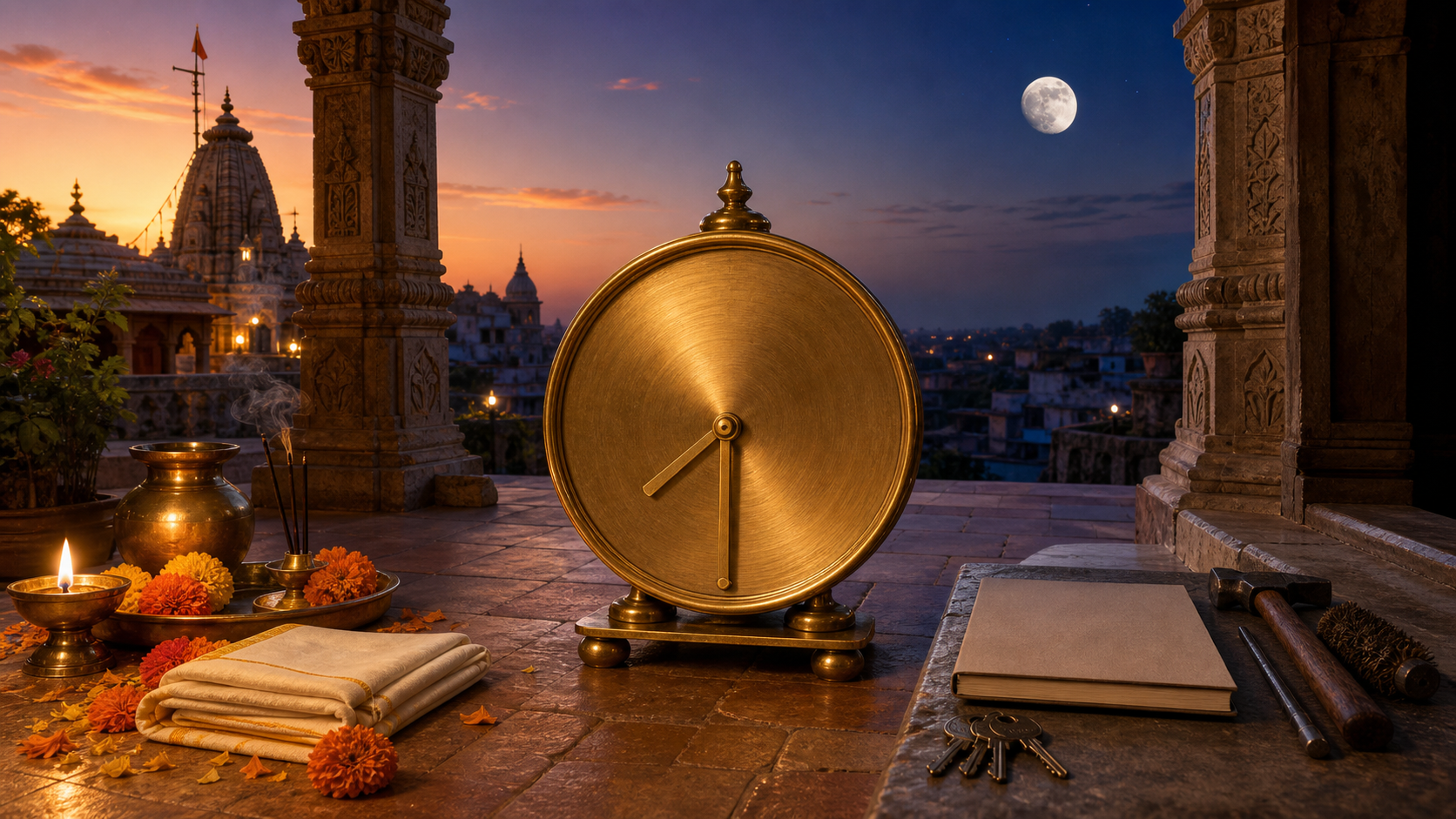
If you are deciding whether June 23 should be a day for worship and preparation or a day for beginning something practical, the decisive boundary comes in the evening. For most Indian locations, Tuesday remains Shukla Paksha Navami until about 7:30 PM, after which Shukla Paksha Dashami begins.
Use 7:30 PM as a planning reference, not as a universal time for every city. Your local sunrise, geographical location, time zone, and chosen drik Panchang can shift the displayed timings. The exact Nakshatra, Moon sign, Yoga, Karana, and day-part periods also need a locality-specific check before you fix an important muhurta.
June 23 Panchang at a glance
Key takeaways
- Vara: Tuesday, or Mangalavara.
- Paksha: Shukla Paksha, the waxing half of the lunar cycle.
- Tithi through most of the day: Shukla Navami, ending at approximately 7:30 PM in most regions.
- Tithi after the transition: Shukla Dashami.
- Best use of the Navami period: japa, meditation, svadhyaya, home worship, disciplined seva, and preparation.
- Better use of the Dashami period: administrative work, correspondence, strategic planning, travel decisions, and the beginning of skills training, subject to local muhurta checks.
- Do not copy fixed clock times from another city: calculate Rahu Kaal, Yamaganda, Gulika Kaal, Brahma Muhurta, Abhijit Muhurat, and Vijay Muhurat from your own sunrise and sunset.
Why the 7:30 PM tithi change matters
A tithi is not a civil date running from midnight to midnight. It changes whenever the angular distance between the Moon and Sun crosses the next 12-degree division. The Moon does not move at a perfectly uniform rate, so one tithi can end in the morning, afternoon, evening, or night.
This gives you two different ways to read June 23, depending on what you are trying to determine:
- For a vrata, festival, or ritual date: the tithi present at local sunrise is often the governing consideration. June 23 is therefore treated primarily as a Navami day under that method.
- For beginning an ordinary task: use the exact tithi operating at the proposed start time. A task begun after the local Navami-to-Dashami transition belongs to Dashami even though the civil date has not changed.
Do not resolve a festival question merely by seeing that Dashami starts during the evening. Festival rules can depend on sunrise prevalence and on the observance tradition followed by your family or sampradaya. For an ordinary application, planning session, course, or piece of correspondence, the clock-time transition is the more directly useful detail.
You may also see different lunar month names attached to this date. North Indian purnimanta calendars end the month at the full Moon, while amanta calendars used in many southern and western traditions end it at the new Moon. An adhik, or intercalary, month in 2026 can make the labels look even less uniform. Compare the paksha and tithi first; a different month label does not automatically mean that one calendar is wrong.
Match the task to Navami or Dashami

Shukla Paksha carries the broad symbolism of growth and increasing light, but that does not make every waxing tithi equally suitable for every undertaking. Classical muhurta places Navami among the rikta tithis: the fourth, ninth, and fourteenth tithis, which are treated as relatively lean for ceremonies intended to establish material increase.
| Local period | Prevailing tithi | Use it for | What needs caution |
|---|---|---|---|
| Before the local transition, approximately 7:30 PM in most regions | Shukla Navami | Japa, dhyana, svadhyaya, home puja, Hanuman upasana, seva, disciplined work, and preparation for a later beginning | Marriage, foundation-laying, and ceremonies centred on wealth-building should not be fixed from the tithi alone |
| After the confirmed local transition | Shukla Dashami | Administrative undertakings, correspondence, strategic planning, travel decisions, organised training, and practical project beginnings | Confirm the local Nakshatra, Yoga, Karana, and any avoidance period before treating the whole evening as auspicious |
Tuesday adds a Mangalavara quality of strength, resolve, and disciplined effort. If you observe Hanuman worship, the Navami portion is well suited to nama-japa, recitation, or quiet seva. Vishnu, Rama, or Krishna nama-japa also fits the contemplative use of the day. The useful distinction is simple: prepare inwardly and practically during Navami, then consider a well-checked outward beginning once Dashami is actually operating.
The 7:30 PM transition is not a universal permission slip. Dashami improves the tithi component, but muhurta is never decided from tithi alone. For a marriage or another consequential samskara, obtain a complete locality-specific and birth-chart-specific determination rather than converting this daily Panchang into a ceremonial date.
Dharmic families can also honour the day’s rhythm without erasing differences among traditions. Jain practitioners may give the contemplative hours to vrata, svadhyaya, or pratikraman. Buddhist practitioners may use them for sustained meditation and renewed discipline. Sikh practice today follows a primarily solar Nanakshahi framework, so seva may express the day’s ethical spirit without treating a Hindu Panchang calculation as the rule for a formal Sikh observance.
Calculate Tuesday’s local good and avoided periods
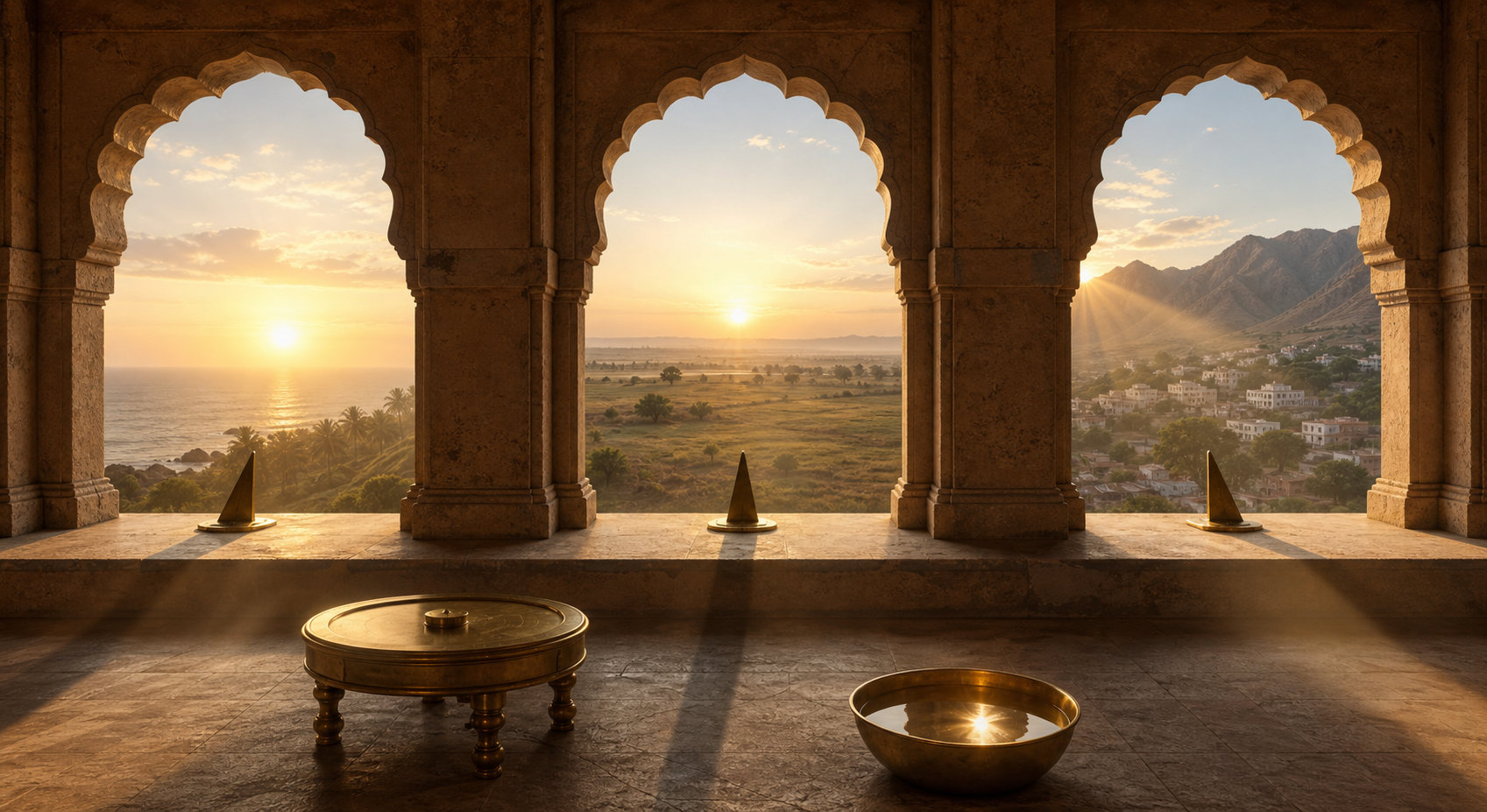
Rahu Kaal, Yamaganda, and Gulika Kaal are portions of the daylight interval, not permanently fixed clock times. A timing copied from Delhi, Mumbai, Toronto, London, or another city can be wrong for you even when the civil date is the same.
- Find the local sunrise and sunset for Tuesday, June 23, 2026, using the same city and time zone that you will use for the activity.
- Calculate the full interval from sunrise to sunset.
- Divide that daylight interval into eight equal portions.
- Number the portions from one through eight, beginning at sunrise.
- For Tuesday, mark the third portion as Yamaganda, the fourth as Gulika Kaal, and the seventh as Rahu Kaal.
- Avoid beginning an activity that requires a strongly auspicious muhurta inside those portions. Continuing routine work already underway is a different question from selecting a ceremonial start.
Suppose the daylight duration in your location is represented by D. Each period has a length of D divided by 8. The third period begins after two such units from sunrise, the fourth after three, and the seventh after six. This method is more reliable than memorising a standard Tuesday chart because seasonal daylight changes alter every segment.
Three positive periods may also help you organise the day:
- Brahma Muhurta: roughly one and a half hours before local sunrise. Use it for meditation, mantra, prayer, or quiet scriptural study rather than for an administrative launch.
- Abhijit Muhurat: a compact interval centred on local solar noon, approximately 24 minutes before and 24 minutes after it. Check that your local Panchang does not place a conflicting inauspicious condition over the proposed time.
- Vijay Muhurat: a short success-oriented period in the later afternoon. Its exact beginning and ending depend on local sunrise and sunset, so retrieve it from a city-specific Panchang rather than estimating by the wall clock.
If your task can wait until Dashami, first confirm the local tithi transition and then inspect the actual evening conditions. Rahu Kaal, Yamaganda, and Gulika are constructed from the daytime interval; their Tuesday positions should not be blindly extended into the night. Other Panchang factors can still affect an evening muhurta.
Refine an important muhurta with all five limbs
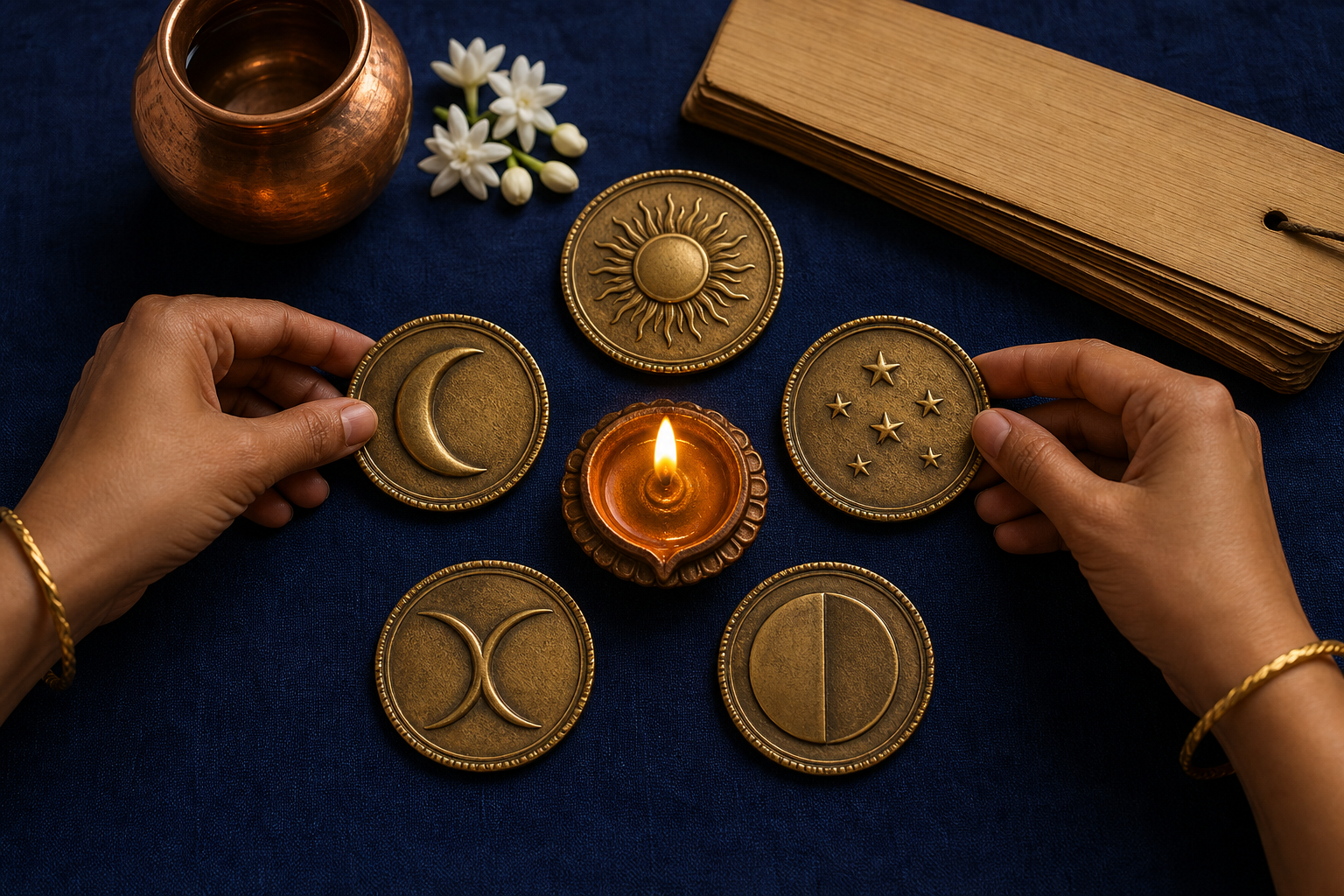
A complete Panchang judgment uses Tithi, Vara, Nakshatra, Yoga, and Karana. June 23 gives you the weekday and the central Navami-to-Dashami transition, but it does not give every reader one universally valid Nakshatra or Moon-sign timing. Those values and their transition points must be checked for the place and ephemeris you actually use.
For a personal undertaking, examine Tarabala and Chandrabala after identifying the local Nakshatra and Rashi:
- Tarabala: count cyclically from your Janma Nakshatra to the day’s Nakshatra. Sampat, Kshema, Sadhana, Mitra, and Parama-Mitra classifications are generally treated as supportive.
- Chandrabala: count the transit Moon sign from your natal Moon sign. The first, third, sixth, seventh, tenth, and eleventh positions are commonly regarded as favourable.
Then inspect Yoga and Karana at the proposed minute, not merely at sunrise. Yogas described as Siddha or Amrita can strengthen an otherwise suitable selection, while Vyatipata or Vaidhriti call for caution. Constructive Karanas such as Bava, Balava, Kaulava, and Taitila can support short-duration undertakings. Because a Karana covers half a tithi, it can change within the same Navami or Dashami period.
Before you commit to a time, open a trusted Panchang set to your city and verify four things in order: the Navami ending time, the Nakshatra and Moon sign at your proposed start, the Yoga and Karana then operating, and any local avoidance period. For a normal day, use Navami for devotion and preparation and place the practical beginning in a clean Dashami window. If your local calculation moves the transition away from 7:30 PM, follow the local calculation.
References
