
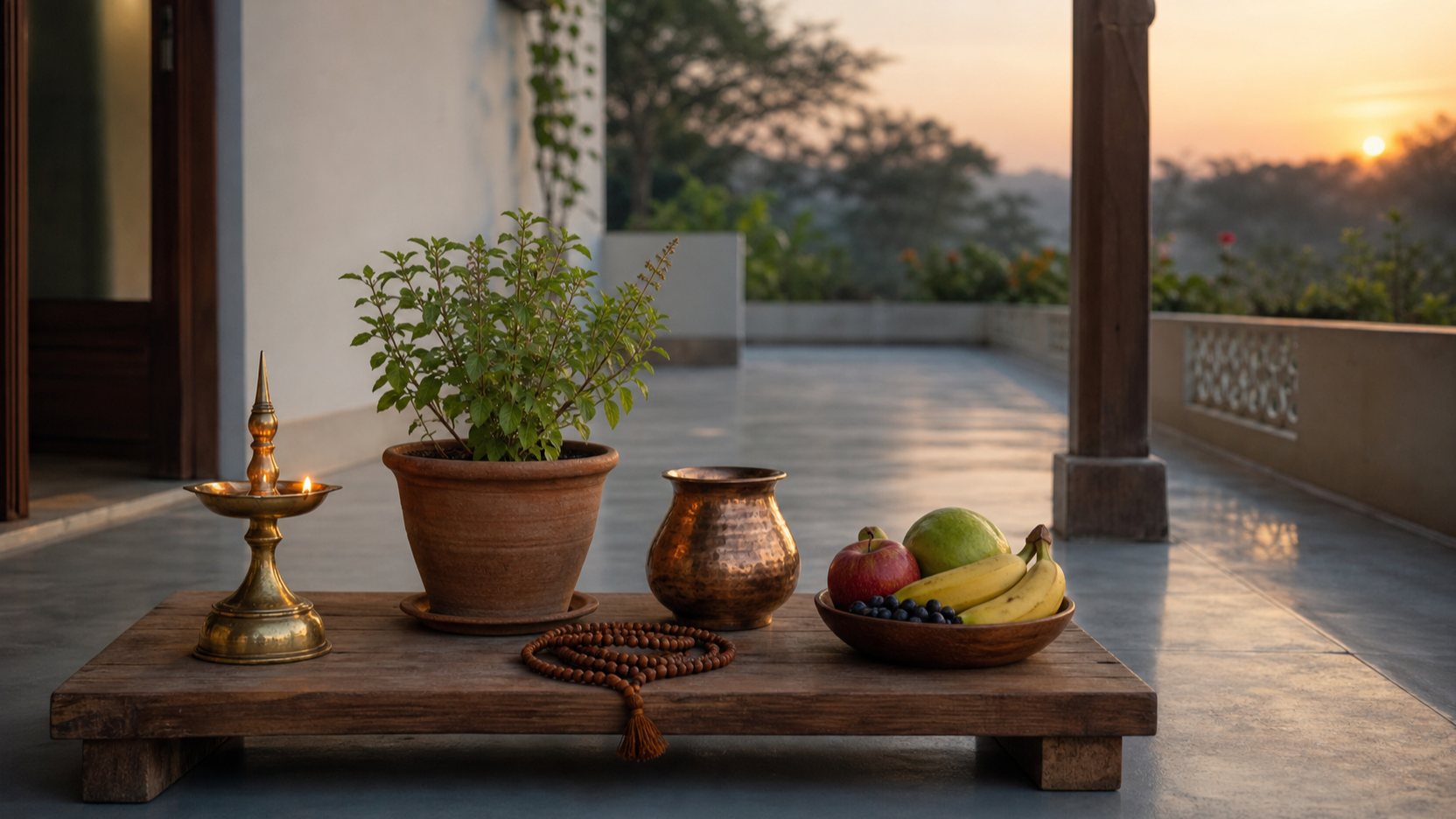
If you are deciding which June date to reserve for Ekadashi vrata, use Thursday, June 11, 2026, in most locations. June 10 is the Dashami preparation day: Ekadashi begins at about 7:34 PM in most regional Panchangs. June 12 is the expected Dvadashi parana day.
That three-day sequence is the useful part to remember. Do not copy an exact parana hour from another city, however. Sunrise, tithi boundaries and the permitted fast-breaking window are location-dependent, and your sampradaya may apply additional rules.
The three dates have three different purposes
A tithi does not begin at midnight. It changes when the angular separation between the Moon and Sun crosses the next 12-degree interval. That is why Dashami can occupy most of a civil day before Ekadashi begins in the evening.
For most Smarta and Vaishnava observances, the controlling question is not merely when Ekadashi starts. It is whether Ekadashi prevails at local sunrise. In the June sequence considered here, Dashami prevails at sunrise on June 10, while Ekadashi prevails at sunrise on June 11. The vrata therefore belongs to June 11 in most regions.
| Date | Calendar position in most regions | What you should do |
|---|---|---|
| Wednesday, June 10 | Krishna Paksha Dashami at sunrise; Ekadashi begins around 7:34 PM | Finish essential work, simplify the evening and prepare for the vrata |
| Thursday, June 11 | Ekadashi prevails at sunrise | Undertake the Ekadashi observance prescribed by your lineage |
| Friday, June 12 | Dvadashi and the expected parana day | Break the fast inside the local parana window, after Hari Vasara has ended |
Treat this table as the planning framework, not as a universal clock. If a reliable Panchang calculated for your city assigns a different local boundary or your temple announces a sampradaya-specific observance, follow that local determination.
Choose a form of observance you can sustain attentively
Ekadashi is not improved by making the food rule so difficult that the entire day becomes an exercise in irritation, fatigue or menu calculation. Decide your level of restraint on Dashami, while you can still prepare calmly.
- If you keep a lineage-based vrata, follow the fasting and food rules taught by your sampradaya or temple. A generic online menu should not overrule a living tradition.
- If you are undertaking a lighter observance, keep food simple and sattvika, avoiding stimulants, excess variety and unnecessary indulgence.
- If a complete fast is not appropriate, retain the spiritual structure of the day through japa, dhyana, kirtana, scriptural reading, remembrance and seva.
If restricting food or fluids could be unsafe for you, or if it could interfere with medication, do not force a complete fast. Choose a safer form of restraint and obtain individual guidance from a qualified clinician before changing your intake or medication schedule. Spiritual discipline does not require preventable harm.
Give the day one definite spiritual center. You might set aside a protected period for nama-japa, read from the Bhagavad-Gita, practise quiet dhyana, join kirtana or perform a specific act of seva. A modest commitment completed with steadiness is more useful than an ambitious programme that exists only on paper.
Plan the vrata from Dashami evening through parana
- During June 10, complete essential errands and household arrangements early. Remove avoidable demands from the next day instead of expecting willpower to carry both a fast and a crowded schedule.
- On the evening of June 10, take a light, sattvika dinner if that accords with your practice. Reduce screen use, settle outstanding responsibilities and sleep early. A short period of japa, dhyana or reading can mark the transition from ordinary activity to vrata.
- At the beginning of your June 11 observance, state a simple intention. Name the discipline you will keep and the quality you mean to cultivate, such as devotion, clarity, ahiṁsa or self-restraint.
- Through June 11, follow your chosen fasting rule while giving the mind constructive work. Kirtana, smarana, japa, dhyana and compassionate service keep the observance from becoming a food restriction without an inward purpose.
- Before the evening ends, check the June 12 parana window for your city. Do this while you still have time to resolve a discrepancy between apps, household custom and a temple calendar.
- On June 12, complete parana after local sunrise and after Hari Vasara, the first quarter of Dvadashi, has ended. Break the fast within the prescribed window and before Dvadashi itself ends.
A usable local Panchang entry should give you the city’s sunrise, the end of Hari Vasara or the beginning of parana, and the end of the permitted window. If the display merely labels June 12 as Dvadashi without supplying a parana interval, it has not yet answered the practical question you need answered.
Keep vrata calculations separate from ordinary muhurta calculations. Abhijit Muhurat, Rahu Kalam, Yamaganda and Gulika Kala may matter when scheduling an activity, and their clock times also vary with local sunrise and sunset. They do not replace the sunrise-tithi rule used to identify the Ekadashi observance or the Dvadashi and Hari Vasara rules used for parana.
Respect Dharmic unity without erasing distinct practices
Ekadashi is especially prominent in Vaishnava life, where upavasa is joined to kirtana, smarana and devotion. Jain communities may observe Agyaras through fasting or semi-fasting shaped by ahiṁsā and aparigraha. Buddhist Uposatha practice likewise uses the lunar rhythm to intensify ethical and contemplative discipline. Sikh teachings, by contrast, place Naam Simran, seva and ethical conduct above ritual fasting.
If your household or community includes more than one Dharmic tradition, do not force every member into the same ritual form. Build the shared observance around remembrance, self-restraint, compassion, study and service; then allow each person to follow the discipline proper to their path. Unity becomes more credible when differences are honoured rather than blurred.
This also supplies a useful test for your own vrata. If the fast makes you harsher toward family, preoccupied with food or proud of endurance, return attention to the quality of conduct. The discipline should reduce grasping and sharpen remembrance, not create a new reason to judge others.
Key takeaways
- Prepare on Wednesday, June 10, when Dashami prevails at sunrise and Ekadashi begins in the evening.
- Observe the Ekadashi vrata on Thursday, June 11, in most regions because Ekadashi prevails at local sunrise.
- Use a fasting form consistent with your sampradaya, actual capacity and safety.
- Reserve Friday, June 12, for parana, but obtain the precise local window rather than breaking the fast at an assumed hour.
- Do not break during Hari Vasara, the first quarter of Dvadashi; complete parana within the prescribed interval before Dvadashi ends.
Before June 10 arrives, open a Panchang set to your actual city and write down two things: confirmation that Ekadashi prevails at sunrise on June 11, and the start and end of the June 12 parana window. Once those anchors are fixed, arrange your meals, rest, worship and seva around them.
References
