
If you are deciding whether January 22 should be observed as Tritiya or Chaturthi, the practical answer turns on one boundary: 2:01 AM local time. Under the general schedule, most household observance on Thursday falls within Shukla Paksha Chaturthi.
That answer still needs one safeguard. A Panchang calculation belongs to a location and calendrical convention. Use the timing below to understand the day, then confirm it against the Panchang followed by your family, temple, or community before arranging a formal puja or time-sensitive event.
Key takeaways for January 22
- January 22, 2026 falls on a Thursday.
- Shukla Paksha Tritiya continues until 2:01 AM local time, followed by Shukla Paksha Chaturthi for the rest of the day in most regions.
- The waxing fortnight’s Chaturthi is observed in many regions as a monthly Vinayaka Chaturthi.
- The 2:01 AM boundary identifies the change of tithi. It is not, by itself, a universal Shubh Muhurat for every activity.
- Exact Nakshatra, Rashi, sunrise-based rules, and auspicious windows require a location-specific Panchang.
How to read the Tritiya-Chaturthi transition correctly

A tithi does not automatically change when the civil clock reaches midnight. The first part of January 22 therefore remains Tritiya even though the new calendar date has begun. On the stated schedule, Chaturthi starts at 2:01 AM local time.
This distinction matters if you are awake for a late-night observance, making a sankalpa near the transition, or coordinating worship across time zones. An activity completed before the boundary belongs to Tritiya under this schedule. An activity after the boundary falls in Chaturthi, subject to the local correction used by your Panchang.
Do not treat 2:01 AM as an instruction to begin worship at that exact minute. It tells you when the lunar day changes; it does not establish that minute as the best muhurta. For an ordinary home observance, you can select a calm and convenient period after Chaturthi has begun. For a ceremony whose rules require a precise window, obtain the full local calculation first.
A simple Chaturthi observance you can plan responsibly
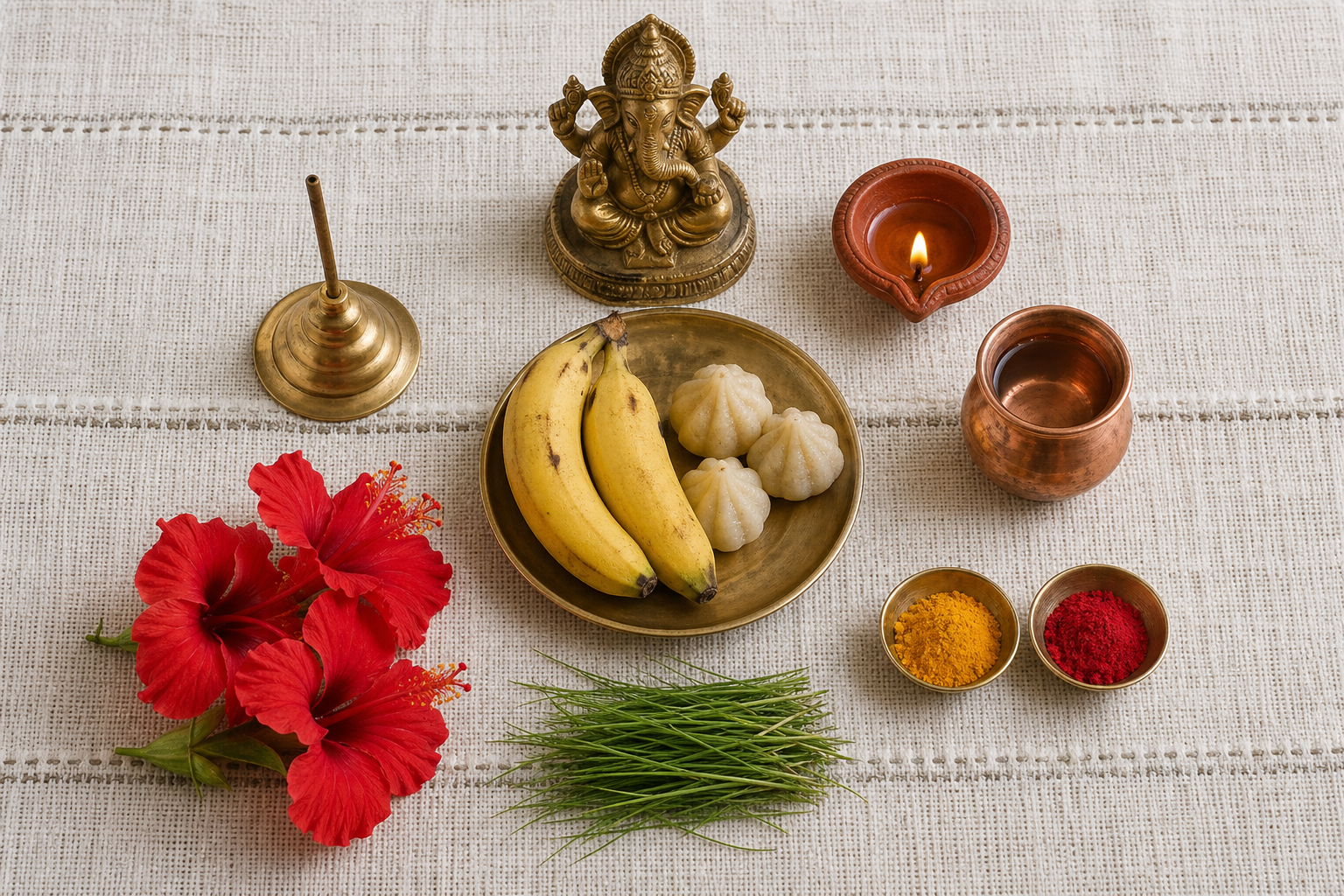
Shukla Paksha Chaturthi is honored in many places as the monthly Vinayaka Chaturthi. Regional traditions and household practices are not identical, so a useful plan begins with the discipline you actually follow rather than an improvised claim of one universal ritual.
- Confirm your customary practice. If your family has an established vidhi, or your temple has published a schedule, let that tradition determine the form of worship.
- Check the local start of Chaturthi. Make sure the Panchang is calculated for the city where the observance will occur. Do not copy a time from another location merely because the civil date is the same.
- Choose an unhurried period after the transition. For a simple, non-time-critical observance, select a period in which you can pray without rushing. The entire day need not be organized around the transition minute.
- Keep the devotional core clear. Quiet prayer, scriptural or reflective study, and an act of service are appropriate ways to cultivate the steadiness and focused intention associated with the waxing lunar phase.
- Make one disciplined intention concrete. Choose a commitment you can actually carry forward, such as completing a neglected duty, keeping a regular study period, or serving someone without seeking recognition. Chaturthi becomes more meaningful when resolve is expressed through conduct.
This framework is deliberately simple. It does not replace a family vidhi, temple instruction, or sampradaya-specific discipline. It gives you a responsible way to observe the day when no elaborate ceremony is planned and no precise muhurta is required.
The broader Indic inheritance of lunar timekeeping is shared across Dharmic civilization, but shared heritage should not be mistaken for identical ritual practice among Hindu, Buddhist, Jain, and Sikh communities. You can honor the common civilizational rhythm while respecting the distinct observances of each tradition.
When your local Panchang must decide the timing

The 2:01 AM transition is a practical general reference, not a time that should be transferred unchanged to every city. Panchang results can vary with locality, local-time correction, sunrise-based reckoning, calculation method, and regional convention. Minor differences between calendars therefore do not automatically mean that one of them is careless.
If two calendars give different timings, resolve the difference in this order:
- Prefer the Panchang calculated for the location where the observance will take place.
- Follow the calendrical convention used by the temple, family, or sampradaya conducting the ritual.
- For a community event, use one published authority consistently so that participants are not working from conflicting clocks.
- Do not combine the tithi boundary from one calendar with the Nakshatra or muhurta window from another without guidance from the person directing the observance.
Tithi alone is not enough to select a precise Shubh Muhurat. If you are planning a formal puja, a public program, or an auspicious beginning, verify the relevant Nakshatra, Rashi, sunrise rule, and local timing in the same regional Panchang. Do not fill missing details from memory or from a previous year’s calendar.
Before January 22, save the city-specific Panchang or temple notice you intend to follow and tell everyone involved which timing governs the observance. For a simple household practice, choose an unhurried period after the locally confirmed start of Chaturthi. For a formal sankalpa or public event, let the complete local calculation set the clock.
References
