
If you are deciding when to perform morning worship on December 20, the date alone is not enough. The tithi changes early in the day, so worship before the boundary and a sankalpa made after it belong to different phases of the lunar cycle.
The practical answer is to treat 6:37 AM as a reference boundary, then verify it against a Panchang calculated for your city. Once that is done, you can plan the morning without confusing a tithi transition with sunrise or with a complete Shubh Muhurat.
The exact transition you need to understand
Saturday, December 20, 2025 begins under Amavasya, the no-moon tithi. Amavasya prevails until 6:37 AM, after which Shukla Paksha Pratipada begins. Pratipada is the first tithi of the waxing lunar fortnight.
| Reference boundary | Panchang position | What it means for you |
|---|---|---|
| Before 6:37 AM on December 20 | Amavasya | Use this period only for practices appropriate to Amavasya in your own sampradaya or household tradition. |
| From 6:37 AM | Shukla Paksha Pratipada | The waxing fortnight has begun, making this the relevant side of the transition for a fresh sankalpa or renewed discipline. |
| 8:21 AM | Following tithi boundary in the stated sequence | Confirm the applicable civil date and local calculation before using this endpoint for an observance. |
The most common mistake is to read December 20 as an all-day Amavasya. It is not under this reckoning. The second mistake is to assume that 6:37 AM is automatically correct everywhere. Panchang calculations can show minor regional differences, so a nationally quoted time should be a starting reference, not the final authority for a location-sensitive ritual.
There is also an important distinction between a tithi boundary and sunrise. If your locally verified sunrise falls before the locally verified transition, the morning contains a post-sunrise Amavasya interval followed by Pratipada. If sunrise falls after the transition, your first post-sunrise worship is already within Pratipada. Check both entries rather than assuming which comes first.
Build your morning around the boundary
You do not need an elaborate ceremony to observe the transition meaningfully. You do need to decide whether your intention belongs to closure or commencement. Amavasya lends itself to quiet reflection, remembrance and the clearing of accumulated disorder. Shukla Paksha Pratipada turns attention toward renewal, clarity and forward movement.
- Open a trusted Panchang for your city and record the local sunrise, the end of Amavasya and the beginning of Pratipada. Do this before fixing the worship time.
- Choose the purpose of the observance. Place reflection or an Amavasya-specific family practice before the verified boundary; place a new sankalpa after Pratipada has begun.
- If you prefer post-sunrise worship, wait until both conditions are satisfied: sunrise has occurred and the local Panchang shows that Pratipada has commenced.
- Prepare the worship space beforehand. Cleanliness is part of the reset, not an unrelated household chore to be rushed through after the chosen time arrives.
- Write one concrete sankalpa. Name the daily discipline, act of restraint, study, japa or service you will actually continue during the waxing fortnight.
A useful sankalpa is observable. Instead of resolving to become more spiritual, decide what you will do when the ordinary day becomes busy: complete your chosen japa before opening distractions, maintain a neglected duty, study a selected passage, or perform a specific act of seva. The lunar transition supplies a point of commencement; continuity gives the resolution its substance.
Do not mistake Pratipada for an all-purpose Muhurat

The beginning of Shukla Paksha carries a natural symbolism of increase, illumination and renewed effort. That symbolism does not make every minute after 6:37 AM universally auspicious for every undertaking.
Tithi is only one part of the decision. Nakshatra, Rashi and the relevant Shubh Muhurat may also matter, and their timings depend on location. The rule is straightforward: a simple personal sankalpa can be placed after the verified transition, but an undertaking governed by detailed ritual rules should not be scheduled from the tithi alone.
- For personal prayer, gratitude, japa or the renewal of a daily discipline, use the locally confirmed post-transition period that suits your tradition.
- For vrata requirements, check whether your practice follows the tithi at sunrise, the moment of transition or another observance rule.
- For a ceremony or important new undertaking, confirm the relevant Nakshatra and Muhurat rather than treating Pratipada as a blanket approval.
- If your family almanac and an online Panchang disagree slightly, use the authority your household or sampradaya normally follows, with guidance from a knowledgeable priest or teacher where necessary.
This prevents two opposite errors. You will not miss the meaning of the waxing fortnight merely because every Panchang component is not ideal, and you will not assign ritual precision to a single national time that was never meant to replace a city-based calculation.
A simple Dharmic practice for the transition
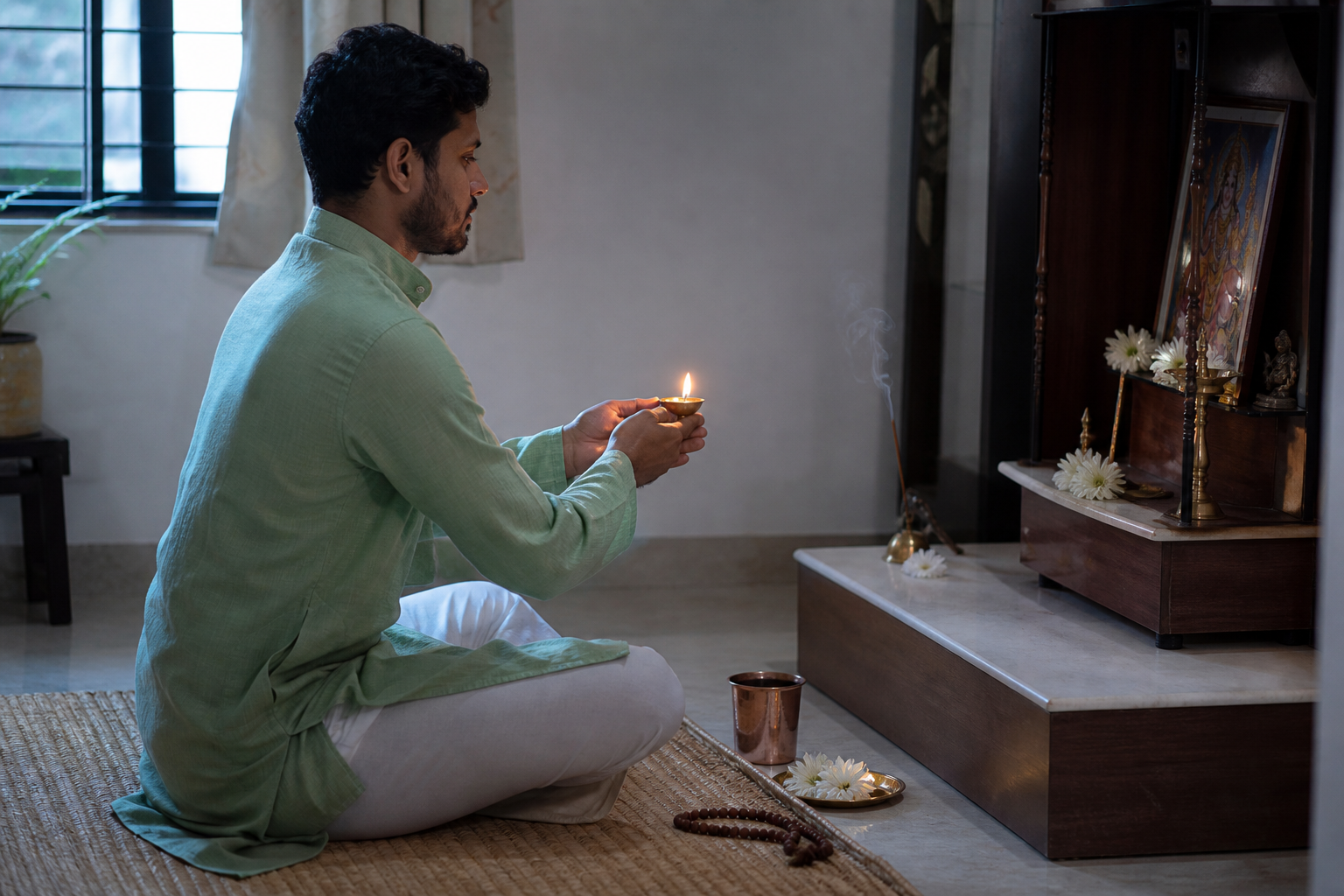
Once the local timing is clear, keep the observance steady and proportionate. The movement from the dark-moon tithi into the waxing fortnight can be marked through cleanliness, prayer, contemplation, gratitude and service.
- Clean the place where you will sit and remove one piece of physical disorder that has been repeatedly ignored.
- After the locally verified transition and sunrise, offer prayer or perform japa in the form followed by your household.
- Review one habit, obligation or unresolved duty without turning the exercise into vague self-criticism. Identify the next action.
- State your sankalpa plainly and connect it to conduct. A resolution about patience, for example, should identify the situation in which you will practise restraint.
- Complete or commit to an act of daana or seva. Keep it within your means and choose something that produces real benefit rather than public display.
- Close with gratitude, then begin the promised action as soon as its proper time arrives.
Hindu, Buddhist, Jain and Sikh traditions have distinct teachings and ritual forms; they should not be collapsed into a single ceremony. A household or community that includes more than one Dharmic path can preserve those distinctions while gathering around shared ethical actions such as disciplined reflection, gratitude, non-harm, generosity and service. Let each person pray according to their tradition, then make the common commitment concrete.
Four quick answers before you set the time
Is all of December 20 an Amavasya day?
No. Under the stated reckoning, Amavasya ends at 6:37 AM and Shukla Paksha Pratipada begins immediately afterward. Your city-based Panchang remains the controlling reference for exact observance.
Can I use 6:37 AM without checking my location?
Use it as a reference, not as a universal local instruction. Verify the transition and sunrise for your city, especially if the ritual depends on which tithi prevails at sunrise or at a precise moment.
Should a new sankalpa be made before or after the change?
If you want the sankalpa aligned with the waxing fortnight, make it after the locally verified beginning of Pratipada. Many devotees prefer the post-sunrise period after that change for quiet worship and intention-setting.
Does Pratipada make the whole day auspicious?
No. Pratipada establishes the tithi, but it does not settle every Muhurat question. Check Nakshatra, Rashi and the appropriate auspicious window before timing an important ceremony or formal beginning.
Before December 20 arrives, save the city-specific Panchang entry and choose one practice you can sustain beyond the morning. Observe the boundary accurately, make the sankalpa modest and clear, and let the first days of Shukla Paksha show whether the intention has become conduct.
References
