
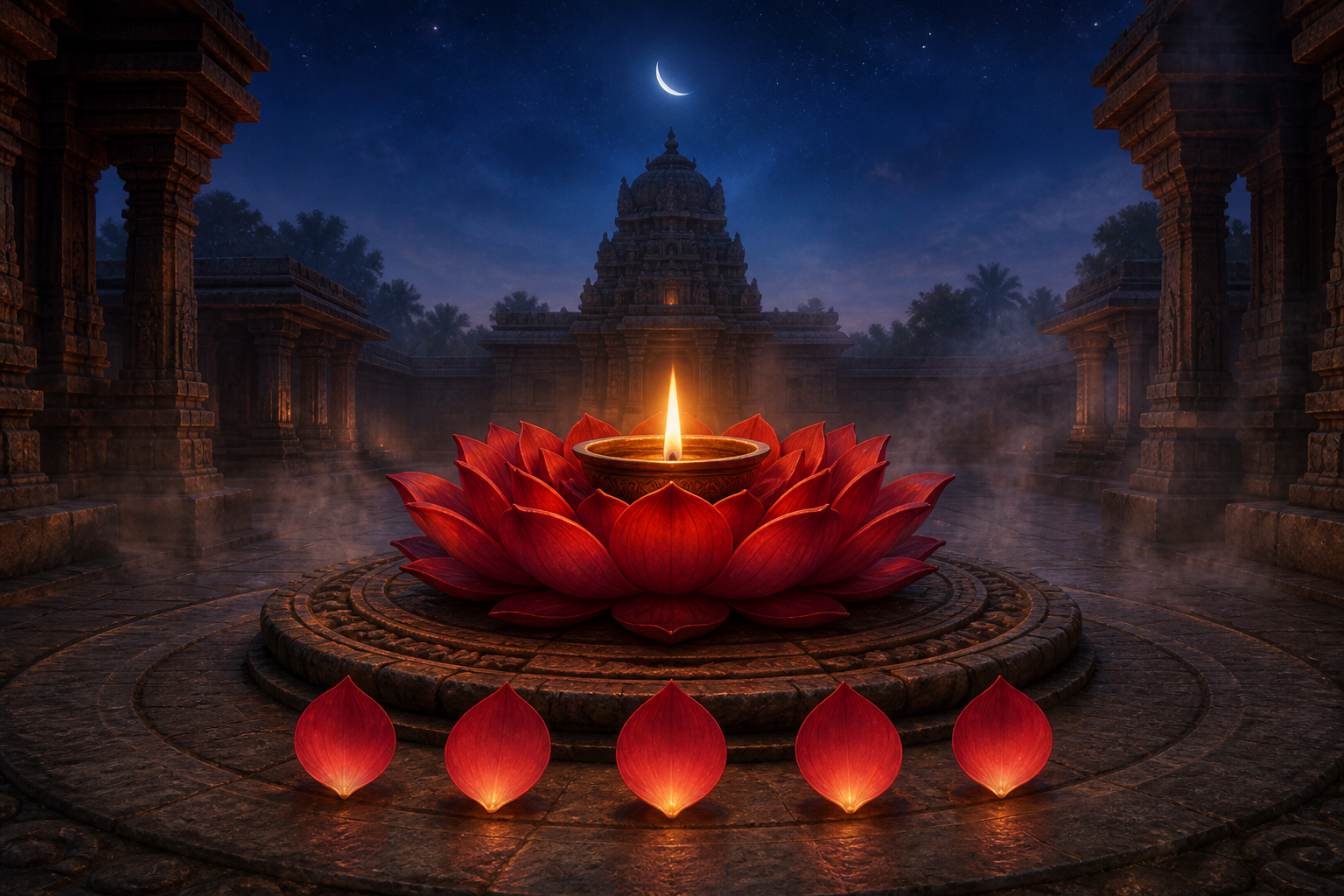
If you found Vahnivasini while trying to match a Srividya deity to Panchami, the first question is not, “Which mantra should I use?” It is, “Which Panchami, at what local time, and within which lineage am I practising?” Those distinctions keep lunar devotion rooted in a living tradition instead of turning it into a collection of disconnected instructions.
Srividya does not treat the lunar calendar as an empty timetable. The waxing and waning cycle unfolds through fifteen tithis in each fortnight, with time itself understood as a manifestation of Devi. Within its sequence of lunar forms, Vahnivasini is the fire-dwelling Goddess associated with the fifth tithi. To approach her meaningfully, you need to hold together three things: the actual tithi, the form of the Goddess, and the discipline that her fiery name brings into focus.
Read the lunar calendar before choosing the day

Panchami means the fifth tithi of a lunar fortnight. It does not simply mean the fifth date printed on a civil calendar. A tithi is a lunar division, so it can begin or end during a civil day rather than conveniently changing at midnight. The date beside the word “Panchami” is therefore only a shortcut; the beginning and ending times are what tell you when the tithi is actually present.
Start with a panchanga calculated for your location. Record three details: whether the fortnight is waxing or waning, when Panchami begins, and when it ends. Panchami occurs in both lunar fortnights, but that does not mean every lineage handles the two occurrences in an identical way. If your guru, temple, family tradition, or established paddhati gives a rule for selecting the observance period, that rule governs your practice.
A useful distinction is that the panchanga supplies the timing, while the lineage supplies the ritual rule. One should not be made to replace the other. An accurate astronomical interval does not tell you which mantra, sequence, or formal observance you are authorized to perform; conversely, a ritual instruction cannot be timed properly if you have mistaken a Gregorian date for the tithi itself.
- Do not assume that the fifth day of a month is Panchami.
- Do not rely on a panchanga prepared for a distant location when precise timing matters.
- Do not omit the paksha, or lunar fortnight, when recording an observance.
- Do not infer a complete ritual merely from the name of the tithi deity.
What the name Vahnivasini asks you to notice

Vahnivasini may be read as “she who dwells in fire”: vahni is fire, while vasini conveys dwelling or abiding. Her name makes radiance central to the contemplation, but it should not be reduced to a decorative image. Fire gives light, consumes what is offered, and transforms the condition of what it touches. These qualities provide a disciplined way to approach her without pretending that a personal interpretation is a revealed ritual instruction.
Begin with clarity. Ask what in your present conduct has been left obscure because you would rather not examine it. Then consider transformation: what habit, confusion, or unfinished duty must pass through sustained effort before it can change? Finally, consider containment. A useful fire is tended and directed; uncontrolled heat merely spreads. In the same way, intensity without discrimination is not spiritual maturity.
This contemplation does not turn Vahnivasini into a psychological metaphor. She remains Devi, not a self-improvement slogan. The inward questions are ways of making your attention answer to the divine form. They help you notice whether your devotion is producing clearer conduct or only accumulating terminology.
Her position as the fifth form in a sequence should also not be mistaken for a ranking. An ordinal place identifies a relationship within the lunar unfolding; it does not say that one Nitya is less complete or less worthy than another. Srividya’s treatment of time invites you to encounter divine presence through change without imagining that the Goddess herself is diminished by succession.
A careful Panchami observance without inventing a ritual

If you have received a Srividya practice from a qualified teacher, follow that transmission rather than replacing it with a general outline. Mantra, nyasa, yantra worship, and other formal elements belong within their proper instructions. A public description of Vahnivasini may help you understand whom a practice invokes, but it is not initiation and should not be treated as authorization.
If you are learning about the tradition but have not received a specific practice, you can still mark Panchami respectfully. Keep the observance simple, transparent, and free of fabricated esoteric details:
- Confirm the tithi. Use a local panchanga and write down the paksha and the beginning and ending times of Panchami.
- State the limit of your practice. Decide whether you are following an initiated paddhati, a temple observance, a family custom, or a simple personal remembrance. Do not blend these levels casually.
- Begin with ordinary purity and attention. Wash, prepare a clean place, settle the mind, and offer a respectful pranama to Vahnivasini. Her publicly known name is enough for remembrance; there is no need to manufacture a mantra.
- Use fire only within a familiar and safe custom. If lighting a household lamp is already part of your worship, it can accompany the remembrance. A lamp is not automatically a homa, and Vahnivasini’s fiery name is not an instruction to improvise a fire rite.
- Contemplate one precise theme. Choose clarity, disciplined energy, or transformation. Stay with one rather than moving through a long catalogue of associations.
- Complete one corresponding dharmic action. Finish an avoided duty, correct something misleading, or bring order to one neglected responsibility. Treat this as an ethical accompaniment to devotion, not as a compulsory Srividya rite.
- Close and record. Offer thanks, note the tithi timing, and write one sentence about what became clearer. Repeating this over several lunar cycles builds real familiarity with tithi-based worship.
The restraint in this approach is intentional. Srividya is not served by assembling bija syllables, mudras, visualizations, and ritual fragments from unrelated lineages. Practices that look similar on a screen may occupy different places in different transmissions. When you do not know whether an instruction is open, initiated, or lineage-specific, pause at respectful remembrance and ask a competent teacher.
Questions that prevent the most common mistakes
Is Panchami always observed on the fifth civil date?
No. Panchami is the fifth lunar tithi, not the number five on a Gregorian calendar. It may overlap portions of two civil dates. Check its local beginning and ending times, then apply the observance rule used by your tradition.
Do I need a special mantra to remember Vahnivasini?
You do not need to invent or copy an esoteric mantra in order to offer a simple pranama, remember her name, or contemplate her association with sacred fire. If you want to perform formal Srividya worship, receive the relevant mantra and method through an appropriate teacher rather than treating a searchable text as transmission.
Does the waxing or waning fortnight change the practice?
Both fortnights contain fifteen tithis, but the exact ritual mapping and intention should not be assumed to be identical in every Srividya lineage. Always identify the paksha. If you have a received paddhati, use its sequence; if you do not, remain with non-esoteric remembrance rather than guessing.
Why worship a division of time as Devi?
Srividya approaches time as a living divine continuum rather than a neutral container in which worship happens. A tithi is therefore more than an appointment on a calendar. Its worship trains you to recognize lunar change itself as an expression of Shakti. The practical result is a different relationship with time: you learn to observe its qualities instead of treating every day as spiritually interchangeable.
Let the fifth tithi become a discipline

At the next Panchami, do four things: verify the local tithi, name the paksha, offer a simple remembrance of Vahnivasini, and complete one act that brings light or order to your conduct. That is enough to move from collecting information to developing lunar attention.
If formal Srividya practice continues to draw you, let that interest mature into patient study and a search for sound guidance. Do not rush toward the most secret-looking instruction. The fire associated with Vahnivasini points first toward clarity, and clarity begins by knowing exactly what you have received, what you have not received, and what the present tithi is asking you to notice.
References
