
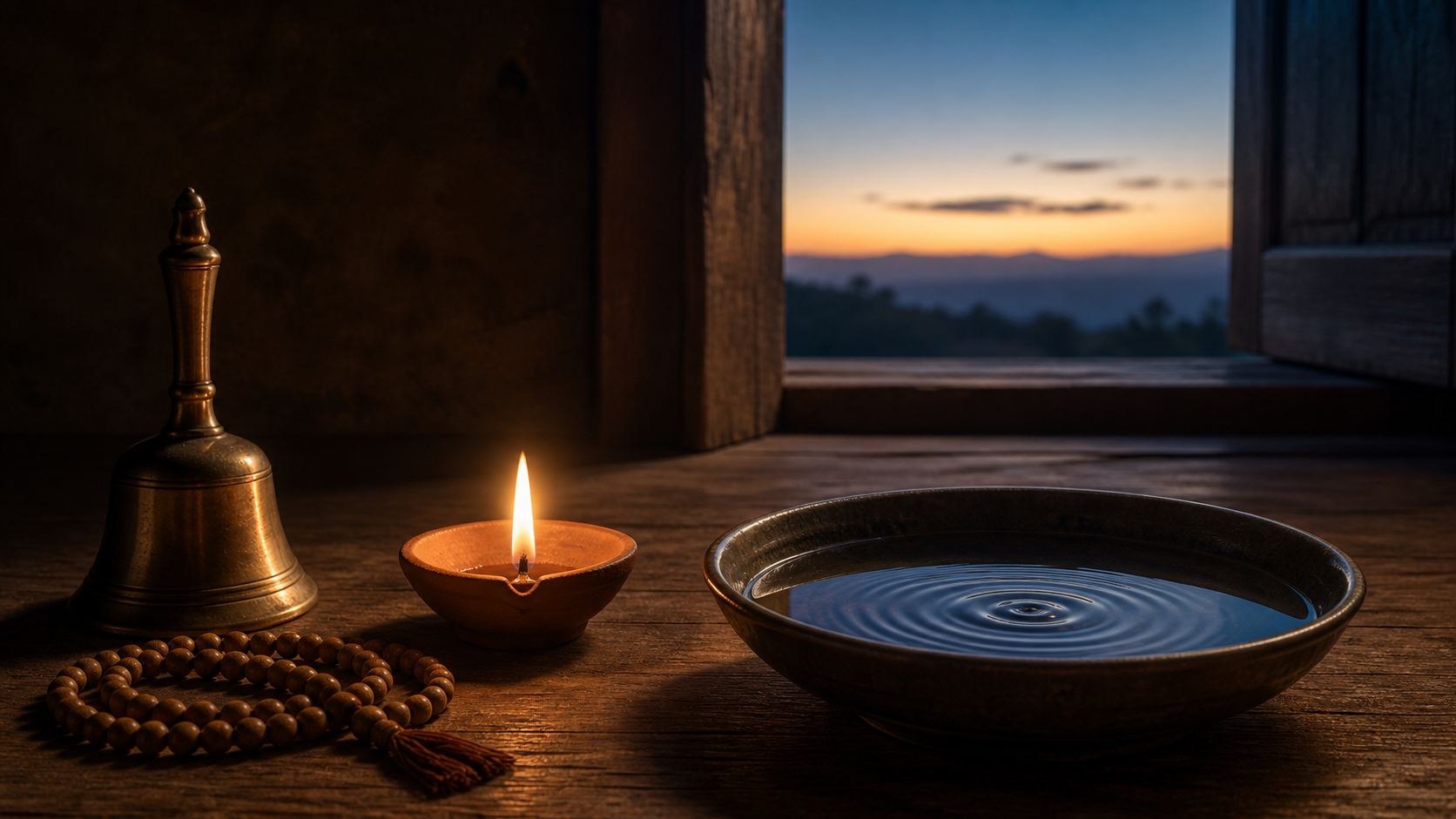
If illness, travel, old age, or caregiving has interrupted your usual practice, you may be asking what remains when the body cannot perform a familiar rite. The same question becomes more urgent when someone you love is approaching death: what can you do that is spiritually meaningful without adding pressure, fear, or ritual anxiety?
A durable Dharmic answer joins inner purification, sacred sound, and ethical conduct. You cleanse attention when an outer rite is impossible, train it to return through mantra, and carry that familiar remembrance into difficult transitions. The aim is not to control death or force a spiritual result. It is to give consciousness a trustworthy place to return.
Key takeaways
- Use inner purification for genuine constraints. Manasa Snana and Mantra Snana preserve prayerful attention when an ordinary bath is not feasible; they are not substitutes for normal hygiene when bathing is reasonably possible.
- Practise before you need consolation. A mantra repeated during ordinary life is more likely to remain available during illness, fear, confusion, or the approach of death.
- Keep sacred sound faithful to the person. Om, Buddhist recitation, the Namokar Mantra, and simran on Waheguru belong to distinct traditions. Their purposes may resonate, but their words are not interchangeable.
- At the bedside, consent comes before performance. Use the dying person’s chosen practice, keep the atmosphere gentle, and pause whenever care, discomfort, or a request for silence requires it.
- Do not turn a final utterance into a verdict. Chanting Om is not a mechanical guarantee of moksha, and an inability to chant does not measure the worth of a life or the sincerity of a practitioner.
Begin with inner purification, not ritual anxiety
Purity in Hindu practice has an outer and an inner dimension. Bodily cleanliness matters, but so do intention, remembrance, emotional clarity, and conduct. When illness, frailty, travel, lack of facilities, or another real limitation prevents bathing, Manasa Snana and Mantra Snana offer a compassionate way to protect the inner dimension.
Manasa Snana is a mental bathing. You recollect the sanctity of tīrthas and sacred rivers such as Ganga and Yamuna, imagine the clarity and coolness of pure water, and direct the mind toward a sattvic resolve. This is not pretending that the body has been washed. It is a deliberate movement from agitation or helplessness toward citta-shuddhi, the purification of mind.
When a physical bath is unavailable, use this simple sequence:
- Acknowledge the actual condition. Sit or rest in the position your body permits. There is no spiritual gain in denying pain, disability, exhaustion, or lack of facilities.
- Let the breath settle without forcing it. Notice a comfortable inhalation and exhalation. If breathing is difficult, do not impose a rhythm or hold the breath.
- Recall sacred water. Bring Ganga, Yamuna, a known tīrtha, or the simple clarity of pure water to mind. Let the image carry reverence rather than visual strain.
- Form an ethical resolve. Ask what needs cleansing in your conduct: resentment, harsh speech, dishonesty, fear, or neglect. Choose the response that would bring you closer to dharma.
- Close with gratitude. Carry the resolve into the next conversation, duty, or act of care. The rite reaches completion in how you behave afterward.
Mantra Snana uses sacred sound as the purifying medium. Practitioners who know Vedic recitation may use the water hymn commonly identified by its opening words, Apo hi stha, purificatory mantras associated with ācamana, or an appropriate śānti mantra. If water is available, it may be touched or sprinkled gently while chanting. If it is unavailable, attentive recitation remains the heart of the practice.
Use a mantra you genuinely know. Vedic intonation deserves care, so a pressured moment is not the time to improvise a long recitation from a half-remembered recording. If Om is already central to your practice, audible, whispered, or mental remembrance may be the more honest choice. Simplicity with attention is better than complexity performed through panic.
Return to an ordinary bath when it becomes reasonably possible. Inner purification addresses a spiritual need under constraint; it does not remove the practical value of washing, nor should it be used to avoid available care.
Turn sacred sound into a dependable reflex
The final transition should not be the first time you ask the mind to rest in sacred sound. Attention under strain tends to follow what has become familiar. Regular japa therefore matters less as a display of quantity than as abhyasa: the repeated act of returning.
Om is especially suited to this discipline within Hindu traditions because it is more than a soothing syllable. The Mandukya Upanishad presents Om as a comprehensive symbol of consciousness, embracing waking, dreaming, deep sleep, and that which transcends these states. The Bhagavad Gita connects final remembrance with the direction of the soul’s onward journey. This makes remembrance at death the mature expression of a lifelong orientation, not a last-minute technique detached from the way you have lived.
You can cultivate that orientation without making daily practice elaborate:
- Choose a core remembrance. Use Om or the mantra given a stable place in your family, sampradaya, or personal sādhanā. Constantly changing mantras makes it harder to establish a dependable return point.
- Attach it to a reliable cue. Recite after bathing, after Manasa Snana when bathing is impossible, before sleep, or at another point that already belongs to your day.
- Learn all three modes. Practise audibly when circumstances permit, softly when others need quiet, and mentally when speech is unavailable. The mental form should not feel like an unfamiliar substitute discovered during illness.
- Use it during ordinary disturbances. Before replying in anger, while waiting through uncertainty, or after receiving difficult news, return to the mantra. This is where sacred sound becomes available under pressure.
- Let silence follow. Do not rush immediately into a screen, argument, or task. Notice whether the recitation changed the quality of your attention and what right action now requires.
Do not use calmness as the only measure of success. A restless mind can still return sincerely. The discipline lies in noticing that attention has wandered and bringing it back without self-condemnation. Over time, that return can become a mantra reflex: not an involuntary magic formula, but a familiar orientation during stress.
Breath awareness may support the practice, provided the breathing remains easy. Allow Om to accompany a comfortable exhalation if that feels natural. Do not strain for a longer sound, compete with another chanter, or treat breath retention as necessary. During serious illness or the dying process, the person’s natural breathing and clinical care take precedence over any preferred cadence.
At the bedside, protect choice, calm, and care
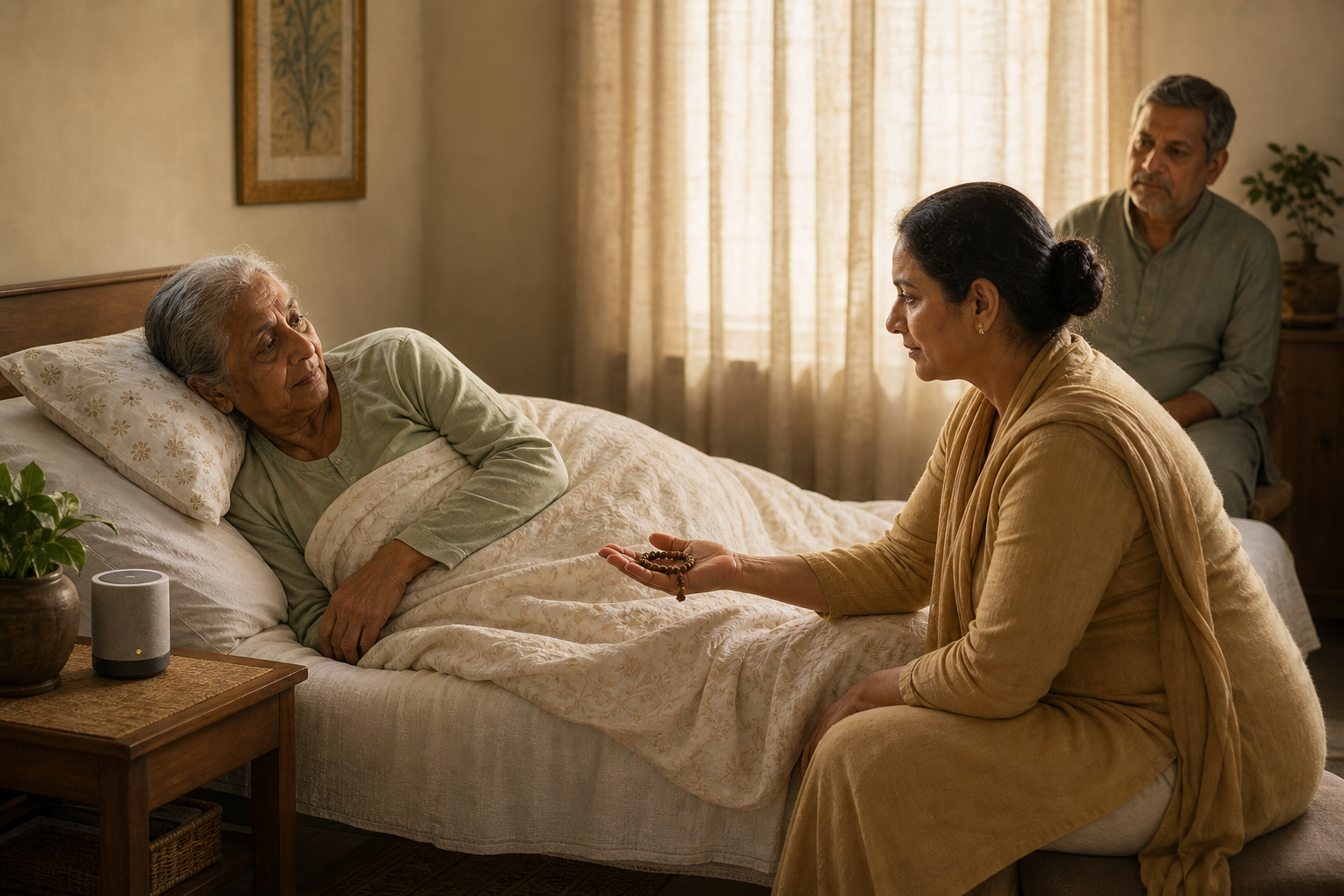
A family’s wish to help can easily become pressure on the person who is dying. The bedside practice belongs first to that person. If conversation is still possible, ask what they want before a crisis: which mantra or Divine Name, whether it should be spoken or silent, who should lead it, and whether they sometimes prefer simple quiet.
Do not assume that every Dharmic person wants Om. A Hindu practitioner may prefer Om, an iṣṭa-devatā mantra, or another familiar name. A Buddhist may rely on Om Mani Padme Hum or a practice from their own lineage. A Jain may turn to the Namokar Mantra. A Sikh may prefer simran on Waheguru or familiar recitation from Nitnem. These paths share an emphasis on disciplined remembrance, but honoring that kinship means respecting each path’s integrity rather than blending its sacred vocabulary without permission.
When chanting is wanted, keep the arrangement uncomplicated:
- Reduce avoidable distraction. Lower unnecessary conversation and soften the lighting if the person wants this and the care setting allows it.
- Let a calm voice establish the cadence. A room full of competing speeds and pitches can create effort where steadiness is needed.
- Follow the person rather than demanding participation. They may chant, listen, remember mentally, move between sound and silence, or become unable to respond.
- Keep the breath unforced. Never instruct a breathless, weak, or dying person to prolong an exhalation for the sake of completing Om.
- Make room for medical care. Pause immediately when clinicians need access or when the person shows discomfort. Mantra is spiritual support; it must not delay treatment or replace attention to pain, breathlessness, or another symptom. Alert the care team when discomfort appears.
- Use silent japa when sound is restricted. Family members can maintain inward remembrance without turning a shared room or clinical space into a conflict.
- Stop when consent changes. A request for silence is not a spiritual failure. Quiet presence can itself express compassion.
If the person can no longer speak, do not declare that they have failed to remember. Vocalization, mental awareness, and outward responsiveness are not the same thing. Health circumstances may prevent any visible participation. Your task is to offer a dignified atmosphere, not to examine the person’s final moments for evidence of spiritual attainment.
The same restraint applies to recordings. Familiar audio may help when the person has chosen it, but continuous playback should not override sleep, silence, clinical communication, or a change in preference. Human presence need not fill every moment with sound.
Let conduct carry the sound into the world
Sacred sound loses its proper place when it becomes a transaction: recite correctly, receive a guaranteed result. Om at the threshold of death does not operate as a mechanical certificate of moksha. Hindu teaching gives profound importance to final remembrance, but that moment carries the momentum of practice, character, and orientation cultivated through life.
That is why ahimsa, satya, and seva belong beside japa. Non-harming refines the intention behind the voice. Truthfulness reduces the inner division that mantra cannot simply conceal. Service turns remembrance outward, especially when illness makes another person dependent on your patience.
You can test whether the practice is ripening by looking at ordinary conduct:
- After chanting, are you less likely to speak harshly to the person who needs your care?
- Can you admit fear or exhaustion without pretending to possess spiritual certainty?
- Do you respect another person’s mantra, lineage, or wish for silence?
- When you cause harm, does remembrance move you toward repair rather than self-justification?
- Can you perform an available physical duty instead of using inward practice to escape it?
If the answers expose a gap, do not abandon the mantra. Join it more honestly to action. The purpose of inner purification is not to feel ritually superior; it is to clear what obstructs right relationship.
Begin on the next ordinary day. Choose the sacred sound you already trust, give it a stable place in your routine, and learn to continue it mentally when voice or circumstances change. If you may one day support a loved one, ask about their wishes while they can answer freely. Then let daily truthfulness, restraint, and service prepare the ground that no last-minute ritual can manufacture.


References
- DharmaRenaissance Blog — Manasa Snana and Mantra Snana: Compassionate Vedic Paths to Purity, Presence, and Peace
- DharmaRenaissance Blog — Sacred Sound at Life’s Threshold: The Transformative Power of Om for Conscious Departure
