

Your japa, kirtana, hearing, or seva may feel luminous on one day and dry on the next. When that happens, it is easy to assume that sweetness must come first and regular practice will follow. The development of bhakti usually asks you to reverse that expectation: practice stops taking instructions from mood, and sustained attention then gives devotional relish room to mature.
This is the practical importance of nistha. It is not forced enthusiasm, emotional numbness, or stubborn attachment to a routine. It is a settled orientation toward Bhagavan that survives ordinary fluctuations. Understanding that distinction will help you evaluate your practice without either exaggerating a passing experience or condemning yourself during a dry period.
Nistha stands between purification and devotional taste

Within the Gaudiya Vaishnava vocabulary used here, nistha means firmness or steadiness in bhajana. The familiar progression of devotion moves through sraddha, sadhu-sanga, bhajana-kriya, anartha-nivritti, nistha, ruci, asakti, bhava, and prema. The sequence is a map of maturation, not a timetable or a certificate of spiritual rank.
Nistha’s position in that sequence is decisive. It comes after anartha-nivritti, the clearing of unwanted habits and motives that obstruct devotion, and before ruci, a more established taste for devotional activity. You do not need to manufacture ruci in order to become steady. Steadiness prepares the inner conditions in which taste can become less accidental.
A practitioner may experience a moment of sweetness before reaching firm nistha, just as a steady practitioner may still pass through periods that feel dry. Neither experience, taken alone, settles the question of one’s condition. A bright moment is an invitation to continue, not proof of arrival. A difficult morning is an occasion to return, not proof that devotion has disappeared.
The central change concerns what governs your action. Before steadiness develops, novelty, convenience, praise, discouragement, or emotional intensity can possess an effective veto over practice. As nistha matures, those conditions may still be felt, but they increasingly lose the authority to decide whether you turn toward Bhagavan.
This also explains why nistha is not grim endurance. Endurance can keep the body in place while the heart quietly bargains for a reward. Nistha is more intimate: it is the growing conviction that hearing, chanting, remembrance, worship, and service remain worth doing because of their object, not merely because of the feeling they produce in you.
Recognize steadiness without pretending to be perfect
If you keep asking whether you have attained nistha, spiritual practice can turn into status surveillance. A more useful question is: where does mood still have the power to cancel, dilute, or redirect my devotional intention? That question exposes the next obstruction without requiring you to assign yourself a rank.
| What you notice | What it may indicate | What it does not prove |
|---|---|---|
| You maintain your authorized practice through ordinary changes of mood. | Your commitment is becoming less dependent on emotional reward. | That every distraction or unwanted tendency has vanished. |
| After an interruption, you return at the next real opportunity. | The relationship matters more than the shame of having faltered. | That your practice will never be interrupted again. |
| Your attention wanders, but you bring it back without abandoning the practice. | The chosen object of attention is regaining priority. | That you have achieved uninterrupted absorption. |
| You spend less energy renegotiating whether to practise. | Your direction is becoming settled. | That routine by itself is devotion. |
| Moments of sweetness make you more willing to hear and serve. | Devotional relish may be beginning to mature. | That an intense feeling is established ruci. |
The ability to receive correction is another important sign. Stubbornness protects a self-image; nistha protects the direction of devotion. A steady practitioner can adjust the time, place, method, or supporting habit when wise guidance shows that an adjustment will serve the commitment better. Firmness in the goal does not require rigidity in every logistical detail.
Questions are not the enemy of nistha either. Honest inquiry can deepen conviction, while suppressed doubt often returns as quiet disengagement. Bring serious questions into the company of trustworthy sadhu, guru, and sastra. Nistha is not the refusal to think. It is a resolution educated by hearing, reflection, practice, and correction.
Do not assess another person’s nistha from attendance, eloquence, tears, clothing, visibility, or institutional responsibility. These things may accompany devotion, but none makes the inner condition transparent. Use the concept to examine your own fidelity, not to construct a hierarchy around people whose interior life you cannot see.
Why devotional nectar begins to flow at this threshold

Devotional nectar is not simply pleasure attached to a religious activity. Music can excite, company can reassure, ritual can calm, and recognition can gratify. Those experiences are not automatically wrong, but they do not by themselves establish spiritual taste. Bhakti’s sweetness is relational: the Holy Name, the qualities and pastimes of Bhagavan, and the opportunity for seva become precious because they connect the practitioner with the beloved object of devotion.
At nistha, the image that nectar begins to flow is best understood soberly. It need not mean an uninterrupted flood of extraordinary emotion. It can begin as a quieter change: less resistance before practice, greater willingness to listen closely, spontaneous remembrance during ordinary duties, or service that does not require an audience.
Several movements within practice make this possible:
- Continuity reduces renegotiation. When you stop reopening the decision to practise, more attention becomes available for the practice itself.
- Attentive repetition develops recognition. A familiar name, prayer, teaching, or form of seva can disclose greater depth when you remain present instead of constantly seeking novelty.
- Hearing gives devotion content. Feeling alone cannot tell you whom you serve, what is pleasing to Bhagavan, or how a devotional relationship is understood. Sravanam keeps sentiment connected to siddhanta and remembrance.
- Seva turns taste away from self-consumption. The desire to serve helps prevent spiritual pleasure from becoming another experience collected for the ego.
- Grace remains grace. Discipline can prepare attention and receptivity, but it cannot force Bhagavan to deliver a chosen experience on demand.
The last point guards against a subtle mistake. Sadhana is not a machine into which you insert enough repetitions and receive ecstasy. Your effort matters, but bhakti is not controlled by technique. Nistha makes you reliably available to the relationship; it does not turn grace into a debt.
You can test apparent sweetness by its direction. Does it make you more faithful, teachable, grateful, and willing to serve? Does it reduce the urge to advertise your advancement or dismiss practitioners whose expression differs from yours? An experience that mainly produces superiority, carelessness with duty, or hunger for another emotional peak deserves scrutiny, however intense it felt.
Dryness can be instructive for the same reason. When emotional reward recedes, your motives become easier to see. You may discover that praise, novelty, social belonging, or self-image had been carrying more of the practice than you realised. The right response is not to despise those motives or abandon bhajana. Notice them, seek guidance where needed, and offer the next act of practice with a cleaner intention.
Build a daily rule that supports nistha
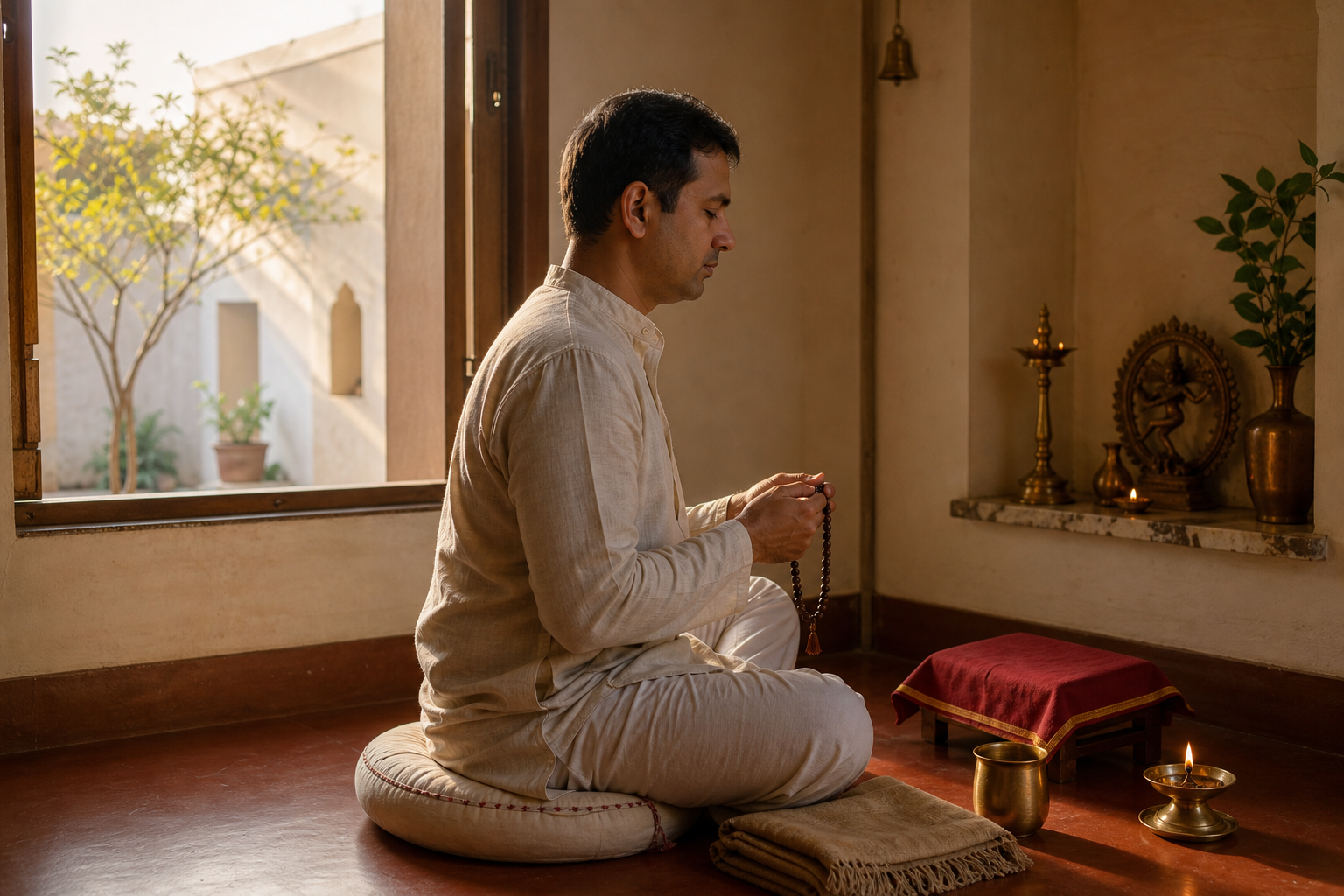
A useful rule of practice should make bhajana difficult to renegotiate and easy to enter. It should support commitments received through your tradition rather than inventing a private spirituality every time your mood changes.
- Begin with what is already authoritative for you. If you have received vows or direct guidance, place those commitments first. Do not bury them beneath an ambitious collection of optional practices.
- Choose a reliable cue and place. Link the practice to a part of the day you can identify clearly, and prepare the mala, text, instrument, or worship materials beforehand. The aim is to remove avoidable decisions at the moment you begin.
- Protect attention concretely. Silence unnecessary notifications, clear the immediate space, and decide how you will handle predictable interruptions. During nama-japa, for example, the practical work is to hear the name being pronounced and return when attention strays.
- Keep voluntary additions realistic. For practices beyond vows and assigned duties, distinguish a sustainable foundation from an aspirational expansion. This distinction must never be used as permission to reduce an initiated vow without proper guidance.
- Stay with one line of hearing long enough to understand it. Constantly switching teachers, recordings, books, or themes can create stimulation without digestion. Let hearing clarify the object and purpose of the practice you are already doing.
- Connect inward practice with outward seva. Ask what your hearing or chanting requires from your speech, conduct, responsibilities, and treatment of other people. Devotion that never reaches service can become preoccupied with its own inner weather.
- Review causes, not just outcomes. When practice becomes scattered, identify the actual obstruction: fatigue, an unprepared space, excessive media, resentment, hurry, or an unrealistic schedule. Change the condition you can change rather than merely demanding stronger feelings.
When the routine breaks
A missed or disrupted practice creates a revealing fork. One path turns the lapse into a verdict about your spiritual worth; the other treats it as information and returns at the next genuine opportunity. Choose the return. Shame often prolongs the distance it claims to regret.
Do not answer an ordinary lapse with a dramatic new vow, punishing volume, or an elaborate system you cannot sustain. Resume what was actually entrusted to you, examine why the interruption occurred, and repair the relevant condition. If the commitment itself needs to change, discuss that with a qualified spiritual guide rather than quietly rewriting it in a discouraged state.
Keep any self-review simple. Record whether you kept the commitment, what most disrupted attention, and what practical repair you will make. You may note sweetness or dryness, but do not make either your performance score. The measure under your control is honest availability; the experience that follows is not a commodity you can demand.
Key takeaways
- Nistha is settled steadiness in bhajana, not uninterrupted emotion or proof of complete purification.
- Its place before ruci matters: you do not wait for constant taste before becoming regular; regularity gives taste room to mature.
- A lapse does not define your condition. How honestly and promptly you return reveals more than the interruption itself.
- Devotional nectar is more trustworthy when it increases service, humility, attention, and teachability rather than spiritual self-display.
- Support steadiness with an authoritative practice, a reliable cue, fewer distractions, sustained hearing, concrete seva, and an honest review of obstacles.
- Discipline prepares receptivity but does not manufacture grace or place Bhagavan under obligation.
Before your next period of practice, settle the cue, place, and authorized commitment in advance. Prepare what you will need, remove one predictable distraction, and begin without checking whether you feel inspired. At the end, identify one obstruction and one repair. Do not chase nectar. Become steadily available to the devotional relationship in which genuine taste can be received.
References
