
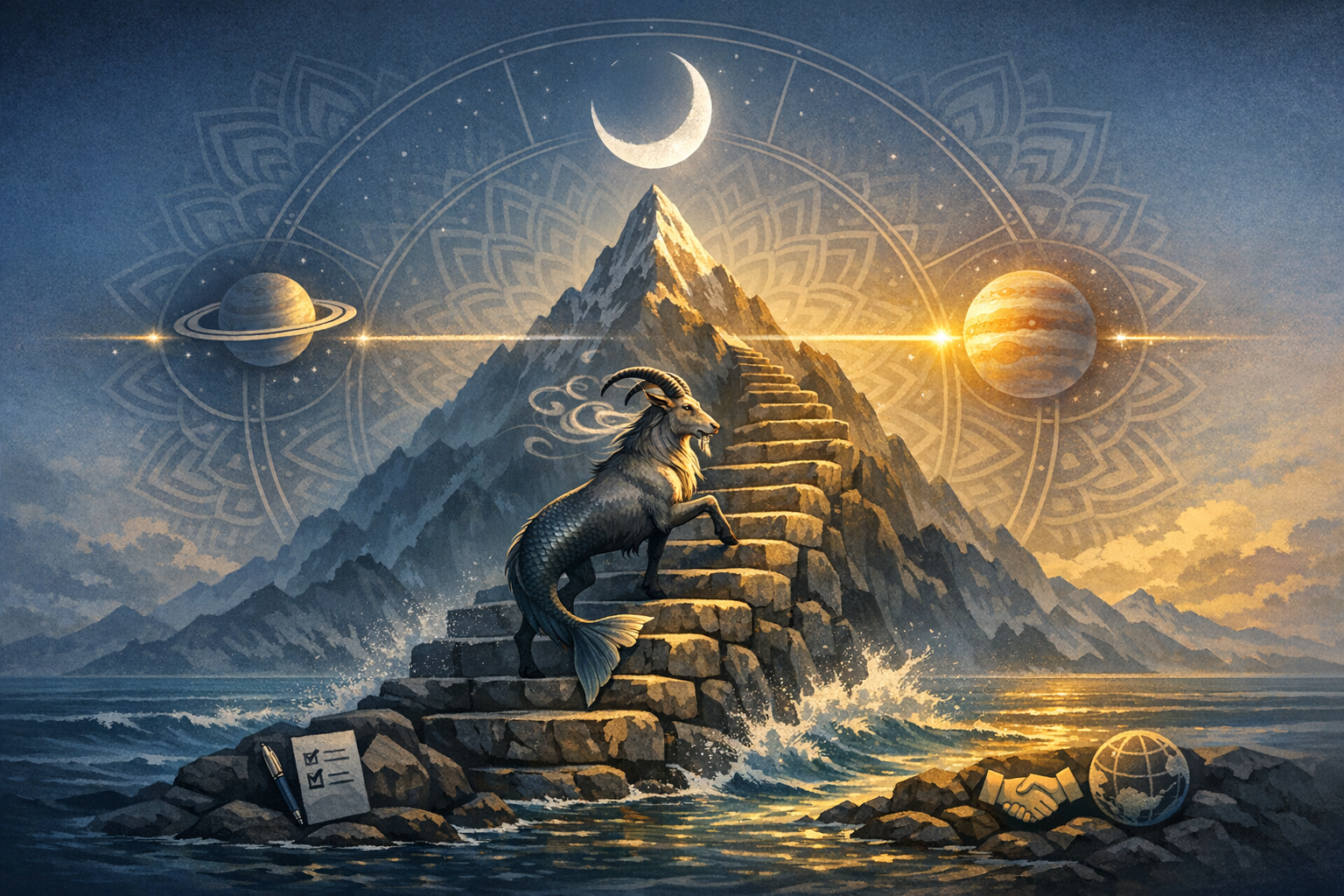
This long-form Vedic astrology overview presents a rigorous, readable, and action-focused forecast for Makara Rashi (Capricorn Moon Sign) across 2026–2027. It addresses the specific experience of natives born with the Moon in Capricorn, traditionally spanning Uttarashada Nakshatra padas 2–4, Shravana Nakshatram, and Dhanishta Nakshatram padas 1–2 (charans). The analysis is grounded in the sidereal (Nirayana) zodiac and Gocharas (planetary transits) assessed from Chandra Lagna (Moon as ascendant), while honoring the shared dharmic ethos across Hinduism, Buddhism, Jainism, and Sikhisman ethos that values inner discipline, service, compassion, and meditative clarity.
Methodologically, the forecast references major slow-moving transits that shape the year’s texture for Makara Rashi: Shani (Saturn) continues in Meena (Pisces)the 3rd house from Capricorn Moonthrough all of 2026 and well into 2027; Guru (Jupiter) traverses Mithuna (Gemini, 6th house) until late June 2026, then enters exaltation in Karka (Cancer, 7th house) from late June 2026 through much of 2027; Rahu remains in Kumbha (Aquarius, 2nd house) until roughly mid-November 2026 and then shifts to Makara (Capricorn, 1st house), with Ketu correspondingly shifting from Simha (Leo, 8th house) to Karka (Cancer, 7th house). Outcomes always vary by individual natal chart and ongoing Mahadasha–Antardasha periods; this is therefore an evidence-based orientation to themes and probabilities, not a deterministic script.
Executive summary: following the long Sade Sati cycle that concluded in 2025, 2026–2027 stands out as a rebuilding year marked by disciplined communication (Shani in the 3rd), the clearing of work-health puzzles early on (Guru in the 6th), and then a clear opening for alliances, marriage, and customer-facing growth after late June 2026 (Guru exalted in the 7th). The nodal shift in mid-November 2026 relocates karmic emphasis to identity and relating (Rahu in the 1st, Ketu in the 7th), calling for sobriety in self-presentation and sincerity in partnerships. It is often observed that Makara natives feel both tested and strengthened under such configurations, emerging with deeper resilience and sharper priorities.
Saturn in the 3rd house emphasizes the power of small, daily efforts. The transit is favorable for developing systematic communication, strengthening bonds with siblings and teammates, and mastering skills that require repetitionwriting, coding, professional documentation, and language learning. It also highlights the need for safety and order in short-distance travel and daily routines. Physiologically, the transit rewards consistent breathwork and posture hygiene (beneficial for lungs, shoulders, and upper back). Many Makara Moon natives notice that a steady, unglamorous routine under Shani brings unusually durable gains.
Jupiter’s movement frames the year in two distinct chapters. Until late June 2026, Guru in Mithuna (6th) can expose hidden inefficiencies in schedules, workflows, and health regimes; it often brings capacity to solve such issues provided effort is methodical. From late June 2026 onward, Guru in exaltation (Karka, 7th) tends to amplify relational gracespousal harmony, client growth, negotiations, and public goodwill. It favors marriage prospects, collaborative ventures, mentoring relationships, and international exposure. The 7th-house Jupiter also acts as a soft protective influence in turbulence, provided ethics (Satya) and reciprocity (Seva) remain central.
Rahu and Ketu add the karmic contrast. Up to mid-November 2026, Rahu in the 2nd house can elevate financial ambition but also create overreach risk: speculative spending, inconsistent savings, or sharper speech that bruises family harmony. Ketu in the 8th house, meanwhile, encourages inward research, detoxification, and cautious handling of insurance, taxes, inheritances, and shared assets. From mid-November 2026, Rahu enters the 1st house and Ketu the 7th, placing identity and relationships under the eclipse axis: clarity, accountability, and mature boundaries become non-negotiable. Authenticity in self-presentation and humility in partnerships diffuse the typical Rahu–Ketu swings.
Key themes for 2026–2027 therefore include: post-Sade Sati consolidation; disciplined speech and process-building; a mid-year pivot into partnership growth; and late-2026 introspection about identity and relating. In spiritual terms, the period invites the cultivation of steadiness (Shani), compassion in dialogue (Guru exalted), and ethical restraint in pursuit of material goals (Rahu in 2nd then 1st). These themes naturally resonate with the core dharmic values of Ahimsa, Satya, Dana, and Seva celebrated across Hindu, Buddhist, Jain, and Sikh traditions.
Career and vocation: the months with Guru in the 6th house prioritize firefighting, compliance, and quality control. Professionals benefit by mapping recurring bottlenecks and installing checklists and documentation SOPs. After late June 2026, capacity for client-facing roles and institutional alliances rises; negotiations find balance more readily, and public reputations tend to strengthen. Those in consulting, sales, partnerships, or legal mediation often notice clearer traction in the second half of 2026 and into 2027.
Leadership and teamwork: Shani in the 3rd promotes measured communication and process resilience. Teams respond well to predictable cadencesstand-ups at the same time, crisp agendas, and retro meetings that actually translate into action. Many Makara natives discover that consistent micro-improvements accumulate into competitive advantage under this transit.
Sectoral signals: regulated industries (banking, healthcare, pharmaceuticals), compliance-heavy functions (audit, risk, information security), documentation-centric roles (technical writing, standards, policy), and infrastructure verticals (construction, logistics, maritime, mining) are well supported through Shani’s methodical tone. With Guru’s 7th-house transit later, cross-border accounts, vendor ecosystems, and multi-stakeholder programs gain momentum.
Entrepreneurs and self-employed professionals benefit from a two-phase approach. Phase 1 (Guru 6th): de-risk operations, strengthen service delivery, and clean receivables. Phase 2 (Guru 7th): cautiously scale alliances, solidify pricing power, and present refined narratives in pitches and public relations. Under Rahu in the 2nd before mid-November 2026, it is wise to temper revenue hunger with margin discipline and conservative cash projections.
Finance and assets: when Rahu occupies the 2nd house, income opportunities can spike, yet budgeting may turn volatile. A practical antidote is envelope budgeting, debt pay-down schedules, and scenario planning for variable income. With Guru in the 6th early in the period, some may be tempted by leverage; structured amortization and prepayment discipline keep the arc favorable. After mid-November 2026, as Rahu enters the 1st, identity-linked spending (image, gadgets, rapid wardrobe revamps) should be balanced against long-term capital goals.
Household economics and the Aaya–Vyaya lens: traditional annual Aaya–Vyaya (income–expenditure) calculations are Panchang-dependent and location-specific. Tracking Aaya–Vyaya 2026–2027 alongside monthly cashflows and festival-linked expenses strengthens financial steadiness for Makara households. In practice, this means pre-setting festival budgets, tuition/insurance autopays, and family contingency funds.
Education and skills: Shani in the 3rd favors mastery through repetition. Languages, logic, law, coding, analytics, and technical writing respond well to a daily quota approach. Students preparing for competitive exams or certifications may face heavier workloads under Guru in the 6th, but outcomes improve when mock-test feedback loops are maintained. From late June 2026, faculty mentorships, study groups, and international academic exchanges are particularly fruitful.
Health and lifestyle: Guru in the 6th spotlights the value of preventive care. Digestive regulation, metabolic markers, and posture hygiene benefit from early, systematic attention. Under Shani in the 3rd, respiratory conditioning and shoulder–neck mobility respond well to gentle daily practice. Across dharmic traditions, core methods converge: mindful eating, Yoga and Pranayama, dhyana (meditation), metta-bhavana (loving-kindness), anuvrata-inspired restraint, and Simran support both nervous-system balance and ethical clarity.
Relationships, marriage, and family: with Rahu in the 2nd through mid-November 2026, speech requires conscious kindness; Nonviolent Communication frameworks are especially potent. From late June 2026, Guru in the 7th tends to bless marriage discussions, spousal harmony, client rapport, and diplomatic outcomes. After the nodes shift to the 1–7 axis in mid-November 2026, boundaries, transparency, and shared values become critical. Integrity about personal priorities prevents projection cycles typical of Rahu–Ketu polarity.
Children and elders: the year often brings practical responsibilitiesschool applications, tutoring logistics, or elder-care coordination. The 3rd-house Saturn supports stable routines and reliable caregiving schedules. Family councils and clear documentation (medical folders, SOPs for caregiving) reduce stress and miscommunication.
Travel and relocation: the 3rd-house Saturn supports purposeful short trips and commuter efficiency, especially for training, audits, and site visits. With exalted Jupiter in the 7th after late June 2026, cross-border engagements, client visits, and relocation planning gain auspiciousness, provided documentation is meticulous and timelines are realistic. Ketu in the 8th until mid-November 2026 can prompt interest in ancestry, pilgrimages to family shrines, and inner retreats.
Property and shared resources: Ketu in the 8th calls for prudence around inheritances, joint accounts, and insurance. Title checks, escrow discipline, and will documentation protect long-term interests. After Ketu moves into the 7th, co-owned property should be managed with explicit agreements; buffers against assumption creep are healthy.
Litigation and negotiations: Guru in the 6th can bring disputes to the surface, yet it often equips natives with the resources to resolve them. When Guru enters the 7th, settlement potential improves. Best practice remains the same: stay documented, be fair, and use principled negotiation. Ethical conduct is the most reliable long-term remedy in all dharmic paths.
Timeline cues for decision-making: until late June 2026, prioritize operational clean-up, compliance, backlog clearance, and health baselining. From late June 2026 to mid-November 2026, emphasize partnerships, marriage planning, client acquisition, and cross-functional alliances. From mid-November 2026 through 2027, center identity work, role clarity, transparent communication, and steady self-care; this framing reduces the volatility that the nodal axis can introduce in the 1–7 houses.
Nakshatra-specific insightsUttarashada (padas 2–4): these padas in Makara blend Surya’s leadership with Saturn’s pragmatism. In 2026–2027, the combination favors ethical authority, policy craft, and codifying standards. The first half of the period may expose gaps in team discipline; the exalted 7th-house Jupiter later supports coalition-building, mentorship networks, and fair contracts. Caution: under Rahu’s 2nd-house influence early on, avoid overpromising or severe speech in family councils.
Shravana: the Moon-ruled Shravana prizes listening, learning, and the transmission of knowledge. The 3rd-house Saturn multiplies the gains from disciplined storytelling, teaching, and documentation. The mid-year Jupiter shift amplifies public goodwill for educators, counselors, media professionals, and spiritual facilitators. Practice: active listening and clear citations anchor credibility, aligning beautifully with the dharmic respect for Vidya and Satya.
Dhanishta (padas 1–2): Mars-ruled Dhanishta thrives on rhythm, teamwork, and material orchestration. The year supports infrastructure projects, operations scaling, and performance cultureprovided metrics are humane and transparent. Watch for impatience when Mars periodically aspects sensitive houses; channel drive into training and safety drills. When Rahu enters the 1st in late 2026, identity charisma surges; pair it with humility to avoid avoidable friction in partnerships.
Calendars and muhurta: local Panchang remains the authority for day-to-day auspicious timing. Makara Sankranti 2026 is a meaningful moment to renew sankalpas that reflect Saturnian steadiness and Jupiterian goodwill. Choghadiya and Tithi guidance should be adapted to one’s location and purpose (transactions vs. spiritual practice vs. travel). Aaya–Vyaya 2026–2027 tracking, aligned with festival cycles and academic calendars, strengthens household resilience.
Dharmic, non-sectarian remedies for steadiness: daily Seva (service) to elders and vulnerable communities harmonizes Shani; mindful speech and study of ethical texts (Bhagavad Gita, Dhammapada, Jain anuvrata literature, Sikh Nitnem) clarify Rahu–Ketu dynamics; japa or Simran undertaken consistently calms the mind; Pranayama and dhyana stabilize the nervous system; Dana (charity) in education and healthcare channels Jupiter’s grace; fasting or food discipline held with compassion refines self-mastery. These practices unite the shared spiritual grammar of Hinduism, Buddhism, Jainism, and Sikhism.
Ethical guardrails: transparency in money, humility in speech, respect for consent, and ecological responsibility are potent remedies in themselves. Aligning means and ends is a timeless dharmic instruction; in 2026–2027, it translates into calmer decisions and sturdier reputations for Makara natives.
Rashifal, Rashiphalalu, and Rashipalan readers will recognize the classical throughline: post-Sade Sati integration, then growth via relationships, then identity work as the nodes highlight the self–other axis. Across this sequence, Vedic Astrology invites steady effort rather than fatalism. Outcomes are best when Gochar insights are paired with Panchang-aware timing, ethical action, and daily contemplative practice.
Technical note: all results are modulated by natal placements (especially Saturn, Jupiter, Venus, and Mars), house lords, and ongoing Dasha–Bhukti. Cross-checks from the Lagna chart and divisional charts (D-9 for relationships, D-10 for career, D-6 for health) refine this overview. As ever, specific medical, legal, or financial steps should be taken with qualified professional advice.
In sum, Makara Rashi 2026–2027 is a constructive arc: systematize early, partner wisely mid-year onward, and cultivate clarity as the nodal axis pivots to identity and partnership. The more speech is gentle and records are clean, the greater the grace with which this grounded Moon sign rebuilds, rises, and thrives.
Inspired by this post on Hindu Pad.
