

You may love kirtan yet feel unsure what to do with a lila after you have heard it. Or you may be preparing for Vrindavan and Govardhan while quietly wondering whether sacred travel could become little more than a crowded sequence of stops. That unease points to the right question: how does an encounter with Krishna’s lila actually change the way you see, desire, and serve?
Gaudiya devotion joins sacred narrative and sacred geography in one discipline of remembrance. Lila gives your attention a divine relationship to enter. Pilgrimage gives that attention a place, a pace, and a community. Neither requires manufactured emotion. Both ask you to move from possession to presence, and from being a spectator to becoming a servant.
Hear lila as an invitation, not merely a charming story
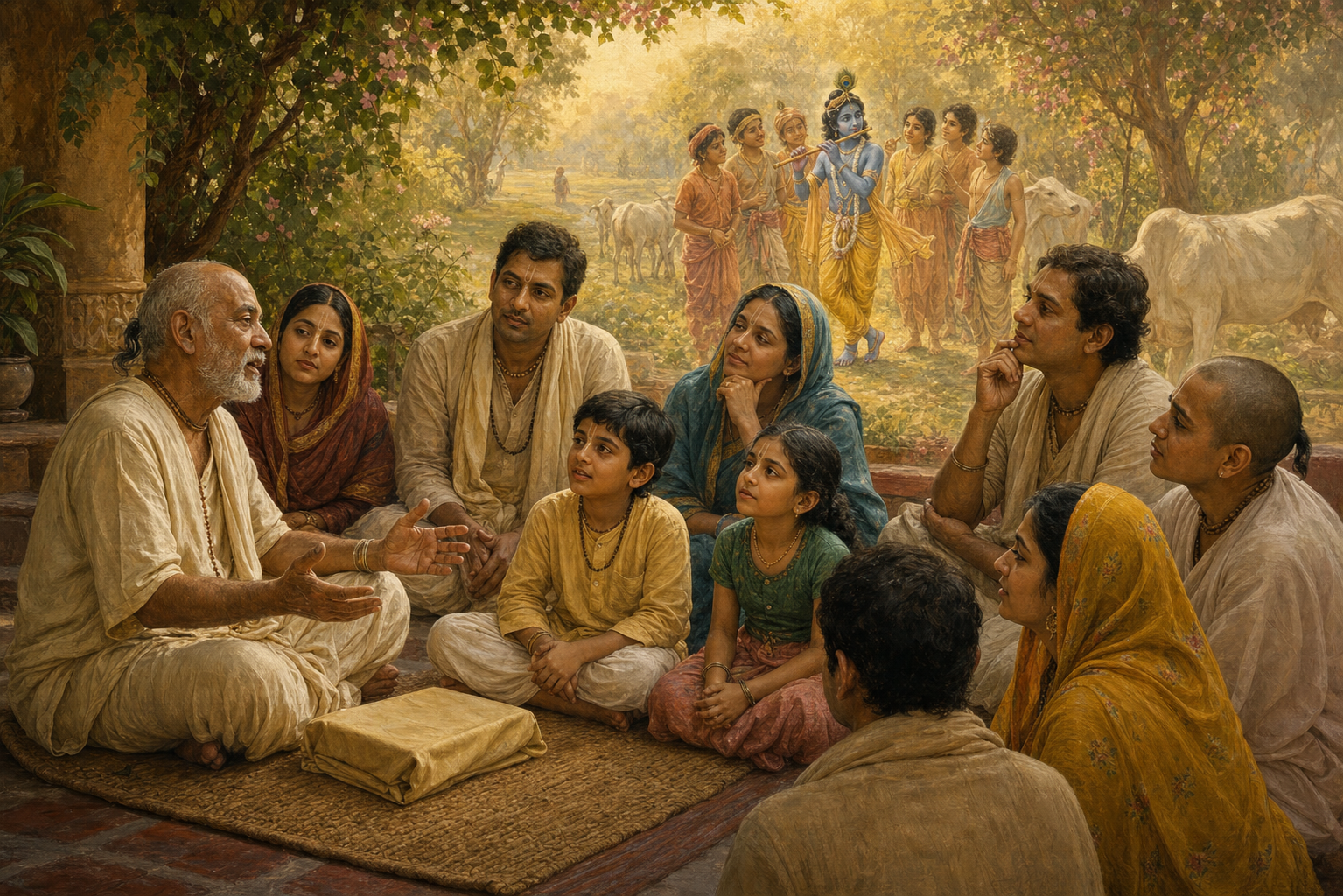
In Nimai’s childhood lila, the neighborhood does not encounter the Divine through a distant philosophical abstraction. A child cries. The people around Him chant “HAR! HARI!” and clap. He becomes peaceful, moves from Sachimata’s lap into His earliest steps, and dances when the neighborhood women promise Him sweets and ksira. His golden ankle bells sound as sacred remembrance, affection, food, rhythm, and household life meet in one intimate devotional scene.
The scene holds a central Gaudiya paradox. The Supreme, whom even exalted beings cannot easily approach, allows Himself to be coaxed by ordinary devotees. Transcendence has not been reduced to cuteness. Rather, divine greatness is revealed through intimacy: the infinite Lord freely accepts the care of His devotees.
This is why lila should not be treated as decorative mythology added to the serious work of theology. It teaches you what relationship with the Divine looks like when it enters daily life. Clapping becomes worship. Sweets become part of loving exchange. A group of neighbors becomes a devotional community because everyone responds to Nimai by invoking the Name.
The thieves who approach Nimai expose the opposite way of seeing. They notice His ornaments, lift Him with counterfeit affection, and speak as if they know Him. Their bodies are close to the Lord, but their desire remains fixed on what can be taken from Him. The lila therefore gives you a sharper test than physical proximity or religious appearance: are you seeking Krishna’s presence, or are you using sacred proximity to acquire an ornament for the ego?
That ornament need not be money or jewelry. It can be the wish to appear advanced, collect unusual experiences, display photographs from holy places, or win an argument with superior religious knowledge. The thieves are easy to condemn from a distance. The more useful reading is to notice their tendency in your own attention.
When you hear a lila, slow the encounter down with four questions:
- Where is relationship happening? Notice who calls, responds, cares, receives, or serves.
- What changes the atmosphere? In Nimai’s childhood scene, the communal chanting of “HARI” turns distress into shared remembrance.
- What does desire make each person see? The neighbors see a child to love; the thieves see ornaments to possess.
- What response does the lila ask from you? Name a concrete change in attention or conduct instead of stopping at admiration.
Stay with the details you have actually received. You do not need to invent dialogue, force hidden symbolism into every object, or claim an inner realization you have not had. Lila becomes formative through faithful attention, not imaginative excess.
Let pilgrimage discipline the way you move and see
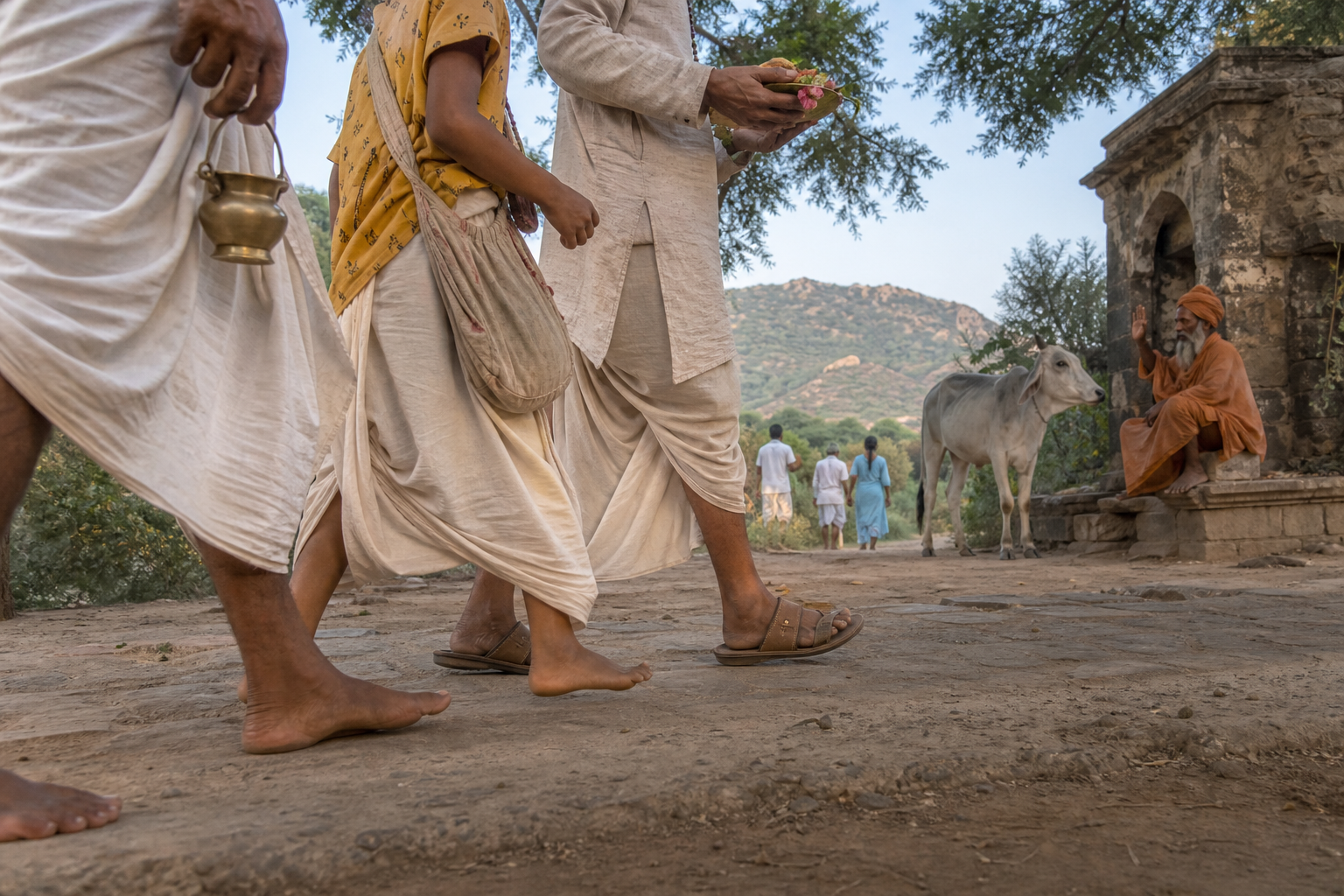
A holy place can be visited without being received. You can move through a sacred landscape while your attention remains occupied by transport, photographs, comfort, comparison, and the pressure to cover everything. Pilgrimage begins when the place is allowed to instruct your movement.
Govardhan makes this distinction especially clear. In Gaudiya devotion, Govardhan is honored as Giriraj and as a manifestation of Sri Krishna. Parikrama is therefore not simply exercise around an important landmark. Each step can become an embodied expression of surrender, provided that the mind is repeatedly returned to remembrance.
During Kartik, revered in this tradition as the month of Damodara, lamp offerings, devotional hymns, prayer, kirtan, satsang, and service give that remembrance a sustained communal rhythm. A Kartik yatra at Govardhan shows how place, practice, and association reinforce one another: the landscape directs attention toward Krishna, shared practices steady that attention, and fellow pilgrims make service immediately possible.
You can protect that purpose before, during, and after a yatra.
Before you leave
Choose a devotional intention, not merely an itinerary. Make it simple enough to remember when the day becomes busy: “May I learn to choose presence over possession,” or, “May I become more ready to serve.” Read or hear the relevant lila beforehand so the geography is already connected to Krishna’s activity and character in your mind.
Also decide what you will not try to collect. A crowded schedule can make every shrine compete for attention. Leaving room for chanting, listening, and unhurried darshan is not wasted travel time; it is what allows travel to become pilgrimage.
While you are there
Return to three anchors: the Name, the meaning of the place, and the person you can serve. Chant when attention scatters. Recall why the place is sacred instead of treating scenery as self-explanatory. Then notice the practical field of seva around you: listening without interrupting, helping a fellow pilgrim, respecting the sanctity of the route, or performing an assigned duty without seeking recognition.
Allow kirtan and silence to support each other. Kirtan gathers the community around the Name; silence lets you notice where your mind keeps wandering. Neither noise nor quiet is automatically devotional. Their value lies in whether they return you to attentive service.
Keep bodily limits separate from spiritual status. Exhaustion is not proof of surrender, and comparison with another pilgrim does not deepen remembrance. Follow the route and safety guidance of the group or temple, move at a sustainable pace, and let humility include honest care for the body through which you are serving.
When you return
Do not measure the yatra only by the intensity you felt there. Ask what has become more consistent at home. Perhaps you now chant with less distraction, perform a neglected duty more readily, speak more patiently, or make space for regular satsang. A pilgrimage has begun to bear fruit when remembrance survives the loss of novelty.
If travel is not possible, do not pretend that reading at home is physically identical to parikrama. Use the distinction constructively. You can prepare the same inner faculties through lila, chanting, temple association, lamp offering, and service where you are. Then, if you later reach Govardhan, you arrive with a practiced form of attention rather than an expectation that geography will do all the work for you.
Sacred sound connects the remembered lila to the present moment
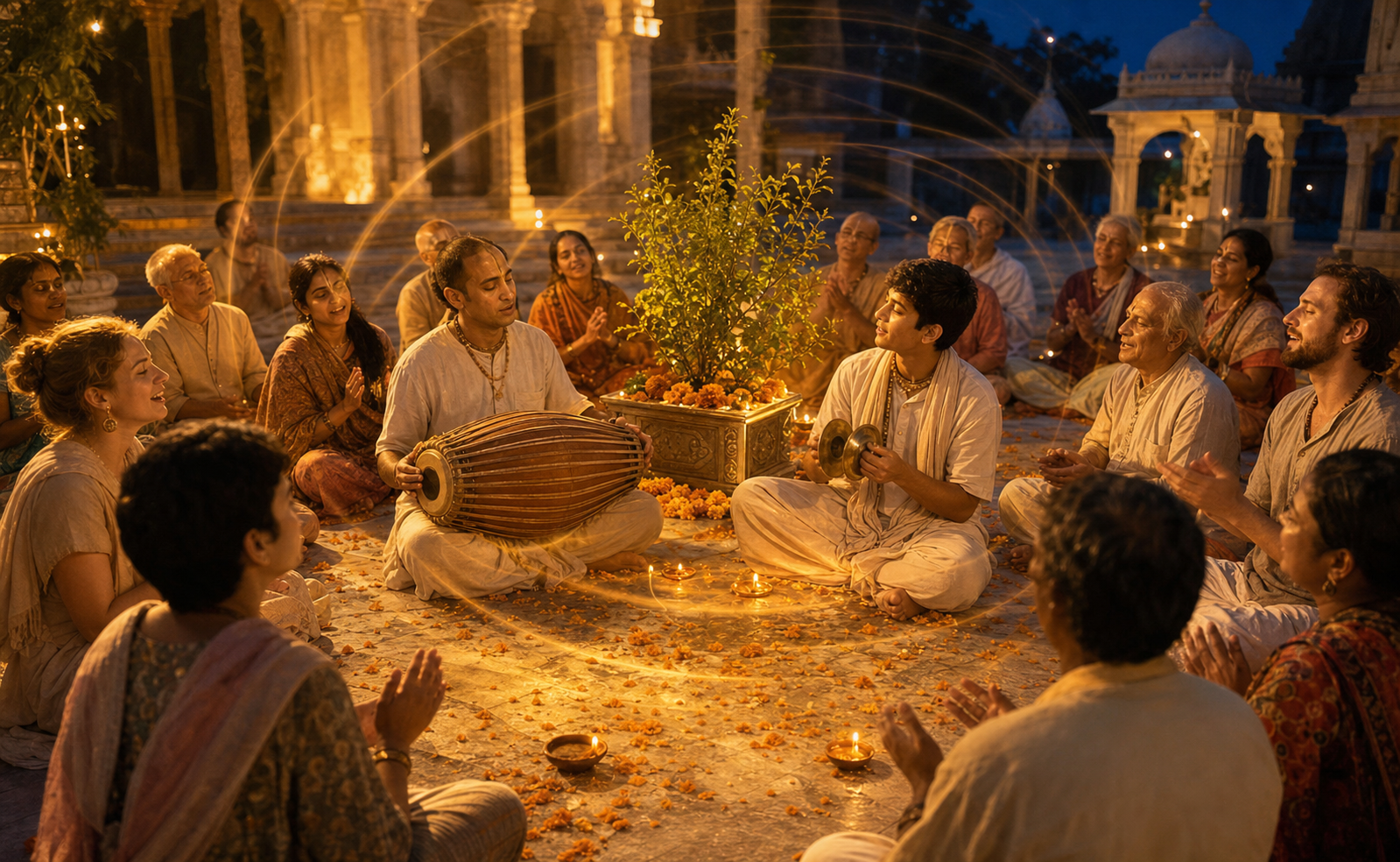
The Name is the bridge between hearing about divine activity and responding now. In Nimai’s childhood scene, chanting is not background music. The people hear His cry, answer with “HARI,” clap together, and form a circle of responsive care. On pilgrimage, kirtan, japa, prayer, and hymns repeatedly gather a scattered mind around Krishna.
This gives sacred sound a personal, communal, and ethical dimension. Personally, it interrupts the mind’s habit of following every desire. Communally, it lets many people orient themselves toward the same sacred center. Ethically, it should make you more responsive to the beings beside you. If chanting leaves you more concerned with being heard than with hearing another person’s need, the form is present but its lesson has not yet reached conduct.
Shared sacred sound can also help Dharmic communities recognize kinship without erasing difference. Kirtan and japa in Hindu traditions, simran in Sikh tradition, and chanting or meditative disciplines in Buddhist and Jain traditions all cultivate forms of recollection, steadiness, and ethical attention. Their theologies and aims should not be collapsed into a claim that every practice is identical. Respect becomes more durable when common values such as ahimsa, mindfulness, compassion, and disciplined remembrance are acknowledged alongside real doctrinal distinctions.
For a Gaudiya practitioner, the center remains specific: remembrance of Sri Krishna through His Name, form, qualities, devotees, places, and lila. You do not honor another Dharmic path by making Gaudiya devotion vague. You honor it by being precise about your own practice while refusing contempt for another person’s disciplined search for truth.
Use this lila-to-pilgrimage practice wherever you are
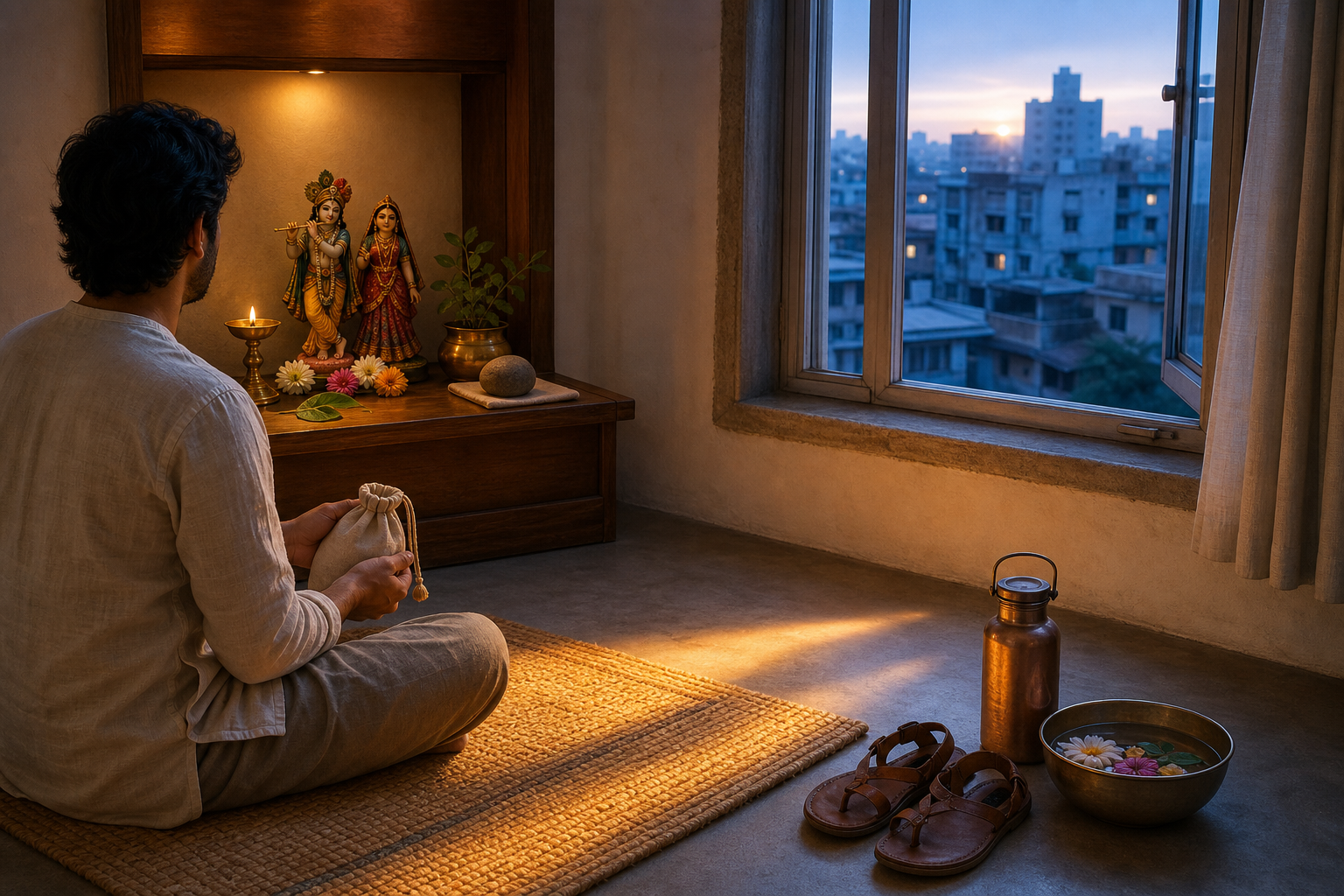
The following sequence can be used after hearing a lila, before darshan, during a pause on pilgrimage, or in your regular practice at home. Its purpose is not to manufacture a mood. It is to carry remembrance into a decision.
- Begin with the Name. Chant attentively enough to mark a transition from ordinary mental traffic into devotional listening.
- Receive a single scene. Stay with one lila rather than accumulating many narratives. Notice the people, actions, sounds, and objects that are actually present.
- Find the relationship. Ask who is giving care, who is receiving it, and how Krishna permits Himself to be approached.
- Find the distortion. Notice where greed, display, haste, control, or false affection interrupts relationship.
- Bring the question to your present place. At Govardhan, ask what it means to walk before Giriraj as a servant. At home, ask where sacred remembrance could transform an ordinary household action.
- Choose an immediate seva. Let the response be visible in conduct: fulfill a duty, assist someone, give undivided attention, join kirtan without performing for notice, or care for a vulnerable person.
- Close with a carry-sentence. State plainly what you intend to remember when the setting changes, such as, “Seek the presence, not the ornament.” Return to it when desire scatters your attention.
The thieves’ encounter with Nimai offers a direct example. You can ask, “What ornament am I trying to take from this sacred moment?” On pilgrimage, it may be an impressive image, a story about your austerity, or the status of having reached a celebrated place. At home, it may be the wish to enjoy devotional culture without accepting an inconvenient duty. Once the ornament is named, redirect the same moment toward presence through chanting and a practical act of service.
This is also a useful test for devotional emotion. Tenderness toward child Nimai is valuable, but its direction matters. Does it soften your treatment of the dependent, the overlooked, and the vulnerable? Serenity at Govardhan is valuable, but does it make you more responsible when ordinary life resumes? Bhava is not reduced to ethics, yet a devotional mood that never touches conduct remains incomplete as a guide for daily life.
Key takeaways
- Lila trains perception. Hear it closely enough to notice the difference between loving presence and religiously decorated possession.
- Pilgrimage is embodied remembrance. Place, practice, and community become transformative when each leads you toward surrender and seva.
- Sacred sound joins the two. The Name carries remembered lila into the immediate work of gathering attention and responding to others.
- Do not use emotion, physical strain, photographs, or proximity to a holy place as automatic measures of advancement.
- The practical test comes afterward: devotion should make chanting steadier, service less self-conscious, and ordinary responsibilities more sacred.
Choose the lila you will carry into your next period of chanting. If a pilgrimage is ahead, arrive with a devotional question and a willingness to serve. If you are staying home, let the next household duty become the place where remembrance takes form. The movement begins as soon as you stop reaching for the ornament and attend to the Presence already before you.
References
- Dandavats – Nimai’s Timeless Childhood Lila: Two Thieves Seek Ornaments, Discover Profound Grace
- Dandavats – Kartik Yatra 2025 Day 7 at Govardhan: Transformative Bhakti with HH Radhanath Swami
