
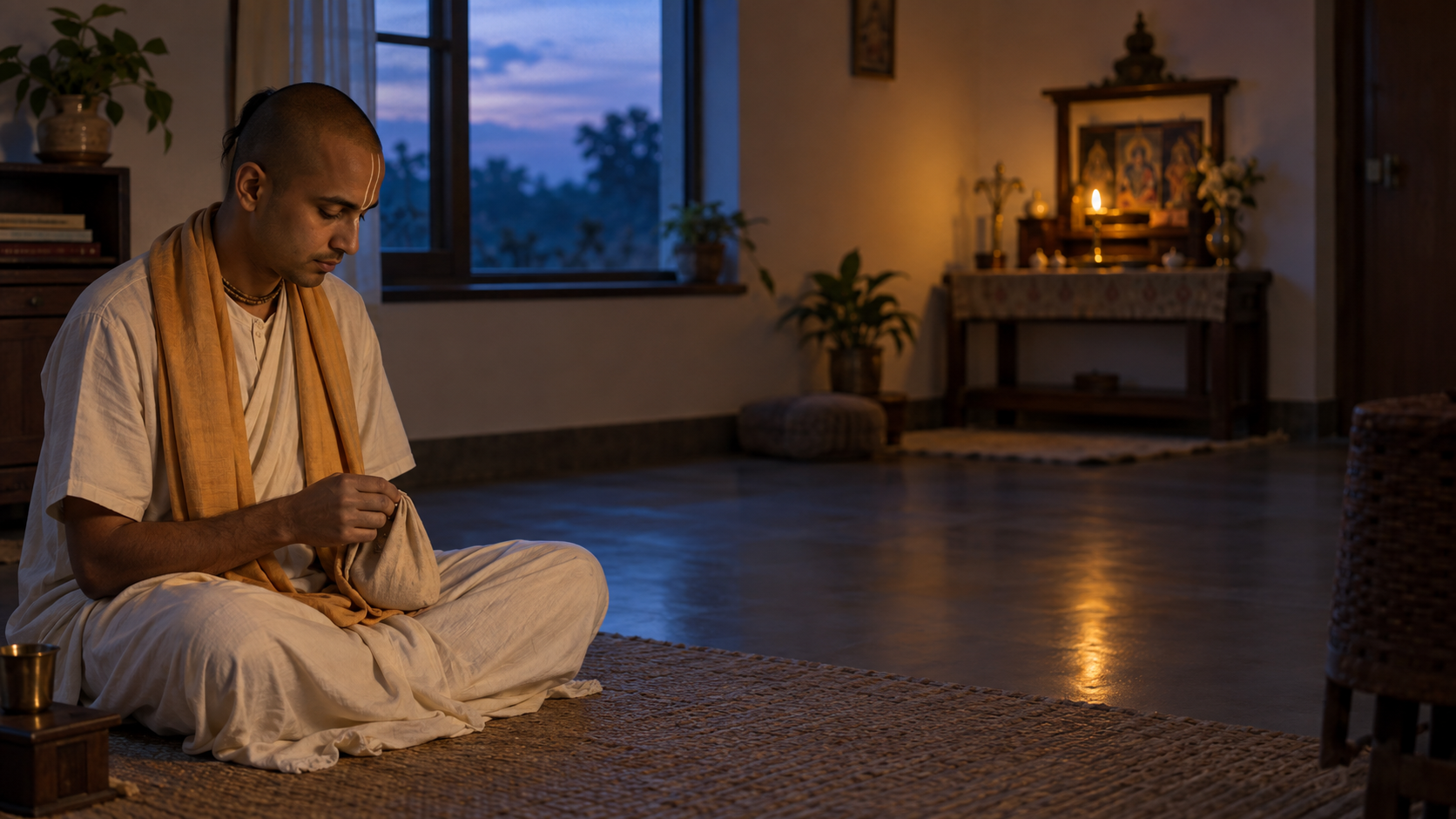
You finish your rounds, put down the beads, and realise that your mouth chanted while your mind spent the session planning, remembering, judging, or worrying. The natural response is to force harder concentration next time or to conclude that you are simply bad at japa. Neither response reaches the heart of the problem.
Japa is not a performance in which you prove control over the mind. It is a meeting in which you hear Krishna’s names, notice when you have turned away, and return. That return is where absorption and dependence meet. Once you understand this, even a difficult session can become honest devotional practice.
Absorption and dependence are two halves of one movement
Absorption answers a simple question: where is your consciousness resting? Dependence answers another: where do you place your hope when your consciousness, strength, or circumstances fail you?
Ordinary self-absorption keeps attention circling around personal ability, injury, status, plans, and control. Krishna-absorption turns attention toward Krishna and the question of how to serve Him. Dependence goes further. You stop treating intelligence, discipline, resources, and contacts as the final guarantors of your spiritual life. You use whatever Krishna has given you, but you do not mistake the instrument for the source of grace.
The Vrajavasis embody this union: their thoughts move toward Krishna’s service, while their confidence rests in Krishna’s mercy rather than in their own capacity to secure the outcome. Their example gives you a precise working definition. Absorption is attention offered to Krishna; dependence is the surrender of the result to Krishna.
Japa brings both movements into a single act. Hearing the holy name is absorption. Returning the wandering mind and asking Krishna to accept your effort is dependence. Absorption without dependence can become a concentration exercise dominated by self-measurement. Dependence without absorption can become a vague religious sentiment that never gathers the mind around Krishna.
This is also why japa can feel more exposing than kirtana. In congregational chanting, other voices, instruments, melody, and the kirtana leader help carry your attention. In japa, you meet Krishna’s name together with your largely unassisted mind. The difficulty is not evidence that the practice has failed. It reveals where your attention habitually goes when external support is removed.
Make hearing, not a spiritual mood, the measure of japa

The Hare Krishna mahamantra gives the mind a definite object:
Hare Krishna, Hare Krishna, Krishna Krishna, Hare Hare / Hare Rama, Hare Rama, Rama Rama, Hare Hare.
Your first responsibility is not to manufacture peace, sweetness, tears, insight, or stillness. It is to chant and hear the names. A peaceful state may come, or it may not. If you make a particular feeling the entrance requirement for sincere japa, you will spend the session examining yourself instead of attending to Krishna.
Attentive japa asks you to release the problem-solving stream for the duration of the mantra and submit to hearing. Its transforming power is not presented merely as breath regulation or mental numbing. The decisive movement is association with Krishna through His name. That is why japa can become a refuge rather than another self-improvement project.
Use this sequence at your next session:
- Establish the relationship before the first mantra. In your own words, acknowledge that this time belongs to Krishna. A simple intention such as, “Please let me hear Your names for Your pleasure,” is enough. It is a prayer, not a formula.
- Chant one complete mantra and listen to it. Do not think about the whole session while chanting the present mantra. Pronounce the names clearly enough for your own ear to follow them.
- When the mind leaves, return to the sound now being uttered. Do not spend the next several mantras conducting an inquiry into why you became distracted. That only turns one distraction into a longer one.
- Do not demand an immediate reward. You may begin dull, anxious, or resistant. Offer the actual mind you have, not the devotional mood you wish you had.
- End with an honest observation. Notice what repeatedly captured you and where you were able to return. Use that knowledge to simplify the next session, not to build a case against yourself.
Lord Caitanya names the absence of attraction as nanuraga, lack of taste. That admission matters. You do not need to counterfeit relish before you can chant sincerely. Taste can be cultivated by continuing to approach the name, just as beneficial habits are cultivated before they become effortless. The practical decision is therefore clear: do not wait to feel eager before you begin hearing.
Turn distraction into a return instead of a verdict

A wandering mind usually produces two problems. The first is the distraction itself. The second is the verdict that follows: “My japa is useless,” “I have made no progress,” or “Krishna will not help someone like me.” The second problem often lasts longer because it disguises discouragement as spiritual honesty.
The Brahma-vimohana-lila offers a useful image. When the calves disappeared, the cowherd boys became anxious, and Krishna assured them that He would retrieve the calves. Because the Sanskrit word go can refer to cows as well as the senses, the episode has been applied to the practitioner whose senses wander away from devotional attention. Its practical lesson is not that you may feed every distraction and expect Krishna to repair the consequences. It is that temporary sensory agitation need not become permanent spiritual despondency.
Your task is to continue the core practice and depend on Krishna while making the return available to Him. Every time you hear that you have stopped hearing, a choice opens. You can follow the thought, condemn yourself, or come back to the holy name. Choose the smallest faithful action: hear the next name.
Make the external return easier as well. Put the phone and other attention-demanding devices outside your immediate reach. If an important obligation keeps intruding, record only enough to remember it later, then resume japa. If something genuinely requires immediate action, address it honestly rather than using the language of surrender to excuse negligence. Dependence on Krishna does not require pretending that ordinary duties do not exist.
It also helps to distinguish three conditions:
- Unnoticed distraction: You discover that several mantras passed without hearing. Return without replaying the entire lapse.
- Recurring preoccupation: The same plan, resentment, or fear repeatedly captures attention. Acknowledge that it is present, place the outcome before Krishna, and return to the mantra now being chanted.
- Deliberate indulgence: You knowingly keep feeding a distraction while expecting Krishna to remove it for you. Stop supplying it. Dependence includes accepting responsibility for the choice that is actually yours.
The important measure is not whether the mind ever wandered. It is whether wandering ended in abandonment or in return. A return does not make distraction desirable, but it prevents distraction from claiming the rest of your practice.
Humility gives dependence its proper shape
Dependence on Krishna is easily misunderstood as a demand: “I chanted, so Krishna must give me peace, solve my difficulty, or produce spiritual taste.” That is not surrender. It is an attempted transaction in devotional language.
Lord Caitanya places humility, tolerance, respect for others, and freedom from the demand for honour at the centre of sustained chanting. The instruction to be humbler than grass and more tolerant than a tree is not an invitation to deny your dignity or enable wrongdoing. It corrects the possessive assumption that Krishna owes you an experience and that other people exist to confirm your spiritual importance.
A particularly useful correction is to replace “Krishna is mine” with “I am Krishna’s.” The first phrase can quietly make the Lord an object of possession. The second places the practitioner in the position of service. Japa is then offered for Krishna’s pleasure, rather than used to make Krishna produce a preferred state for yours.
Japa may also expose memories of careless speech, injuries you caused, pride, envy, or self-righteousness. Do not assume that seeing an unpleasant fault means chanting has made you worse. The practice can uncover what self-protection kept hidden. Facing your own faults while refusing to dwell on the faults of others creates room for a less entitled approach to the name.
Before beginning, ask yourself three questions:
- What result do I presently think Krishna owes me?
- Whose fault am I more eager to contemplate than my own responsibility?
- What service is already clear, even if the outcome remains uncertain?
You do not have to solve all three questions before chanting. Their purpose is to expose the posture you are bringing to the beads. Once the posture is visible, offer it and begin.
Dependence becomes visible when the outcome is uncertain

It is easy to speak of dependence when events are favourable. Its substance appears when plans fail, protection seems absent, or the next step lies beyond your strength.
Vasudeva’s conduct shows that dependence is not passivity. He endured imprisonment, the deaths of his sons, and repeated apparent defeat without abandoning faith in Krishna’s will. When Krishna instructed him to carry the newborn Lord to Vrindavana, Vasudeva acted although the prison doors were locked and guards stood in the way. He did not wait to understand every mechanism by which the journey would become possible. He accepted the service that had been given and moved toward it.
This is why steadfast dependence amid repeated loss can be understood as bravery. Bravery here does not mean confidence that events will unfold according to your preference. It means continuing the service that is clear without making favourable circumstances a condition of devotion.
When you bring a calamity or uncertainty into japa, separate what belongs to you from what does not:
- Your part: hear the name, fulfil the next clear duty, seek appropriate help, make amends where required, and stop conduct that is within your power to stop.
- Krishna’s part: the final outcome, the timing of relief, the opening of doors you cannot open, and the spiritual fruit of the offering.
This distinction prevents two opposite mistakes. Self-reliance tries to control both columns. Fatalism neglects the first and calls that neglect faith. Bhakti acts wholeheartedly in the first while refusing to seize ownership of the second.
The image of a mountain receiving heavy rain adds another dimension. The mountain remains steady while the downpour washes away accumulated dust. Applied carefully, adversity can reveal attachments and deepen remembrance. This does not mean that every sufferer’s pain was deserved or caused by personal impurity. The useful question concerns your response: will difficulty drive consciousness entirely into fear and resentment, or will it become an occasion to remember Krishna while doing what must be done?
Worldly victories and defeats eventually pass. For the practitioner, their durable value lies in whether they increase remembrance of Krishna. A success that strengthens self-sufficiency can be spiritually dangerous; an apparent defeat that awakens sincere dependence can become spiritually fruitful. Do not judge either event before asking what it is doing to your remembrance.
Key takeaways for your next japa session
- Make hearing Krishna’s names your immediate task. Do not make a special mood the price of admission.
- Treat every noticed distraction as an invitation to return, not as a verdict on your spiritual worth.
- Use kirtana’s communal support when it helps, while recognising that personal japa reveals where your unaided attention goes.
- Ask Krishna for help without demanding that He provide a preferred feeling, timetable, or worldly result.
- Take responsibility for the next clear act of service and leave the inaccessible outcome with Krishna.
- Let japa expose your own faults without turning it into a session for prosecuting the faults of others.
At your next session, make one change before the first bead: consciously place the time in Krishna’s service. Then chant one complete mantra and hear it. When the mind leaves, return without drama. That small movement, repeated sincerely, is not merely recovery from failed concentration. It is the practice of absorption and dependence itself.
References
