
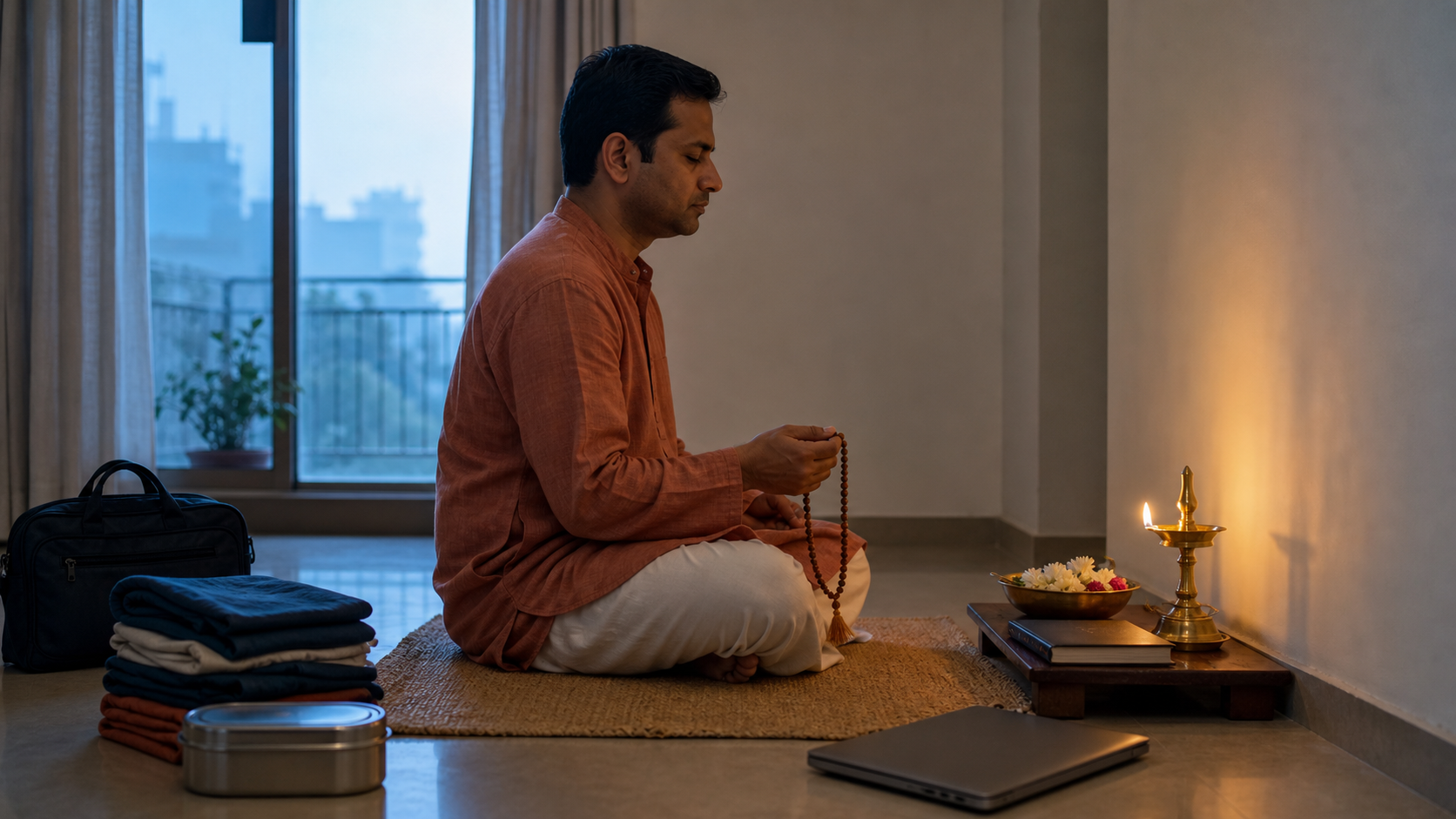
You may already know which prayer, meditation, recitation, worship, or study belongs in your day. Yet when work expands, travel interrupts you, or the mind becomes uncooperative, the practice disappears. The difficulty is usually not a lack of respect for Dharma. It is that a sincere intention has never been turned into a clear rule.
A sustainable sadhana does not require you to manufacture a devotional mood every morning. It gives devotion a dependable form. You decide what you will do, what will call you to it, what completion means, and how you will return after disruption. That structure is what allows spiritual aspiration to survive ordinary life.
Sadhana begins when aspiration becomes an obligation
Sadhana is intentional, repeated discipline directed toward spiritual realization. An inspiring discourse, an occasional temple visit, or a burst of intense practice may nourish you, but intensity alone does not create a discipline. Sadhana begins when a legitimate practice receives a stable place in your life.
This distinction matters because inspiration and discipline solve different problems. Inspiration can show you why a path is worth following. Discipline determines what you do when the inspiration is absent. If your practice depends on feeling peaceful, pure, enthusiastic, or spiritually receptive before you begin, your mood has quietly become its gatekeeper.
Start by identifying the practice that actually belongs to your path. It may involve prayer, mantra repetition, meditation, worship, recitation, scriptural study, devotional singing, service, or a combination received through your tradition. Do not assemble an impressive mixture merely because its parts sound spiritual. Dharmic traditions differ in doctrine, method, initiation, and spiritual aim. Respecting those differences is part of disciplined practice, not an obstacle to it.
- Name the core practice precisely. Meditation is vague; the particular method you have been taught is precise.
- Name its authority. Ask whether it comes from your guru, your sampradaya, a recognized teaching lineage, a public foundational instruction, or your own preference.
- Name the point of completion. It might be a received recitation commitment, a complete liturgical sequence, a defined period, or another boundary appropriate to the practice.
- Name the conduct it should support. Your discipline should make you more capable of living the duties and ethical demands recognized by your path.
If you have accepted formal vows or instructions, begin there. Do not replace an assigned discipline with something more novel because novelty feels powerful. If you are not under formal guidance, choose a public and foundational practice from a tradition you genuinely understand. Where a mantra, rite, austerity, or method is reserved for initiation, do not treat internet access as authorization.
You should be able to complete this sentence without using words such as more, regularly, or deeply: My core sadhana is [specific practice], received or learned from [authority], and it is complete when [clear boundary]. If you cannot fill in those blanks, refine the practice before trying to strengthen your motivation.
Build a rule that removes the daily negotiation

Most inconsistency happens before the practice begins. You wake up and start negotiating: now or later, the full practice or something easier, before checking messages or after. Every open decision gives distraction another chance to win. A rule of practice settles those decisions in advance.
A workable rule contains a cue, a place, a starting action, a completion boundary, and an adaptation for genuinely disrupted days. Write it in operational language:
After [stable event], at [prepared place], I begin with [first action], continue with [core practice] until [completion boundary], and record completion before moving to [next activity].
- Choose an event-based cue when your clock schedule changes. Waking, bathing, returning home, or finishing a fixed duty can be more reliable than waiting until you feel ready.
- Use a consistent place when possible. Keep the seat clean and the required book, beads, or other permitted materials ready, with due reverence for sacred objects.
- Make the opening action unmistakable. Sitting down, offering the prescribed invocation, opening the text, or assuming the taught posture is easier to obey than a vague command to become spiritual.
- Define completion before beginning. Otherwise a restless mind will shorten the session while a perfectionist mind may keep expanding it.
- Keep the phone and unrelated media outside the practice sequence. If the device is required for a text or recording, open only that material before the cue arrives and disable avoidable interruptions.
- Record whether you completed the rule. A simple mark is enough. The record exists to reveal patterns, not to display spiritual status.
Prepare the physical setting before the next cue rather than as part of the session. Searching for a book, clearing a chair, choosing a recording, and deciding what to recite may look like preparation, but they consume the moment in which you were supposed to begin. Put those decisions on the other side of the cue.
You also need a legitimate fallback for illness, travel, caregiving, or an unavoidable change in duties. A fallback is a smaller form that preserves your relationship to the discipline without pretending that every day has identical conditions. It must be decided while calm, not improvised when resistance appears. If you have a vowed practice, ask the relevant teacher what adaptation is permitted instead of reducing it unilaterally.
Keep the full rule and the fallback visibly distinct. If the fallback becomes your normal practice, either the full rule is poorly designed or avoidance has learned to use flexibility as a hiding place. Review the pattern on a fixed day. Change the size, cue, or setting deliberately rather than renegotiating all of them each morning.
Measure faithfulness, not spiritual sensation

A disciplined session can feel distracted, dry, mechanical, or emotionally flat. A careless session can occasionally feel luminous. If pleasant inner states become your scorecard, you will reward experiences you cannot command and undervalue the act of returning attention.
The practical work of attention is not to prevent every wandering thought. It is to notice wandering without feeding it and return to the object, words, form, or action prescribed by the practice. The return is not evidence that the session failed. The return is part of the discipline being trained.
Evaluate the session with questions you can answer honestly:
- Did I begin when the chosen cue occurred, or did I enter negotiation?
- Did I follow the received method, or keep modifying it according to mood?
- When attention wandered, did I return without building a second story about the wandering?
- Did I reach the predefined completion boundary?
- Did the practice support greater restraint, truthfulness, steadiness, compassion, service, and responsibility in the moral language of my own tradition?
Do not grade yourself by tears, calmness, bodily sensations, vivid imagery, unusual dreams, or a feeling of spiritual importance. Such experiences can be interpreted in many ways, and chasing them makes the mind more fascinated with itself. Record an unfamiliar or disturbing experience plainly and discuss it with a qualified teacher. Avoid declaring its meaning on your own.
Keep your record simple: completion, the main obstacle, and any question that requires guidance. Long daily self-analysis can become another form of self-absorption. The point is to find correctable patterns. If messages repeatedly delay the start, change the device arrangement. If drowsiness repeatedly overtakes you, examine the cue, posture, and daily routine. If you rush because another duty begins immediately afterward, move the practice away from that collision.
Your routine matters only insofar as it becomes the disciplined carrier of spiritual life. A flawless attendance record accompanied by growing pride, irritability, dishonesty, or contempt is not evidence of mature sadhana. The outer rule is necessary, but its purpose is transformation rather than self-congratulation.
Repair a broken routine without turning it into an identity

A missed session is an event. I am undisciplined is an identity claim. Confusing the two makes repair harder: the event requires a practical response, while the identity claim invites shame, excuses, or a dramatic restart.
When you miss the practice, return at the next appointed cue. Do not wait for an auspicious mood, a cleaner calendar, or a symbolic new beginning. Do not invent a punitive make-up session unless your received discipline already includes a rule for lapses. The quickest repair is usually an ordinary return to the ordinary rule.
After returning, classify what happened:
- A design failure means the rule does not fit your actual duties, health, or household conditions.
- A cue failure means the trigger is too variable or easily missed.
- A preparation failure means materials, place, or privacy were not ready.
- An unavoidable disruption means illness, travel, caregiving, or urgent duty displaced the usual form.
- A resistance failure means the opportunity existed, but you chose avoidance, entertainment, or delay.
Each category calls for a different repair. Redesign an unrealistic rule. Replace an unreliable cue. Prepare the setting earlier. Use the authorized fallback during genuine disruption. For avoidance, reduce access to the competing behavior and make the opening action immediate. Calling every lapse laziness hides design problems; calling every lapse a scheduling problem hides choices you need to own.
Change one variable at a time on your chosen review day. If you simultaneously change the practice, location, cue, and completion boundary, you will not know what repaired the routine. Preserve the core discipline while adjusting the frame around it.
Repeated use of the fallback is important information. It may mean the full form is too ambitious for your present station of life. It may also mean that convenience has replaced commitment. Bring the actual record to a teacher or mature practitioner and ask which explanation fits. Do not present the version of the routine you intended to keep.
Discipline should not become punishment. Do not answer inconsistency by imposing extreme fasting, loss of sleep, forceful breath practices, or escalating austerity on yourself. These can harm the body, destabilize the mind, and obstruct legitimate duties. Advanced austerities and intensive methods require qualified guidance. Spiritual practice also does not replace medical or mental-health care; if a practice is accompanied by persistent panic, disorientation, inability to function, or risk of harm, stop the intensive element and seek appropriate professional help as well as trustworthy spiritual guidance.
Keep technique answerable to teacher, scripture, and conduct
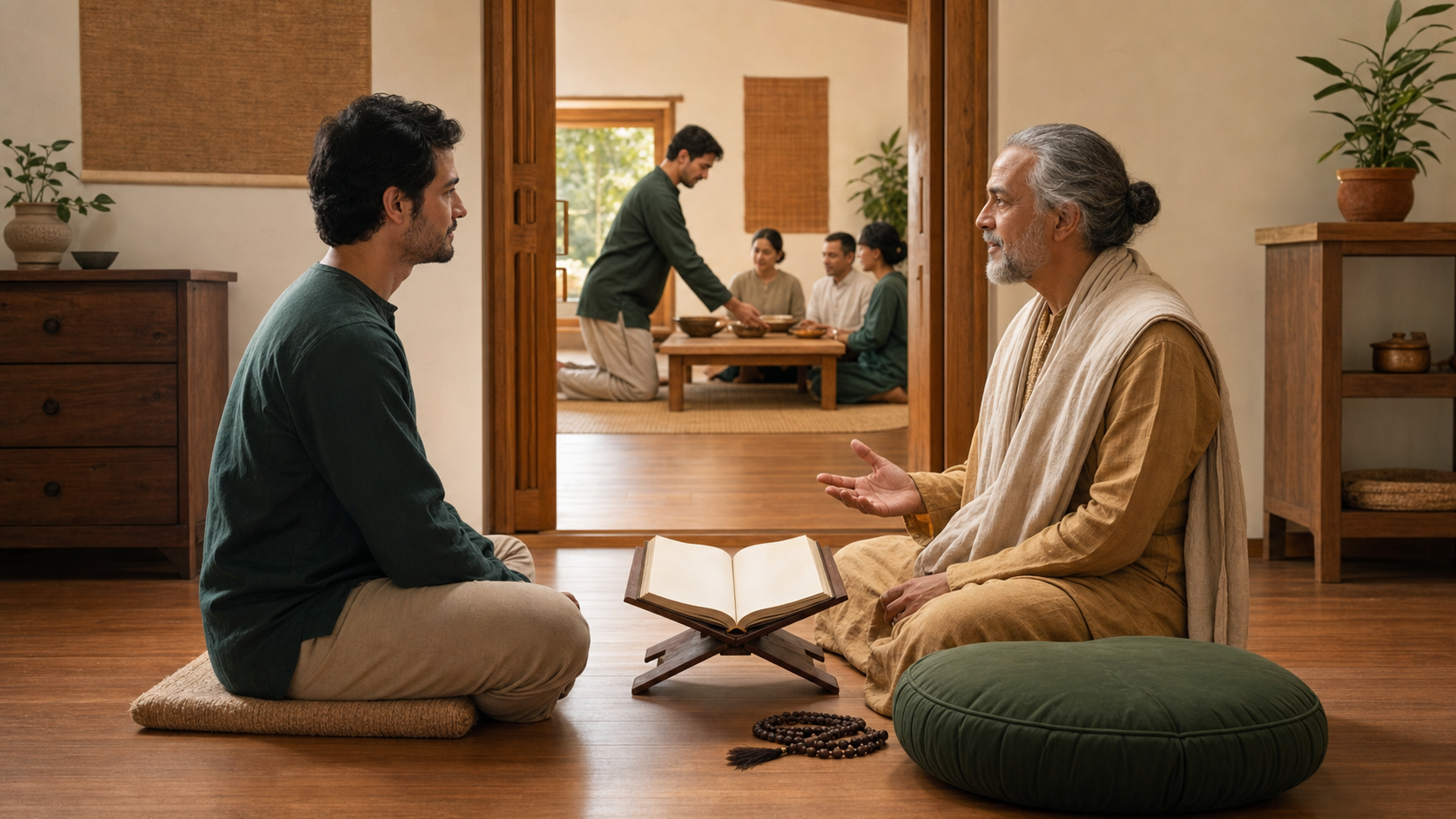
A routine can become efficient while drifting away from its purpose. Technique answers what you do. Spiritual direction answers why you do it, how it should reshape you, and which interpretations belong within your path. You need both.
If your path is centered on the Bhagavata tradition, hearing a careful exposition of Srimad Bhagavatam 3.28.01 can anchor reflection in a definite scriptural passage. Listen with an operational question: what should change in the way I prepare, attend, act, or understand my daily discipline? Write down the question that remains and take it to someone competent to answer within that tradition.
Use teachings to correct practice, not to avoid it. Listening to one discourse after another can create the impression of progress while leaving your actual rule untouched. After focused hearing, identify one concrete correction. It might concern the object of attention, the motive for practicing, an avoidable distraction, an ethical obligation, or a misunderstanding to verify. Apply that correction before collecting more material.
A qualified teacher should be able to help you answer practical questions:
- Is this discipline appropriate to my path and present responsibilities?
- What is the correct method, and what common error should I watch for?
- What counts as completion, especially when the practice is vowed?
- What adaptation is permitted during illness, travel, menstruation where relevant to a particular observance, caregiving, or another changed condition?
- Which experiences should be ignored, which should be reported, and which indicate that I should pause?
- What change in conduct should this practice gradually support?
Community can provide accountability without turning spirituality into performance. Choose a mature person who understands the discipline and can ask whether you kept the rule, where it broke, and what your teacher has authorized. Broadcasting streaks, austerities, or inner experiences to an audience can feed the very self-importance the discipline is meant to expose.
Keep household and social duties visible as you assess the routine. A practice that consistently depends on neglecting dependants, deceiving family members, abandoning honest work, or becoming harsh toward others needs examination. The correction may involve your schedule, your interpretation, or your motive. More practice is not automatically the answer to a badly integrated practice.
Key takeaways for your rule of practice
- Choose a specific core discipline grounded in your tradition, not a changing assortment selected by mood.
- Bind it to a stable cue, a prepared place, an unmistakable first action, and a clear completion boundary.
- Decide an authorized fallback before illness, travel, or urgent duty disrupts the normal form.
- Track completion and the main obstacle; do not use spiritual sensations as a score.
- After a lapse, resume at the next cue, classify the cause, and repair the relevant part of the design.
- Do not compensate with self-imposed extremes. Seek guidance before altering vows or undertaking intensive methods.
- Test the routine by its effect on conduct, duty, humility, and your capacity to return attention.
Before your next practice window, write the rule in one sentence and prepare the place. When the cue arrives, begin with the predetermined first action before opening a negotiation with yourself. Keep the rule unchanged until your fixed review day, then correct the single obstacle that most often prevented observance.
That first dependable return is more useful than another grand promise. Let the next cue find you ready.
References
- Dandavats — Sadhana & Spiritual Life | S.B. Keshava Swami in Georgetown, Guyana | August 2026
- Dandavats — Srimad Bhagavatam Text 3.28.01 Speaker – H.G. Harilila Das
