

Someone shares a careless claim about your tradition. A family discussion becomes a test of loyalty. A temple or community group divides over leadership, language, or method. You do not want passivity, but you also do not want every disagreement to become a lasting wound.
Dharmic practice gives you a harder and more useful task: become steady enough to defend what is right without letting agitation choose your words. When body, mind, and inner conscience support one another, conviction can become disciplined action rather than hostility. That inner alignment is where durable social unity begins.
A divided reaction cannot build an undivided community
Social division appears at the level of groups, but it often begins inside an individual reaction. The body becomes tense. The mind starts assembling reasons to retaliate. Group identity makes any concession feel like betrayal. By the time you speak, you may be answering a threat larger than the words actually in front of you.
This is why inner balance is not a private wellness project. Your physical state affects your attention. Your attention shapes your interpretation. Your moral orientation determines what you do with the strength available to you. Neglect one of these, and the others can be recruited by anger, fear, vanity, or exhaustion.
Before answering a provocative message or entering a difficult meeting, make three checks:
- Body: Where are you carrying tension, and can you settle it before speaking?
- Mind: What was actually said, and what story have you added to it?
- Conscience: Which value should govern your next action: truth, ahimsa, duty, compassion, accountability, or service?
Do not ask whether your emotion is legitimate and stop there. Ask whether it is fit to lead. Anger may tell you that a boundary has been crossed, but it does not automatically know the most truthful sentence, the right audience, or the proportionate response.
Steadiness is not softness. A calm person can refuse an injustice, correct a falsehood, protect a community, or end a bad-faith exchange. The difference is that the response serves dharma instead of merely discharging tension.
Dharmic unity does not require doctrinal sameness
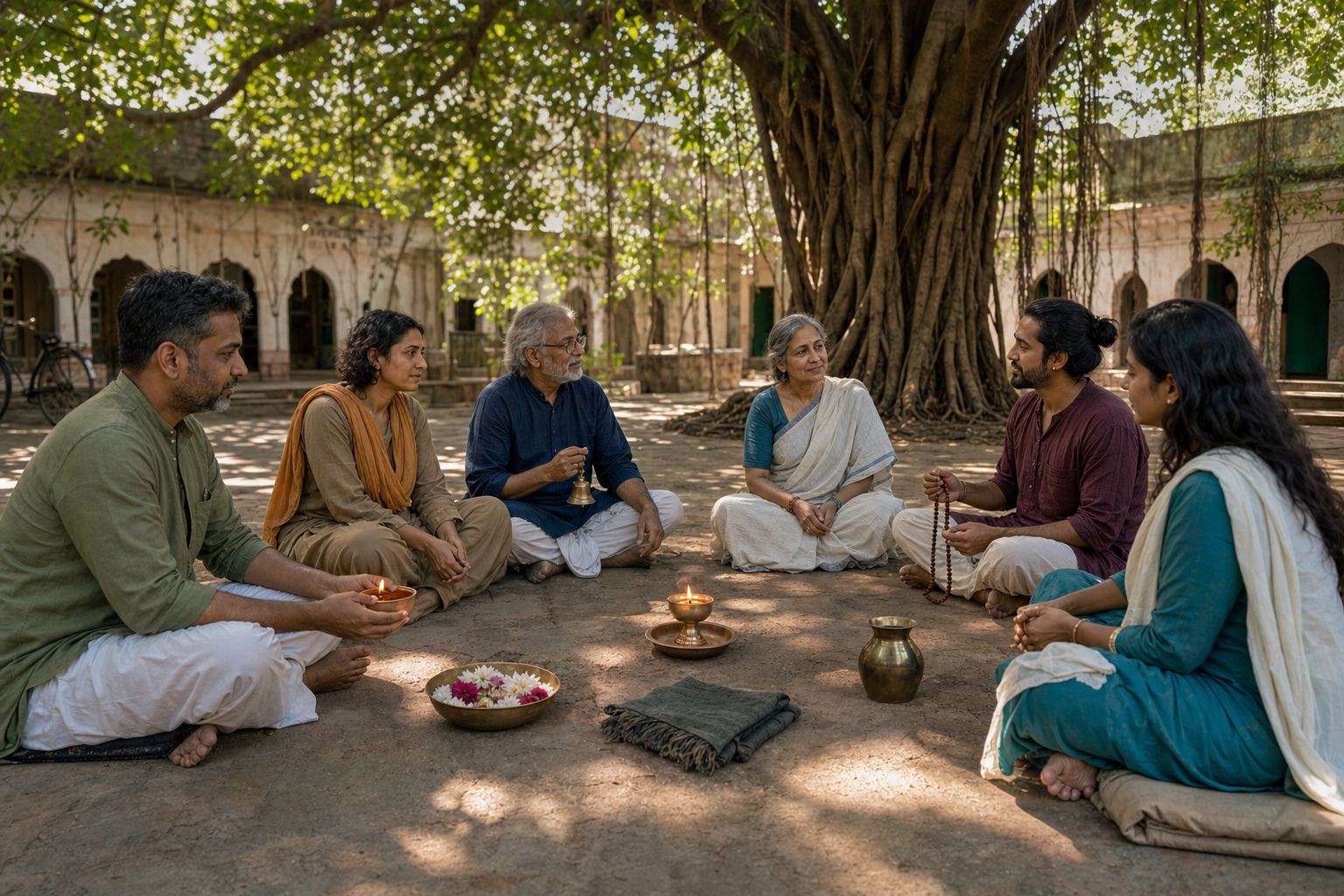
Hinduism, Buddhism, Jainism, and Sikhism do not make identical claims about the self, liberation, reality, or religious discipline. Treating them as interchangeable would produce a shallow unity that cannot survive serious study. Their social value lies in the distinct ways they challenge egoic certainty and the illusion that one person or group exists in isolation.
- Hindu thought: The Upanishadic Tat Tvam Asi and the Bhagavad-Gita’s vision of the same Self in all beings ask you to look beneath temporary labels. The practical question is: how would you treat this person if the separation you feel is not ultimate?
- Buddhist thought: Pratitya-samutpada, or dependent origination, directs attention to conditions and relationships rather than isolated blame. Ask what causes, habits, fears, and incentives are sustaining the conflict, including those on your own side.
- Jain thought: Anekantavada, the many-sidedness of truth, warns that one standpoint may disclose something real without exhausting the whole matter. Ask what your present angle reveals and what it might conceal.
- Sikh thought: Ik Onkar places oneness at the heart of spiritual vision, while seva and langar put that vision into shared practice. Ask whether the dignity you affirm in worship is visible in how people are welcomed, fed, heard, and served.
These principles do not require you to pretend that every proposition is equally sound. Unity without discernment becomes sentimentality; discernment without humility becomes domination. A mature Dharmic approach holds three boundaries at once:
- You can respect a person’s dignity without endorsing every belief or action.
- You can recognize that your perspective is partial without abandoning moral judgment.
- You can cooperate for the common good without erasing the identity, vocabulary, or discipline of your own tradition.
Hindu recognition of Ishta is especially useful here. People may approach the Divine according to different temperaments and contexts. That does not make conviction meaningless; it prevents personal devotion from becoming a license to deny every other path. Diversity then becomes a field for disciplined coexistence rather than a competition for compulsory uniformity.
Use a daily practice that reaches beyond the meditation seat
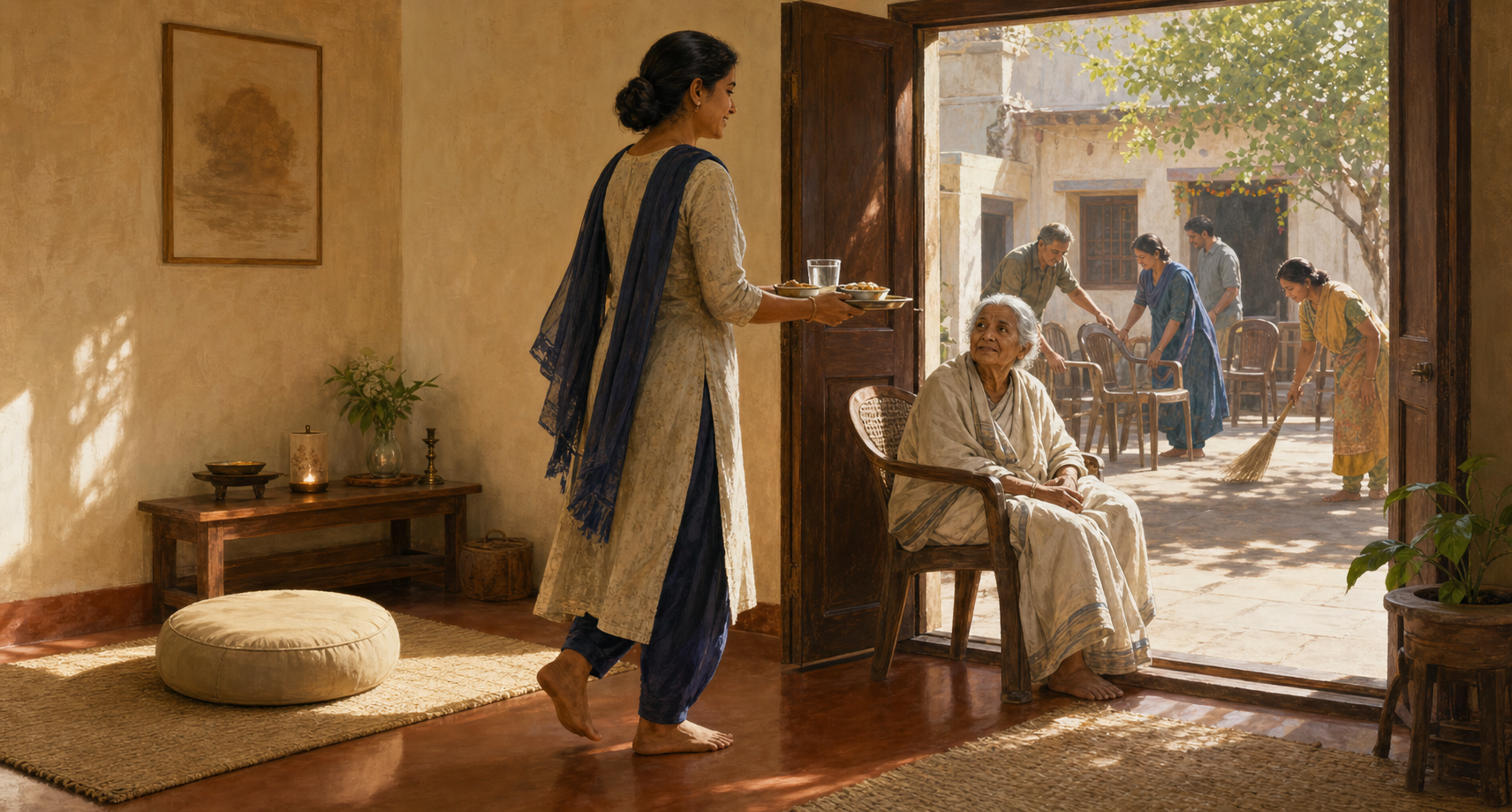
Inner balance becomes dependable through repetition. Waiting until a conflict erupts is like beginning physical training after the heavy work has already started. A simple routine can prepare the body, clarify the mind, and give conscience the final word.
- Move first. Use gentle asana, stretching, or a brief walk to reduce restlessness and bring attention back into the body.
- Give ten minutes to mindful breathing or pranayama. Do not use the period to rehearse an argument. Keep returning attention to the breath.
- Sit in silent reflection for a few minutes. Ask: What is my duty here? What harm can I avoid? Whom will my action serve?
- Choose one concrete act of seva. Complete an overlooked task, help someone without seeking recognition, share useful knowledge, or take your fair portion of community work.
The order matters as a practical discipline. Movement gives unsettled energy somewhere wholesome to go. Breath steadies attention. Reflection reconnects attention with purpose. Seva tests whether that purpose can leave the realm of private feeling and become beneficial conduct.
Use this rhythm before predictable points of friction: a community meeting, a difficult family conversation, or a reply to a provocative public claim. If a daily routine feels difficult to establish, attach it to a transition that already occurs reliably, such as the start of your morning or the end of work.
Notice what has fallen out of balance
Different forms of imbalance require different corrections. Do not respond to every problem by adding more meditation, more exercise, or more religious language.
- If the mind is dominating, you may see overthinking, perfectionism, repeated mental arguments, or fatigue. Interrupt the loop with movement and breath before seeking another explanation.
- If bodily appetite and distraction are dominating, comfort may repeatedly displace duty. Restore a clear schedule, study, reflection, and service so that energy receives direction.
- If spirituality has lost its grounding, elevated language may be covering neglected health, work, family, or community obligations. Return to ordinary duties. A spiritual idea that excuses every responsibility is not producing integrity.
Treat these as indicators, not permanent labels. Balance is not a flawless state you acquire once. It is the ability to notice drift and realign with less drama. The practical signs are equally ordinary: steadier energy, calmer focus under pressure, and a sense of purpose that reliably produces ethical action.
A five-step method for difficult Dharmic disagreements

Suppose another person says something you believe is false, harmful, or dismissive of your tradition. You do not need to choose between silence and escalation. Use a process that preserves both truth and relationship where relationship remains possible.
- Settle the pace. Do not let bodily agitation determine how quickly you answer. If you need a pause, say when you will return to the discussion so that the pause does not become avoidance.
- Define the disputed claim. Replace a total judgment about a person or community with the exact words, decision, or conduct at issue. “This statement misrepresents our practice” is more accurate and more actionable than “You people never respect us.”
- Name the shared value before the difference. It may be truthfulness, non-harm, fairness, protection of the vulnerable, fidelity to tradition, or community welfare. Then state precisely where your conclusions diverge.
- Apply many-sided inquiry. Summarize the other person’s position in terms they accept, and ask them to do the same for yours. This is not surrender. It prevents you from winning an argument against a position nobody actually holds.
- End with a proportionate next action. Correct the public record, amend a community rule, acknowledge a specific wrong, arrange a focused follow-up, or cooperate on a service task. Agreement is valuable, but a clear and ethical next step is often the more realistic first result.
This process has limits. Pluralism does not oblige you to participate indefinitely in abuse or bad-faith repetition. If someone refuses to define the issue, misstates your position after correction, or uses dialogue only to delay accountability, you may close the exchange and choose a more appropriate forum. Unity does not mean unlimited access to your attention.
Nor should oneness be used to suppress a legitimate grievance. If harm has occurred, naming it is not divisiveness. Ahimsa disciplines the means of correction; it does not require indifference to adharma. A pro-Dharma posture should be firm enough to confront harm and disciplined enough not to reproduce it.
Individual restraint also needs social form. Communities can make unity habitual through seva, shared meals such as langar, and dialogue grounded in Anekantavada. Joint study can clarify real doctrinal differences. Service projects give people a common duty with a visible beneficiary. A shared meal makes equality concrete. A dialogue circle gives disagreement a structure in which one issue is considered at a time and each person must listen before replying.
Do not use common service to bury an unresolved problem. If the conflict concerns leadership, policy, misrepresentation, or misconduct, address that matter through an accountable process as well. Fellowship and correction should reinforce each other.
Key takeaways
- Regulate your body and attention before responding; an agitated reaction rarely produces the most Dharmic form of courage.
- Seek unity in dignity, responsibility, and conduct without pretending that Hindu, Buddhist, Jain, and Sikh teachings are identical.
- Use Tat Tvam Asi, dependent origination, Anekantavada, and Ik Onkar as practical correctives to separation, blame, certainty, and exclusion.
- Train daily through movement, ten minutes of breath awareness, a few minutes of reflection, and one concrete act of seva.
- In conflict, define the exact claim, identify the shared value, represent the other view fairly, and agree on a proportionate next action.
- Build social unity through recurring practices such as service, shared meals, study, and structured dialogue, while keeping accountability intact.
At your next point of friction, do not begin by trying to fix the whole community. Settle your body, separate the actual issue from the identity story around it, and choose one action that protects truth without abandoning dignity. Repeated often enough, that is how inner discipline becomes a social culture others can trust.
References
- DharmaRenaissance Blog – Mind, Body, and Soul in Balance: Practical Strategies to Build Inner Strength and Harmony
- DharmaRenaissance Blog – Beyond Differences: Dharmic Wisdom on Unity, Empathy, and the Illusion of Separation
