
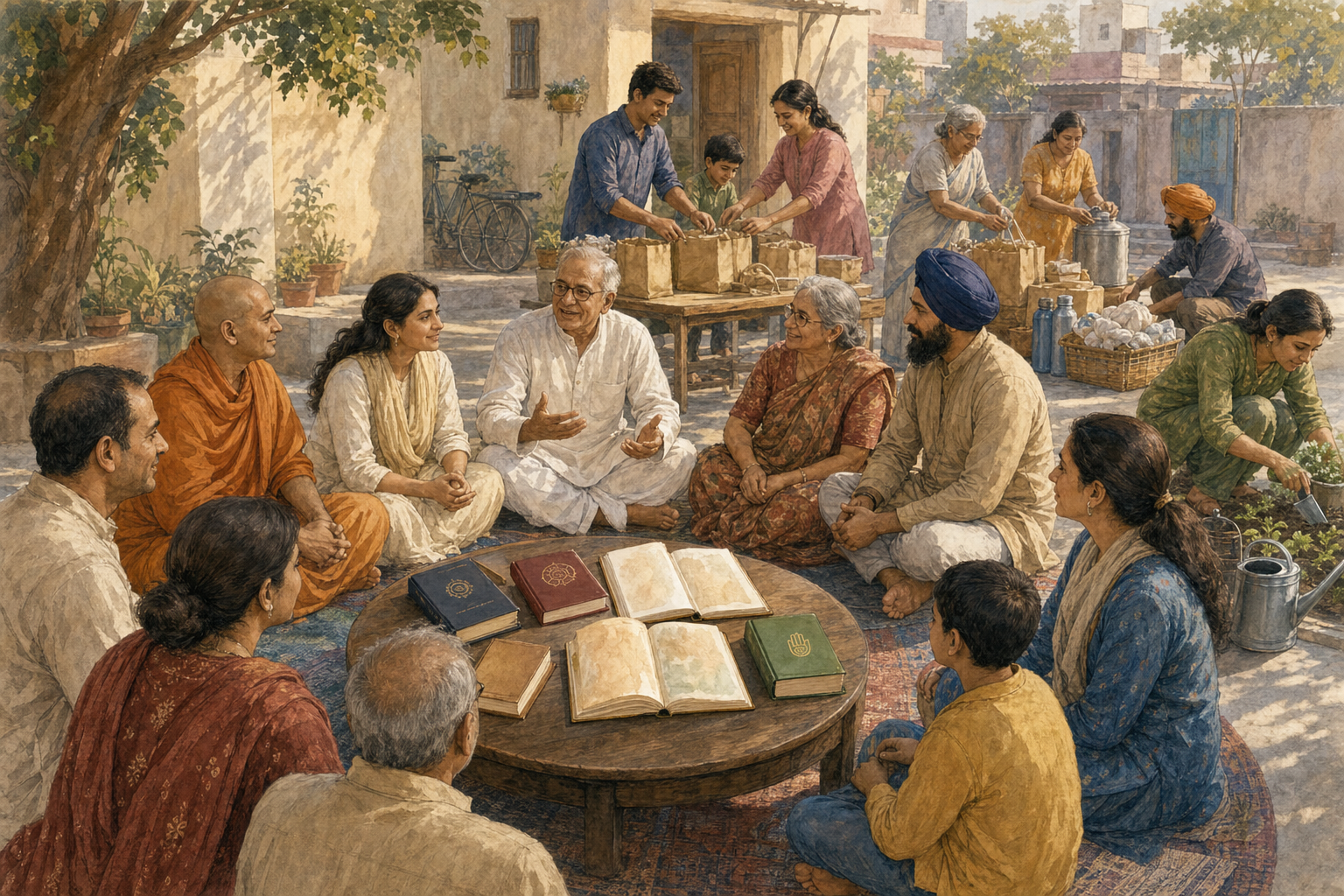
You may be trying to bring Hindu, Buddhist, Jain, and Sikh neighbours together without producing another ceremonial gathering that ends when the chairs are folded. The hard question is not how to fill a hall. It is how to create cooperation without flattening real differences or turning one community into a decorative guest.
Build the gathering around two anchors: disciplined listening and a specific local duty. Shared wisdom gives people a language for meeting one another; shared service tests whether that meeting has created trust. The aim is not a blended religion. It is a community strong enough to learn, disagree honestly, and act together.
Start with a covenant, not a claim that all paths are identical
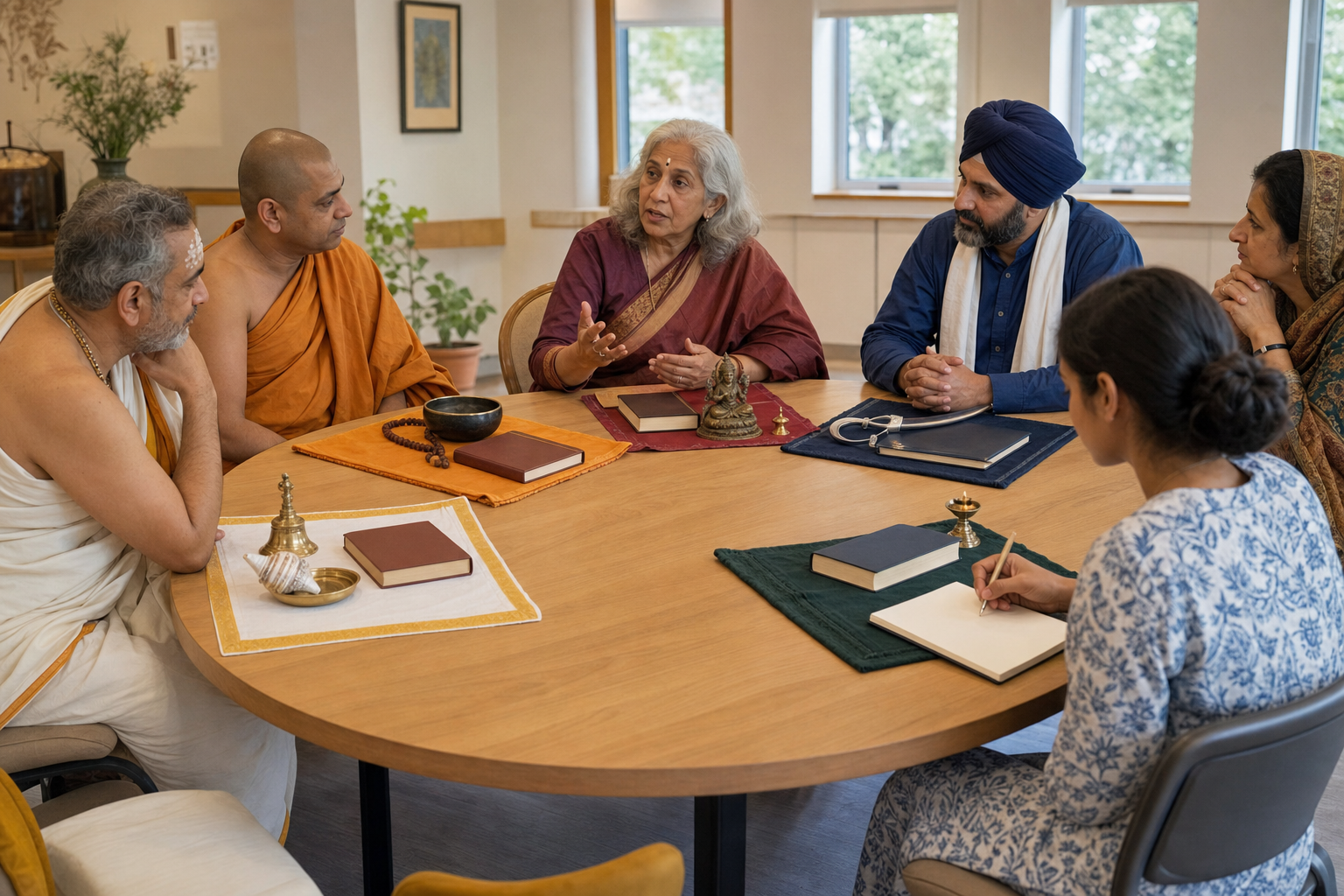
Dharmic unity becomes fragile when it rests on the slogan that every tradition teaches exactly the same thing. Hinduism, Buddhism, Jainism, and Sikhism inhabit a connected civilizational world, yet they do not use identical accounts of selfhood, ultimate reality, authority, practice, or liberation. Even the substantial common ground of inner inquiry, compassion, non-harm, disciplined practice, and ethical living does not erase those distinctions.
That is an advantage if you handle it well. Unity built on accurate difference is more durable than unity built on polite misrepresentation. A Buddhist participant should not have to affirm an Upanishadic account of atman. A Hindu participant should not have to conceal the place of the Upanishads in Hindu thought. Jain and Sikh participants must likewise be able to describe their own commitments in their own vocabulary.
The Upanishadic method can still offer a valuable discipline to a Hindu-led gathering. Its movement through sravana, attentive study; manana, critical reflection; and nididhyasana, deep contemplation asks a seeker to listen before concluding and to examine an idea before claiming to understand it. The practice of neti, neti also warns against mistaking the first label for the whole reality. Use that spirit to shape the conversation, but do not rename every participant’s path as a form of Vedanta.
Working covenant: We gather to understand one another accurately, deepen ethical conduct, and serve our neighbourhood together. No participant is required to surrender a distinct doctrine, lineage, or discipline.
Before choosing a theme, apply four tests:
- Can every represented community approach the theme through its own teachings and practices?
- Does the theme lead to a recognizable duty rather than an abstract display of agreement?
- Can people cooperate on that duty without affirming a theology they do not hold?
- Will a newcomer understand the language, or does it assume familiarity with one sect’s vocabulary?
Truthfulness, non-harm, compassion, restraint, service, and mutual respect usually provide better starting points than a claim about metaphysical sameness. Make the question concrete: What does truthfulness require before we repeat a rumour? What form of restraint prevents a local disagreement from becoming hostility? How can service preserve the dignity and agency of the person receiving it?
Use a study-reflection-service cycle
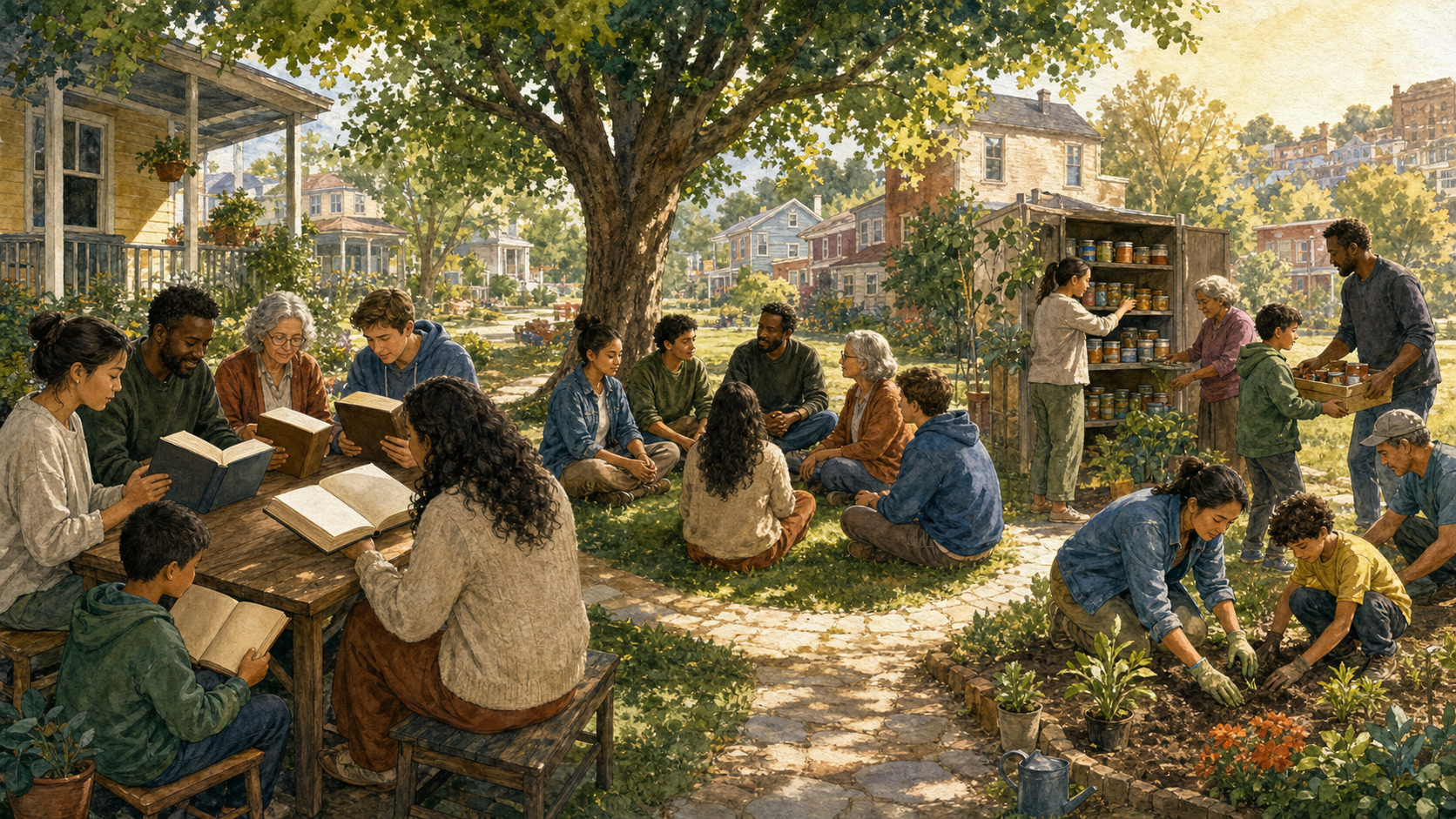
A panel can produce courteous applause without changing a single relationship. The missing step is usually translation: participants hear wisdom but are not asked what it requires of them in the place where they live.
Use the following cycle for a study circle, sammelan, heritage gathering, or neighbourhood forum:
- Name one local need. Write it as an observable condition, not a civilizational grievance. A need might concern care for elders, access to heritage learning, upkeep of a shared space, or assistance requested by local families.
- Choose one ethical question. Keep it narrow enough for participants to connect teaching with conduct. Do not ask speakers to explain an entire tradition in one sitting.
- Hold a wisdom round. Invite each represented community to explain how it approaches the question. Speakers should describe their own traditions, not summarize somebody else’s.
- Reflect across difference. Ask participants what they learned, which difference must be preserved accurately, and what shared responsibility follows from the discussion.
- Select one service action. Define what completion looks like, who owns the first step, what resources are available, and how progress will be reported.
- Return to the experience. At the next meeting, discuss what the service revealed about trust, dignity, discipline, and cooperation before choosing another task.
This cycle borrows the seriousness of study, reflection, and contemplation without pretending that every tradition organizes spiritual learning in the same way. Community action becomes an additional civic test: did reflection refine conduct, or did it remain on the stage?
If local families want better heritage education for young people, for example, do not begin and end with speeches about cultural decline. Ask elders to identify knowledge worth preserving, let each tradition verify its own material, give youth responsibility for format and communication, and have families leave with a named coordinator, venue, and next date. The output is not merely awareness. It is a functioning relationship.
Do not overload the first gathering with every possible concern. One completed act of cooperation teaches more than a crowded programme of unresolved themes. The next subject should emerge after participants have proved that they can keep one commitment together.
Make local ownership the unit of scale
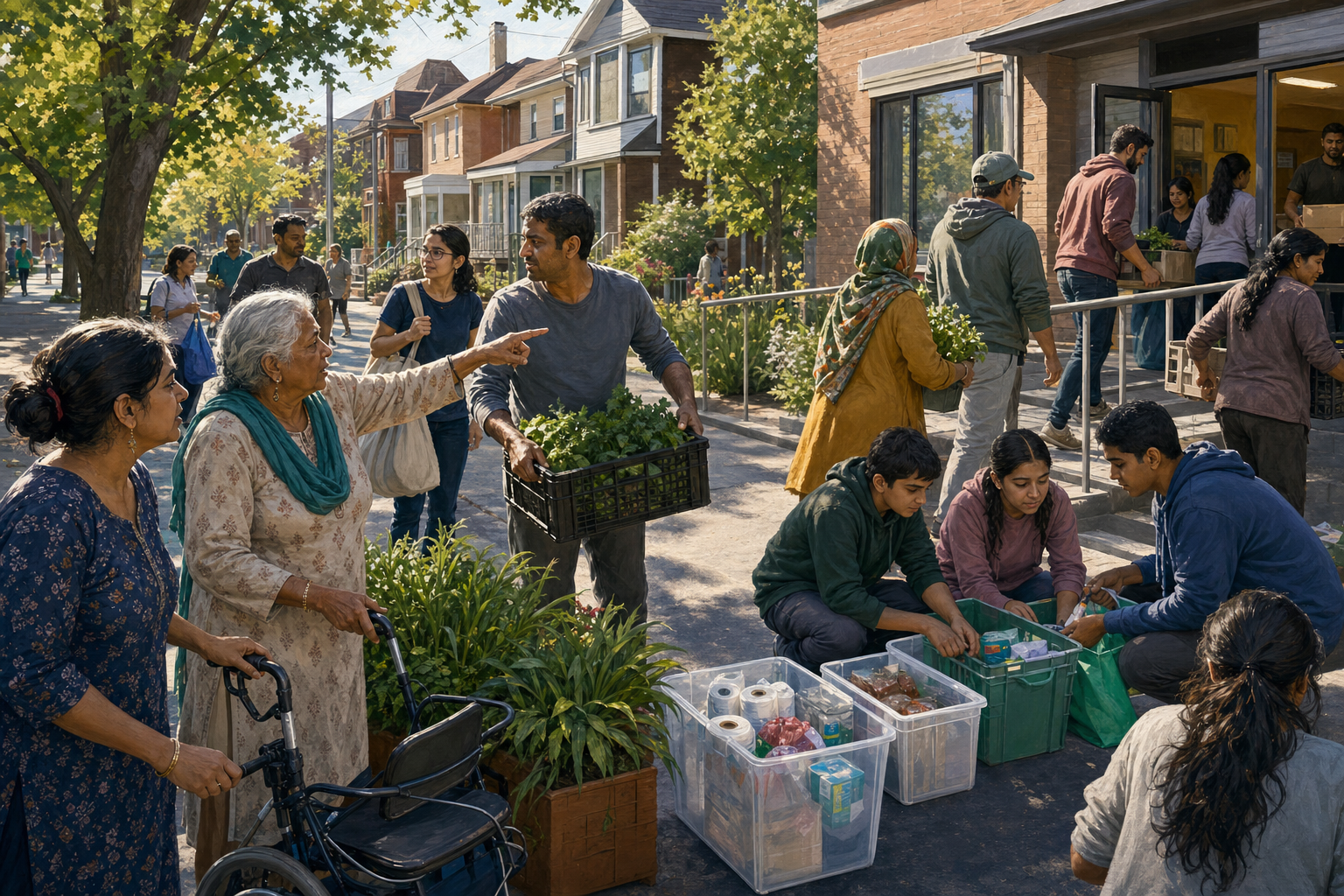
The RSS centenary outreach announced an effort to organize more than one lakh Hindu Sammelans across India. A number of that size does not by itself demonstrate unity. Its useful organizational lesson is that broad reach requires a format simple enough for local committees to host and flexible enough for local conditions.
Use a common skeleton, then let the locality supply the substance. The skeleton is the covenant, wisdom round, facilitated reflection, service decision, named responsibility, and follow-up. The substance is the language, local need, participating traditions, cultural expression, and form of service. This balance keeps a network recognizable without turning every gathering into a centrally scripted performance.
Name ownership honestly. If the event is a Hindu Sammelan that welcomes guests from other Dharmic communities, say so. If it is a jointly owned Dharmic forum, invite the participating communities to help choose the title, theme, speakers, and service task. Confusion about whether somebody is a guest, adviser, or co-host is an early source of tokenism.
Assign functions before assigning ceremonial prominence:
- Convenor: states the purpose, protects the covenant, and prevents the programme from drifting into unrelated agendas.
- Tradition representatives: check the accuracy of language, readings, introductions, and claims about their own communities.
- Service coordinator: converts intention into tasks, owners, resources, and a reporting method.
- Youth team: handles communication, registration, documentation, and follow-up while participating in decisions rather than serving only as event labour.
- Elders: contribute memory and context without being asked to control every new format.
- Women leaders: share authority over design, speaking, service, and evaluation rather than appearing only in cultural or hospitality roles.
- Accessibility steward: checks language, transport, family participation, physical access, and whether rural or urban conditions require a different format.
This distribution reflects the potential of family-friendly programmes, youth initiatives, women’s leadership, elders’ memories, and locally adapted urban and rural gatherings. It also prevents the microphone from becoming the only visible form of leadership.
After each gathering, evaluate five things. Voice: did each represented community help shape the programme? Accuracy: can participants describe one genuine difference without caricature? Action: is there a task with an owner and a definition of completion? Reciprocity: are labour and visibility shared, or does one group always host while others attend? Continuity: has the next contact point been fixed?
If participants cannot name the next action and the person responsible for it, you held a cultural programme, not an outreach cycle. Cultural programmes have value, but calling them unity-building does not create the missing follow-through.
Protect trust when disagreement appears

Difference is not evidence that the gathering failed. Misrepresentation, humiliation, coercion, and concealed agendas are failures. A serious unity effort needs a way to distinguish disagreement from disrespect.
Watch for four common breakdowns:
- Forced equivalence: Someone insists that different doctrines are merely different words for the same belief. Repair it by asking each community to state both the overlap and the distinction in its own terms.
- Symbolic inclusion: A community is visible in the photograph but absent from planning and interpretation. Repair it by sharing authority before invitations and publicity are finalized.
- Service as recruitment: Assistance becomes a way to secure religious allegiance, organizational membership, or political conformity. Repair it by separating service from proselytizing and by stating that help is not conditional.
- Scale as a substitute for trust: Attendance, stages, and publicity receive attention while commitments disappear afterward. Repair it by reporting completed service, lessons, and unresolved problems alongside participation.
When a difficult exchange occurs, the facilitator should pause and paraphrase the disputed claim without sharpening it. Ask whether the objection concerns a fact, a theological difference, or someone’s conduct. Let the relevant community speak for itself. Record a difference that cannot be resolved. Return to the shared task only if doing so does not require false assent.
Dharmic confidence does not require vagueness. A Hindu host may speak clearly from Hindu traditions, just as Buddhist, Jain, and Sikh participants may speak clearly from theirs. Confidence becomes credible when it can hear a neighbouring tradition without editing that tradition into a more convenient shape.
A gathering can therefore be rooted in Dharmic civilizational confidence while maintaining peaceful coexistence, pluralistic norms, and responsible public conduct. If a partisan or geopolitical question needs discussion, name it openly as the subject of a suitable forum. Do not smuggle it into a spiritual or service gathering and then treat agreement as a test of belonging.
Pluralism is not silence. It is the discipline of refusing caricature and exclusion while continuing to seek truthful conversation. Unity is not the absence of boundaries. It is the capacity to cooperate across boundaries that have been described honestly.
Key takeaways for your next gathering
- Define unity as accurate understanding and dependable cooperation, not identical theology.
- Choose an ethical question that leads to one visible local duty.
- Let every represented tradition explain itself in its own vocabulary.
- Combine a repeatable gathering structure with local ownership of language, need, and service.
- Give youth, elders, women, and service coordinators real authority, not merely ceremonial roles.
- Measure success by fulfilled commitments, reciprocal participation, and the ability to discuss differences without caricature.
Before you issue an invitation, complete these fields in writing: purpose; shared ethical question; local need; co-hosts and their roles; first action owner; and check-in date and channel. If one field is blank, settle it with your partners before announcing the programme.
Then begin with the smallest commitment your group can complete with dignity. Report what was done, invite correction from every participating community, and let the next gathering grow from earned trust. That is how shared wisdom becomes a living public relationship.
References
- DharmaRenaissance Blog – Historic nationwide outreach: RSS to host 1 lakh Hindu Sammelans for centenary, advancing dharmic unity
- DharmaRenaissance Blog – Why the Upanishads Inspire Unity: Timeless, Non-Sectarian Wisdom for All Seekers
