
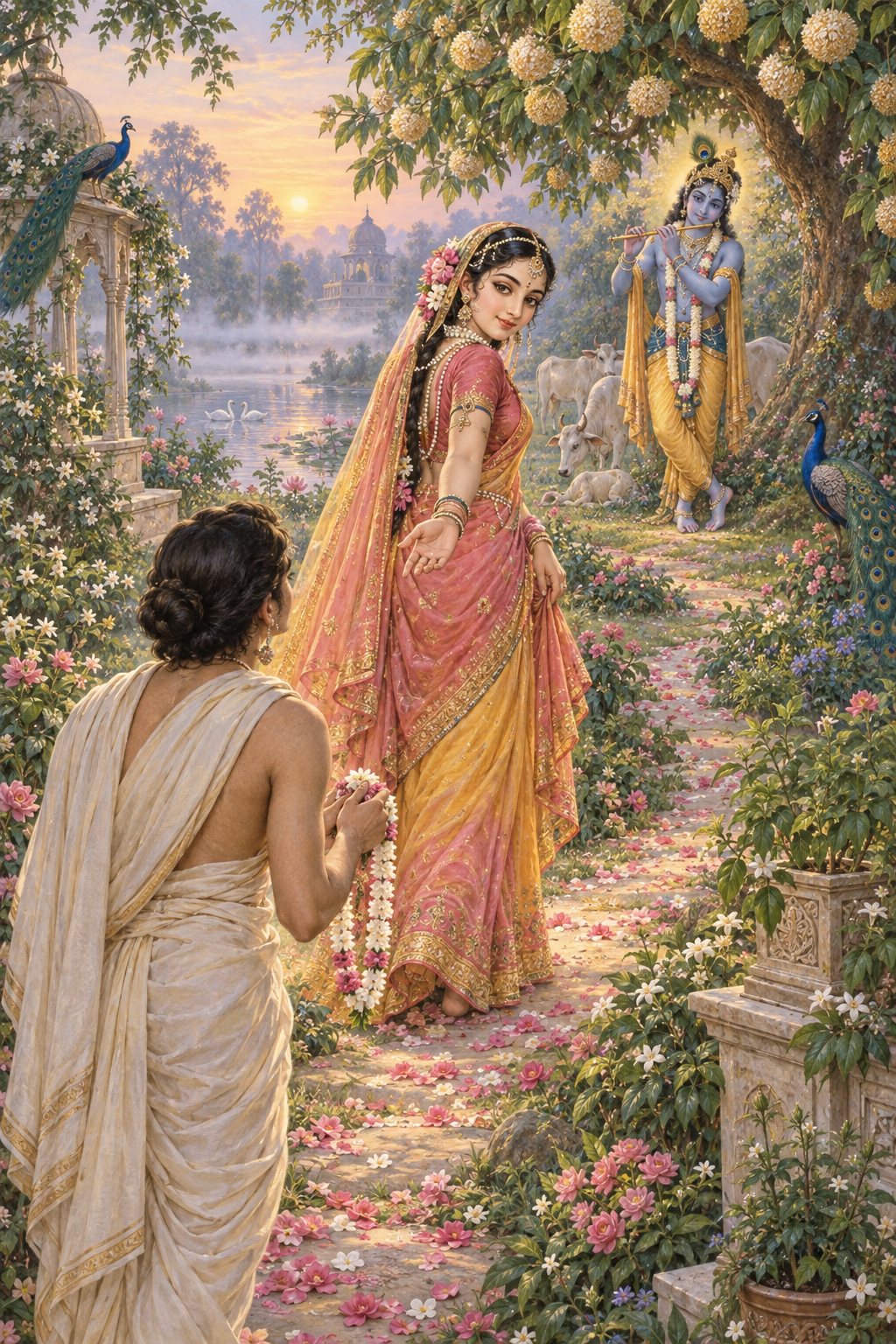
You may chant Krishna’s names, attend kirtan and read about bhakti, yet still feel that you are standing outside the relationship. Krishna is revered, but he remains distant. Your practice is sincere, but it can feel formal or centered on what you hope to receive.
Radha-bhakti addresses that distance by changing your position. You approach Krishna in the care of the devotee whose love is wholly directed toward him. Instead of asking, “How can I obtain Krishna?” you begin asking, “How can I learn to serve Krishna in the spirit of Sri Radha?” That change turns devotion away from acquisition and toward loving participation.
Radha’s mercy changes what it means to approach Krishna
Within Radha-Krishna bhakti, Sri Radha is honored as the highest expression of devotion to Krishna. Approaching him through her mercy does not mean persuading a reluctant God or finding a shortcut around spiritual discipline. It means admitting that divine love cannot be seized through ego, argument or emotional performance. It is received in a mood of humility and service.
Reaching Krishna through Radha’s mercy therefore begins with a practical correction: Krishna is no longer treated as the supplier of your preferred spiritual experience. You ask Sri Radha to teach you how to remember him, please him and place his happiness before your own demand for recognition.
Listen to the verbs in your prayers. Are they mostly “give me,” “remove this” and “make me feel”? Requests for help aren’t wrong, but they reveal where the attention rests. Radha-bhakti gradually adds different verbs: “teach me,” “engage me,” “let me remember” and “show me how to serve.” You don’t have to suppress your needs. You place them inside a larger relationship.
- Replace “Give me a powerful experience” with “Help me serve faithfully, whether or not I feel spiritually powerful.”
- Replace “Make Krishna notice me” with “Teach me to notice what would please Krishna.”
- Replace “Prove that my practice is working” with “Correct whatever makes my service self-centered.”
This is why mercy and effort aren’t opposites. You still chant, hear, remember and serve. Mercy changes the spirit in which you do them. Effort stops being a claim upon Krishna and becomes an offering.
Let sacred beauty lead you from seeing to serving
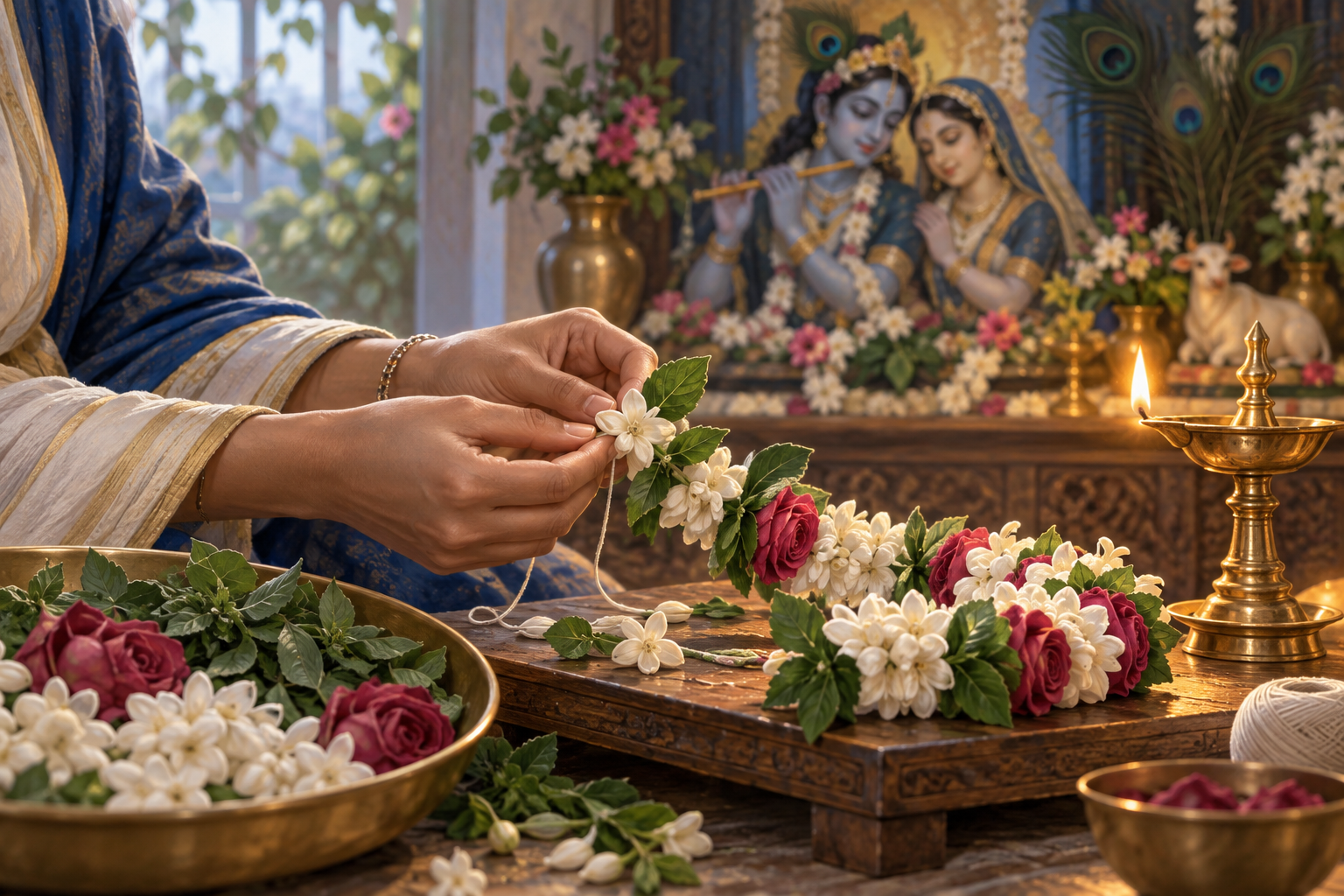
Devotional traditions often use uddipana, a stimulus that awakens remembrance of the beloved. A name, melody, place, ornament or feature of the divine form may draw the mind out of distraction and into relationship. Even contemplation of Sri Radha’s forehead as a stimulus for ecstatic love shows how focused sacred seeing can become an aid to remembrance.
The point is not to catalogue Radha’s beauty as though the divine form were an aesthetic object. A sacred feature matters because it belongs to the person you seek to remember. Beauty opens attention; attention should then mature into reverence, prayer and service.
When you take darshan of Radha and Krishna, try a simple movement of attention. First, look carefully without rushing across the altar or image. Then remember whose presence you are approaching. Let one feature, gesture or ornament hold your attention. Ask what devotional response it awakens: gratitude, tenderness, humility or a desire to serve. Close by making one concrete offering rather than merely preserving a pleasant feeling.
That offering might be attentive chanting, a neglected duty performed honestly, food prepared with devotional care, help given to another person or restraint from speech that would injure someone. The visual impression has then completed its work: it has moved from the eyes into conduct.
Keep imagination under discipline. A private image or strong feeling should not automatically be declared a revelation. Let recognized teachings, responsible guidance and the devotional practice you have received provide the frame. Sacred imagination should make you humbler and more service-minded, not more certain that you possess a special status.
A daily sequence for practicing Radha-centered Krishna bhakti
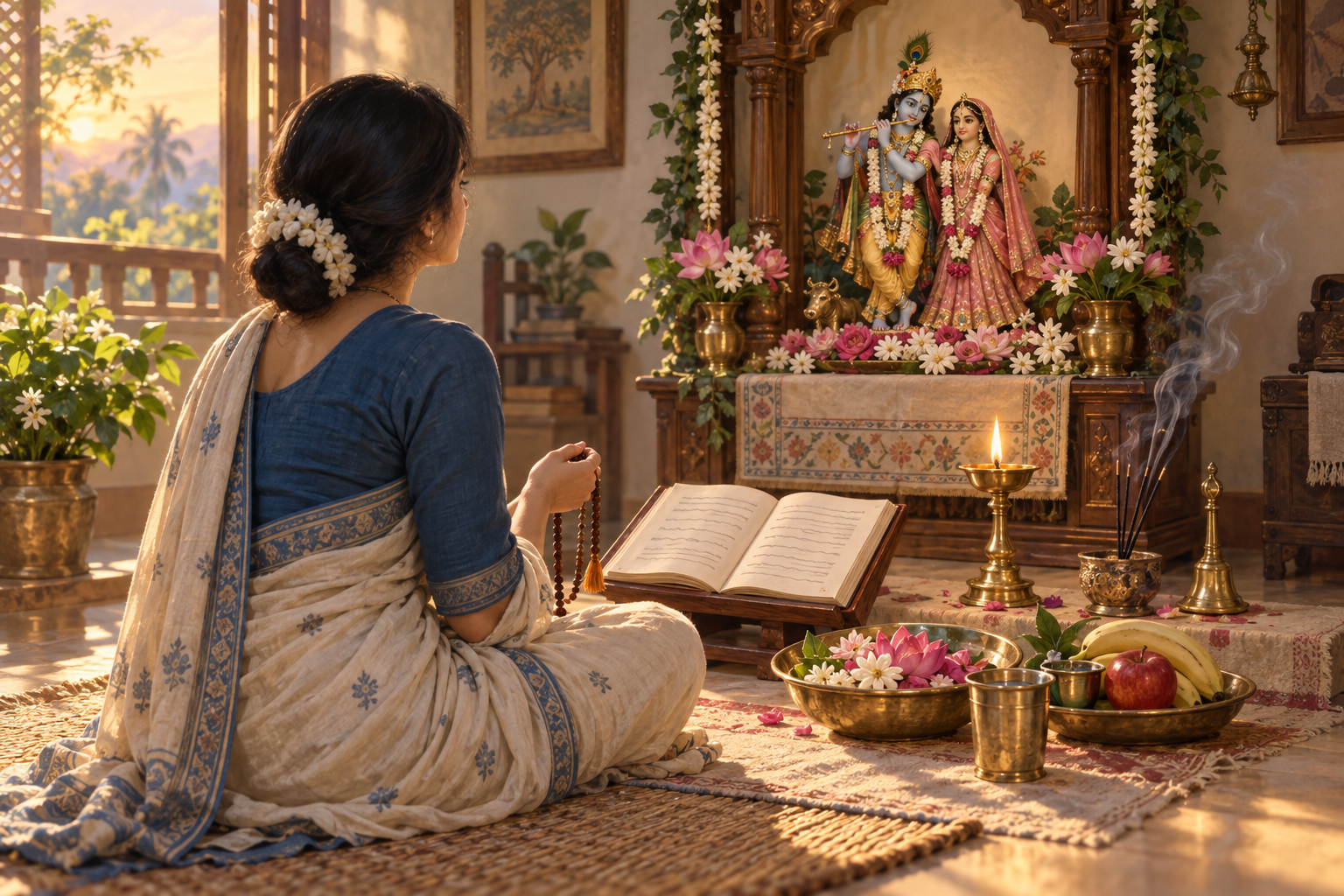
You don’t need to manufacture an advanced inner state. Build a repeatable sequence that gives attention a clear direction. If you have received a mantra or method from a guru within your tradition, follow that instruction rather than replacing it with an improvised practice.
- Arrive deliberately. Put away the device or task competing for your attention. Sit or stand before the image, murti or devotional space you actually use. The first offering is undivided attention.
- Offer respect. Bow or make pranam according to your custom. Acknowledge that you are approaching Radha and Krishna as a servant, not summoning a spiritual experience for consumption.
- Ask for Radha’s guidance. Use your own plain words if you haven’t received a formal prayer. You might say, “Sri Radha, please teach me to remember Krishna without making myself the center. Let my actions become service.” Treat this as a personal petition, not as a traditional mantra.
- Chant the holy names attentively. Use the nama, mantra or kirtan practice taught in your devotional community. When the mind wanders, return without drama. The return itself is an act of service.
- Contemplate one feature or quality. Let one recognized description, image or devotional theme awaken remembrance. Don’t race through many details. Give one doorway enough attention to lead somewhere.
- Choose today’s seva. Name one action through which remembrance will leave the prayer space and enter your day. Make it concrete enough that you will know whether you did it.
- Close without demanding a result. Offer the practice itself. If it felt dry, offer the dryness along with your effort. If it felt sweet, offer the sweetness without trying to possess or reproduce it.
The crucial step is choosing the seva. Without it, Radha-bhakti can remain beautiful language surrounding the same self-centered habits. With it, remembrance becomes embodied. You begin carrying the prayer into speech, work, family obligations and dealings with other devotees.
Correct the habits that quietly turn bhakti back toward the ego
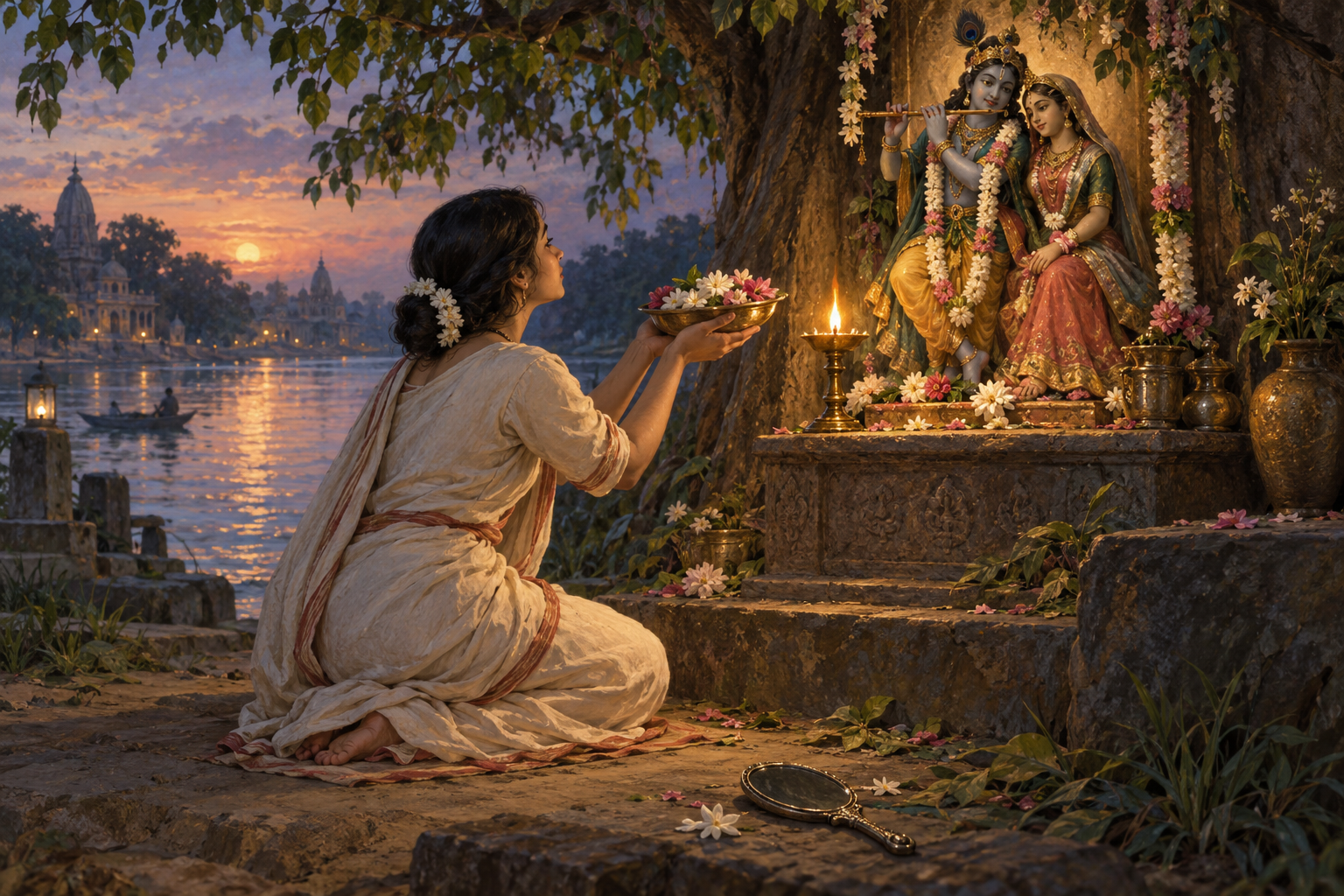
The most common error is treating Radha as a means of getting privileged access to Krishna. Mercy then becomes a spiritual advantage, and intimacy becomes status. Correct this by asking whether your practice is increasing your willingness to serve when nobody notices.
A second error is chasing sentiment. Tears, absorption or a strong emotional response may come, but emotion is not a credential. Descriptions of ecstatic love should awaken respect for mature devotion, not pressure you to imitate its external appearance. If you spend the practice monitoring whether you feel enough, attention has returned to you.
A third error is separating tenderness toward Radha and Krishna from conduct toward living beings. A person can speak delicately about divine love while remaining harsh, vain or unreliable. Test devotional feeling where it costs something: accepting correction, keeping a promise, refusing gossip, honoring another devotee and completing an ordinary duty without applause.
A fourth error is collecting esoteric material before establishing basic steadiness. Intimate themes call for reverence and guidance. More detail does not automatically produce deeper bhakti. If a teaching makes you fascinated with your imagined spiritual identity but less attentive to chanting, seva and character, return to the foundations.
You can assess direction without pretending to measure divine grace. Ask yourself:
- Am I becoming less entitled to a particular feeling or result?
- Do I remember Krishna during ordinary responsibilities, not only during devotional events?
- Does contemplation of Radha make service more attractive than recognition?
- Am I more careful with the dignity of devotees and other living beings?
- Can I continue the practice when it feels quiet and uneventful?
- Do guidance and correction make me more teachable rather than defensive?
A “no” is not a reason to abandon the path. It identifies the next place to practice. Choose one correction and carry it into the next day.
Key takeaways
- Approaching Krishna through Radha means seeking formation in her mood of devotion, not using her mercy as a shortcut to spiritual status.
- Move prayer from acquisition toward service: ask to remember, learn, become useful and accept correction.
- Let sacred beauty function as uddipana: it should awaken remembrance and lead to an offering, not end in aesthetic fascination.
- Keep a stable sequence of pranam, prayer, chanting, contemplation and concrete seva.
- Don’t imitate advanced emotion. Look for humility, steadiness, ethical care and willingness to serve without recognition.
- Judge the direction of practice by what it does to your conduct after worship, not only by what you feel during worship.
At your next practice, make one small change: before asking Krishna for anything, ask Sri Radha to teach you one act of service. Name that act, complete it and return the next day. The path becomes tangible when longing is given hands.
References
- Dandavats – Through Radha’s Mercy, We Reach Krishna | SB 11.9.19 | Bhagavatam Class w/ HG Madana-gopala Dasa
- Dandavats – Stimulation for Ecstatic Love Part 196 – Sri Radha’s Forehead

Leave a Reply
You must be logged in to post a comment.