

You want a daily Jain practice you can actually sustain, but the choices can seem to run between elaborate observance and vague good intentions. The useful middle path is a modest routine with a clear purpose: notice your passions earlier, interrupt harmful reactions, and bring thought, speech, and action closer to Dharma.
You do not need to perform every possible ritual at once. Begin with dependable anchors in the morning, during ordinary activity, and before sleep. Give each outward act an inward meaning. Once that foundation is stable, you can deepen the form without letting form replace transformation.
Judge the practice by what it changes in you
A Jain ritual is not merely an event completed in a prayer space. It is a rehearsal for the next difficult choice. Its disciplined structure brings ahimsa, self-restraint, mindfulness, and inner purification into daily conduct.
This gives you a practical test. After regular practice, do you notice anger before it controls your words? Do you recover from pride more quickly? Are you less casual about harm, consumption, and possessiveness? Can you admit a fault without immediately defending it? These changes matter more than how impressive the ritual looks.
Jain practice pays particular attention to kashaya, the passions that cloud judgement and bind us to harmful patterns. A peaceful feeling during worship may be welcome, but it is not the only measure of progress. The harder evidence appears later: restraint during provocation, honesty when concealment would be convenient, compassion toward a vulnerable being, and simplicity when acquisition is tempting.
Readers from the wider Dharmic family may recognize resonances with dhyana in Hindu traditions, mindfulness and ethical discipline in Buddhism, or the regularity of nitnem and the outward responsibility of seva in Sikhism. These practices are not interchangeable. Their shared lesson is narrower and still valuable: repetition serves Dharma when it reshapes attention and conduct.
Build a routine around morning, action, and review

Consistency matters more than complexity. Choose a form that fits your actual responsibilities and that you can perform attentively. A short observance kept with sincere bhava is more useful than an ambitious schedule that becomes rushed, resentful, or mechanical.
Morning: establish equanimity before the day claims you
- Prepare a simple space. Remove obvious clutter, attend to cleanliness, and keep only what supports concentration. Preparation should quiet the mind, not become a display.
- Settle the body. Adopt a steady, respectful posture. Let the breath become measured and allow a period of silence before recitation or contemplation.
- Turn toward the ideal. Offer a prayer or devotional recitation praising the Tirthankaras. Attend to the qualities being honoured rather than allowing familiar words to pass unnoticed.
- Practise Samayik. Withdraw temporarily from the day’s competing roles and cultivate equanimity. Notice attraction, aversion, irritation, fear, or pride without feeding them.
- Make a clear Pratyakhyana. Choose a restraint relevant to the day ahead. You might resolve to pause before an angry reply, examine unnecessary acquisition, or bring greater care to choices involving living beings. A defined restraint gives mindfulness somewhere concrete to act.
Do not make a grand promise merely because it sounds devout. Choose a commitment you understand and intend to keep. Renunciation trains reliability when it is deliberate; careless vows train the opposite.
During the day: place small pauses before consequential acts
The prayer space is only the beginning. Use recurring activities as reminders to check your direction:
- Before eating: slow down enough to remember ahimsa, restraint, gratitude, and the effects of your choice. Mindful eating should influence what and how you consume, not merely the words said beforehand.
- Before speaking or sending a message: ask whether the statement is truthful, necessary, and free from a wish to injure. If passion is driving it, delay the response until you can choose rather than react.
- Before acquiring something: distinguish need from restlessness, status, or habit. Aparigraha becomes practical when it interrupts possession at the point of decision.
- During Svadhyaya: read a manageable passage or teaching with full attention, then translate it into a question for the day. For example: where is attachment narrowing my judgement, or which interaction requires more careful non-violence?
- When you encounter a teacher or worthy example: practise Vandana as reverence rather than personality worship. Let humility make you more teachable and less certain that preference is the same as truth.
These pauses prevent ritual from being confined to a separate religious compartment. The aim is continuous ethical recollection: worship informs the meal, the purchase, the disagreement, and the private thought no one else sees.
Evening: review the day without excuses or self-contempt
- Become quiet. Step out of the day’s momentum and let the body settle.
- Reconstruct your conduct. Examine thought, speech, and action. Look especially at moments shaped by anger, pride, deceit, greed, carelessness, or attachment.
- Perform Pratikraman. Acknowledge harm honestly, repent without disguising the fault, and identify the restraint that would have changed the moment.
- Enter Kayotsarga. Remain still and loosen identification with bodily agitation and immediate impulse. Stillness gives repentance room to become clarity rather than drama.
- Renew your direction. Form a careful intention for the next occasion. Where repair is possible, let the reflection lead to an apology, correction, or changed action rather than stopping at private regret.
Repentance is not an invitation to rehearse self-hatred. Self-condemnation can keep attention fixed on the ego as effectively as pride does. Honest Pratikraman names the fault, understands its passion, accepts responsibility, and prepares a different response.
Use the Avashyaka to find what your routine is missing
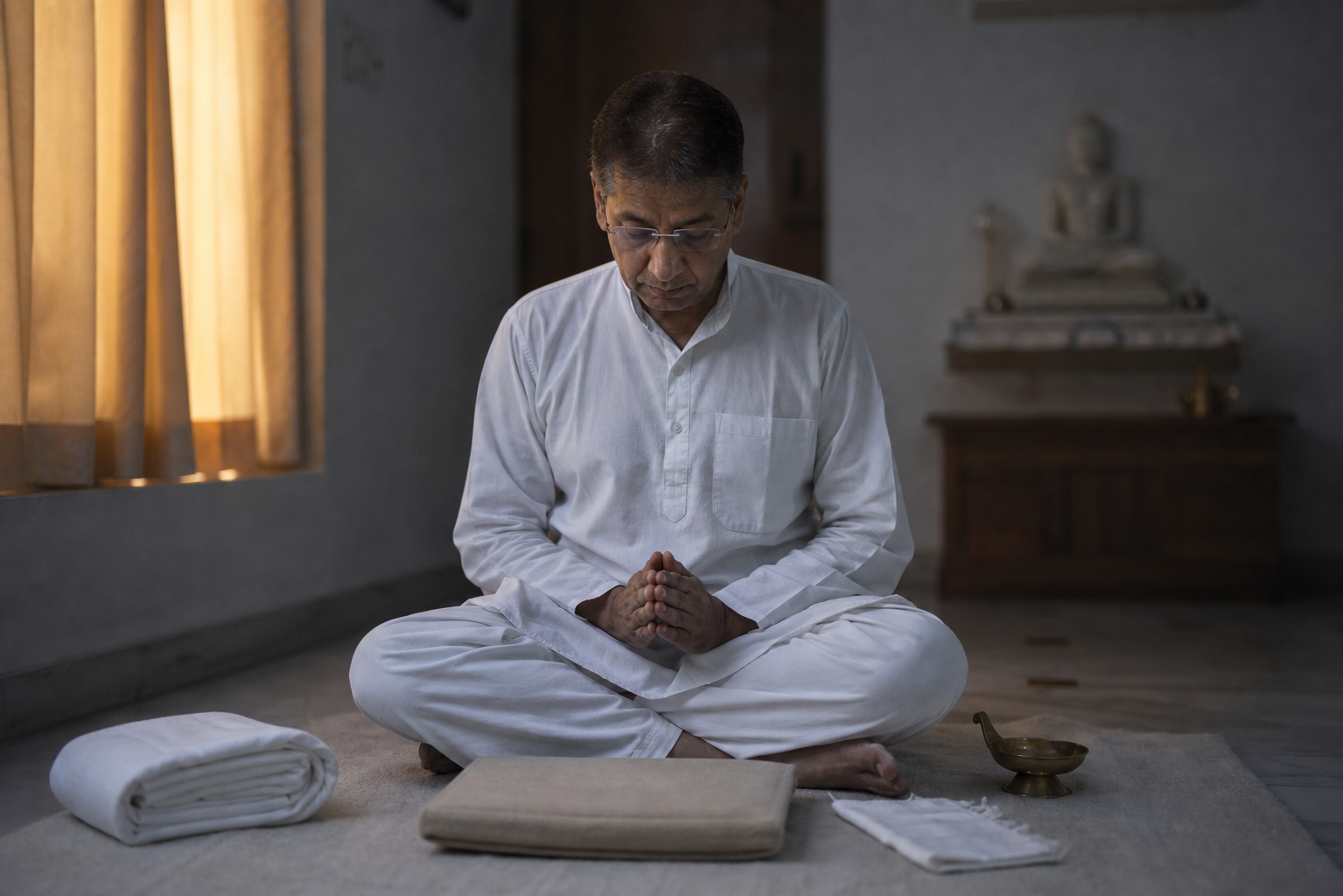
The commonly named Avashyaka provide a balanced map of essential practice. You can use them diagnostically rather than treating them as unrelated items on a checklist:
- Samayik — equanimity: emphasize it when preference, hostility, or agitation is governing your attention. Its question is: can you remain ethically awake without being dragged by attraction and aversion?
- Pratikraman — return through reflection and repentance: emphasize it when mistakes pass without examination or when you keep repeating a familiar justification.
- Vandana — reverence: emphasize it when pride makes correction difficult. Proper reverence restores humility and receptivity to guidance.
- Pratyakhyana — deliberate renunciation: emphasize it when your intentions are sincere but vague. A clearly understood restraint turns aspiration into a boundary.
- Kayotsarga — meditative stillness and letting go: emphasize it when bodily restlessness and immediate impulses dominate. It trains the capacity to observe without instantly obeying sensation.
- Devotional praise of the Tirthankaras: emphasize it when practice becomes dry, self-congratulatory, or narrowly centred on personal comfort. Praise redirects attention toward the qualities you seek to embody.
A healthy routine draws from all these functions: equanimity, self-examination, humility, restraint, stillness, and devotion. If you meditate but never review your conduct, add Pratikraman. If you feel remorse but set no boundary, strengthen Pratyakhyana. If rules are making you proud, return to Vandana and the inward purpose of devotion.
Formal wording, sequence, and community practice should be learned within the tradition you follow. The functional map helps you understand what each observance is doing; it does not require you to discard an inherited liturgy or invent a new one.
Keep Dravya Puja and Bhav Puja connected
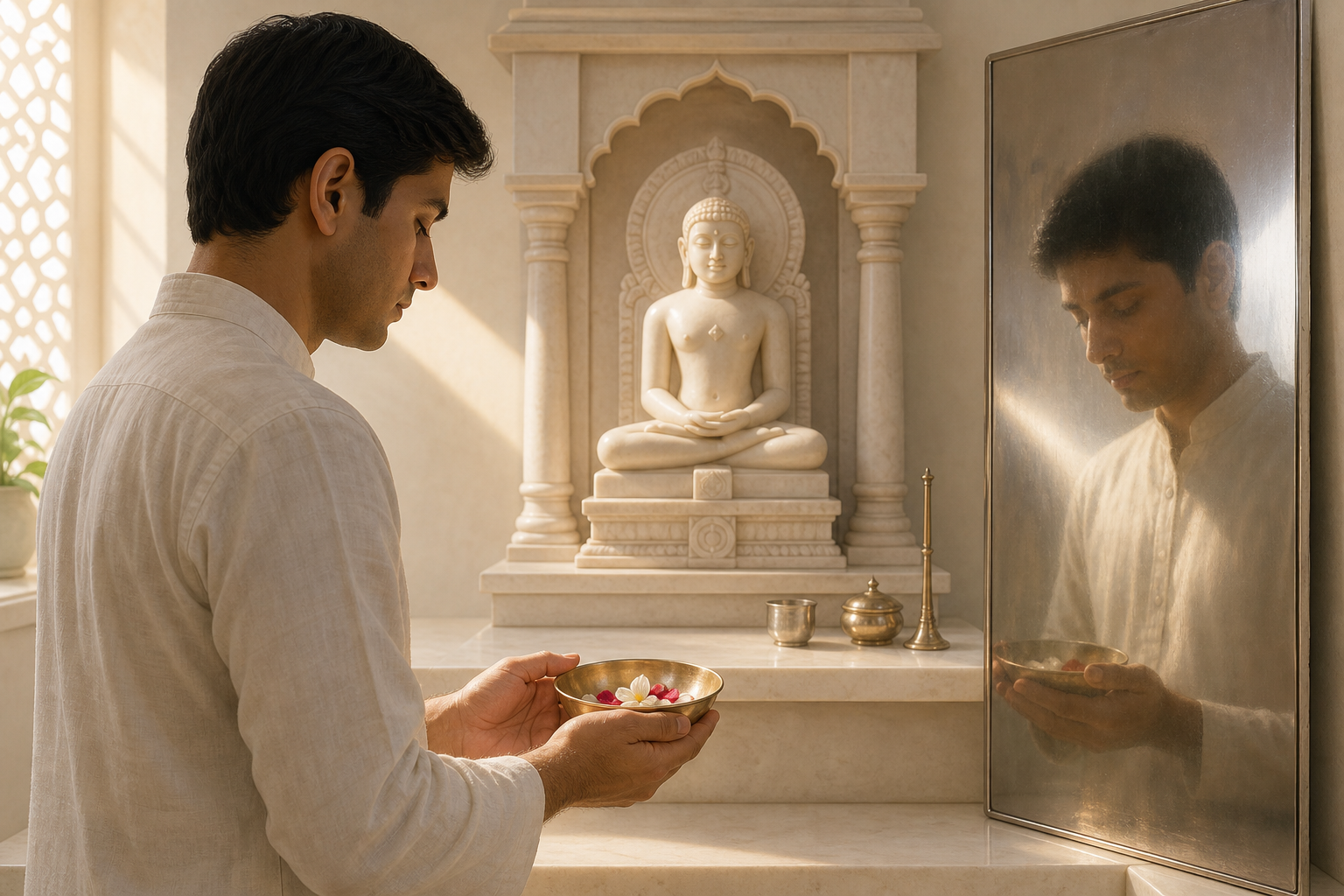
Dravya Puja uses physical materials and actions. Offerings such as water, rice, and fragrance can recall purity, restraint, and surrender. Bhav Puja is inward worship: contemplation, gratitude, reverence, and the intention to purify your own conduct. The distinction matters, but the practices need not compete. The outward act gives attention a form; inward disposition gives that form spiritual meaning.
Before making an offering, identify the quality it should awaken. Perform the action slowly enough to remain aware of that quality. Afterwards, name the situation in which you will carry it into life. If purity is present only at the altar but disappears in hostile speech, the symbolism has not yet completed its work.
Let ahimsa and aparigraha govern the materials as well as the intention. Choose non-harmful materials, avoid needless excess, and keep the setting clean without turning expense into a measure of devotion. Simplicity is not spiritual laziness when it protects attention and non-possessiveness. Elaborateness is not necessarily empty when every action is understood and sincerely performed.
Watch for common signs that form has separated from bhava:
- You rush through words while thinking about completion.
- You treat attendance or performance as moral credit that excuses later conduct.
- You increase display and expense while neglecting aparigraha.
- You seek calm in ritual but refuse an apology or correction that ahimsa requires.
- You become harsh toward people whose observance differs in complexity.
- You dismiss all outward form as unnecessary even though your inward intention has no dependable discipline supporting it.
The remedy is not automatically more ritual or less ritual. Restore the connection. Understand the symbol, bring full attention to the act, and give it a behavioural consequence.
Key takeaways for a sustainable Jain practice
- Begin the morning with quiet preparation, devotional recollection, Samayik, and a restraint suited to the day ahead.
- Carry the practice into meals, speech, consumption, relationships, and Svadhyaya through deliberate ethical pauses.
- Use evening Pratikraman to name harm precisely, Kayotsarga to release agitation, and renewed restraint to prepare a better response.
- Let Dravya Puja support Bhav Puja. Materials and gestures are useful when they awaken inward qualities and change outward conduct.
- Measure progress by reduced reactivity, greater honesty, more careful non-violence, and simpler choices—not by complexity, display, or temporary mood.
- If you miss an observance, return at the next regular anchor. Do not let guilt turn one lapse into abandonment or unnecessary compensatory display.
Start with a morning restraint you can state clearly and an evening review you will not evade. Notice where the restraint held, where passion overran it, and what would help at the next encounter. When this rhythm begins changing the choices between rituals, deepen your study and observance from that stable ground.
References
