
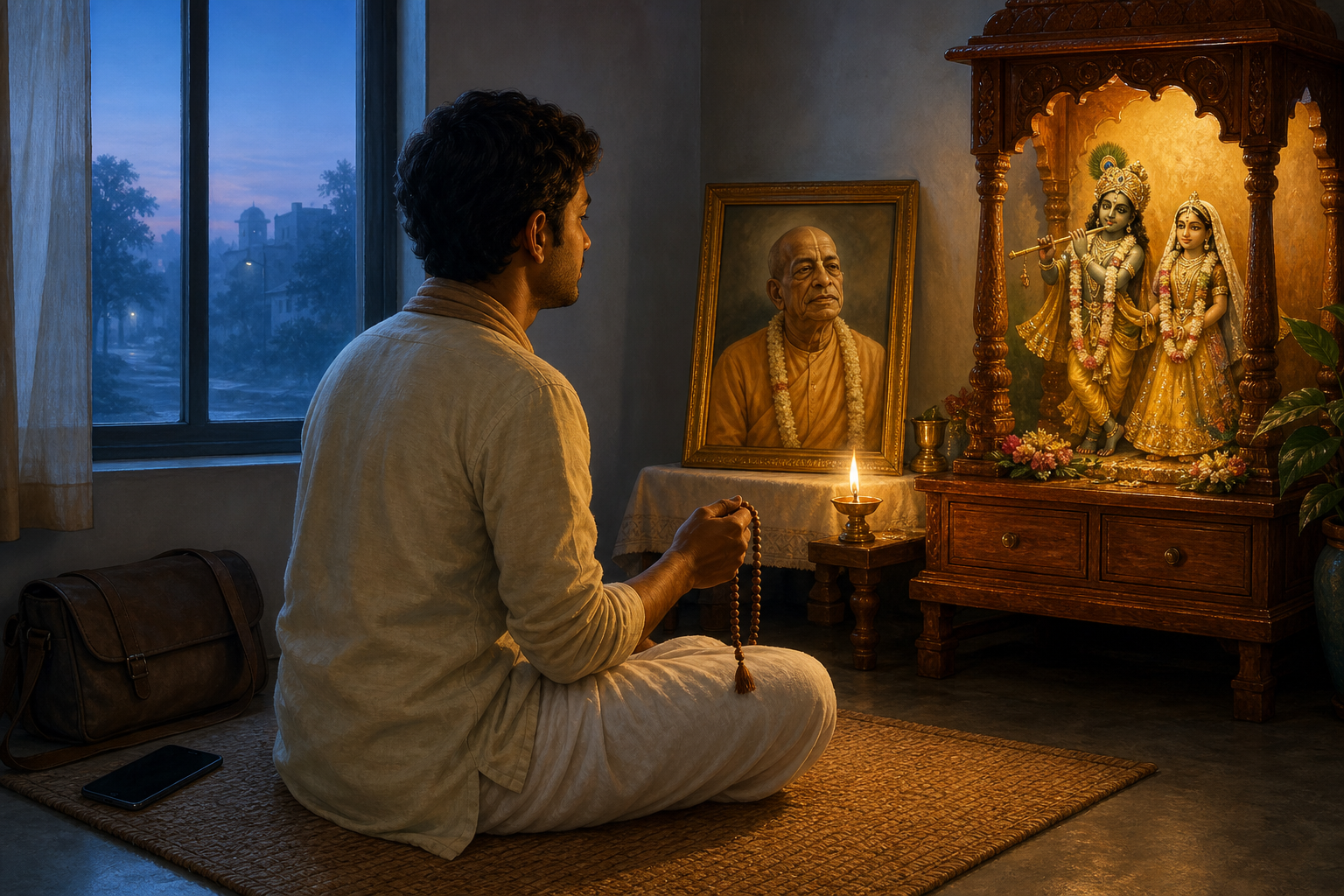
You want Srila Prabhupada at the centre of your spiritual life, but the practical questions arrive quickly. What should you say after pranam? How does prayer fit beside japa? What can you keep when work, family duties, travel, or mental fatigue disrupt the ideal morning?
The answer is not to collect more devotional language. Build a repeatable sequence that brings you to Krishna through Prabhupada’s instruction, gives your mind something definite to do, and ends in service. Prayer is working when it changes how you chant, hear, speak, correct a mistake, and carry out an ordinary duty. A strong feeling may accompany that change, but it is not the daily test.
Keep Prabhupada-centred devotion clearly Krishna-centred
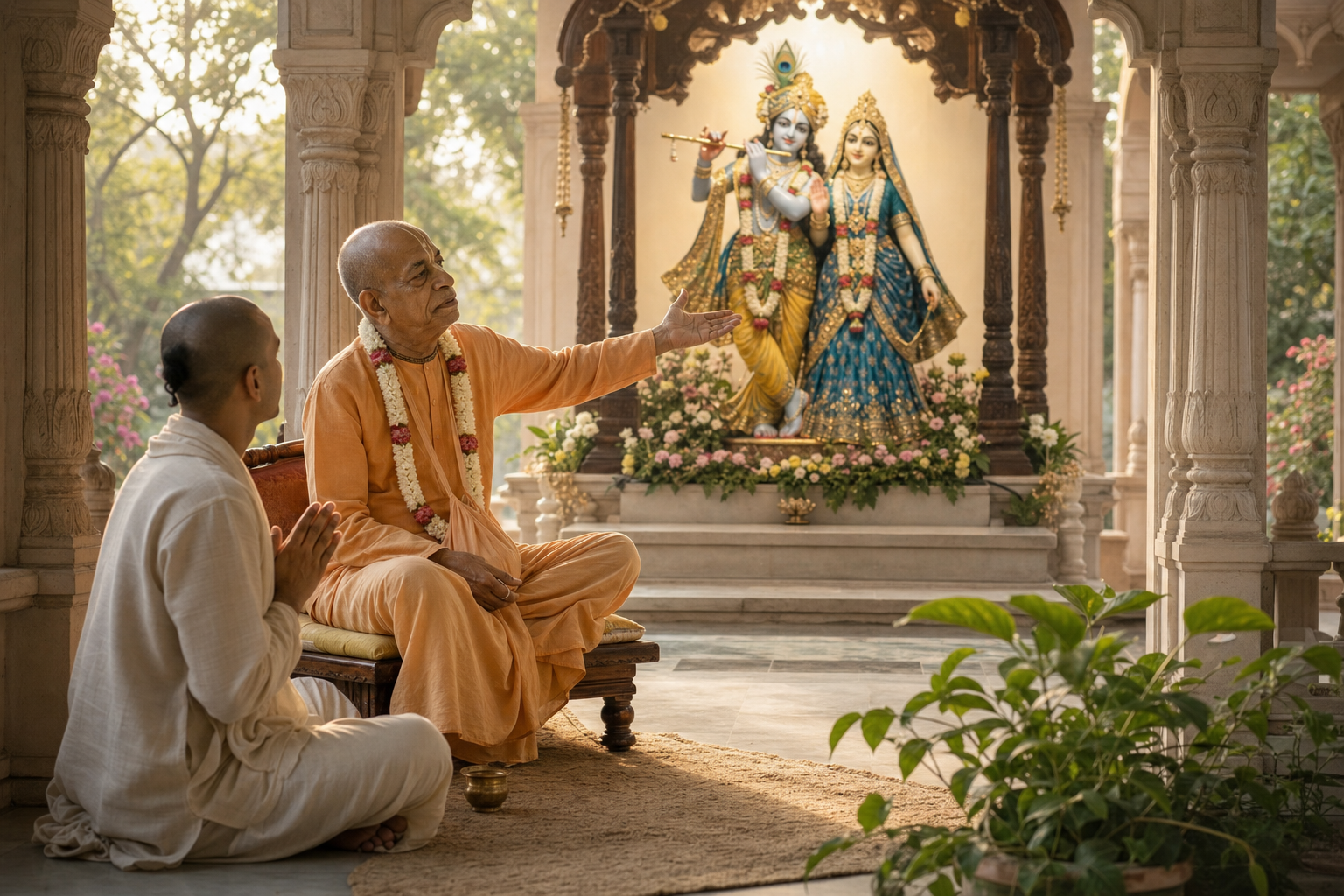
In Gaudiya Vaishnava understanding, the guru is honoured because he represents Krishna faithfully. Srila Prabhupada does not become a competitor to Krishna or an alternative object of ultimate devotion. His exceptional position rests in transparent surrender: his teaching, conduct, and compassion direct the disciple toward the Supreme Personality of Godhead.
This distinction protects your prayer from two errors. The first is treating the guru as an inspirational personality whose instructions can be admired but selectively ignored. The second is speaking about devotion to the guru in a way that erases the distinction between the perfected devotee and Krishna. Proper guru-bhakti avoids both. You ask Prabhupada for mercy, clarity, discipline, and the capacity to serve; then you act on the guidance that brings you to Krishna’s Name, Form, Instructions, and Pastimes.
A useful test is simple: after praying to Srila Prabhupada, are you more willing to chant attentively, hear scripture honestly, restrain an unworthy impulse, and serve without demanding recognition? If not, do not abandon prayer. Correct its direction.
Srimad-Bhagavatam 7.5.23 places vandanam among the nine limbs of bhakti. Prayer therefore belongs with hearing, chanting, remembrance, worship, service, friendship, and surrender; it is not devotional decoration added after the supposedly serious practices. At the same time, tradition holds that sincere absorption in even one limb can bear the highest fruit. That is a reason to practise prayer deeply, not permission to discard commitments already received from guru and sadhu.
Three questions keep vandanam spiritually precise:
- Sambandha: What relationship am I acknowledging? Krishna is the Supreme Lord, I am dependent upon His grace, and Srila Prabhupada is the acharya whose teachings show me how to serve.
- Abhidheya: What will I actually practise now? The answer should name something concrete: pranam, japa, hearing, ethical restraint, worship, or seva.
- Prayojana: What is the prayer moving toward? The aim is loving service, not merely calmness, success, relief from inconvenience, or a more spiritual self-image.
These questions also explain why Prabhupada’s pattern of japa, study, teaching, kirtan, and service matters. No part floated free from the others. Prayer nourished remembrance; remembrance governed action; action became service. Your daily rule should reproduce that connection on the scale your present duties allow.
Build a daily sequence that survives a difficult weekday

A daily rule is a sequence, not a new vow invented in a burst of enthusiasm. If you have received a prescribed mantra, chanting commitment, or temple responsibility, keep it intact. The compact sequence below supports those obligations; it does not quietly replace them.
Attach the sequence to a dependable event rather than waiting for a devotional mood. You might begin after washing, after lighting the altar lamp, or before opening discretionary messages and news. Keep the place ready: the required prayer text, its translation, your beads, and the scripture you intend to read should already be within reach. Removing small decisions makes regularity easier when the mind is tired.
- Arrive physically. Silence avoidable interruptions, bring your hands together or bow, and take a steady breath. The posture is not theatre. It tells the restless body that you are no longer moving casually from one demand to another.
- Offer pranam with meaning. Recite the authorized pranama-mantra you have learned for Srila Prabhupada and the lineage. Keep a translation beside you until you can explain what you are saying in plain language. Pronunciation deserves care, but sound without understood intention easily becomes automatic.
- State the relationship. Acknowledge Krishna as the object of devotion, Srila Prabhupada as the guiding acharya, and yourself as a person learning to serve. This prevents the prayer from shrinking into a list of requests.
- Give thanks specifically. Name a mercy you can actually recognize: access to the Holy Name, a teaching that corrected you, the opportunity to serve, the patience of another devotee, or protection from an impulse you did not follow.
- Admit and rectify. Name a concrete fault without dramatizing it. Then pair it with a correction you can make. If your speech was harsh, the next step may be an apology and restraint. If you neglected japa through avoidable distraction, remove the distraction and return to the commitment.
- Ask for help with today’s duty. Pray for attentiveness in japa, honesty in hearing, steadiness under provocation, and freedom from the need for praise. A petition becomes useful when it names the conduct for which you are seeking strength.
- Chant and hear. Give your japa commitment its proper place. Prayer can prepare the heart to chant, but more words about chanting are not a substitute for hearing the maha-mantra as you chant it.
- Read for instruction. Read a short passage from Srila Prabhupada’s teachings or the translation of a daily prayer. Pause when a sentence exposes a decision you need to make. The purpose is not to finish material; it is to let meaning enter conduct.
- Name the day’s seva. Choose a real duty that can be offered: caring for family without resentment, completing honest work, helping at the temple, sharing Krishna-katha appropriately, preparing prasada, or refusing speech that would inflame a needless quarrel.
- Close in surrender. Offer the result to Krishna and ask to be corrected where your own preference is disguising itself as devotion.
You do not have to expand every element into a long speech. On a compressed morning, gratitude, confession, petition, and surrender can each be expressed in a direct sentence. What matters is that you do not turn a short practice into a careless one.
If personal words are difficult, use a plain-language scaffold such as this: Srila Prabhupada, please help me hear Krishna’s Name attentively, understand your instruction honestly, correct the fault I can see, and serve without seeking credit. Let today’s duties become service to Krishna. This is not a received mantra and should not be presented as one. It is a prompt for truthful personal prayer alongside the authorized prayers of the lineage.
The established Gaudiya Vaishnava and ISKCON daily program joins Mangal-arati, Tulasi-puja, japa, and guru-puja. If you already follow that program, keep its structure. Use the sequence above to bring attention into each part, not to reduce a full practice to the most convenient fragments. If your present home situation cannot reproduce a temple morning, let the temple program provide direction without using the gap as an excuse for shame or abandonment.
Add an evening return, not a second performance
At the end of the day, return briefly to the morning sankalpa. You are not trying to manufacture a spiritually impressive report. Ask where remembrance affected a choice, where you forgot, what must be repaired, and what mercy deserves thanks. Carry a specific correction into the next morning. This closes the gap between prayer as speech and prayer as formation.
When prayer becomes mechanical, diagnose the actual failure

Dryness does not always mean the same thing. Sometimes the words are unfamiliar. Sometimes the mind is overloaded. Sometimes you are avoiding a correction already understood. Calling every difficulty a lack of faith hides the remedy.
- Your mouth is moving but meaning is absent: stop after a line and read its translation. Paraphrase it without ornamental language. Then identify what that line asks you to believe, stop doing, or begin doing.
- Your mind keeps scattering: reduce avoidable input before prayer and make brief returns to remembrance during the day. A pranam before work, a moment of gratitude before prasada, or a petition before a difficult conversation can reconnect the day to the morning. Do not use these returns to dilute a formal japa commitment.
- You feel nothing: do not counterfeit emotion. Offer attention, truthfulness, and service. Feelings can change from day to day; the decision to hear and obey can still be real.
- You repeat the same confession: attach rectification to it. Confession without repair can become a ritual recycling of remorse. Make the apology, remove the trigger, seek guidance, or restore the duty you neglected.
- You doubt what you are saying: name the doubt precisely. Is it uncertainty about doctrine, distrust caused by a human interaction, or simple resistance to discipline? Take doctrinal questions to a qualified teacher and examine scriptural context. Honest inquiry is more useful than reciting certainty you do not possess.
- You keep redesigning the routine: stop measuring seriousness by novelty. Keep the sequence stable long enough for the words to reveal your habits. Enthusiasm is valuable, but it needs confidence and patience beside it.
Set prayers and personal prayers perform different work. Authorized prayers carry the language and conclusions of the lineage; they protect you from making your present mood the measure of truth. Personal prayer exposes the condition in which you are actually approaching that truth. Keep both. Recite the traditional prayer, read its meaning, and then speak plainly about the place where your life has not yet caught up with it.
The practical counsel of utsaha, niscaya, and dhairya — enthusiasm, confidence, and patience — keeps this balanced. Enthusiasm begins the practice. Confidence prevents every dry day from becoming a theological crisis. Patience allows repeated prayer to shape perception and conduct over time. Regularity is not glamorous, but without it prayer remains something you visit instead of a relationship you inhabit.
Judge the prayer by the kind of day it produces

Prabhupada-centred prayer should make Prabhupada’s instructions more authoritative in your decisions, not merely make his name more frequent in your vocabulary. Purposeful speech is a strong test. Before sending a cutting reply, passing along a rumour, or turning Krishna-katha into a contest for status, ask whether the act serves truth and devotion or only your agitation.
Do not measure progress only by peaceful sessions. At the end of the week, use a simple dated note and examine signs that reach beyond the prayer space:
- Did remembrance arise during a difficult moment, or only after the damage was done?
- When you made a mistake, did you return, repair, and resume service more quickly?
- Did gratitude become more specific and less dependent on getting the outcome you wanted?
- Was your speech more truthful, restrained, and useful?
- Did you follow dharma when nobody was likely to notice?
- Did service become less dependent on recognition, position, or agreement?
This review is not a scorecard for ranking yourself against other devotees. It is a way to detect whether the meanings voiced in prayer are becoming the mind’s working horizon. If your record shows the same avoidable failure, change the condition around it and seek guidance. Do not merely promise greater sincerity in increasingly dramatic words.
The outward fruit also matters in the wider dharmic family. Sikh Naam-simran and seva, Buddhist cultivation of goodwill and the bodhisattva ethic, and Jain reverence expressed through the Namokar Mantra, ahimsa, and aparigraha all show how remembrance, restraint, and service can shape a life. These are meaningful resonances, not proof that distinct traditions teach an identical theology.
A practitioner formed by Srila Prabhupada should be able to hold both truths: Krishna-bhakti has definite theological claims, and virtues in another dharmic path do not have to be denied in order to preserve those claims. In conversation, describe your own practice accurately. Do not flatten every form of prayer into the same thing, and do not use loyalty to the guru as permission for contempt. Humility, disciplined speech, non-harm, truthfulness, and service make conviction more credible.
This gives Prabhupada-centred devotion a public consequence. Your prayer before the altar should make you more dependable in the temple, more just in work, more patient at home, and less careless with another person’s dignity. Otherwise, the day is revealing where the prayer still needs to enter.
Key takeaways
- Honour Srila Prabhupada as Krishna’s transparent representative; let every prayer to the acharya direct you toward Krishna’s Name, teachings, remembrance, and service.
- Keep a fixed sequence: pranam, relationship, gratitude, rectification, petition, japa, hearing, seva, and surrender.
- Do not let a compact home routine displace formal commitments you have received or a temple program you are able to follow.
- Read the translation of daily prayers. If a line cannot be connected to a belief, choice, restraint, or service, you probably have not yet absorbed its meaning.
- Treat dryness according to its cause. Distraction needs fewer competing inputs; confusion needs study; repeated remorse needs rectification; doubt needs precise inquiry.
- Measure growth by remembrance under pressure, quicker repair after mistakes, purposeful speech, unseen integrity, gratitude, and service without a demand for credit.
At your next normal prayer time, do not attempt to construct the perfect devotional morning. Prepare the text and beads, offer pranam with understood meaning, name the duty you need help to perform, chant, and carry one instruction into the day. Return in the evening and see whether you did it. That honest cycle is a sound place for daily bhakti to deepen.
References
- Dandavats — Srila Prabhupada and the sastric ideal: timeless devotion, inner power, and dharmic unity
- Dandavats — Unlocking the Power of Prayer: Vandanam in Daily Sadhana and Dharmic Unity Practices