
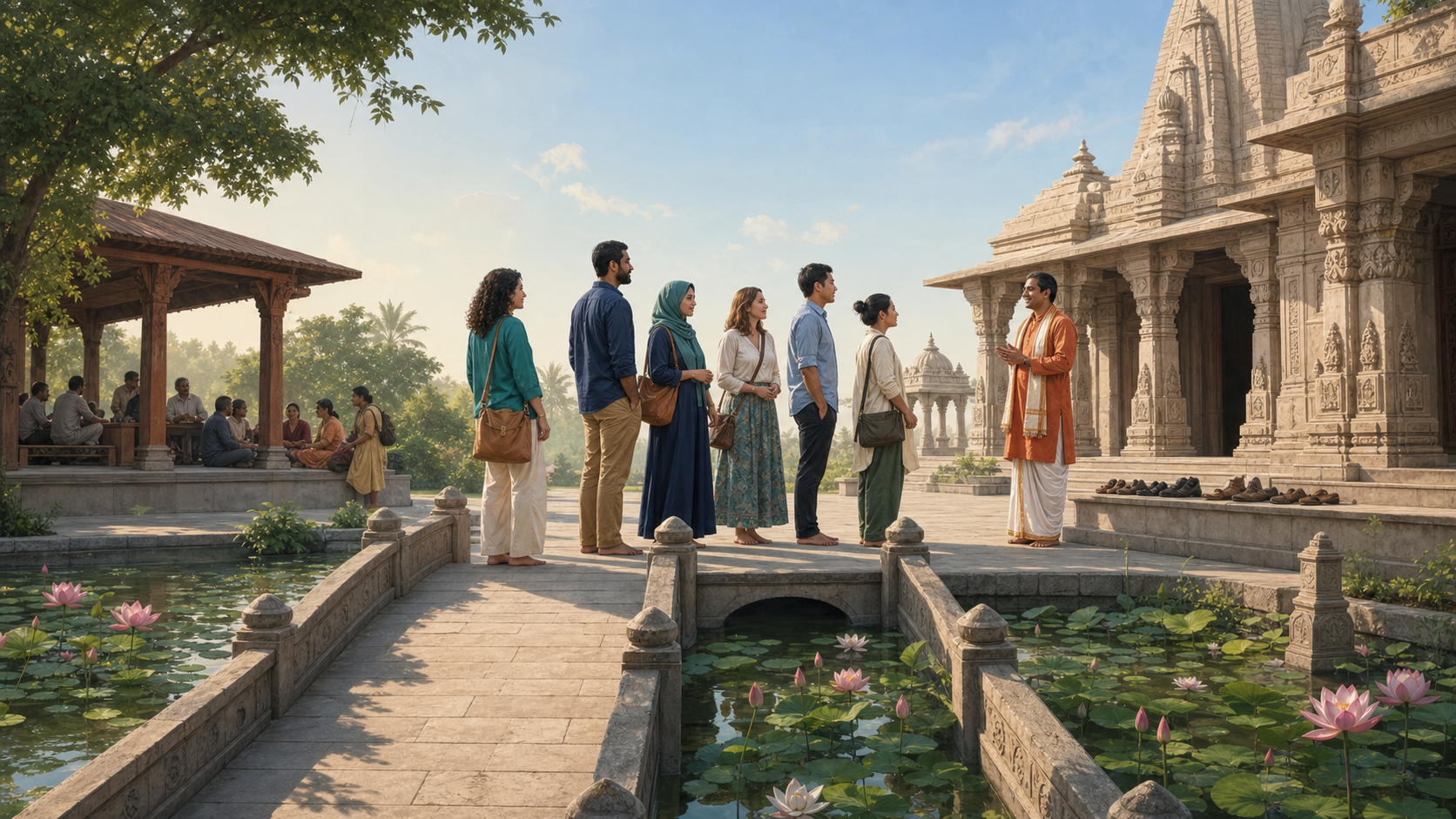
You have been asked to organise an interfaith gathering, welcome visitors to a mandir, join a neighbourhood dialogue, or respond to tension around a sacred place. The concern is legitimate: how do you pursue peace without concealing what you believe, accepting a false account of history, or turning the occasion into a recruitment contest?
A dharmic bridge does not require you to choose between truth and harmony. It gives people a safe way to encounter real differences. The practical task is to define the purpose, protect voluntary participation, make the rules symmetrical, and keep civic cooperation separate from theological agreement.
Define the bridge before you invite anyone
Interfaith programmes become muddled when participants expect different things from the same room. A temple committee may think it is offering hospitality. A civic organiser may expect a statement on a political dispute. A guest may arrive ready for theological debate. None of those aims is inherently illegitimate, but combining them without warning creates distrust.
Begin by choosing the kind of bridge you are building:
- Hospitality: one community hosts, explains its customs, and answers respectful questions. Guests are not expected to imitate belief or participate in worship.
- Cooperation: distinct communities work on a shared civic need such as food service, neighbourhood care, or heritage protection. The goal is joint action, not doctrinal agreement.
- Dialogue: participants examine beliefs, disagreements, memories, or ethical questions under agreed moderation. Candour is part of the purpose.
Do not advertise one format and deliver another. A seva project should not become an unannounced conversion platform. A temple visit should not turn into a tribunal on everything ever done in the name of Hinduism. A theological conversation should not be presented as though every participant has endorsed a common creed.
Write a purpose sentence and a boundary sentence before selecting speakers. For example: This gathering will help local Hindu, Buddhist, Jain, Sikh, and other faith communities understand how each serves the neighbourhood. It will not ask participants to merge teachings, perform another tradition’s worship, or settle disputed historical claims.
That distinction is dharmically sound. Compassion, restraint, seva, contemplation, integrity, and gratitude can provide common ethical ground without requiring a single religious expression. Hindu, Buddhist, Jain, and Sikh traditions can recognise resonances among their practices while remaining distinct traditions with their own authorities, disciplines, and understandings of liberation.
Shri Rama’s bridge offers an apt civilisational image: a shared undertaking can unite contributors without erasing their different roles. A bridge is useful precisely because the shores remain real. Interfaith harmony should connect communities across difference, not pretend that no difference exists.
Before proceeding, require four commitments from every organiser:
- Each participant may describe sacred truth in the vocabulary of his or her own tradition.
- No participant may caricature another tradition or assign beliefs to someone who rejects them.
- Prayer, ritual, sacred food, literature, photography, and follow-up contact remain voluntary.
- The same standards apply to the host, the guests, the majority, and the minority.
If an organising partner wants restraint only from the Hindu side while allowing others unrestricted advocacy, the problem is not insufficient politeness. The arrangement is unequal. Correct the terms before putting devotees on a public stage.
Build the encounter around practice, not performance

A public debate rewards fast rebuttals and memorable lines. It rarely shows how a tradition forms character, sustains families, serves neighbours, or disciplines the mind. If your purpose is understanding, let participants encounter lived practice before asking them to evaluate abstract claims.
Choose the format according to the actual obstacle:
- If people are strangers, begin with hosted hospitality or a shared service activity. Familiarity must exist before a difficult dialogue can carry much weight.
- If misunderstanding concerns worship, arrange an observed visit with a knowledgeable host who can explain what guests will see, what is optional, and what conduct the sacred space requires.
- If the tension concerns doctrine, use a moderated study circle. Give each tradition time to state its own position before anyone compares it with another.
- If the dispute concerns history, property, access, or law, do not disguise negotiation as a cultural celebration. Use an appropriate civic, legal, or heritage process.
Krishna-conscious communities already have several adaptable points of welcome: Harinam, prasadam, book distribution, Bhagavad Gita study, and home programmes can be shaped for local language, music, venue, and digital participation. Adaptation should make the encounter intelligible; it should not hide its sacred character. If food is prasadam, call it prasadam and explain what that means. If singing is Harinam, let guests know that they are hearing and, if they wish, joining devotional practice.
The same care applies across traditions. Langar and prasadam can both open a door through hospitality, but they are not interchangeable labels for free food. Kirtan, simran, dhyana, scriptural reflection, and vows of ahimsa may create points of recognition, yet each belongs within a particular discipline and community of meaning. Respect grows when you explain those distinctions plainly.
A workable gathering can follow this sequence:
- Send a pre-event note identifying the host, purpose, programme, expected conduct, food arrangements, photography policy, and any part involving worship.
- Let the host community explain its space and practice in its own words. Do not appoint an outsider to interpret it before its members have spoken.
- Invite questions about experience before arguments about superiority: What practice shapes your ordinary day? How does your community understand service? What do visitors commonly misunderstand?
- Give participants something responsible to do together, whether serving a meal, supporting a local need, caring for a shared environment, or planning a reciprocal visit.
- Close by naming what was agreed, what remains disputed, who owns the next action, and whether participants consent to further contact.
Your invitation should be equally clear. Tell guests whether they will observe worship, participate optionally, share a meal, discuss a text, or work on a service project. A person who knows what is coming can consent honestly. Surprise may produce compliance in the room, but it damages trust afterward.
Protect candour with rules that stop coercion and caricature

Harmony does not mean that nobody disagrees. It means disagreement is expressed without threat, humiliation, deception, or compulsion. A meeting that permits only pleasant generalities may look peaceful while leaving the real conflict untouched.
Give the moderator enforceable rules rather than a vague request to be respectful:
- Speak from your own tradition and experience. A participant may say what a teaching means within a particular lineage, but should not claim to represent every Hindu, Buddhist, Jain, Sikh, Muslim, or Christian.
- Describe another community’s position in terms its members recognise. If they say the description is inaccurate, pause and repair it before arguing against it.
- Distinguish devotional conviction, historical claim, personal memory, and current civic arrangement. They require different kinds of discussion and evidence.
- Ask questions to understand before asking questions intended to expose inconsistency.
- Do not add guests to mailing lists, distribute material directly into their hands, photograph them, or contact them afterward without permission.
- Let anyone decline prayer, chanting, food, gestures, or literature without being challenged in public.
- Record unresolved disagreements accurately. Do not convert silence into consent or publish a joint claim that participants did not approve.
The moderator also needs language for difficult moments. When someone generalises, say: Please identify the teaching, institution, event, or person you mean; do not assign that claim to an entire community. When a question becomes a sermon, say: State your own conviction briefly, then return the choice to respond to the other participant. When a sacred claim is mocked, say: Disagreement is permitted here; contempt is not.
Do not confuse non-coercion with religious embarrassment. A Hindu host may speak openly about Bhagavan, murti puja, dharma, karma, moksha, guru, or the authority of a chosen scripture. A Sikh, Buddhist, or Jain participant must have the same freedom to name the teachings and practices that define that path. A guest’s freedom not to assent is protected alongside the host’s freedom to speak.
Pay special attention to asymmetry. If one community has recently faced threats, desecration, intimidation, or exclusion, asking everyone to move on can conceal the very harm that must be addressed. Invite a concrete request: What conduct would reduce the immediate risk without forcing anyone to abandon a legitimate claim? That question moves the group from ceremonial goodwill to accountable coexistence.
At contested sacred sites, separate peacekeeping from truth claims
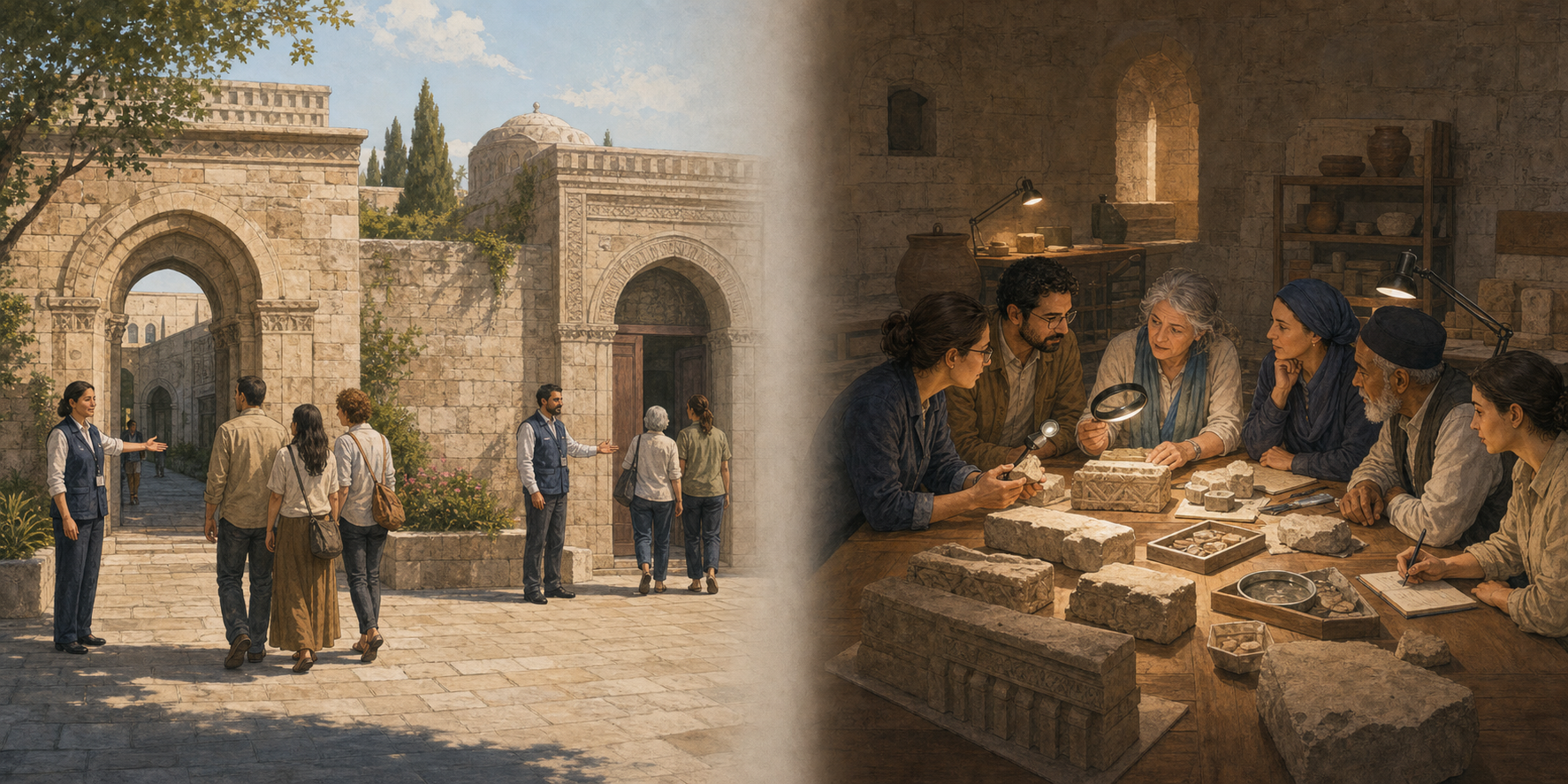
A shared or disputed sacred place carries several problems at once: worshippers need safe access, a heritage structure needs protection, administrators need workable procedures, and communities may hold incompatible accounts of history or ownership. One goodwill statement cannot perform all those jobs.
At Bhojshala, the Supreme Court permitted Hindu and Muslim prayers in separate time slots, with security arrangements, while directing that the Archaeological Survey of India report be opened for consideration. The practical lesson is not that scheduling resolves history. It is that immediate access, public order, evidence, and conservation can be handled through distinct mechanisms.
That separation protects dialogue from a common failure. If an interim schedule is treated as a final verdict on history, one side may see every logistical concession as surrender. If historical disagreement is allowed to suspend all practical arrangements, worshippers, residents, and the site itself bear the cost.
For any contested place, put the operational questions in writing:
- Which areas may each group enter, and under whose supervision?
- When does each observance begin and end, and how will transitions occur?
- What rules govern sound, processions, sacred objects, food, footwear, photography, and recording?
- Who is responsible for conservation, cleaning, crowd movement, and emergency contact?
- How will an incident be documented, reported, and reviewed without immediate public speculation?
- Is the arrangement provisional, and which competent process will consider the longer-term claim?
Preserve evidence and keep heritage work under qualified supervision. Do not move, alter, conceal, or ceremonially repurpose disputed material as a gesture of reconciliation. An irreversible act can destroy both trust and information.
If ownership, legal access, criminal allegations, or statutory rights are disputed, an informal interfaith committee cannot decide them. Use competent legal and heritage processes, and do not ask worshippers to waive rights at a harmony event. Community dialogue can reduce danger and clarify conduct while those processes continue; it should not manufacture a settlement outside its authority.
Security should protect devotees, visitors, staff, and residents without treating an entire community as suspect. Publish rules in advance, apply them consistently, designate responsible contacts, and avoid triumphalist statements after a peaceful observance. Restraint is not weakness here. It is what keeps a practical accommodation from becoming fresh material for mobilisation.
Key takeaways: test the bridge before you call it harmony
- Name the purpose: hospitality, cooperation, dialogue, or dispute management.
- Keep every tradition visible in its own vocabulary; common ground is not a common creed.
- Make prayer, sacred food, literature, photography, and follow-up contact voluntary.
- Apply the same speaking and conduct rules to hosts, guests, majorities, and minorities.
- Match the format to the obstacle: practice for unfamiliarity, dialogue for doctrine, and competent civic or legal processes for rights and property.
- At contested sites, separate immediate safety and access from historical findings and long-term stewardship.
- Record unresolved differences instead of hiding them behind a ceremonial declaration.
- Judge the encounter by accurate understanding, fulfilled commitments, and the ability to cooperate again, not by attendance or photographs alone.
After the gathering, ask questions that can reveal whether trust actually improved. Can participants describe another community’s position without parody? Did anyone feel pressured into ritual or follow-up contact? Was every public statement approved by those named in it? Did an agreed service or safety action receive a responsible owner? Were difficult questions recorded for an appropriate future forum?
A successful event need not produce agreement. It should leave people more accurate, more accountable, and less willing to dehumanise one another. That is a sturdier measure than a crowded hall or a photograph of leaders holding hands.
Your next step is small but decisive: write the purpose sentence, choose the correct type of bridge, and send the conduct rules to every partner before announcing the event. If the organisers cannot agree on the purpose and boundaries, postpone the public programme and begin with a private planning conversation. Harmony built on clarity can bear weight; harmony built on ambiguity usually fails at the first serious disagreement.
References
- Dandavats — Culturally Sensitive Sharing: Inclusive Paths to Krishna Consciousness and Dharmic Harmony
- Hindu Existence — SC greenlights Hindu and Muslim prayers at Bhojshala; harmony upheld as ASI report opened
- DharmaRenaissance Blog — Bhagavan Sri Rama the Bridge-Builder: Powerful Symbolism Uniting Culture, Heart, and Spirit
