

You open one Hindu scripture and encounter philosophical inquiry. Another gives you sacred narrative, rules of conduct, or instructions for worship. Then you meet Narasimha and Parasurama, both revered as avatars of Vishnu, even though their forms, actions, and prominence in worship are strikingly different. If truth is one, you may reasonably ask, why is its expression not uniform?
The confusion usually comes from treating Hinduism as though every scripture must answer the same question and every avatar must perform the same task. Once you distinguish purpose, scope, and context, plurality stops looking like a defect. It becomes a disciplined way of addressing the complexity of life without pretending that one teaching, image, or practice fits every person and circumstance.
Many scriptures do different kinds of spiritual work

Hinduism as a whole is not organized around one universally exclusive book. Its many scriptures divide the work of explaining a life too complex to be contained in a single volume. That does not mean every text is interchangeable. It means different texts may address different dimensions of dharma.
A ritual instruction tells you how to perform something. A philosophical teaching asks what the self, reality, bondage, or liberation means. A sacred narrative shows dharma under pressure through persons, choices, consequences, and conflicts. Devotional teaching cultivates a relationship with the divine. Guidance about conduct helps a community order responsibilities. All may belong within a sacred inheritance, but they are not making the same kind of claim.
This distinction matters whenever someone extracts one sentence and announces, “Hinduism teaches this.” Before accepting that conclusion, ask four questions:
- What kind of text is this: philosophical teaching, narrative, praise, ritual direction, or guidance for conduct?
- What question is the passage actually answering?
- Is its instruction presented as universal, or is it tied to a particular role, practice, community, or circumstance?
- How does the tradition that preserves the passage understand and apply it?
A metaphysical statement and a ritual instruction cannot cancel each other merely because they sound different. They operate at different levels. Likewise, a story about an extreme crisis should not automatically be converted into an ordinary rule for daily behaviour.
Some teachings really do disagree, and it is better to acknowledge that than to manufacture an artificial harmony. Hindu traditions have developed different interpretations of ultimate reality, divine form, spiritual discipline, and liberation. Diversity includes debate. The responsible response is to identify which interpretive tradition holds a view, understand its reasoning, and avoid presenting one community’s conclusion as the only Hindu position.
Scriptural authority is layered rather than flat

A shelf full of sacred books is useful only when you know that the books do not all carry the same authority for every reader. A scripture may have wide civilizational importance, central authority within a particular lineage, or a narrower role in a regional or ritual community. Its sacred status does not erase its scope.
This is why two Hindus can be committed to dharma while organizing their study and worship around different textual centres. They need not be secretly practising two unrelated religions. They may be entering a shared sacred world through distinct theological and devotional inheritances.
Layered authority also prevents two opposite mistakes. The first is fundamentalism by quotation: treating one isolated line as a complete and context-free command for every Hindu. The second is careless relativism: assuming that the presence of many scriptures makes every interpretation equally sound. Neither approach respects the tradition’s internal disciplines.
When you encounter a difficult or apparently contradictory passage, use this sequence:
- Read beyond the quoted sentence. Identify the speaker, audience, problem, and surrounding argument.
- Determine the passage’s domain. A teaching about contemplation should not be made to answer a question about public ritual unless the text itself connects them.
- Identify the interpretive community in which the passage carries authority. Do not silently detach it from that setting.
- Look for a sustained explanation rather than a convenient translation fragment or social-media quotation.
- Ask how the interpretation relates to dharmic qualities such as truthfulness, self-command, responsibility, and reverence for life.
The final step is not a licence to accept only what feels pleasant. Dharma frequently challenges preference. It is a check against readings that use sacred language to excuse vanity, cruelty, irresponsibility, or contempt while ignoring the larger moral and spiritual purpose of the teaching.
Different avatars answer different disorders
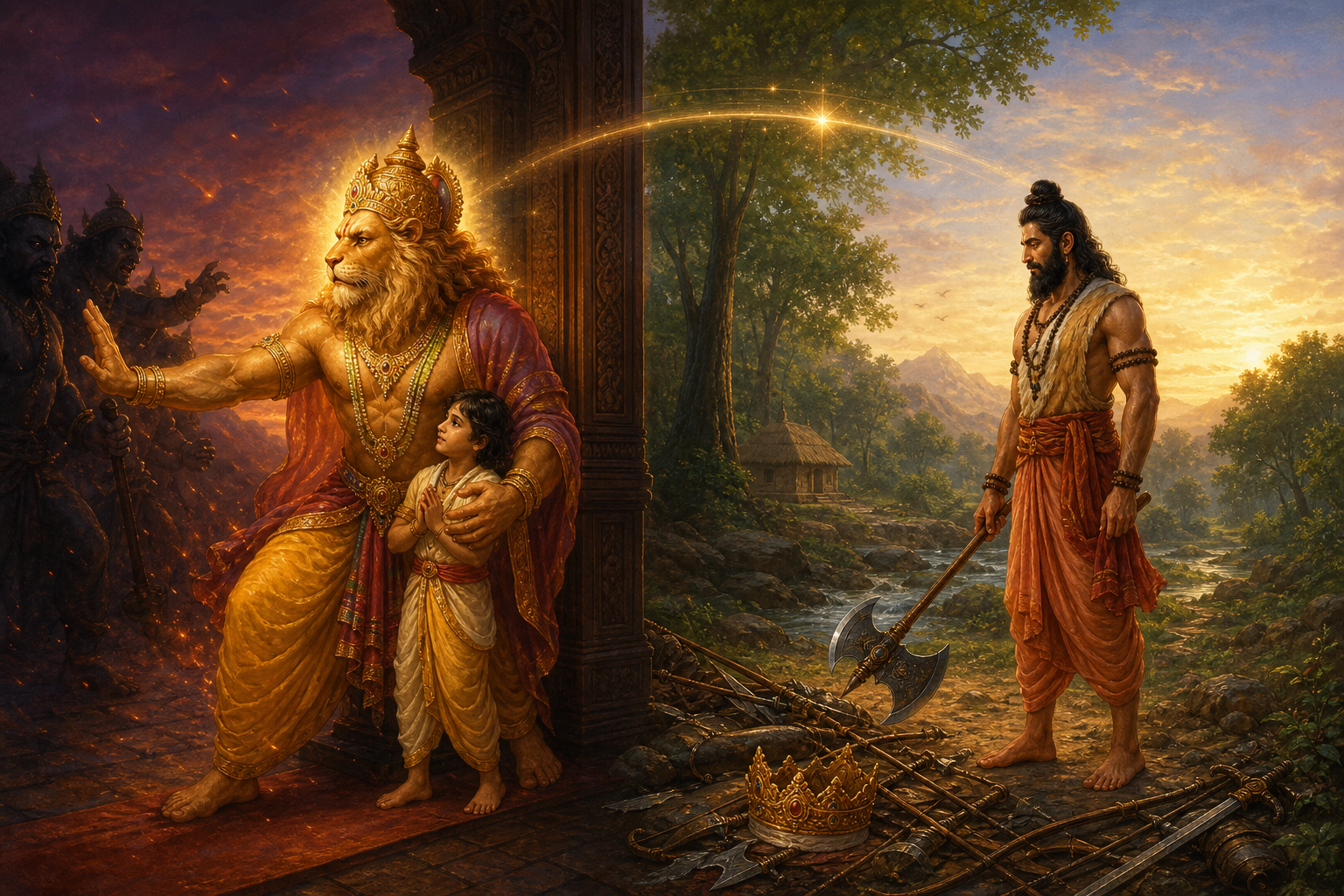
An avatar is not simply another word for any deity. It refers to a divine manifestation or descent understood in relation to the divine reality being manifested. Hindu traditions do not all explain that relationship in precisely the same way, so you should not impose one school’s metaphysical formula upon every Hindu community.
The central point is practical: an avatar has a purpose. The form, disposition, and actions associated with an avatar belong to the particular form of disorder being confronted. If every avatar appeared with the same temperament and acted through the same method, the idea of a purposeful divine response would lose much of its meaning.
Narasimha and Parasurama are both revered as avatars of Vishnu, yet Narasimha has a much larger presence in temple worship while temples dedicated to Parasurama are comparatively few. That difference tells you something about their public devotional prominence. By itself, it does not establish that one avatar is more divine, more authentic, or more valuable than the other.
Temple numbers are not a theological voting system. A form’s visibility in public worship and its status within an account of divine manifestation are different questions. Without further evidence, popularity cannot tell you why worship developed in a particular way, much less settle the spiritual meaning of an avatar.
Instead of ranking avatars by fame, dramatic power, or personal appeal, ask:
- What form of adharma or disorder is being confronted?
- What task does this avatar perform that the situation requires?
- Which qualities of divine action become visible through this form?
- What does the narrative ask the devotee to remember, resist, or cultivate?
- How does the relevant devotional tradition relate this avatar to Vishnu?
These questions keep you from confusing difference with contradiction. Fierceness, restraint, protection, discipline, and decisive action need not be rival definitions of the divine. They may disclose different responses to different conditions. The right comparison is therefore not, “Which avatar behaves most like the others?” It is, “Why is this form fitting here?”
How to choose a path without reducing the tradition

Plurality becomes confusing when you try to absorb everything at once. If you are beginning serious study, do not assemble a private theology from unrelated quotations gathered across different traditions. Choose one well-defined question and follow it within one coherent interpretive setting long enough to understand its vocabulary and assumptions.
- Name your question. Are you trying to understand duty, devotion, meditation, divine form, or liberation? A vague search for “what Hinduism says” invites vague answers.
- Choose the appropriate kind of teaching. Use philosophical instruction for a philosophical question and ritual guidance for a ritual question. Do not demand that every genre function as an encyclopedia.
- Learn one framework before comparing several. Comparison becomes useful only after you understand what each tradition means by its own terms.
- Distinguish explanation from commitment. You can understand why a community holds a position without immediately adopting it. This gives you room to study without pretending that all differences are trivial.
- Consult a qualified teacher when practice is involved. Ask how an interpretation follows from the wider teaching, not merely whether a teacher can supply a supporting quotation.
- Watch the fruit of your reading. Increased clarity, discipline, devotion, humility, and responsibility do not prove every interpretation correct, but their opposites are reasons to examine your understanding more carefully.
The same discipline applies to worship. You need not perform equal devotion to every divine form in order to respect Hindu plurality. A chosen form can give your practice depth and continuity. Respecting other forms means refusing to turn your own devotion into a claim that every other legitimate expression is false or inferior.
Nor should plurality become spiritual shopping. Moving constantly among texts, teachers, and forms may create novelty without formation. Stay with a sound discipline long enough for it to correct your habits. Breadth is most fruitful when it grows from depth.
Key takeaways
- Hinduism’s many scriptures address different questions, audiences, practices, and levels of spiritual inquiry.
- Sacred texts are not automatically interchangeable or equally authoritative in every Hindu tradition.
- An apparent contradiction may be a difference of genre or scope, though genuine disagreements between traditions should be acknowledged honestly.
- Avatars differ because their forms and actions are related to different manifestations of disorder and different divine tasks.
- The popularity of an avatar in temple worship does not, by itself, establish a hierarchy of divinity.
- You will understand Hindu plurality more clearly by studying one coherent framework before comparing several.
The next time a scripture or avatar seems to conflict with another, write down two things: the question the teaching answers and the task the divine form performs. If you cannot identify either, postpone the verdict and seek the missing context. That small habit lets you remain open without becoming indiscriminate, and committed without caricaturing the rest of the Hindu tradition.
References
- Hindu Pad — Why do Divine Avatars differ each other
- Hindu Blog — The Library of Life: Why Hinduism Embraces Many Scriptures Instead of One
