
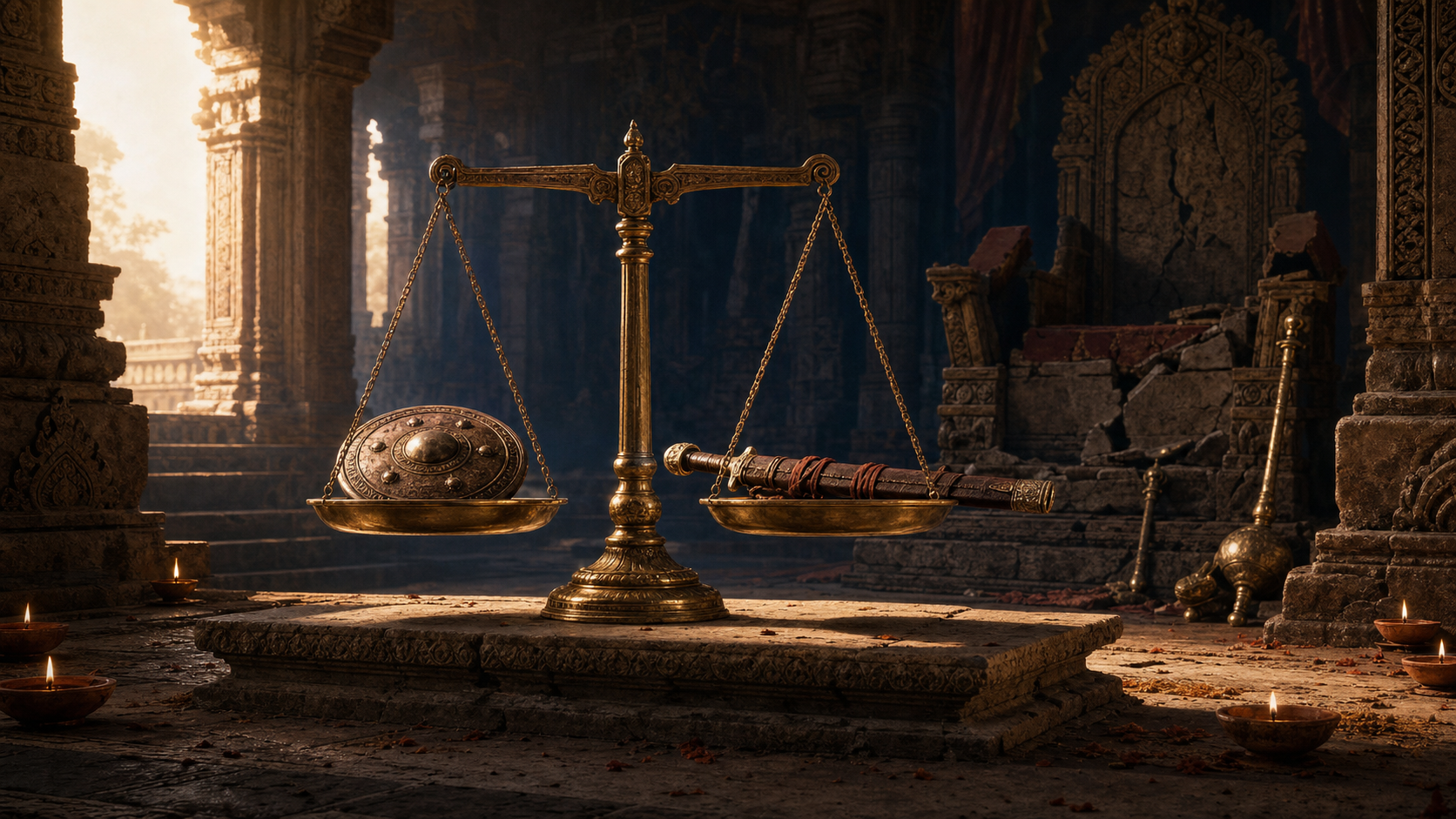
If you are trying to decide whether the Mahabharata endorses severe punishment, neither a simple yes nor a comfortable no will help you. The epic sometimes honours restraint, sometimes permits deception, and sometimes presents lethal force as a protective duty. Yet it does not treat all three as interchangeable.
The difference becomes visible when you compare Kichaka’s immediate predation with Jayadratha’s path from reprieve to renewed wrongdoing. Their fates give you a disciplined way to distinguish punishment from revenge: identify the harm, the person responsible, the duty that has failed, the remedies still available, and the amount of force actually required.
Key takeaways
- Dharmic punishment begins with protection and restoration, not the anger of the person imposing it.
- Proportionality depends on the danger, the offender’s responsibility, the available institutions, and the likelihood of further harm.
- Mercy is a measured opportunity for correction, not the cancellation of accountability for later conduct.
- Apaddharma can alter the permissible response during an emergency, but it does not erase the duties to identify the right target and limit collateral harm.
- Resourceful means, or upaya, are not justified merely because they succeed. Their purpose, target, and consequences still require moral scrutiny.
Kichaka: when protection cannot wait for a captured court

Kichaka’s conduct is easy to misread as a private failure of sexual restraint. It is more dangerous than that. As the powerful commander of Matsya, he uses his position to harass Draupadi while she is living in King Virata’s court under the identity of Sairandhri. Desire has become coercion, and political influence protects the coercer.
The Purushartha framework does not condemn kama as such. Kama has a legitimate place in human life when governed by Dharma. Kichaka reverses that order. He treats his desire as an entitlement and Draupadi’s vulnerability as an opportunity. Once backed by institutional power, his misconduct becomes a public failure of Rajadharma, the ruler’s obligation to protect those within the realm.
The Pandavas cannot pursue an ordinary public remedy without risking discovery during the final phase of their incognito exile. Yudhishthira’s caution therefore addresses a real danger, but concealment cannot become an excuse to abandon Draupadi. This is the pressure of apaddharma: an emergency changes the available method without eliminating the underlying duty.
Draupadi and Bhima answer that pressure with a controlled plan. Kichaka is drawn to a late-night meeting in the dancing hall, away from the court and its bystanders. Bhima confronts and kills him there. The relevant sequence is predation protected by power, failure of ordinary redress, and an intervention narrowed to the aggressor. Remove any one of those elements and the moral assessment may change.
The Dharmashastric category of atatayin helps explain the severity. An atatayin is not merely an unpleasant or immoral person but an active aggressor whose conduct creates grave harm; the traditional classifications include one who violates another’s wife. Read through that category, Bhima is not inflicting pain to satisfy wounded pride. He is ending an immediate pattern of predatory violence that the court has proved unable or unwilling to stop.
The fate of the Upa-Kichakas sharpens another distinction. They are not punished simply because they are related to Kichaka. They become active aggressors when they attempt to burn Draupadi alive, and Bhima kills them while rescuing her. Kinship is not guilt. Participation in a new attack is.
When you evaluate this episode, notice how tightly the response is bounded. The target is identified, the location is isolated, the threat is concrete, and bystander exposure is reduced. Those constraints matter. A harsh response that expands from the responsible aggressor to his family, community, or associates would not follow the same logic.
Jayadratha: mercy remains accountable to what follows
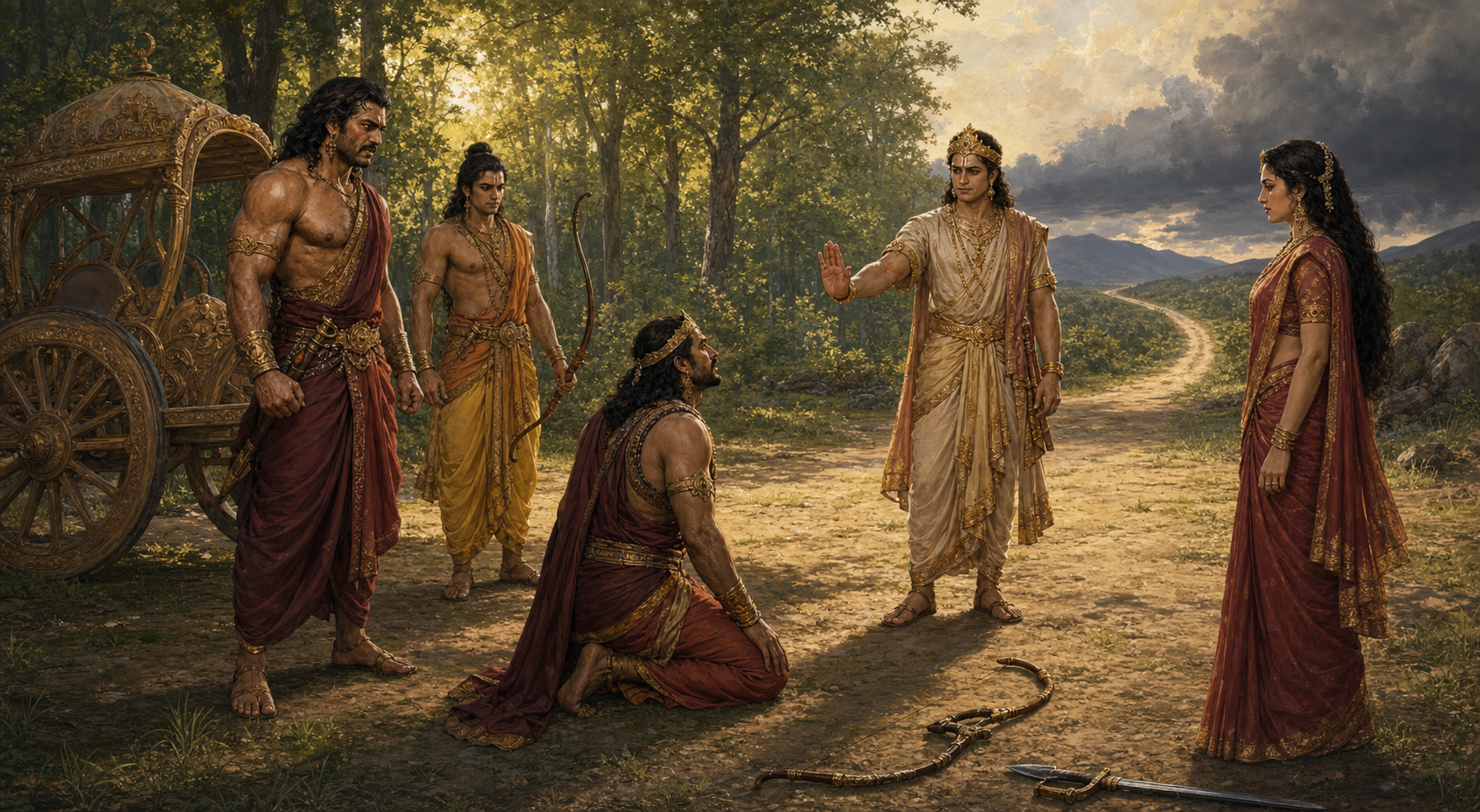
Jayadratha first enters this moral problem during the Pandavas’ forest exile, when he attempts to abduct Draupadi from the hermitage in the Kamyaka forest. After his capture, Bhima and Arjuna want him killed. Yudhishthira instead chooses public humiliation: Jayadratha’s head is shaved and his disgrace is made unmistakable.
That penalty is not an assertion that the offence was trivial. Yudhishthira is weighing more than Jayadratha’s desert. Jayadratha is married to Dushala, the Kauravas’ sister, and executing him could intensify already dangerous kinship and political tensions. The punishment censures the wrong while preserving room for social stability.
This is an important correction to two common readings of mercy. Mercy is not the same as pretending that no violation occurred, which is why Jayadratha is punished and disgraced. Nor does his later conduct automatically prove that Yudhishthira’s earlier decision was irrational. A proportionate decision must be judged by the responsibilities and risks present when it is made. What later conduct can do is end the case for continued leniency.
Jayadratha does not use reprieve for reform. After austerities, he receives from Shiva the ability to hold back the Pandava forces for one day, with Arjuna excepted. On the thirteenth day of the war, he uses that advantage to prevent reinforcements from reaching Abhimanyu inside the Chakravyuha. He does not single-handedly kill Abhimanyu, but his obstruction contributes materially to the isolation in which the young warrior is surrounded and killed in violation of fair combat norms.
Arjuna responds with a time-bound vow: Jayadratha will die before sunset the next day, or Arjuna will enter the fire. The vow does not create Jayadratha’s guilt. Its ethical significance lies in directing Arjuna toward a specific person whose conduct had a specific battlefield consequence, rather than releasing indiscriminate fury against everyone on the opposing side.
On the fourteenth day, Krishna manages the battle and momentarily veils the sun. Believing sunset has arrived, Jayadratha lowers his guard, and Arjuna kills him with a precisely directed arrow. This use of upaya, or resourceful means, is presented within a targeted reckoning for Jayadratha’s role in Abhimanyu’s unlawful death. It should not be reduced to a blanket rule that deception becomes righteous whenever one’s own side claims a noble end.
Jayadratha is also not executed belatedly for the original abduction. His later fate answers a later and graver act. That distinction protects justice from retrospective opportunism: an authority should not revive an old charge merely because it regrets having shown mercy. It should respond to new wrongdoing on the evidence, danger, and responsibility attached to that wrongdoing.
A seven-question test for punishment claimed in Dharma’s name

Before accepting the claim that a punishment is dharmic, run it through seven questions. This keeps a moral judgement from becoming a slogan attached to whatever outcome you already prefer.
- What exact harm must be answered? Name the conduct, not merely the offender’s character. Kichaka’s offence is coercive predation backed by power; Jayadratha’s later culpability concerns his obstruction of Abhimanyu’s rescue.
- Who has the duty to protect? Rajadharma places protection on legitimate authority. When the court shelters the aggressor, that institutional failure becomes part of the ethical problem rather than a reason for the vulnerable person to endure more harm.
- Is the danger immediate, continuing, or completed? An ongoing attack can require urgent restraint. A completed offence normally leaves more room for deliberation, evidence, censure, restitution, or monitored mercy.
- Are ordinary remedies genuinely available? Apaddharma applies because normal action is blocked by an emergency, not because procedure is inconvenient. Kichaka’s influence and the Pandavas’ concealment sharply restrict their options.
- Is the target personally responsible? Do not replace proof with association. The Upa-Kichakas become liable through their own attack, not through their family name. Jayadratha is targeted for his own consequential action, not simply for standing with the Kauravas.
- What is the least response that will reliably protect and correct? Yudhishthira initially judges humiliation sufficient for Jayadratha. Bhima confronts Kichaka lethally because the predation is continuing and institutional restraint has failed. Proportionality concerns effective protection, not equal amounts of suffering.
- How tightly are collateral harm and future risk controlled? Look at the choice of target, time, place, and method. Then ask what leniency requires if it is granted and what new conduct would justify escalation.
This test also exposes revenge. Revenge typically begins with the punisher’s pain, treats humiliation as an end in itself, expands blame by association, and regards excess as proof of resolve. Dandaniti begins elsewhere: with the protection of order, restraint of the responsible wrongdoer, deterrence of further harm, and a consequence fitted to circumstances.
Intent is necessary but not sufficient. A person may sincerely believe that anger serves Dharma. You still have to examine target selection, available alternatives, proportionality, and collateral damage. Good motives do not make an undisciplined method righteous.
What this ethic asks from institutions now

The first modern lesson is not that individuals should imitate Bhima or Arjuna. Epic categories such as atatayin and apaddharma are tools for ethical interpretation, not personal permission to stage a violent confrontation. If you or another person faces an immediate threat, move toward safety and use lawful emergency and safeguarding channels rather than engineering a private reckoning.
The institutional lesson is harder. A temple, school, workplace, family, or public body cannot praise protection in principle while making the endangered person carry the entire cost of obtaining it. A responsible process should separate the threatened person from the alleged aggressor where safety requires it, prevent retaliation, establish individual responsibility, and apply a consequence capable of stopping repeat harm.
Leniency also needs structure. State what it is intended to achieve, what conduct must cease, and what later behaviour will trigger a stronger response. Mercy without continued protection transfers risk back to the person already harmed. Jayadratha’s arc warns against confusing the preservation of social peace with unlimited tolerance for escalation.
The deeper remedy begins before punishment. Kama becomes destructive when self-mastery gives way to entitlement and power shields the result. That insight has relatives across Dharmic traditions: Buddhism disciplines craving, Jain thought joins brahmacharya to ahimsa, and the Sikh saint-soldier ideal combines compassion with defence of the weak. The common centre is not enthusiasm for punishment. It is disciplined desire, responsible strength, and refusal to abandon the vulnerable.
The next time you meet a fierce judgement in the Mahabharata, do not begin by asking whether it proves that Dharma is harsh or merciful. Write down the harm, the duty-holder, the available process, the responsible person, the minimum sufficient response, and the likely collateral cost. If those answers remain vague, the appeal to Dharma is premature. If they are clear, you can begin to see whether punishment is restoring order or merely giving anger a sacred vocabulary.
References
