

If you came looking for the meaning of Surpanakha’s name, the answer is more precise than either a literal insult or a sweeping claim about her character. The name describes nails associated with a winnowing basket. Its deeper moral force arises from what a winnow does: it separates what should be kept from what should be discarded.
That distinction matters when you read the Panchavati episode. Surpanakha’s name does not deliver a ready-made verdict. It directs your attention to discernment: how desire is examined, how boundaries are recognized, how injury is answered, and how one reaction can widen into a destructive chain.
Begin with the literal meaning, not the moral interpretation
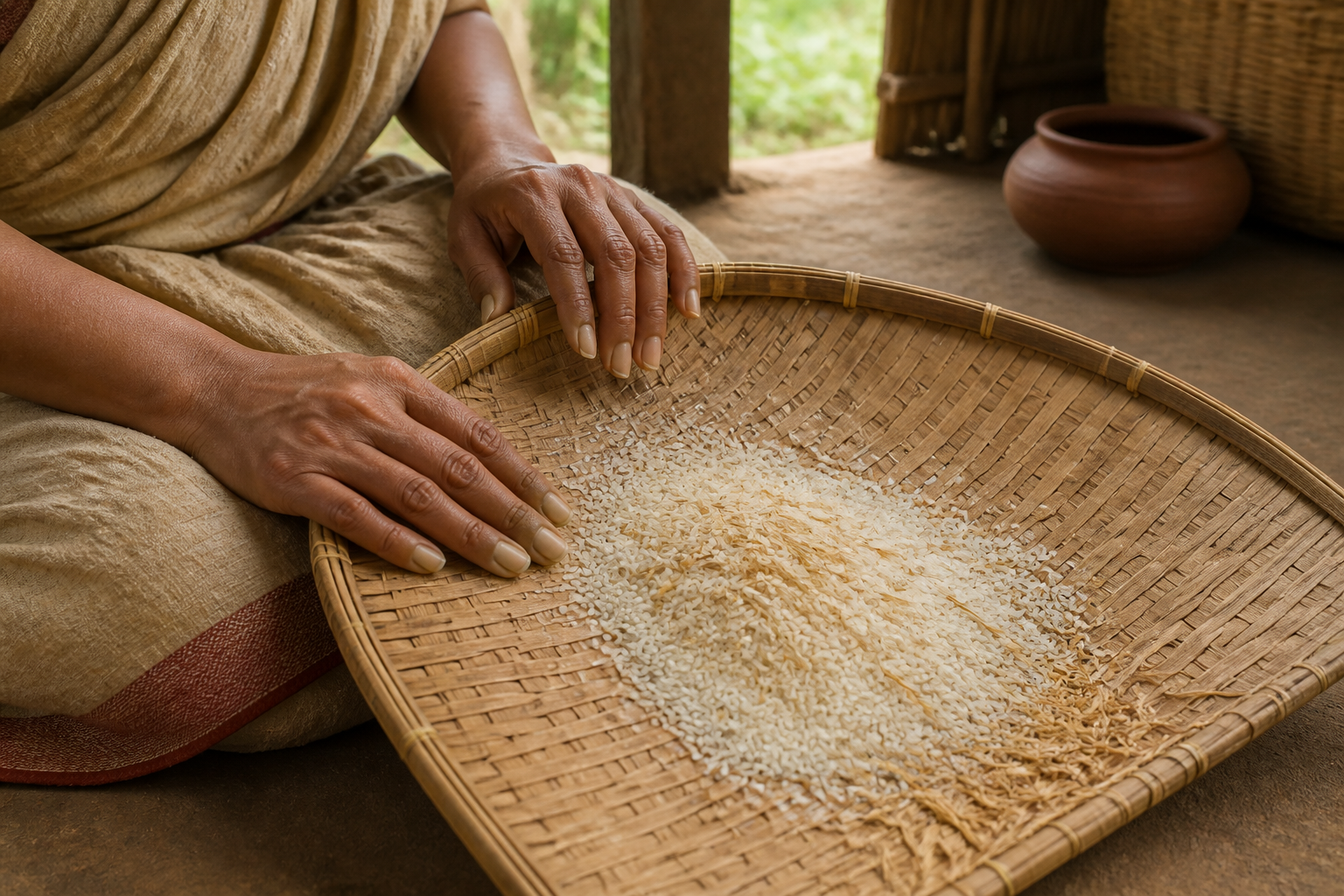
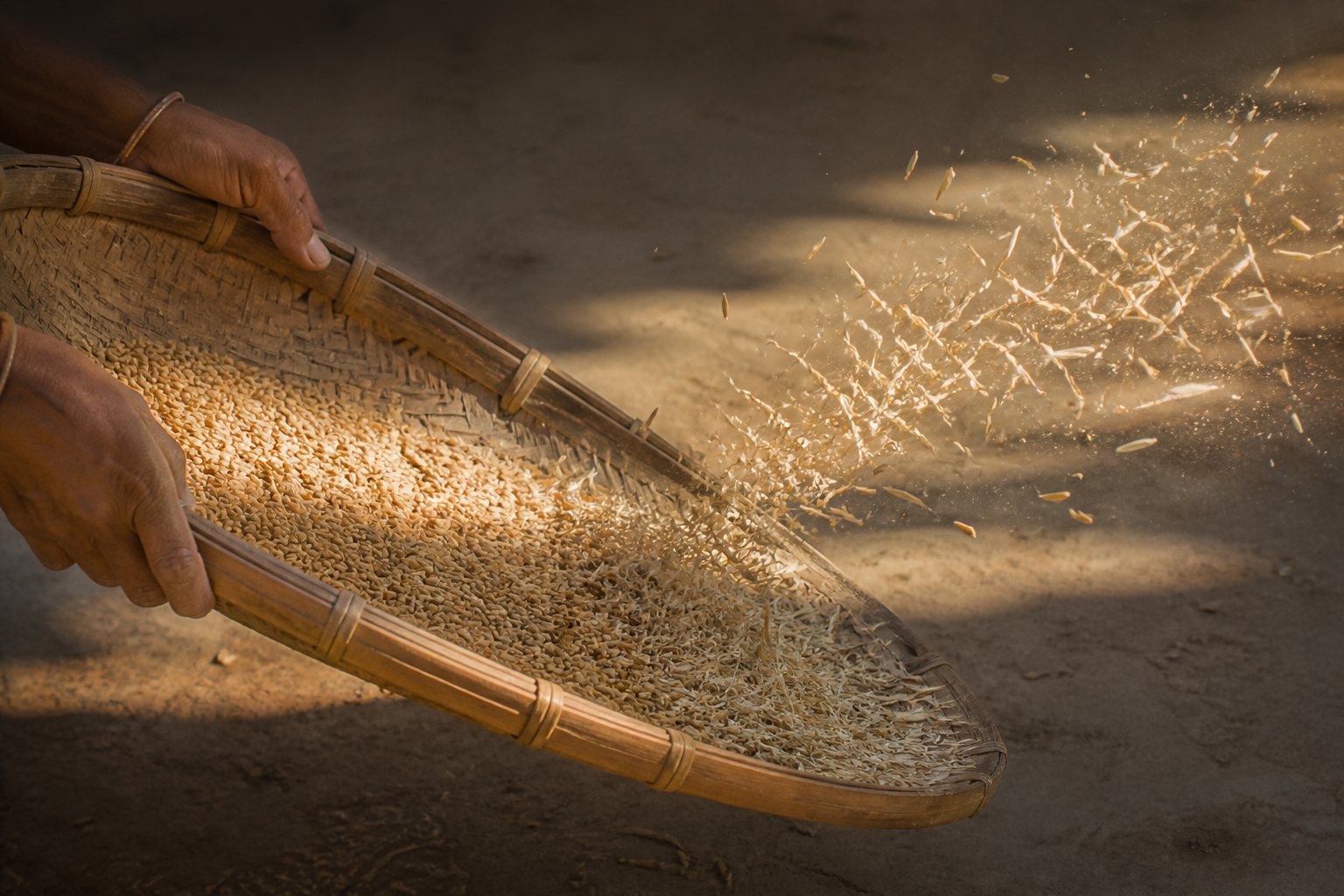
Surpanakha is the simplified Roman spelling of the Sanskrit Śūrpaṇakhā. The common Sanskrit parsing joins śūrpa, a winnowing basket used to separate grain from chaff, with nakha, meaning nail. The compound is therefore commonly understood as she whose nails resemble a winnow, or she of winnow-like nails.
The image combines different qualities. A nail suggests sharpness. A winnow suggests breadth and the repeated motion of sifting. Those associations may help you interpret the character’s disruptive arrival, but they are not additional words hidden inside the name. The literal meaning gives you an image; the narrative gives that image significance.
This is the first safeguard against overstatement. Surpanakha does not literally mean a woman without self-control, an embodiment of evil, or someone incapable of distinguishing dharma from adharma. Those are possible moral readings imposed on the image. They are not translations of the Sanskrit compound.
A careful explanation should therefore use two separate sentences: Surpanakha’s name commonly means that her nails are like a winnowing basket. The winnowing image can then be read as a symbol of discernment. Keeping translation and interpretation separate lets you appreciate the poetry without turning an interpretation into philological fact.
There is also a textual distinction worth preserving. In the Valmiki Ramayana, Surpanakha functions as a proper name. Some later regional and vernacular traditions call her Meenakshi and understand Surpanakha as a descriptive epithet. That variation does not justify declaring one usage universal. It shows how a memorable Sanskrit name can function both as identification and as characterization across a long retelling tradition.
The winnow creates an ethical irony
A winnow is an instrument of separation. Grain is distinguished from chaff; what nourishes is retained, while what does not is cast aside. In a moral reading, that ordinary agricultural act becomes an image of discrimination: the capacity to distinguish an impulse from a wise course of action.
Surpanakha’s conduct near Panchavati produces an irony. She bears the name of an instrument used for sorting, yet she enters the scene through sudden desire and agitation. The problem is not that an impulse appears. The ethical pressure lies in what happens when the impulse is not examined, when another person’s boundary is not accepted, and when rejection gives way to hostility.
The most fruitful symbolism is therefore not that Surpanakha herself is chaff. That reading reduces a character to something disposable and misses the more demanding lesson. The winnow is better understood as the faculty the situation requires. She needs to sift desire from entitlement, feeling from action, and injury from retaliation. The other participants, in turn, must sift necessary protection from excessive response.
This reversal gives the name its literary force. An object associated with orderly separation becomes attached to a scene of mounting confusion. Inner agitation disturbs the stillness of the forest. A personal encounter becomes a confrontation. The confrontation becomes an injury, and that injury helps carry the conflict outward.
You can test this symbolic reading at three levels:
- Lexical: Does the interpretation begin with the actual meanings of śūrpa and nakha?
- Narrative: Does the winnowing image illuminate something that happens at Panchavati, rather than importing an unrelated theory?
- Ethical: Does the reading sharpen your understanding of choice and consequence without pretending that a name predetermines a person’s conduct?
If a claim fails the first test, it is not a reliable etymology. If it fails the second, it may be an imaginative association but not a strong reading of the episode. If it fails the third, it risks using symbolism to replace moral thought rather than deepen it.
The Panchavati episode tests more than Surpanakha
It is easy to isolate one moment and make it carry the whole moral weight of the episode. A closer reading follows the sequence. Desire meets a boundary. The encounter involving Rama and Sita becomes a confrontation with Lakshman. Lakshman’s mutilation of Surpanakha then becomes part of the widening chain that draws Ravana into the conflict.
Following that sequence does not require you to pretend that every act is morally equivalent. It requires you to ask the right question at each transition:
- Desire: What does Surpanakha want, and has the desire been examined before it becomes action?
- Boundary: What refusal, commitment, dignity, or safety must be recognized even when the desire remains strong?
- Response: Once a boundary is threatened, what action is justified, and is the action proportionate to the danger?
- Aftermath: How do humiliation, anger, and the desire to retaliate enlarge a local encounter into a broader conflict?
This method prevents two common distortions. Calling Surpanakha nothing more than a villain erases the human experiences of rejection, humiliation, and anger that make the episode morally recognizable. Calling her nothing more than a victim erases her responsibility for how she handles desire and another person’s boundary.
The same balance applies to Lakshman’s action. Surpanakha’s conduct can be criticized while the proportionality of mutilation is still examined. Asking about intention, necessity, and consequence does not diminish the Ramayana’s sanctity. It treats the epic as a serious field of dharmic inquiry rather than a collection of characters who must be defended or condemned before their conduct is considered.
Empathy and accountability perform different tasks. Empathy helps you understand the inner movement from desire to humiliation and anger. Accountability asks which boundaries were crossed. Proportionality asks whether the answer to a wrong remained properly measured. Consequence shows how unresolved injury can recruit other people and powers into an expanding cycle. You do not have to discard any one of these lenses to use the others.
Use the name as a practice of discernment
The symbolism becomes useful when you stop treating the winnow as an ornament and begin using it as a reading practice. At every moment of friction, separate four things that are easily mixed together:
- Fact from projection: Identify what was actually said or done before adding assumptions produced by hope, fear, jealousy, or wounded pride.
- Desire from entitlement: Wanting something does not establish a claim over another person’s choice, affection, loyalty, or body.
- Protection from retaliation: A firm boundary may be necessary, but its purpose and proportion still matter.
- Immediate satisfaction from later consequence: Before acting in anger, ask what your response invites the other person to do next.
This is the practical force of Surpanakha’s name. The relevant question is not only whether you can separate grain from chaff in principle. It is whether you can do so while desire, fear, or humiliation is pressing for immediate action. Discernment matters most in the interval between feeling and response.
That discipline resonates across Dharmic traditions without making those traditions interchangeable. Ethical cultivation may be articulated through terms such as śīla and prajñā, ethical discipline and wisdom; ahimsa and aparigraha, non-harm and non-grasping; or satya and daya, truth and compassion. The doctrines and paths differ, but each vocabulary directs attention toward the training of perception, desire, speech, and action.
Restraint here should not be mistaken for weakness or passivity. A boundary can be clear and firm. The harder demand is to make the response serve dharma rather than wounded pride. Surpanakha’s episode remains unsettling because it asks whether clarity survives when several people are acting under pressure, not merely whether one character can be assigned the label of adharma.
Key takeaways
- Surpanakha, or Śūrpaṇakhā, is commonly parsed from śūrpa, a winnowing basket, and nakha, a nail.
- The literal name describes winnow-like nails. Discernment is a symbolic interpretation of the winnowing image, not part of the dictionary translation.
- The Valmiki Ramayana uses Surpanakha as a proper name, while some later traditions use Meenakshi and treat Surpanakha as an epithet.
- The symbolism is strongest when it follows the narrative sequence from desire to boundary, response, injury, and widening consequence.
- A balanced reading can hold Surpanakha accountable, understand her humiliation, and still question the proportionality and consequences of Lakshman’s response.
- The practical lesson is to separate fact from projection, desire from entitlement, protection from retaliation, and immediate reaction from later consequence.
When you next read the Panchavati scene, pause at each transition instead of rushing to the final conflict. Ask what needed to be winnowed at that moment and who failed to do it. Surpanakha’s name will then become more than a striking description: it will show you how the Ramayana turns a single word into a disciplined examination of dharma.

References
