
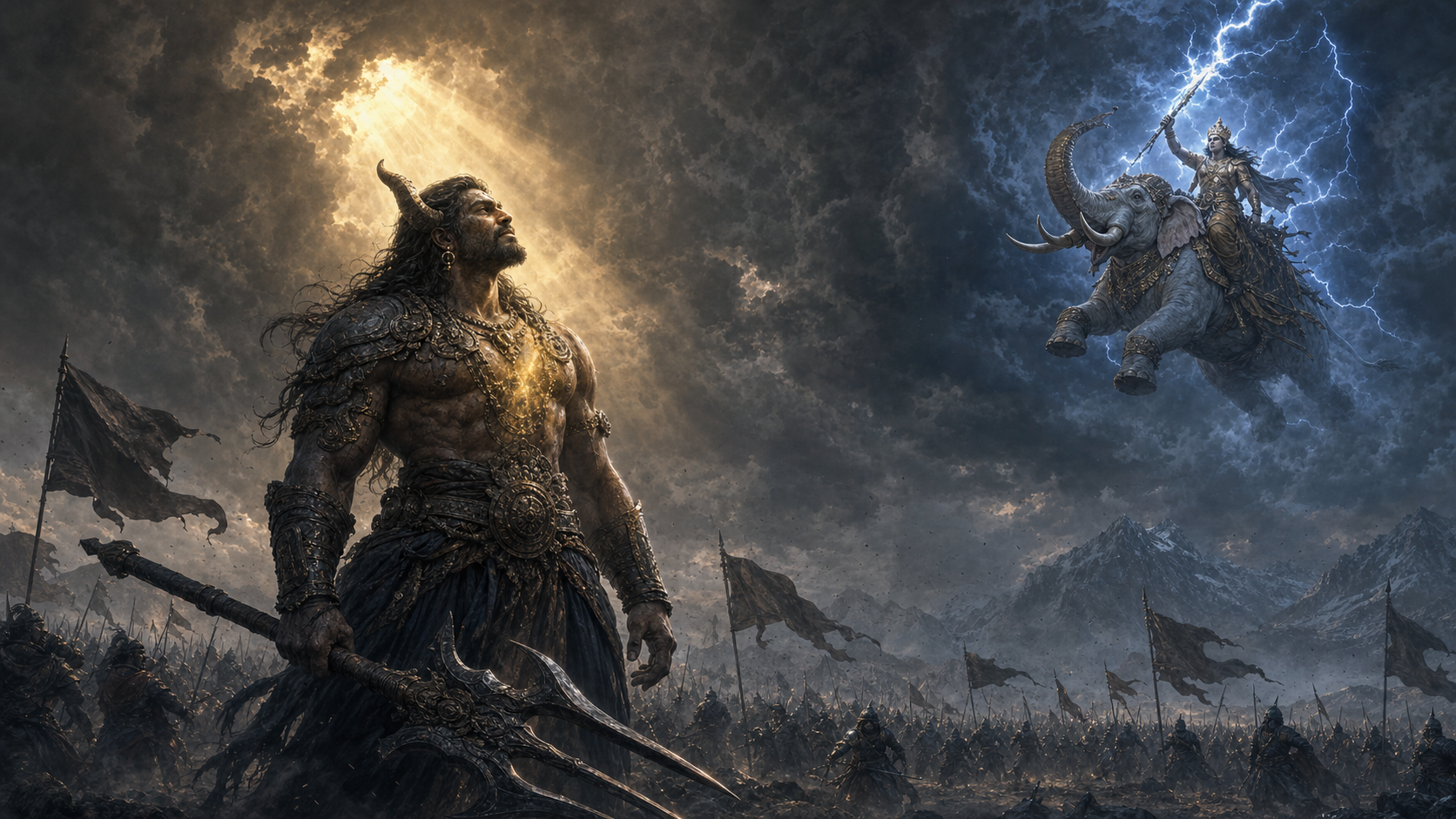
If Vritrasura was an asura, why does the Srimad Bhagavatam give him the spiritual clarity of an unwavering devotee? And why does Indra, the deva who defeats him, emerge from the battle carrying a moral burden?
The contradiction disappears once you stop treating deva and asura as a simple scoreboard of good and evil. Vritrasura’s katha distinguishes the role a being occupies, the actions that role involves, the inward direction of the heart, and the soul’s ultimate destination. That distinction can change how you judge another person, exercise authority, and face circumstances you didn’t choose.
The paradox begins before Vritrasura is born
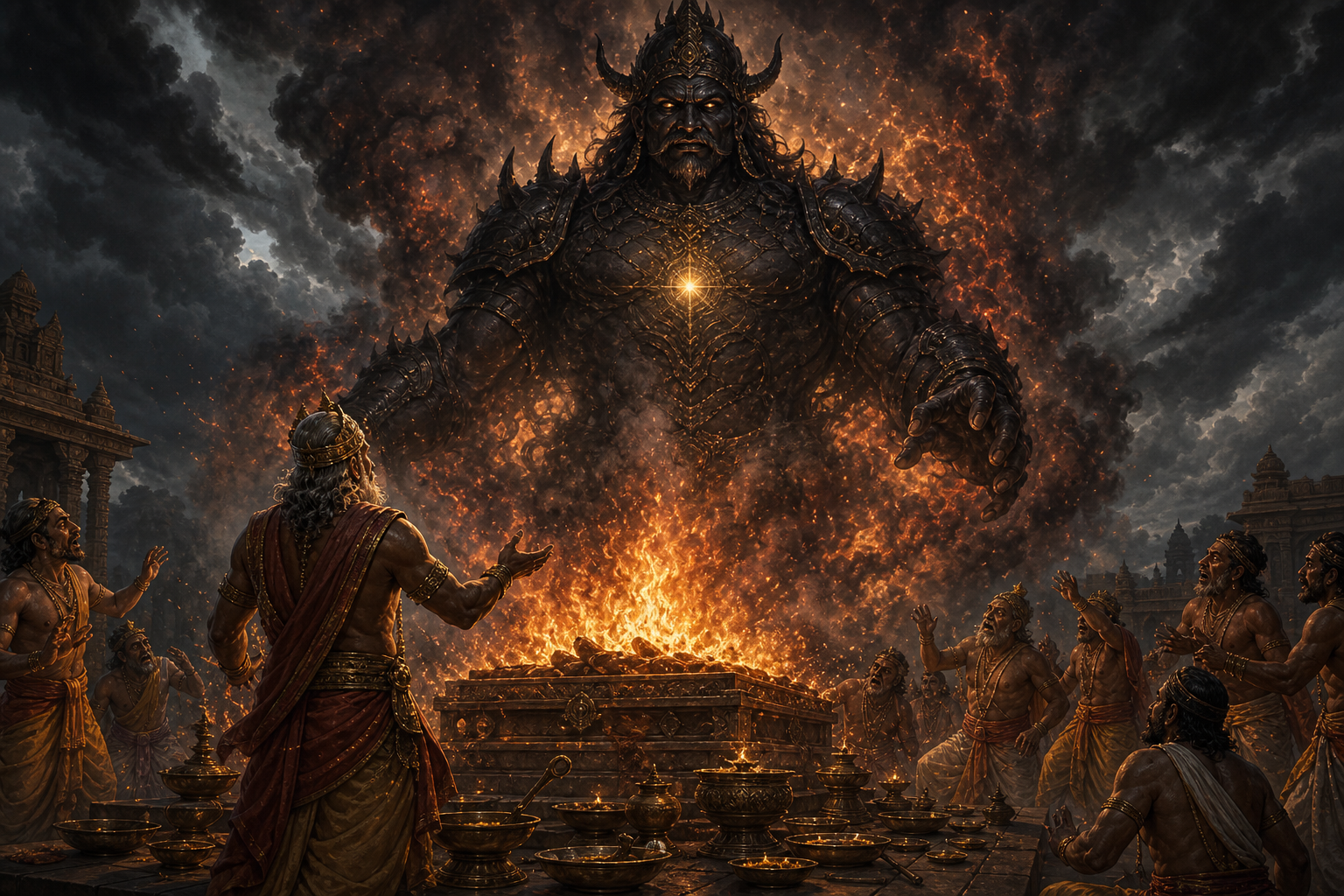
Vritrasura does not appear as an isolated villain. His birth belongs to a chain of actions and consequences. Indra, driven by political anxiety and suspicion, kills Vishwarupa, the spiritually accomplished son of Prajapati Tvashta. Tvashta responds by conducting a yajna intended to bring forth a being capable of defeating Indra. Vritrasura emerges from that sacrificial fire.
This sequence matters because Indra helps create the danger he later has to fight. Fear leads him to attack someone he mistrusts; that attack produces grief and retaliation; the retaliation produces Vritrasura. The apparent defender of cosmic order is therefore not morally detached from the disorder threatening it. If you enter the story only at the final battle, you miss the decision that made the battle necessary.
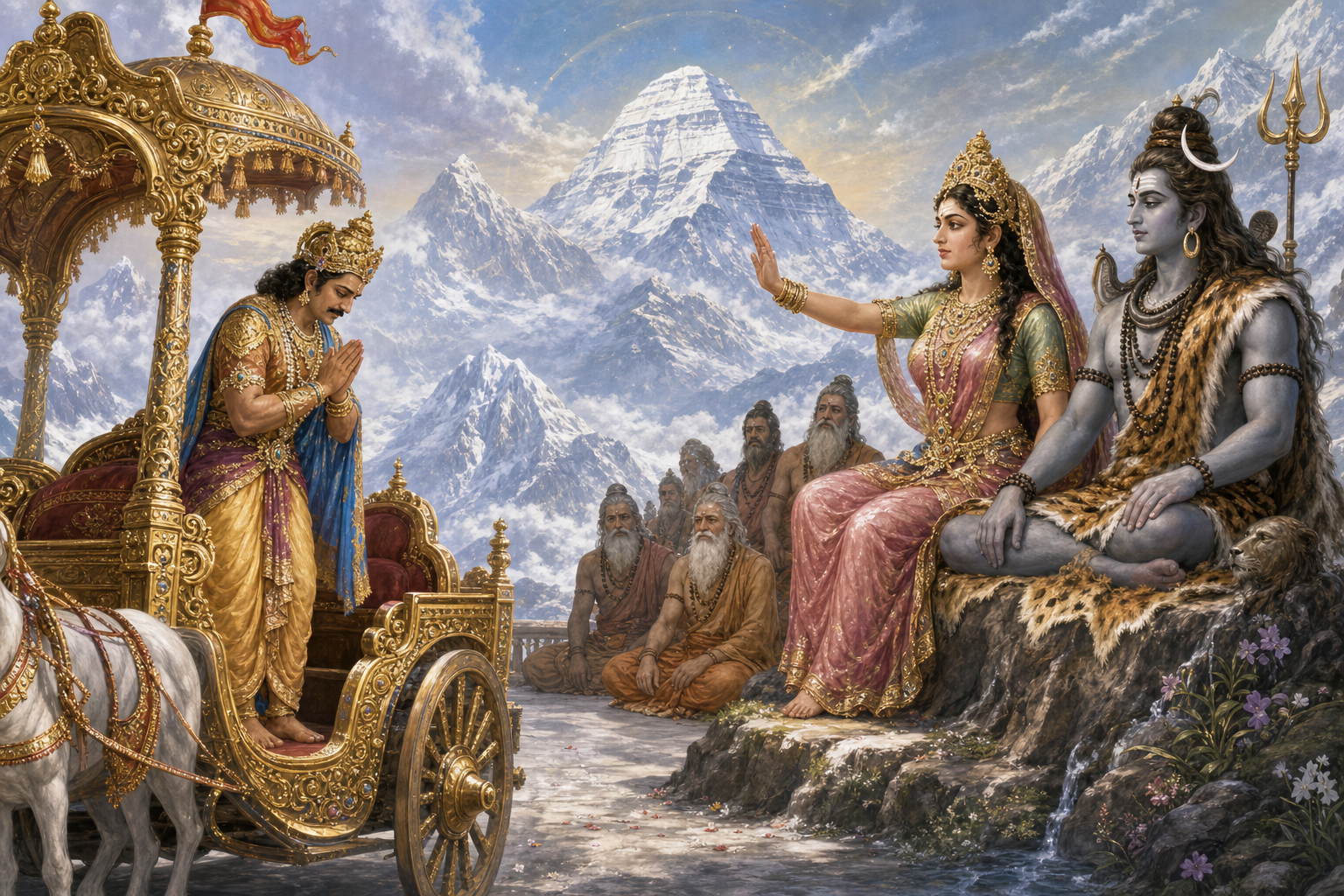
Vritrasura also has a history preceding his asuric birth. He is identified with King Chitraketu, whose encounter with Shiva and Parvati culminates in Parvati’s curse and his rebirth as an asura. His outward station changes dramatically, but his devotion is not erased. A karmically conditioned body and social identity do not tell you everything about the consciousness inhabiting them.
That is the first key to the paradox. Vritrasura is not spiritually significant because an evil being unexpectedly says something admirable. He is significant because a devotee has entered a destiny in which he looks like the enemy, fights as the enemy, and dies as the enemy. His appearance conceals his deepest allegiance.
During the battle, that allegiance becomes unmistakable. Vritrasura does not ask the Divine for victory, position, celestial pleasure, or protection from death. His longing is directed toward the Divine rather than the rewards devotion might bring. The battlefield exposes what he values when every lesser security is being stripped away.
Destiny sets the conditions, not the measure of the soul
It is tempting to read destiny as fatalism: a curse determines a birth, a birth determines a side, and the side determines whether someone is righteous. Vritrasura’s life breaks that sequence. His circumstances are conditioned, but the narrative does not equate those circumstances with his ultimate spiritual identity.
- Inherited conditions: Chitraketu enters an asuric birth as a consequence of a curse. He does not choose the form in which the next stage of his journey begins.
- Consequences already in motion: Indra’s killing of Vishwarupa and Tvashta’s retaliatory yajna create the conflict Vritrasura enters.
- Present orientation: In the midst of that conflict, Vritrasura directs his mind toward the Divine rather than toward survival or dominion.
- Ultimate destination: His military defeat does not prevent liberation. The condition of his heart, rather than the label attached to his body, determines the deeper outcome.
This does not prove that circumstances are irrelevant. Vritrasura still has to inhabit his asuric role, meet Indra in battle, and undergo death. Dharma does not promise that inward clarity will immediately dissolve outward consequences. It shows instead that consequences need not own your consciousness.
You can apply that distinction without pretending to possess Vritrasura’s spiritual stature. A family history, professional role, hostile environment, public label, or past mistake may constrain what happens next. None of them automatically decides what you must worship inwardly: status, resentment, fear, comfort, or truth. The freedom highlighted here is not unlimited control over events. It is the possibility of maintaining a worthy orientation within events you cannot fully control.
Tvashta’s yajna adds a second warning. In Vedic ritual, sound, intention, and execution have consequences; sacred action is not an empty performance. The practical lesson is larger than ritual technique. When you make a vow, issue an order, define an enemy, or authorize force, your words direct action beyond the moment of speaking. Precision is therefore an ethical discipline. Before making a consequential declaration, ask whether your wording expresses what dharma requires or merely gives anger a sacred appearance.
Vritrasura loses the battle but reaches the greater destination

The devas cannot overcome Vritrasura through ordinary strength. Vishnu directs them to the sage Dadhichi, whose bones can provide the material for Indra’s vajra. Dadhichi willingly gives up his body, allowing the weapon to be made. Indra then uses it to kill Vritrasura.
Calling Indra the winner is correct only at the military level. The katha presents several kinds of success at once:
- Indra achieves the immediate objective by defeating the threat facing the devas.
- Dadhichi embodies voluntary sacrifice by giving what no ordinary donation could replace.
- Vritrasura demonstrates devotion without bargaining and attains liberation after death.
- Indra survives, yet must undergo penance for the moral burden connected with the killing.
These outcomes should not be compressed into a new, equally simplistic verdict in which Vritrasura becomes the hero and Indra becomes the villain. Vritrasura’s devotion does not make his military threat unreal. Indra’s duty to resist that threat does not make every action in the causal chain pure. The power of the katha lies precisely in its refusal to make tactical necessity, personal virtue, and spiritual attainment identical.
The Rigvedic layer emphasizes Indra’s defeat of Vritra, the breaking of obstruction, and the release of life-giving waters. The Bhagavatam places unusual weight on the combatants’ inner and ethical condition. These are not mutually exclusive lessons. One asks whether the obstruction is overcome; the other asks what the struggle reveals about everyone involved.
That gives you a better way to assess success. After a difficult decision, do not ask only, “Did I get the result?” Ask what means produced it, who paid for it, what disposition it strengthened in you, and what responsibility remains afterward. A necessary result can carry moral residue. An outward defeat can reveal inward freedom.
Indra’s victory places power under moral accounting
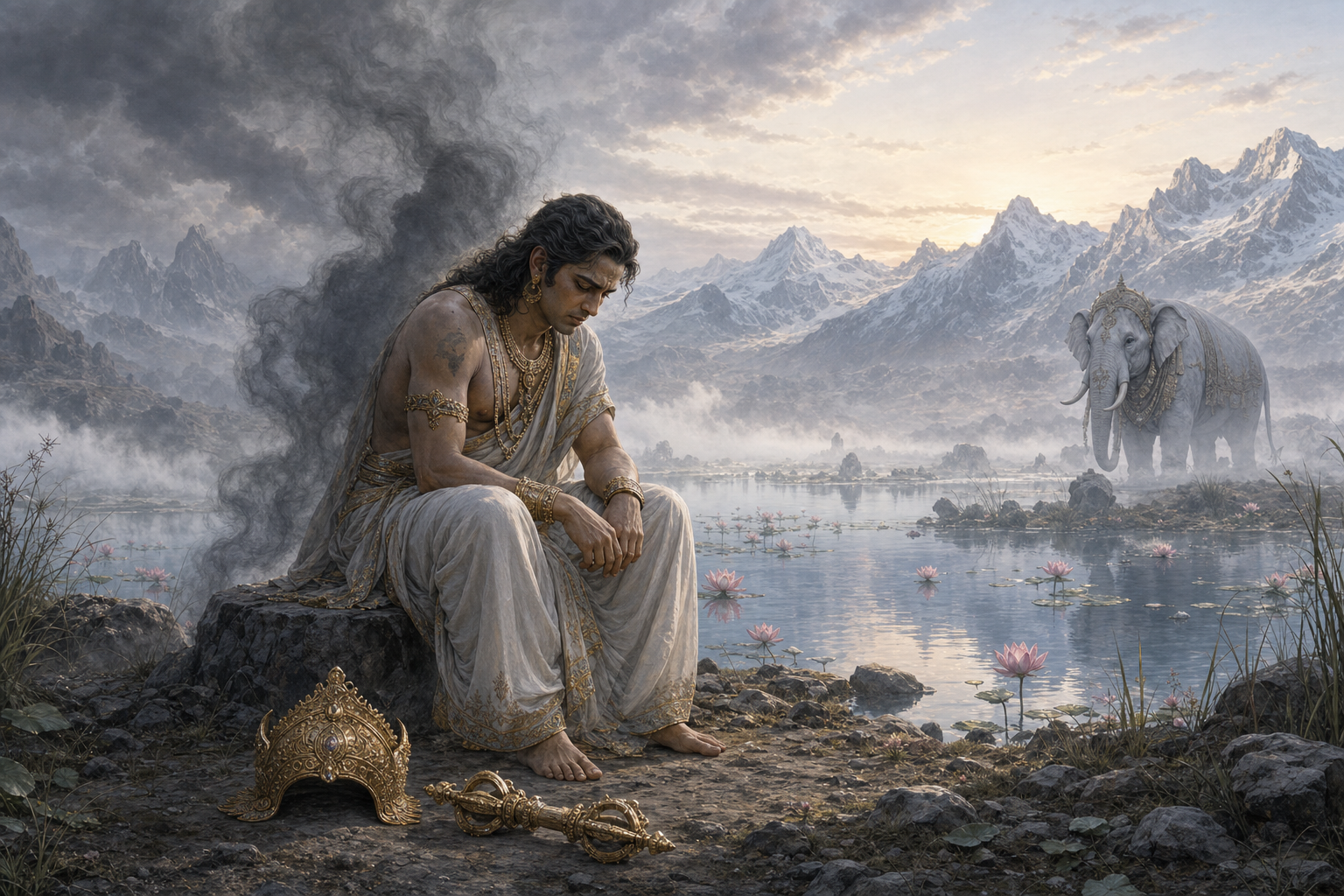
Indra’s predicament begins with suspicion. He sees Vishwarupa as a political risk and acts violently before that anxiety has been governed by restraint. The decision does not remain private. It spreads outward through Vishwarupa’s death, Tvashta’s grief, Vritrasura’s creation, the devas’ defeat, Dadhichi’s sacrifice, and the final battle.
This is a severe lesson for anyone who holds authority. Power magnifies the distance travelled by an unmastered fear. A leader’s suspicion can become another person’s punishment, a community’s conflict, and eventually a crisis presented as unavoidable. When that happens, defeating the crisis does not erase the original failure of judgement.
Nor should Dadhichi’s sacrifice be used to romanticize the sacrifice of others. His willingness is the moral center of the act. He offers his own body; he is not selected by someone else as an expendable resource. If you invoke duty to ask another person to bear a cost, distinguish clearly between voluntary service and sacrifice imposed by those who will remain safe.
Indra’s penance establishes another boundary around power: accountability continues after a justified objective has been achieved. The restoration of order does not provide retroactive innocence. Even when force becomes necessary, the means, intention, and moral aftermath still require scrutiny.
For a consequential decision, write one sentence in answer to each of these questions before you act:
- What duty am I actually trying to fulfil? Name the obligation, not the fear or personal advantage accompanying it.
- What action created or intensified this problem? Include your own contribution instead of beginning the story where you became the defender.
- Who will bear the cost? Identify whether that burden is voluntary, informed, and fairly shared.
- Which means remain unacceptable? A righteous end does not sanctify suspicion, deception, humiliation, or needless harm.
- What accountability will remain if I succeed? Decide in advance what repair, disclosure, penance, or restraint the outcome may require.
This short audit will not make every dharmic choice obvious. It will make it harder to disguise anxiety as duty or victory as innocence.
Use Vritrasura’s test before your next difficult choice
Vritrasura’s devotion becomes visible under extreme pressure, but the lesson is not to wait for a crisis and hope for sudden spiritual clarity. Pressure usually reveals the attachments already being practised. If you repeatedly choose status, vindication, or control in small matters, a larger conflict is unlikely to produce detachment by itself.
You can begin with a simple distinction between identity and conduct. When you catch yourself reducing someone to a label, replace the label with the action you can actually evaluate. “He is bad” becomes “He broke this commitment.” “She is against us” becomes “She opposed this proposal.” This does not excuse adharma. It prevents you from pretending that one visible role reveals the whole person.
Apply the same discipline to yourself. Your position in a conflict does not certify your motives. Being on the institutionally correct side, defending a legitimate interest, or opposing a genuine wrong may establish what you must do. It does not establish that pride, fear, and vengeance are absent from how you do it.
Then test your devotion by subtraction. Ask: if this decision costs recognition, comfort, victory, or control, what commitment remains? Vritrasura’s prayerful orientation matters because he seeks the Divine when battlefield survival is slipping away. Devotion that depends entirely on receiving the preferred outcome is still a negotiation with circumstance.
The katha can also speak across Dharmic traditions without erasing their distinct teachings. Restraint, self-mastery, courageous service, accountability, and freedom from attachment are recognizable concerns across Hindu, Buddhist, Jain, and Sikh paths. That ethical resonance does not require claiming that their accounts of the soul, karma, devotion, or liberation are interchangeable. Respect grows through careful recognition, not doctrinal flattening.
Key takeaways
- An outward identity such as deva or asura does not, by itself, disclose a being’s complete spiritual condition.
- Destiny may determine the field of struggle without determining what you value within that struggle.
- Military success, ethical conduct, voluntary sacrifice, and spiritual attainment are different measures of victory.
- A necessary use of power can still leave duties of accountability, repair, and penance.
- Judge conduct precisely, but do not turn a role, faction, body, or past mistake into a final judgement on the soul.
When your next hard choice arrives, begin with four lines: name your duty, your contribution to the problem, the means you will refuse, and the attachment you are prepared to surrender. That is where Vritrasura’s paradox stops being an intriguing story and becomes a discipline for living within destiny without being inwardly ruled by it.
References
