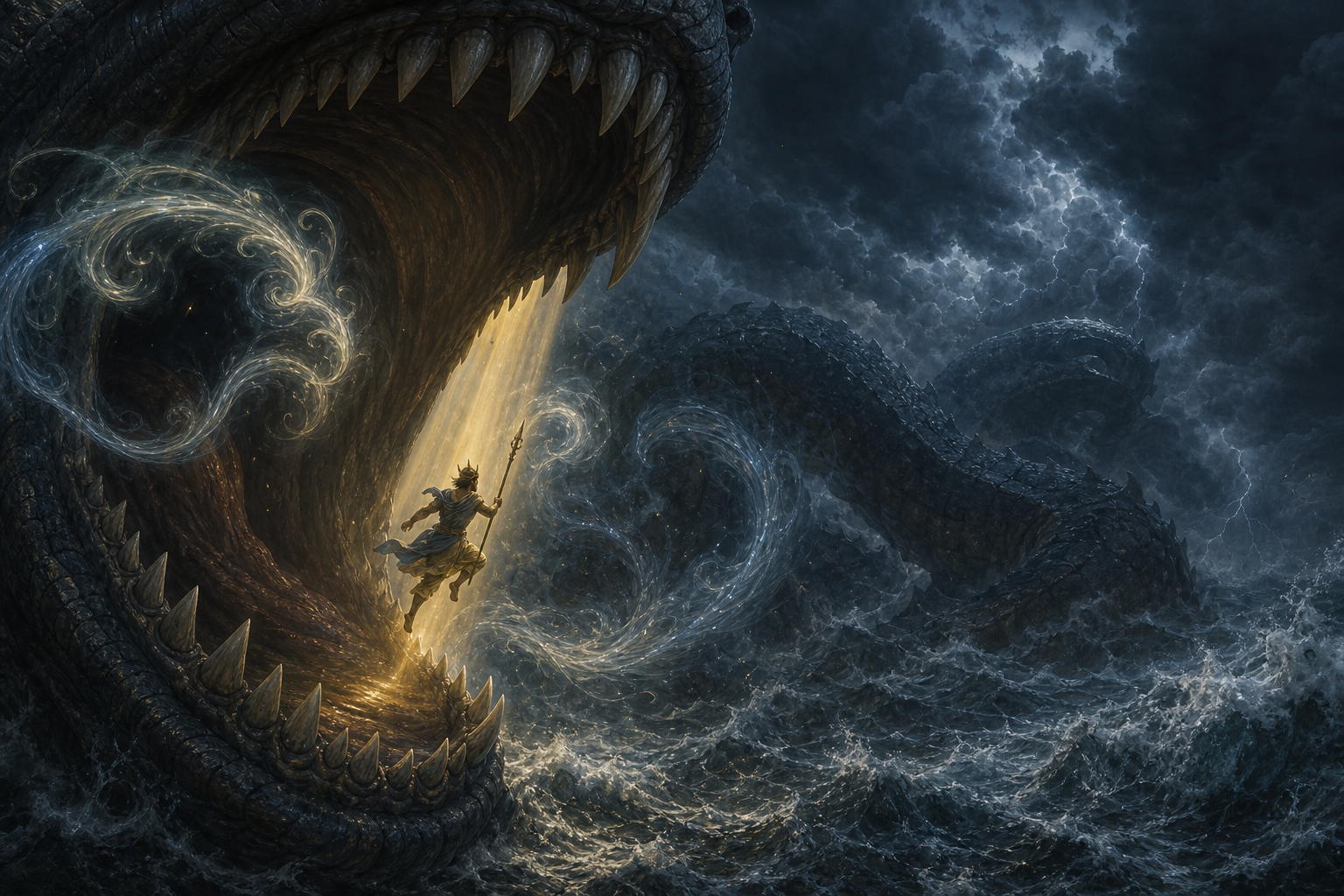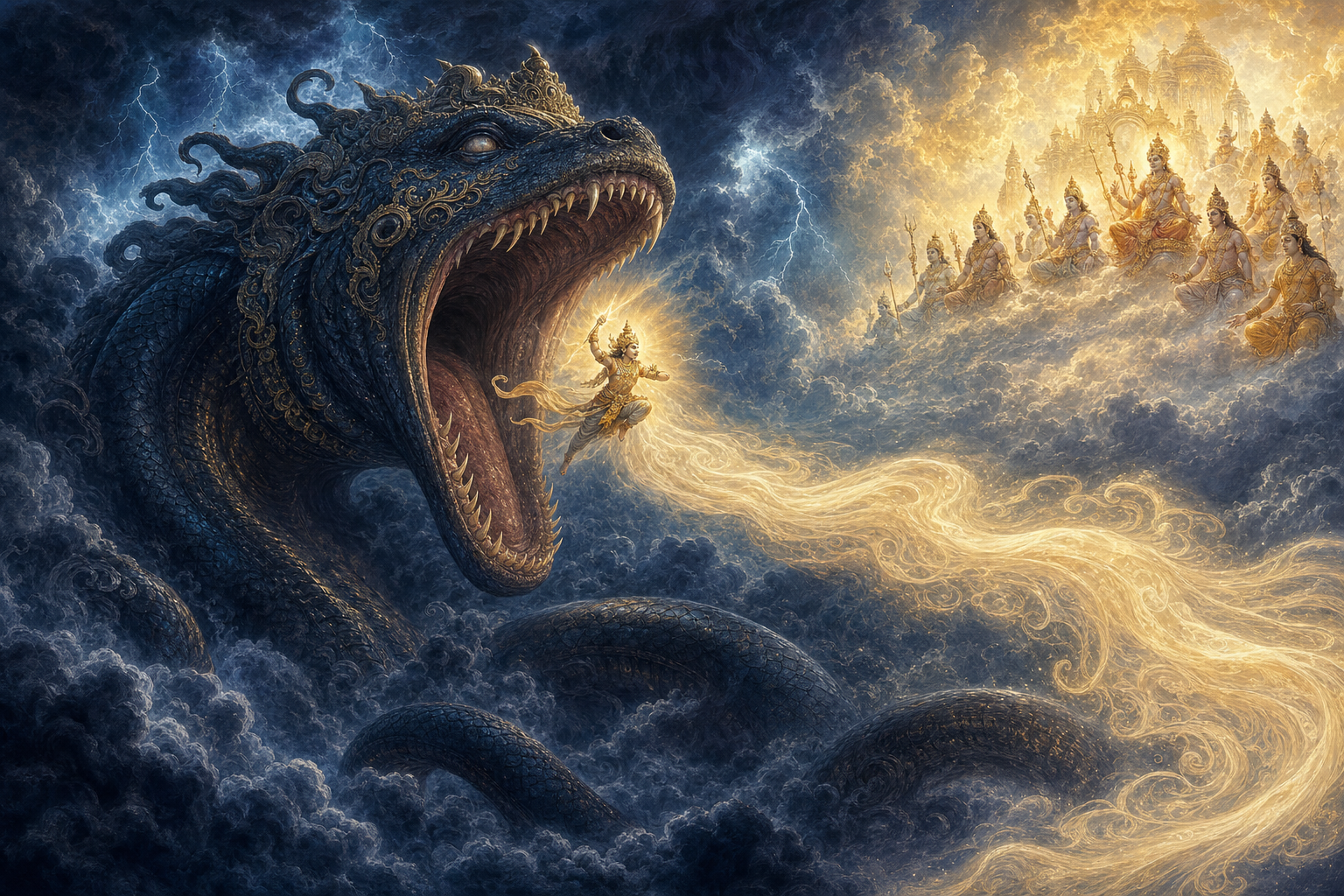
In the Mahabharata, yawning enters the lives of embodied beings through a moment of divine peril. Vritra has swallowed Indra, the ruler of the Devas, and the gods create Jṛmbhikā, the power of yawning, to open the captor’s mouth long enough for Indra to escape.
The episode is more illuminating when read as more than an unusual explanation for a familiar reflex. Its wider narrative connects yawning with threatened authority, the misuse of power, adaptation under pressure, and the difficult passage from survival to genuine restoration.
The instant yawning enters the cosmic story
The DharmaRenaissance account locates the decisive passage in the Udyoga Parva, commonly numbered Mahabharata 5.9.47–48 in Sanskrit editions and Section IX in the English prose translation associated with Kisari Mohan Ganguli. Edition and transliteration differences can produce forms such as Vṛtra or Vritra and Jṛmbhikā or Jrimbhika without indicating different figures.
During his battle with Vritra, Indra is seized and swallowed. The other gods, bewildered by his disappearance, do not immediately overpower Vritra. They instead create Jṛmbhikā. When Vritra yawns and his mouth opens, Indra draws his limbs together, makes himself compact, and passes through the opening. The passage then says that Jṛmbhikā came to dwell among living creatures throughout the worlds.
This is a sacred literary etiology: a narrative that gives an everyday feature of life a meaningful cosmic beginning. It is not presented as a modern physiological account of why bodies yawn. Its explanatory work is literary, moral, and theological, placing an involuntary bodily act within a story about danger and deliverance.
Why the conflict begins before Vritra is born
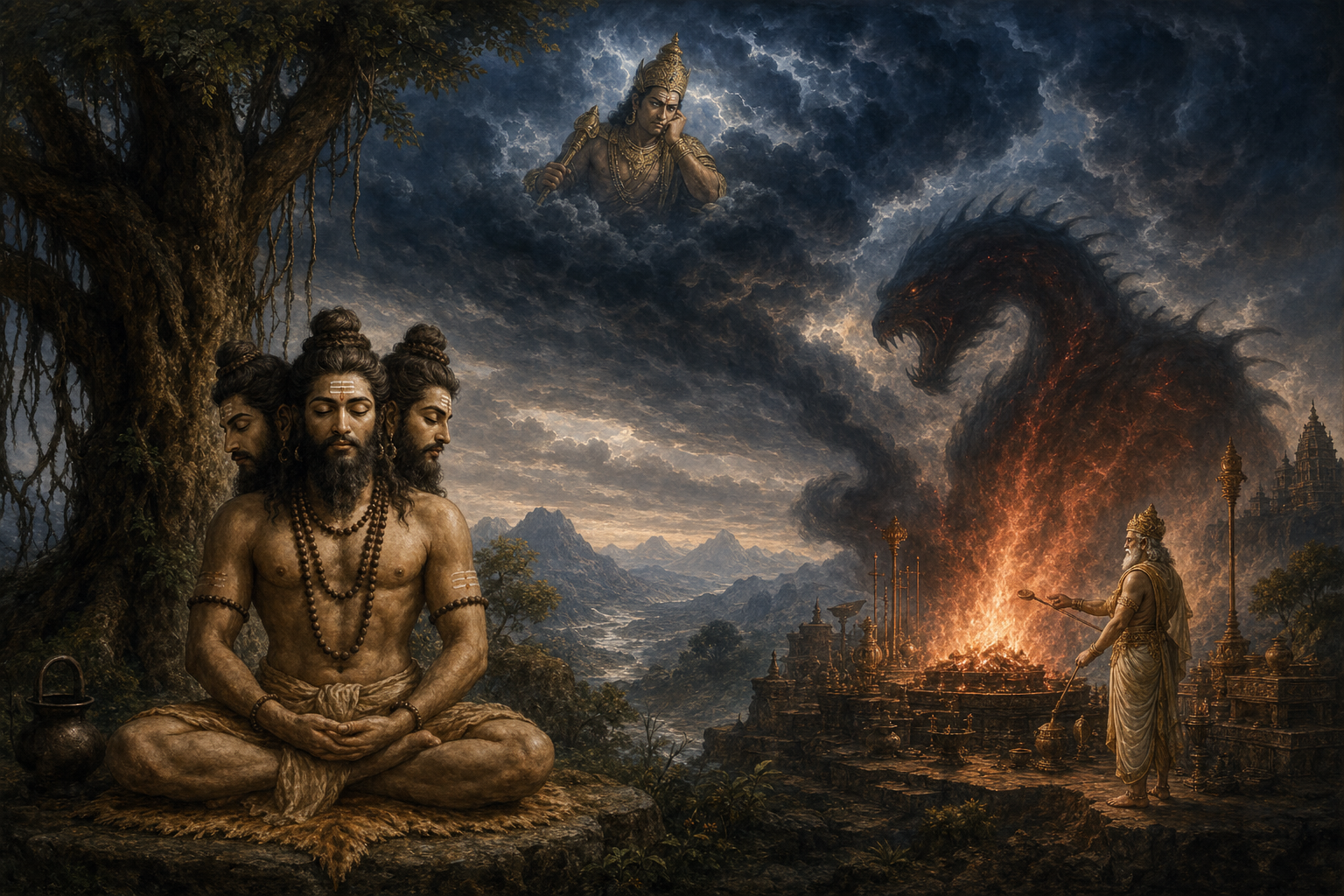
The meaning of Indra’s confinement depends on the events that precede it. According to the source account, Tvaṣṭṛ’s three-headed son Triśiras, also identified there as Viśvarūpa, undertakes severe austerities. He is portrayed as disciplined and restrained, but his growing ascetic power alarms Indra, who fears a challenge to his celestial position.
Indra first sends celestial nymphs to disrupt the ascetic’s discipline. When that effort fails, he kills Triśiras with the Vajra and subsequently persuades a reluctant carpenter to sever the fallen figure’s three heads. The carpenter raises the moral gravity of killing a Brahmana, but Indra promises protection and a ritual share in exchange for compliance.
Vritra therefore does not appear as an uncaused interruption of an otherwise orderly world. Tvaṣṭṛ creates him through a rite after learning of his son’s death and commands him to grow through ascetic power and kill Indra. The source also connects the name Vṛtra with a Sanskrit root suggesting covering, enclosing, or obstruction. In this epic episode, that idea becomes bodily and immediate: Vritra encloses Indra within himself.
This background complicates any simple division between an innocent divine ruler and an inexplicably hostile adversary. Indra is endangered within a chain of consequences that his own fear and violence helped initiate. His eventual rescue does not erase that responsibility.
Jṛmbhikā creates an opening, not a complete victory
Jṛmbhikā is related to the Sanskrit verbal root jṛmbh, associated with yawning, gaping, opening the mouth, or stretching. The feminine noun allows yawning to appear not merely as an action but as an active, almost personified power created for a specific crisis.
The mechanics of the rescue are as important as the marvel itself. Vritra’s yawn produces an opening, but Indra must recognize it and alter his own posture to use it. He does not escape by expanding his strength or breaking his prison. He survives by contracting his limbs. The episode consequently joins divine assistance with adaptive action: help makes freedom possible, while disciplined responsiveness converts possibility into escape.
The source stresses a frequently lost distinction: the yawn does not kill Vritra. Although Jṛmbhikā is called destructive of Vritra in the cited passage, its immediate narrative effect is Indra’s release. The battle resumes, Vritra again gains the advantage, and Indra retreats. Final victory belongs to a longer process of deliberation and cooperation rather than to the escape alone.
That sequence separates three conditions often treated as identical: avoiding destruction, overcoming an adversary, and recovering stable authority. Indra achieves only the first when he leaves Vritra’s jaws. The legend thereby resists the comforting fiction that one ingenious intervention resolves every consequence of a crisis.
Why Shalya tells the story to Yudhishthira
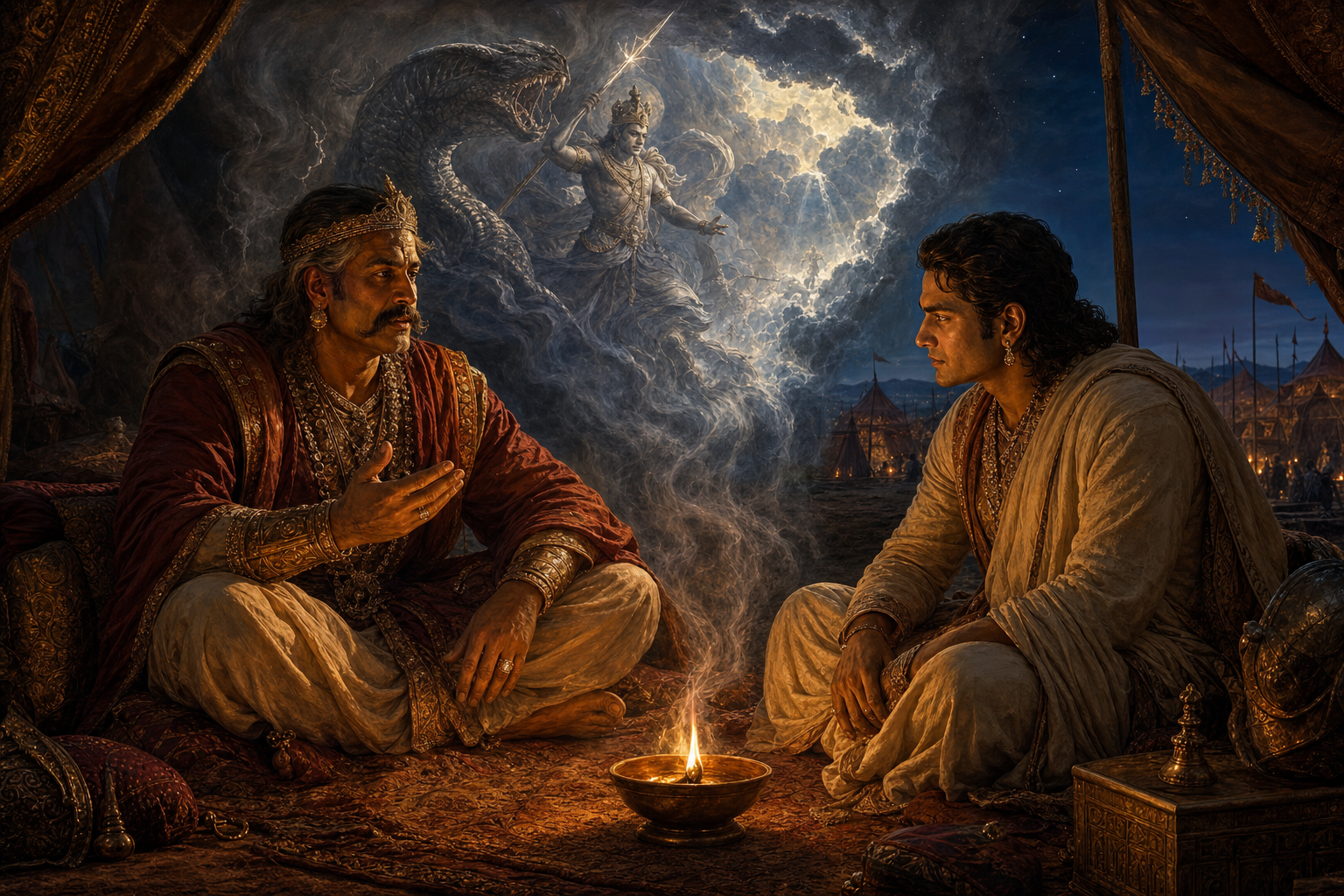
The episode appears inside a political and emotional conversation before the Kurukshetra conflict. The source reports that Shalya, king of Madra and maternal uncle of Nakula and Sahadeva, had intended to support the Pandavas. Duryodhana secretly arranged lavish hospitality along Shalya’s route, prompting the pleased king to offer a boon before learning the identity of his host. Duryodhana then claimed Shalya’s military support.
Although Shalya considers himself bound by his word, his affection remains with the Pandavas, and he later agrees to assist them indirectly while serving as Karna’s charioteer. In his exchange with Yudhishthira, however, his immediate concern is not battlefield technique. He addresses the suffering endured by Yudhishthira, Draupadi, and the Pandavas through exile, humiliation, and concealment.
Shalya introduces Indra’s ordeal as an ancient history showing that even a powerful ruler can be trapped, displaced, and apparently defeated. The comparison does not promise that distress will disappear quickly. Indra escapes the jaws only to face further reversals. Its consolation is therefore demanding rather than sentimental: present powerlessness need not be permanent, but restoration may require endurance, adjustment, cooperation, and continued moral reckoning.
What the origin story invites readers to notice
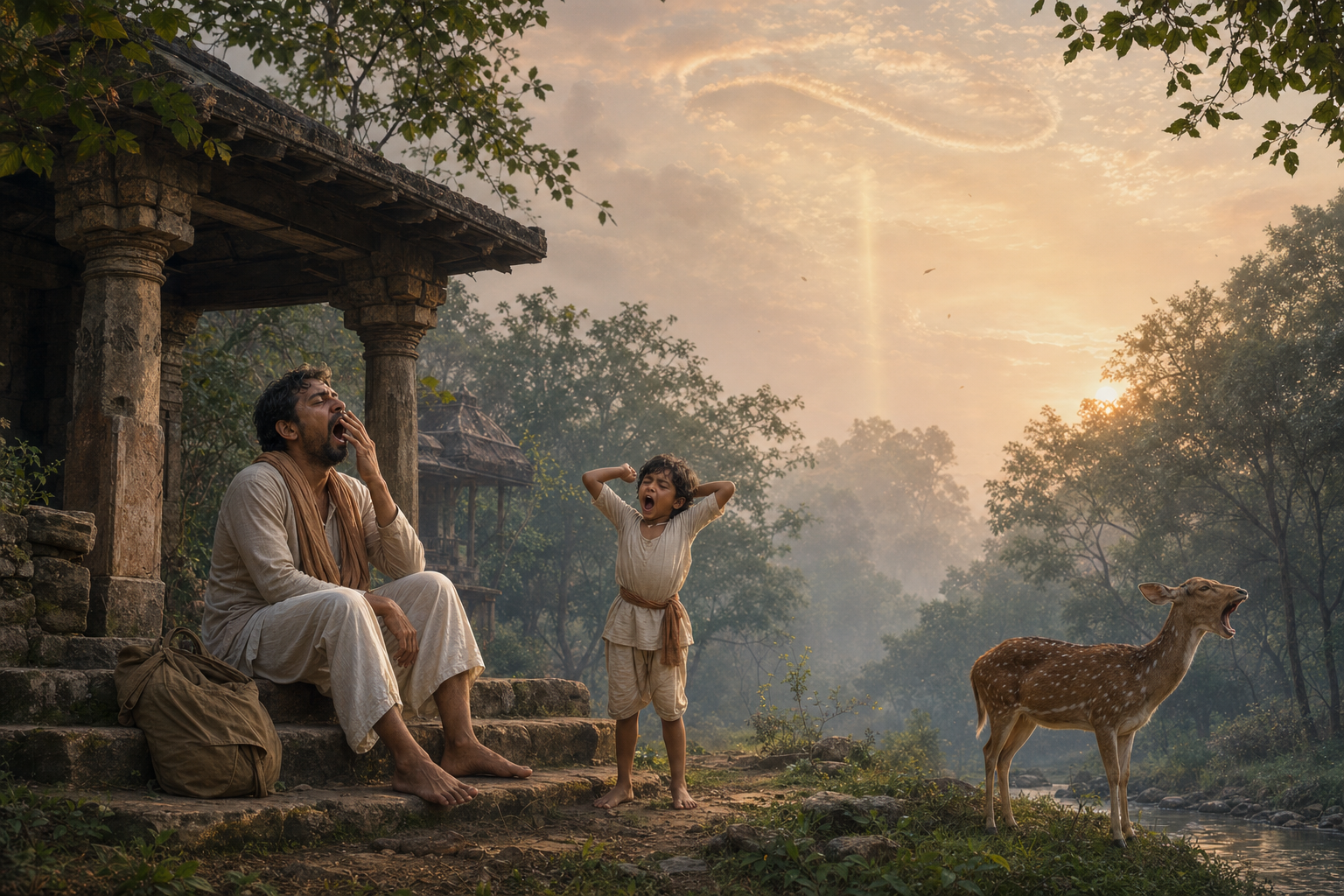
The legend can be read respectfully without turning scripture into a scientific textbook. Its enduring question is not which biological mechanism produces a yawn, but why the epic makes that humble action the hinge between confinement and renewed possibility.
Key takeaways
- The Mahabharata account presents Jṛmbhikā as the divinely created power that causes Vritra’s mouth to open after he swallows Indra.
- Indra’s compact movement through the opening makes adaptation, not overwhelming force, the immediate means of survival.
- The yawn enables escape but does not defeat Vritra or end the wider conflict.
- Vritra’s creation follows Indra’s fear-driven killing of Triśiras, placing the crisis within a chain of moral consequences.
- Shalya tells the history to help Yudhishthira understand that severe reversals can be endured without being mistaken for the final outcome.
Read in its full frame, the origin of yawning becomes an invitation to watch for small openings without confusing them with finished victories. Its future relevance lies in that disciplined distinction: survival can begin in an instant, while restoration remains a longer ethical task.