

When fear takes hold, your mind usually makes one demand: secure the future before you can be at peace. But the future cannot be secured in that way. Relationships change, plans fail, possessions pass to other hands, and the body itself remains within time.
Vedic wisdom offers something more durable than reassurance. It teaches you to see what fear is protecting, notice how Māyā distorts that perception, and act from devotion rather than panic. Liberation begins not when uncertainty disappears, but when uncertainty no longer decides who you are or how you will live.
Fear grows when the temporary is treated as ultimate

Ordinary fear has a practical function. If danger is present, you should notice it and respond. The deeper problem begins when fear becomes an unquestioned account of reality: if this role ends, my life has no value; if this person leaves, I cannot be whole; if this plan fails, everything is lost.
Māyā is crucial here. It is not merely a label for the world, nor an excuse to dismiss suffering as unreal. It is the power by which perception becomes veiled and the relative appears absolute. Under that veil, you confuse what you presently possess with what you fundamentally are. A threatened circumstance then feels like a threatened self.
Avidyā, or ignorance, keeps this confusion intact. Vidyā, or insight, begins to loosen it. You may still value your work, family, health and responsibilities, but you stop asking them to provide an identity that no changing condition can sustain. This distinction is practical: care deeply for what has been entrusted to you without pretending that you can hold it outside time.
Kāla makes the lesson unavoidable. Past, present and future continually alter the conditions around you. Within the prayers of the personified Vedas, Māyā, the wheel of time, devotion and liberation belong to one spiritual diagnosis. Worldly arrangements remain exposed to change, while consciousness can be reoriented toward the Supreme.
The first useful question, therefore, is not simply, “How do I stop feeling afraid?” Ask instead: “What temporary thing am I treating as the final basis of my safety?” Naming it does not immediately remove the fear. It does reveal the attachment through which fear is governing you.
Liberation changes your relationship with fear

Mokṣa is often imagined as a distant condition reached after every worldly difficulty has ended. That picture can make spiritual practice feel irrelevant to the fear in front of you. The Vedic movement toward liberation begins much closer: ignorance gives way to discernment, discernment matures into devotion, and devotion relocates the centre of life from anxious self-preservation to loving service.
This does not mean a devotee becomes emotionally numb. Grief can still hurt. A real threat can still require immediate action. Responsibility does not disappear. What weakens is existential fear: the conviction that a change in material circumstances can destroy the deepest truth of your being or sever your relation to the Divine.
Bhakti matters because intellectual analysis alone rarely steadies the heart. You can understand impermanence and still live as though everything depends on your control. Devotion turns an idea into a relationship. Through remembrance, mantra-japa and seva, attention repeatedly moves away from the isolated ego and toward the Supreme. Trust is cultivated through practice rather than demanded as a mood.
Key takeaways
- Māyā magnifies fear by making a temporary condition appear to be your ultimate identity or security.
- Kāla cannot be defeated by arranging circumstances perfectly; everything within worldly existence remains subject to change.
- Vidyā helps you distinguish what is passing from what deserves ultimate trust.
- Bhakti converts discernment into lived steadiness by directing attention toward remembrance and service.
- Fearlessness is not denial of danger. It is freedom from allowing fear to become the ruler of consciousness.
Use fear as a prompt for remembrance and right action

A frightened mind tends to do one of two things: rehearse an imagined future or reach for immediate control. Neither response reliably tells you what the present moment requires. A short spiritual sequence can interrupt that momentum without pretending the problem has vanished.
- State the fear plainly. Complete the sentence, “I am afraid that…” Avoid turning it into a general verdict such as “Nothing is safe.” Name the event you fear.
- Identify the threatened attachment. Ask what the feared event seems to take from you: status, approval, comfort, control, companionship or a particular vision of the future.
- Place it within kāla. Recognise that the circumstance has changed before, is changing now or will change later. This is not pessimism. It is an honest refusal to demand permanence from what belongs to time.
- Return attention to the Divine. Use the mantra, prayer or form of remembrance proper to your sampradāya. The purpose is not to force a pleasant feeling but to recover the centre from which you intend to act.
- Choose one act of dharma or seva. Make the necessary call, tell the truth, fulfil the duty, help the person in front of you or refrain from the impulsive act that fear is urging. Service restores agency without feeding the illusion of total control.
- Release the result you cannot command. Act carefully, then stop treating repeated mental rehearsal as additional action. Concern can guide a duty; rumination only imitates control.
This sequence also prevents a common misuse of spirituality. “It is all Māyā” should never become a reason to neglect danger, tolerate injustice or abandon a legitimate responsibility. Discernment separates the action that is yours from the outcome that never was. Bhakti strengthens your capacity to do the former while surrendering your claim over the latter.
Seva is especially useful when fear has made your attention contract around yourself. Helping another person does not erase your difficulty, but it breaks the assumption that you must first feel completely safe before you can live meaningfully. You can serve while uncertain. That discovery is one form of freedom.
Dharmic traditions share an aim without becoming identical
Hindu, Buddhist, Jain and Sikh paths do not use interchangeable doctrines. Their understandings of self, liberation, karma, Divine reality and spiritual authority must be allowed to retain their integrity. Yet each gives you a disciplined way to loosen the bond between deluded perception and fear.
- Within Hindu bhakti traditions, insight into Māyā is joined to loving service of the Supreme. Knowledge exposes misidentification; devotion gives consciousness a positive object of trust; mokṣa names release from bondage and the cycle of birth and death.
- Within Buddhism, careful attention to impermanence and the practice of non-clinging weaken the demand that changing conditions remain fixed. The practical question becomes whether grasping is adding another layer of suffering to what is already occurring.
- Within Jainism, liberation is approached through the purification of karmic accretions and the reduction of moha, or delusion. Fear can be examined as part of the attachment and reactivity that keep the soul bound.
- Within Sikhism, Māyā is understood within Hukam, while Naam simran steadies attention in remembrance. The practitioner learns to live responsibly within change without making worldly possession or status the final ground of identity.
The family resemblance is practical, not a claim that every path says the same thing. Delusion narrows consciousness. Disciplined insight reveals instability and attachment. Sustained practice reduces reactivity. Freedom becomes possible as the practitioner ceases to obey every movement of fear.
If you already belong to a tradition, depth is usually more useful than collecting techniques. Let your own lineage determine the mantra, contemplative discipline and theological frame. Learn from neighbouring Dharmic traditions with respect, but do not flatten their practices into interchangeable methods for feeling calm.
Build a rhythm that remains available under pressure
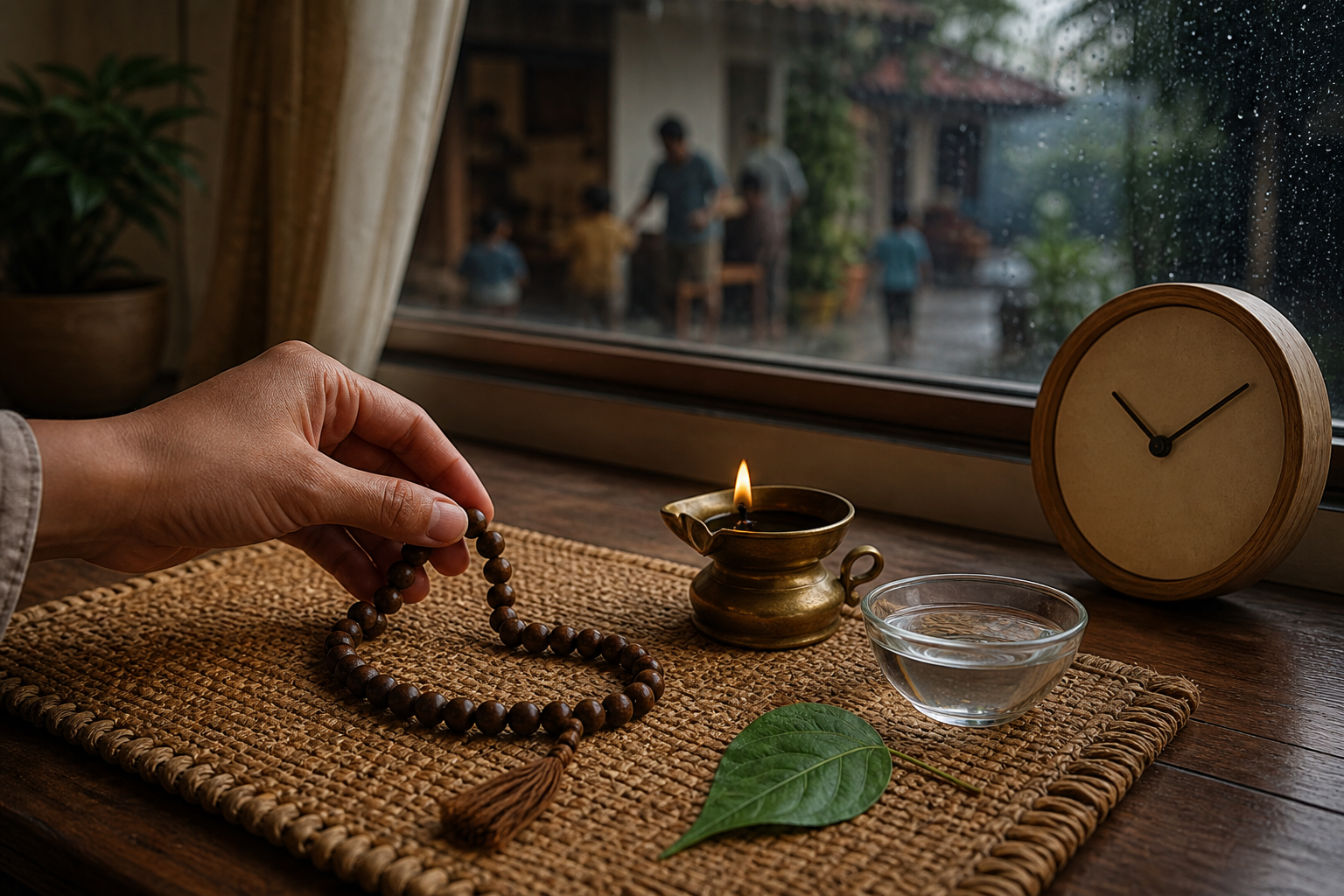
A practice begun only in crisis is difficult to remember in crisis. Fear accelerates thought and narrows attention, so the response must already be familiar. Build a simple rhythm around study, remembrance and service.
- At the beginning of the day, recall one teaching about Māyā, kāla or devotion before entering the stream of demands. Choose a sentence or passage you can actually carry into the day.
- When fear appears, pause before obeying it. Name the threatened attachment, return to mantra or prayer, and decide which action belongs to dharma rather than panic.
- During ordinary responsibilities, turn at least one task into seva. The outward task may remain unchanged; the inner claim changes from “This must secure me” to “This can be offered.”
- At the end of the day, review where fear distorted perception and where remembrance restored proportion. Do this to sharpen discernment, not to manufacture guilt.
Measure the practice by conduct rather than by whether fear instantly disappears. Are you less likely to speak harshly under pressure? Can you make a necessary decision without endless rehearsal? Do you return to duty more quickly after uncertainty unsettles you? These are concrete signs that understanding is reaching the heart.
Spiritual discipline should not be used as a substitute for mental-health care. If anxiety is persistent, overwhelming or seriously interfering with sleep, safety or daily functioning, seek qualified professional support. Prayer, japa, study and seva can accompany appropriate care; needing that care is not a failure of faith.
The next time fear demands certainty, do not begin by negotiating with every imagined future. Name what appears to be at stake. Place it honestly within time. Remember the reality in which you take refuge, and perform the next act of dharma available to you. Repeated faithfully, that movement from possession to offering is how fear begins to lose its claim over your life.
References
