
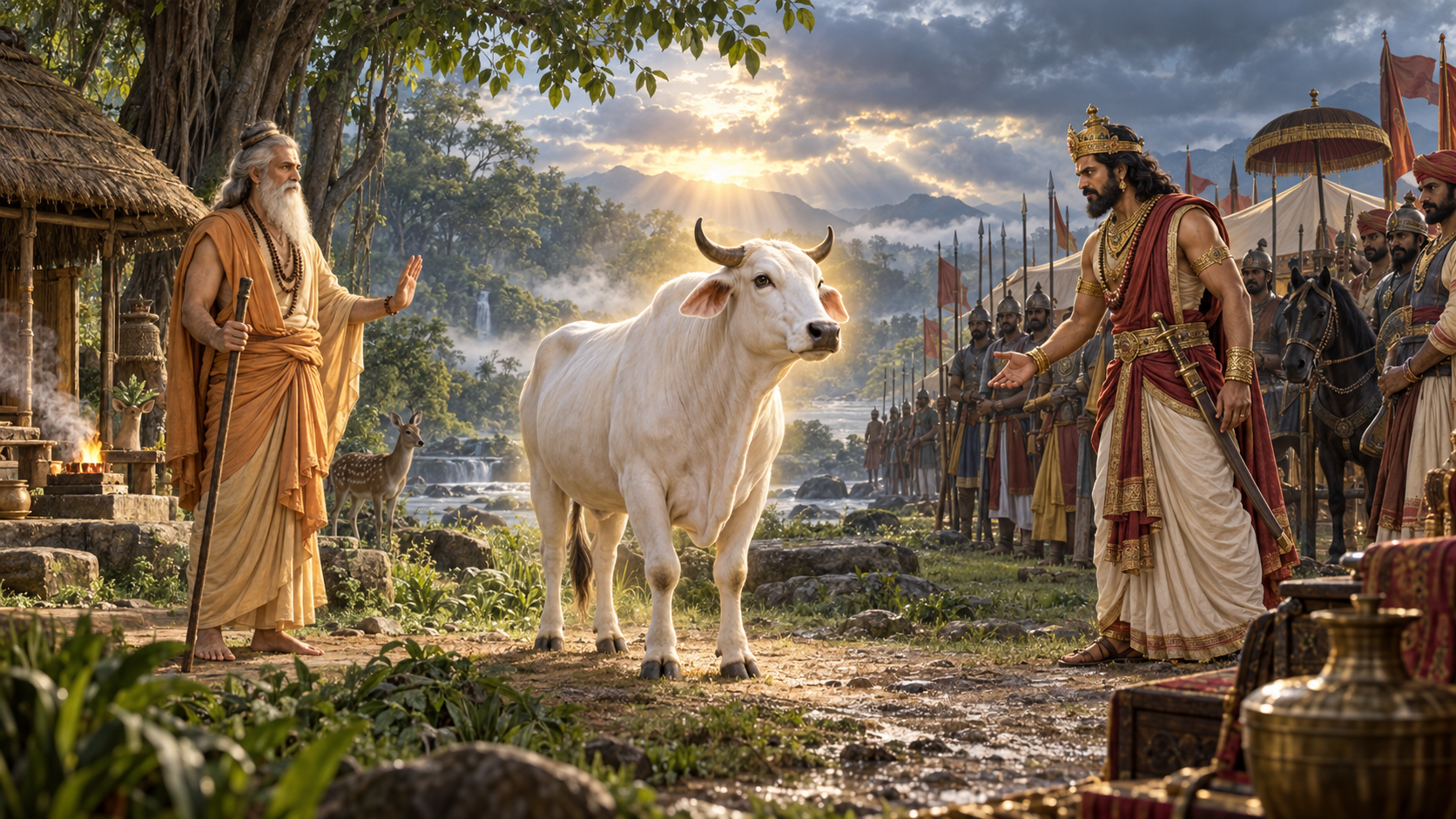
If you reached the Kamadhenu episode wondering whether it describes a miracle, an ancient political conflict, or a lesson about power, you don’t have to force it into only one category. The account becomes clearer when you first respect what it narrates and then separate that narration from the conclusions you draw from it.
That distinction matters. Read too literally and you may miss the conflict over authority and consent. Reduce everything to economics or geopolitics and you erase the sacred character of Śabala, the agency the narrative gives her, and the transformation taking place in Viśvāmitra.
The conflict begins with hospitality, not hostility
The story reaches Rāma at Mithilā. Rāma and Lakṣmaṇa have arrived with Viśvāmitra and have been received by King Janaka. Near the sacred fire, Janaka’s priest Śatānanda recounts Viśvāmitra’s earlier encounter with Vasiṣṭha. The account appears in Vālmīki Rāmāyaṇa, Bāla Kāṇḍa, Sargas 51–56.
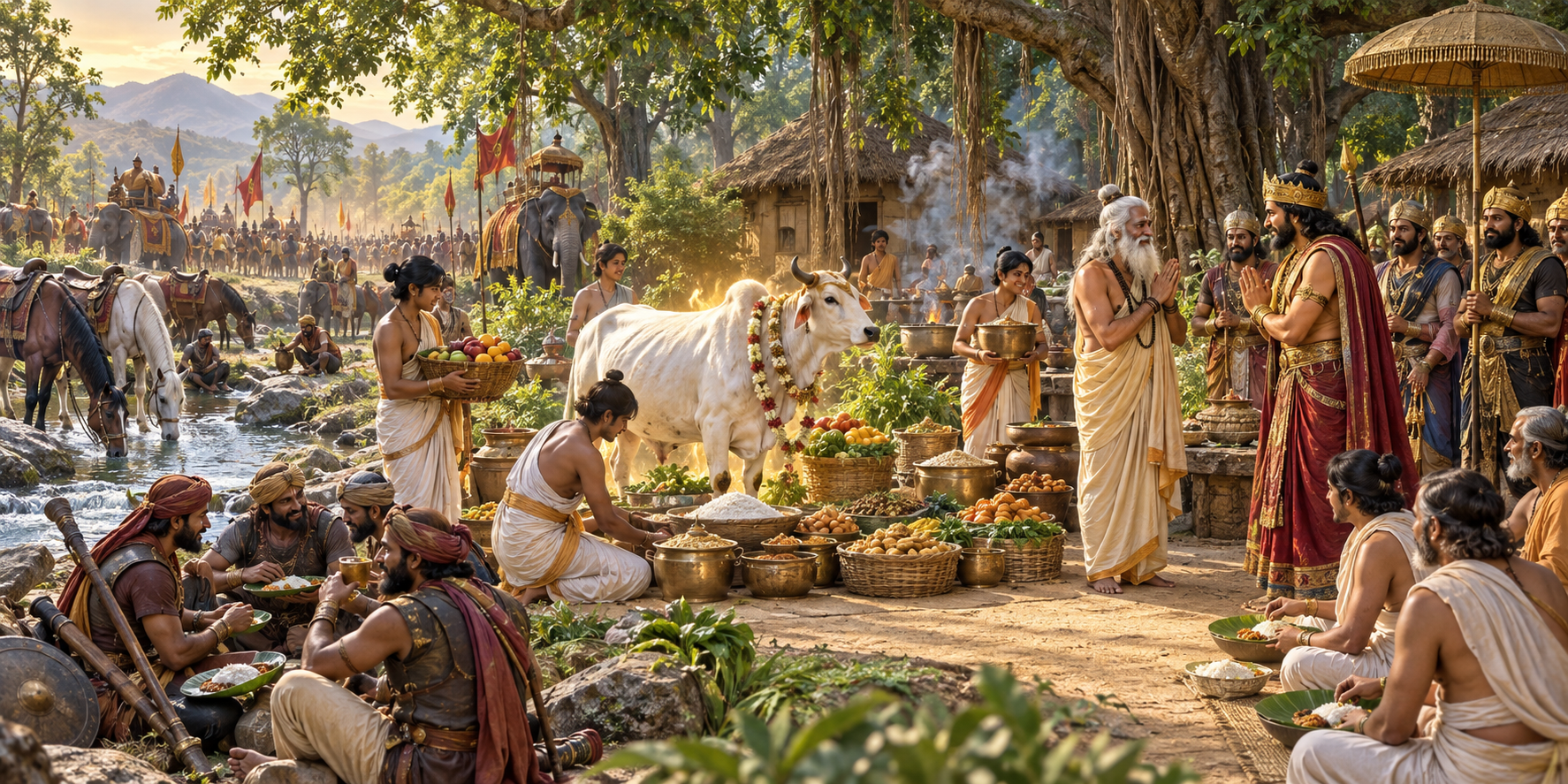
Viśvāmitra was then a powerful king travelling with an akṣauhiṇī army. Its traditional enumeration—21,870 elephants, the same number of chariots, 65,610 cavalry and 109,350 infantry—establishes the scale of the challenge facing Vasiṣṭha’s āśrama. These numbers function within the epic’s description of military magnitude; they shouldn’t be silently converted into a modern archaeological headcount.
Vasiṣṭha receives the king with honour. He asks whether Viśvāmitra has defeated his enemies and whether his subjects are well. He then offers food to the king and the entire army. Viśvāmitra initially tries to decline. An āśrama whose inhabitants live simply on roots and fruits doesn’t appear capable of feeding such a force, and the king says that Vasiṣṭha’s welcome is sufficient.
Vasiṣṭha insists and calls Śabala, also identified as Kāmadhenu. At his request, she provides abundant food suited to different preferences and the six tastes. The seemingly poor āśrama reveals a capacity greater than the wealthy king expected.
Watch what happens next, because the order exposes the real dispute:
- Viśvāmitra receives hospitality from Vasiṣṭha without coercion.
- Śabala displays an extraordinary capacity to sustain the visiting army.
- The king asks Vasiṣṭha to exchange her for 100,000 cows.
- After Vasiṣṭha refuses, the offers rise to 14,000 ornamented elephants, 800 golden chariots, ten million cows, and as much gold or gems as the sage might desire.
- Vasiṣṭha explains that Śabala is indispensable to his yajñas and inseparable from the life of the āśrama.
- Viśvāmitra stops treating refusal as a valid answer and tries to take her by force.
The feast doesn’t create the conflict. It reveals a capability that the king doesn’t control. His admiration turns into acquisition, and acquisition turns into coercion when wealth cannot secure consent.
Why ten million cows cannot purchase Śabala
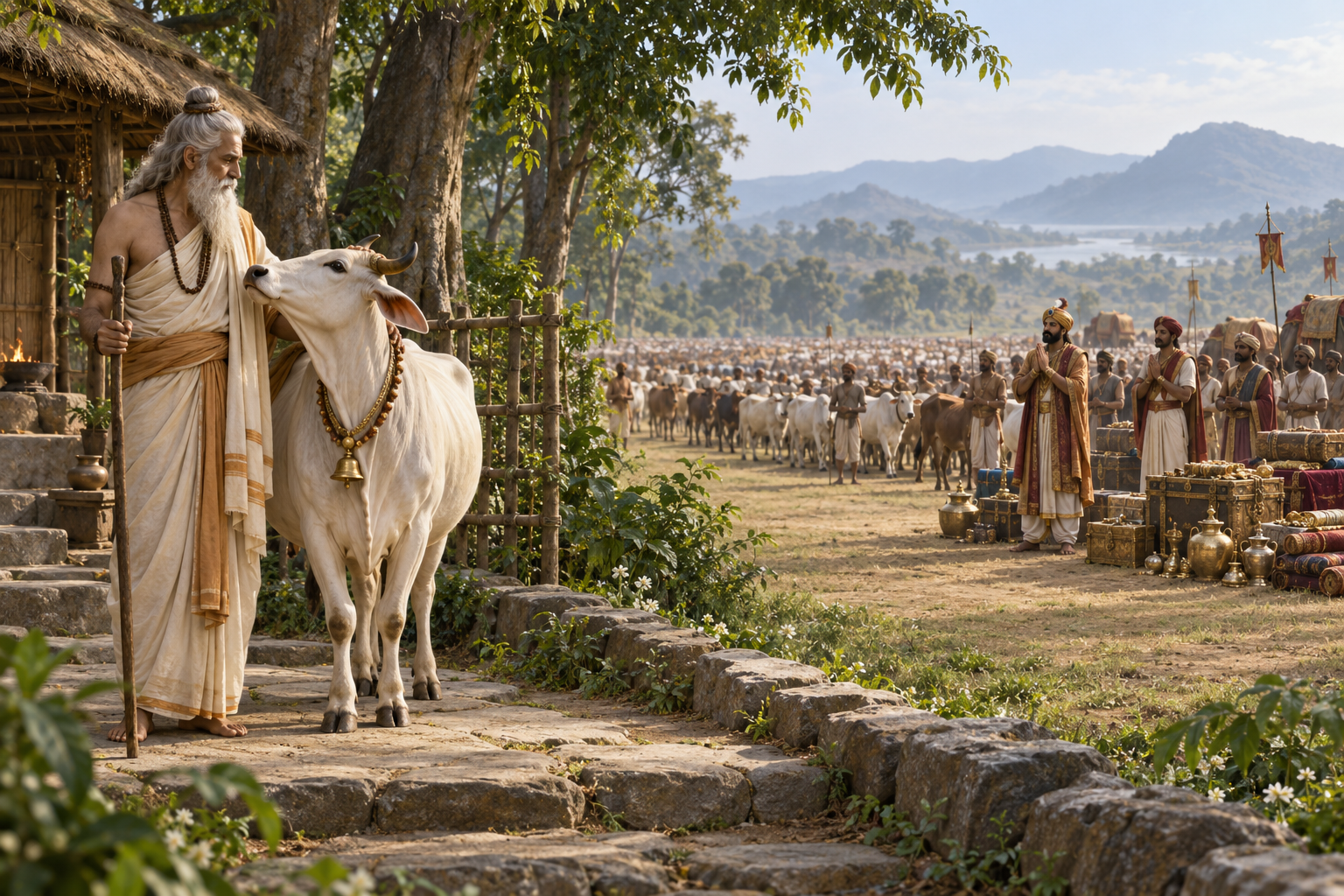
Viśvāmitra treats Śabala as a treasure and reasons that kings are entitled to gather treasures. Vasiṣṭha treats her as integral to sacred duties that cannot be transferred merely because a ruler offers an enormous price. Their disagreement is therefore deeper than bargaining. They don’t share the same definition of what Śabala is.
You can read her significance through three compatible lenses:
- Sacred reality: Within the Rāmāyaṇa’s world, Śabala is a divine, wish-fulfilling cow. She provides food and later generates defenders. This is the story’s own level of reality and should be acknowledged before symbolism is proposed.
- Institutional abundance: Śabala sustains hospitality, yajña and the āśrama’s independence. In this sense, she embodies a productive capacity that isn’t visible in conventional inventories of royal wealth.
- Relational value: Śabala isn’t interchangeable property. She belongs within a web of duties connecting the sage, the sacred rites, the residents of the āśrama and its guests.
The second lens helps you understand why an economically modest āśrama can feed an army. It doesn’t authorize you to declare that the cow was merely a treasury, a technology or a coded administrative system. That would exchange one reduction for another. An economic interpretation can disclose one dimension of the story without exhausting its meaning.
Śabala’s own conduct reinforces the point. When Viśvāmitra tries to seize her, she escapes and returns to Vasiṣṭha weeping. She isn’t narrated as an inert asset passed between male owners. The being whom the king classifies as treasure is given agency, loyalty and a voice within the moral world of the episode.
This is why the escalating offers fail. If Vasiṣṭha had merely wanted a larger herd, ten million cows would be an overwhelming substitute. But no numerical increase can replace something whose value comes from its identity, relationships and role in dharmic obligations. A price measures exchange value; it doesn’t automatically measure sacred or institutional dependence.
How to interpret the armies born from Kamadhenu
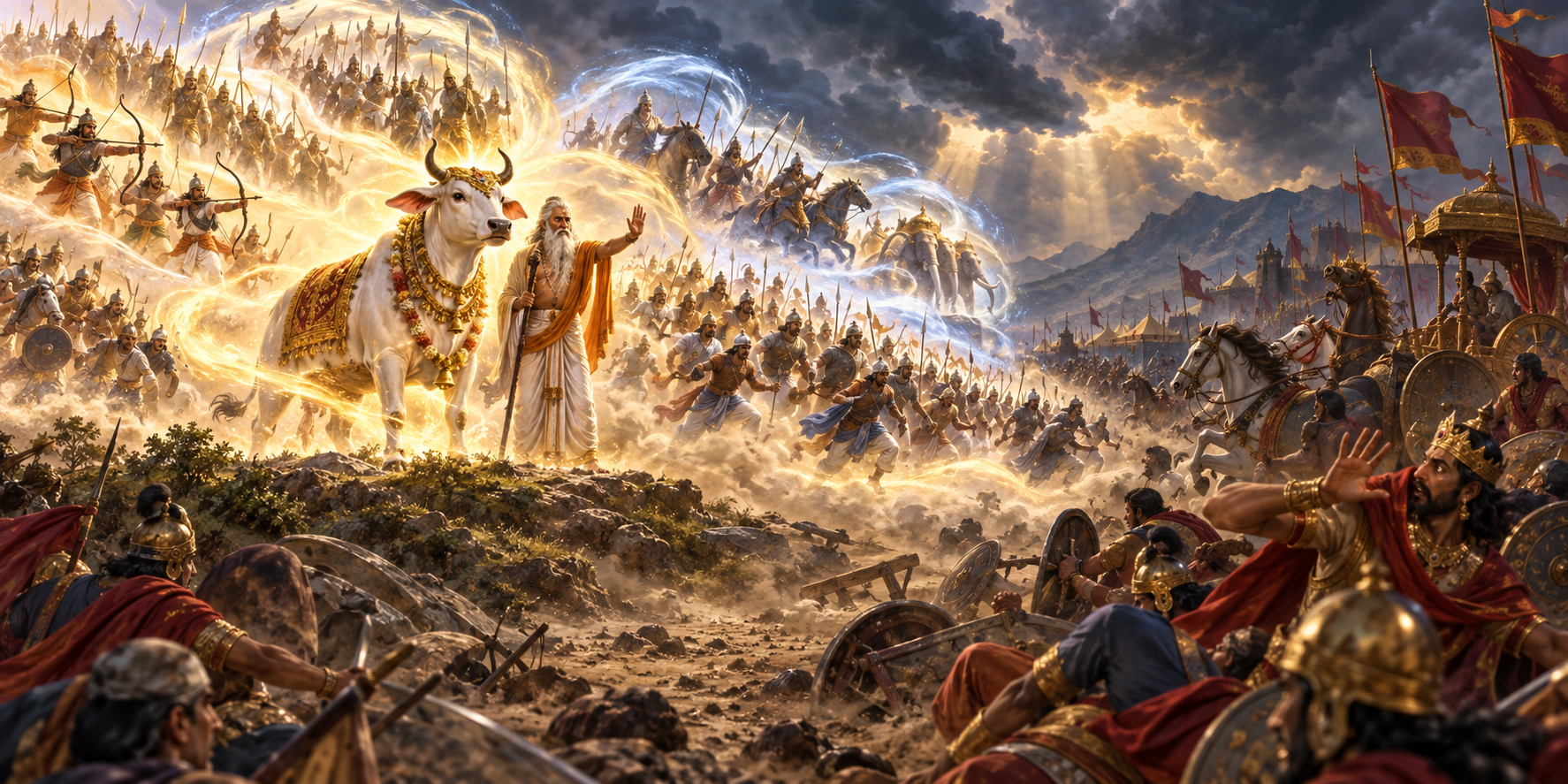
After returning to Vasiṣṭha, Śabala is empowered to resist. She first brings forth Pahlavas. As the struggle escalates, the defenders include Śakas, Yavanas, Kāmbojas, Hāritas, Kirātas and mlecchas. The imagery places their emergence in her sounds and different parts of her body: Kāmbojas from her bellowing, Pahlavas from her udder, Yavanas from her lower region, Śakas from her posterior, and other groups from the roots of her hair. Viśvāmitra uses his astras, but the forces arising through Śabala ultimately overwhelm his army.
This is the point where readers are most tempted to turn interpretation into certainty. Three readings are possible, but they don’t carry the same kind of claim:
- The theological reading stays closest to the narrated event: divine abundance becomes divine protection when a sage and his āśrama face unlawful seizure.
- The symbolic reading sees the body of Śabala as an image of latent power. What appeared to be one vulnerable cow contains a world of sustaining and defensive capacities.
- The historical-political reading asks whether the named peoples preserve memories of frontier communities, military alliances or groups known to the tradition through long cultural contact.
The third reading is a legitimate question, not a completed historical demonstration. The presence of ethnonyms shows that these names mattered within the transmitted narrative. By itself, it doesn’t establish the date of a particular textual layer, identify a single war, or prove that all the named forces once formed one geopolitical coalition.
You should also resist translating ancient group names directly into present-day national identities. Labels such as Yavana, Śaka, Pahlava, Kāmboja, Hārita and Kirāta have histories of usage, and a modern border cannot be projected backward merely because a familiar geographical association seems available. Nor should the body imagery be handled like a literal military register. It is highly structured sacred-poetic imagery, whatever historical memories may also stand behind the list.
The strongest conclusion available without additional dating and independent evidence is modest but important: the king misjudges the āśrama as materially weak, and Śabala reveals access to forms of power beyond his command. The episode can prompt historical investigation, but it shouldn’t be made to certify more than it establishes.
The real contest is over the boundary of royal power
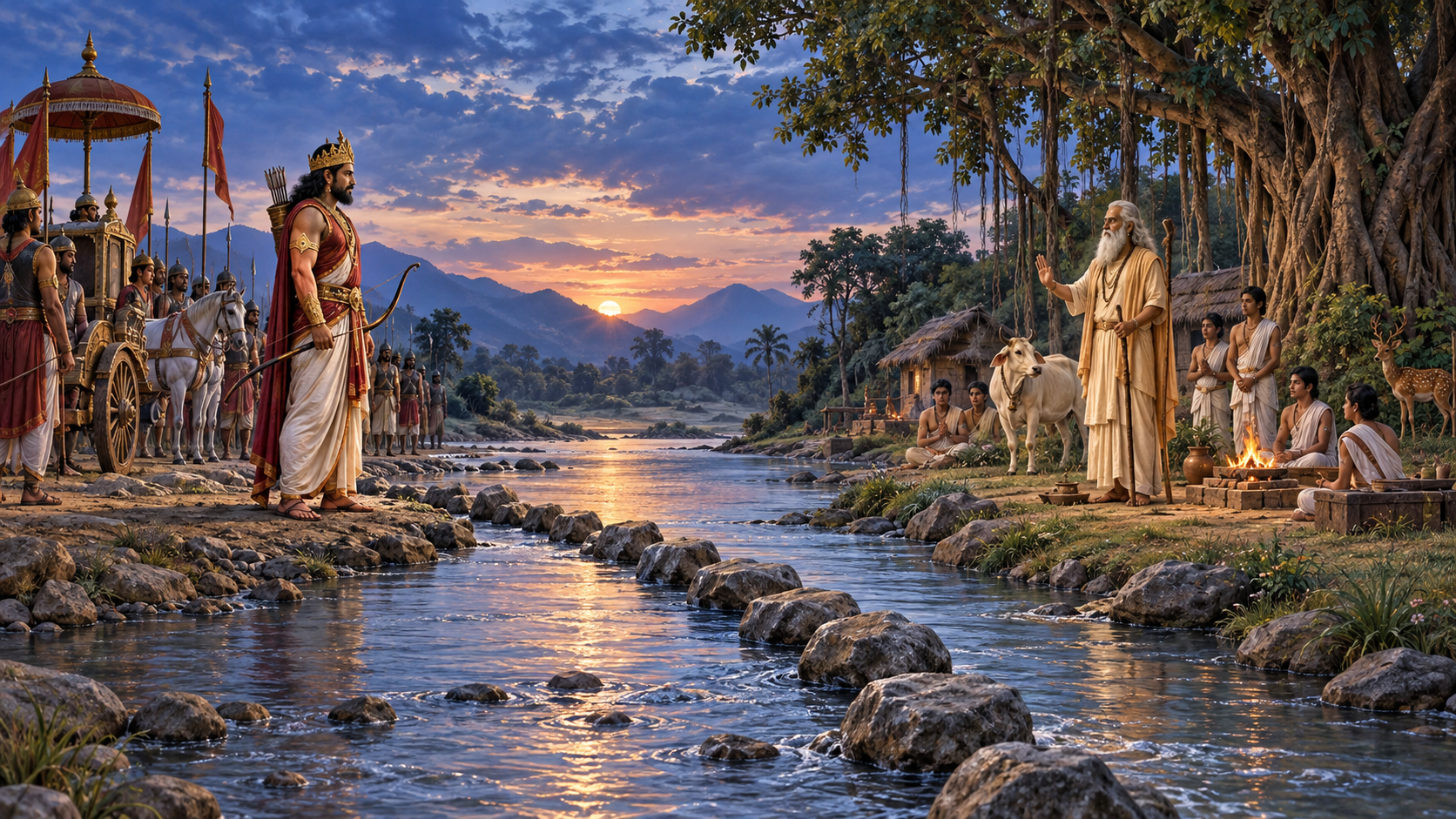
Viśvāmitra’s first mistake isn’t desire. He sees something extraordinary and asks to acquire it. The decisive mistake comes after Vasiṣṭha refuses. Viśvāmitra assumes that royal status and an immense offer can cancel another person’s authority to say no.
This makes consent the hinge of the conflict. A generous offer remains an offer only while refusal remains possible. Once the king treats refusal as illegitimate, exchange becomes expropriation. His claim that kings collect treasures turns a function of rulership into an unlimited entitlement.
In dharmic terms, power and adhikāra aren’t identical. The ability to seize something doesn’t create the rightful authority to possess it. Kingship is a role ordered toward the welfare of subjects and the protection of dharma; it isn’t a licence to absorb every source of value into the state. Vasiṣṭha’s resistance marks a boundary that worldly sovereignty cannot cross merely by declaring an object valuable.
The conflict also corrects a shallow idea of poverty. Viśvāmitra possesses the visible signs of strength: troops, chariots, elephants, weapons, gold and command. Vasiṣṭha’s community appears materially sparse. Yet the āśrama can sustain the royal force and survive its aggression. Visible accumulation and actual resilience aren’t the same thing.
The narrative frame sharpens that lesson. Śatānanda tells Rāma about the former king while Viśvāmitra is present at Mithilā as Rāma’s sage-guide. You are therefore not being shown a conqueror frozen forever in his failure. You are seeing the past of a man whose identity no longer fits the assumptions that led him to seize Śabala. Defeat becomes instruction when it exposes an inadequate understanding of power.
When you apply this episode to another institution, dispute or historical claim, ask four precise questions:
- Who has legitimate authority over the resource? Possession, political power and rightful control may belong to different parties.
- Was consent actually preserved? A large payment doesn’t turn a rejected transfer into a voluntary one.
- Which duties depend on the resource? Removing a productive asset can destroy the system that made it valuable.
- Which layer of interpretation am I using? Keep the sacred event, ethical meaning, political analogy and historical hypothesis distinct enough that one isn’t falsely presented as proof of another.
Key takeaways
- The Vasiṣṭha–Viśvāmitra conflict begins when royal admiration becomes a claim of entitlement and then an attempted seizure.
- Śabala is Kāmadhenu within the sacred narrative, but she also embodies the āśrama’s capacity for hospitality, yajña, independence and defence.
- Vasiṣṭha refuses immense compensation because Śabala is not a fungible commodity; her value lies in identity, relationship and dharmic function.
- The armies of Pahlavas, Śakas, Yavanas, Kāmbojas, Hāritas and Kirātas permit theological, symbolic and historical questions, but the names alone don’t prove a precise geopolitical reconstruction.
- The episode distinguishes possession from adhikāra: having the force to take something doesn’t establish the right to take it.
- Viśvāmitra’s presence at Mithilā as Rāma’s guide turns an old defeat into evidence that a person’s understanding of power can change.
On your next reading, begin with the sequence of actions rather than a ready-made theory: hospitality, revelation, offer, refusal, coercion and resistance. Then mark where the Rāmāyaṇa’s narration ends and your interpretation begins. That one discipline lets you honour the sacred account, draw out its political intelligence and remain honest about what still requires evidence.
References

Leave a Reply
You must be logged in to post a comment.