

You may know the cadence of the Narayana Suktam and still reach the end of its opening without knowing what it asks you to see. When that happens, the mantra remains beautiful but external. Its practical demand is more exacting: do not confine Narayana to an image, a temple, or a private devotional moment while treating the rest of existence as spiritually empty.
Here, the first sukta means the opening mantra or stanza of the Narayana Suktam. Read slowly, it moves from a vast image of divine awareness to a direct claim about the universe, and then to the imperishable reality beneath changing forms. That movement can reshape how you look at another person, perform an ordinary duty, and respond when life refuses to remain as you want it.
Read the opening as one complete movement
The Narayana Suktam presents Narayana as the supreme reality pervading existence. It is situated in the Mahanarayana Upanishad, associated with the Taittiriya Upanishad of the Krishna Yajur Veda. That setting invites you to hear the opening not only as praise of a deity, but also as an inquiry into what is ultimately real.
Sahasrasirsam devam visvaksam visvasambhuvam; visvam narayanam devam aksaram paramam padam.
Narayana Suktam, opening mantra
A close sense of the mantra is this: the divine is thousand-headed, all-seeing, and the source of well-being for the whole; the universe is Narayana, the divine, the imperishable, the supreme state or abode. No single English sentence can carry every shade of these compact Sanskrit expressions. The more useful approach is to notice their sequence.
- Sahasrasirsam: Narayana is pictured as having a thousand heads. The number expands your vision beyond one body and one centre of experience.
- Visvaksam: the divine is all-seeing. No isolated viewpoint contains the whole.
- Visvasambhuvam: Narayana is connected with the well-being or auspiciousness of the entire universe, not merely the private benefit of one worshipper.
- Visvam Narayanam: the mantra makes its decisive turn. The universe is not placed outside Narayana as an unrelated object.
- Aksaram paramam padam: behind the changing world is the imperishable, presented as the supreme reality, state, goal, or abode.
The order matters. The mantra first loosens your attachment to a single viewpoint, then widens the field to the whole universe, and finally directs attention to that which does not perish with any particular form. During recitation, resist the urge to rush from the cosmic image to the final philosophical conclusion. Let each movement correct the way you usually see.
The thousand heads remove you from the centre
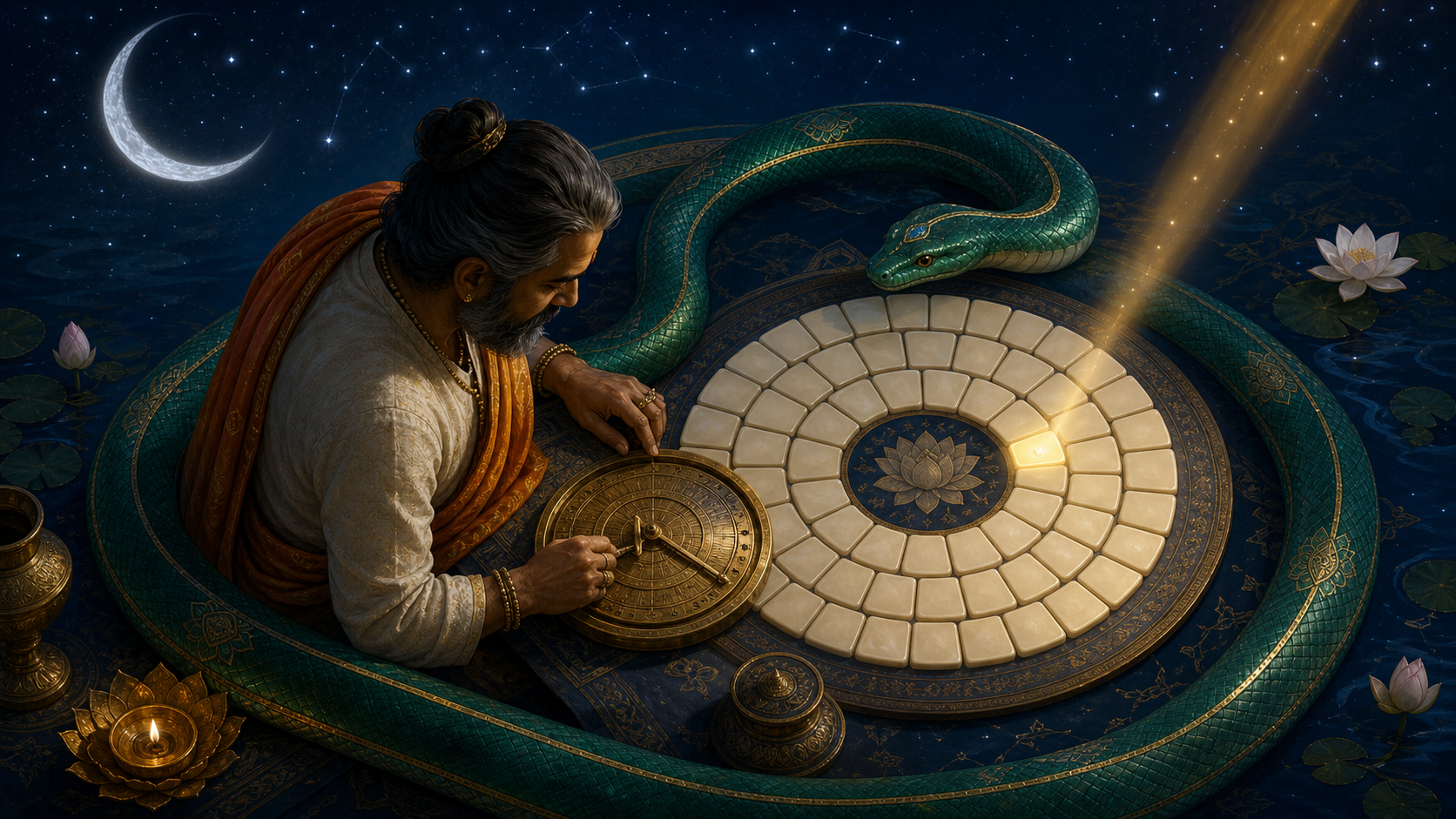
The thousand heads are not best approached as an anatomical puzzle. The image is contemplative. Every head represents a centre from which life is encountered; every pair of eyes presents another field of experience. The divine vision cannot be reduced to your preferences, injuries, loyalties, or assumptions.
This does not tell you that every opinion is correct. It tells you that your opinion is not the measure of all existence. That distinction is crucial. Humility does not require abandoning discernment, and discernment does not require imagining that only you can see.
You can test this teaching the next time another person frustrates you. Before answering, notice three things:
- The person before you has an interior life that you cannot see completely.
- The presence of the divine does not make harmful conduct harmless; you may still need a clear boundary or a firm refusal.
- You can oppose an action without reducing the person to that action.
That pause is a practical form of the thousand-headed vision. It makes room for truth and proportion before the ego turns one encounter into the whole story. If your response becomes more accurate, less contemptuous, and still appropriately firm, the mantra has already entered conduct.
Visvam Narayanam closes the sacred-secular divide
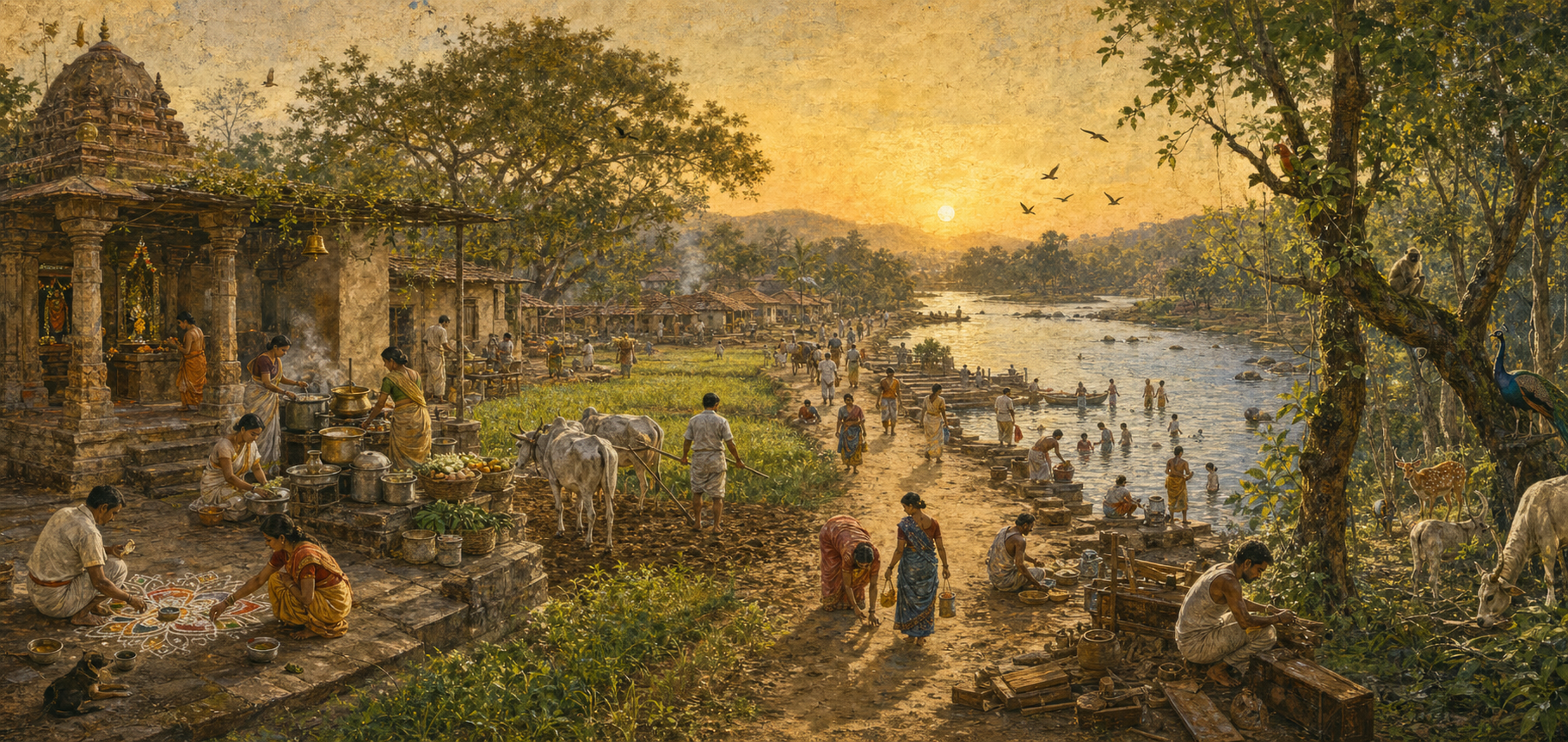
The phrase visvam narayanam is the centre of gravity. It does not merely say that Narayana occasionally intervenes in the universe or occupies a sacred corner within it. It identifies the whole field of existence with Narayana. The implication is uncomfortable in a useful way: you cannot honour Narayana during worship and then behave as though people, duties, food, water, animals, tools, and places have no sacred significance.
This vision can be applied without turning every activity into a ceremony. Use three ordinary tests:
- Test your speech: would you use the same words about a person if you consciously remembered that the life before you is not outside Narayana?
- Test your use of things: are you handling food, water, money, and shared spaces with care, or treating them as disposable because they are not on an altar?
- Test your duty: are you performing the task in front of you honestly, or using spiritual language to avoid an obligation that is plainly yours?
Seeing Narayana in all does not erase distinctions between dharma and adharma, care and negligence, truth and manipulation. The mantra universalises sacred presence; it does not declare every choice equally worthy. In fact, the wider the presence you recognise, the less room you have for careless conduct. A dishonest act is not made sacred by calling everything divine.
This also prevents devotion from shrinking into self-concern. Visvasambhuvam directs attention toward the well-being of the whole. When you make a decision, ask not only whether it benefits you, but what kind of relationship it creates with the larger field of life. That question turns cosmic theology into dharmic responsibility.
The imperishable is not a promise that forms will remain

Aksaram, the imperishable, appears beside the declaration that the universe is Narayana. This pairing helps you avoid two opposite errors. One is to treat changing appearances as the final reality. The other is to dismiss the changing world as though its suffering, duties, and consequences do not matter.
Forms change. Bodies age, relationships alter, institutions rise and decline, possessions pass from hand to hand, and even cherished roles cannot be held permanently. Calling Narayana imperishable does not mean that these particular arrangements will be preserved. It directs your trust beneath them.
When change unsettles you, separate three questions that the mind often confuses:
- What exactly is changing? Name the form, role, expectation, possession, or relationship without vague language.
- What are you trying to protect? Decide whether you are defending a genuine duty or merely demanding that a temporary arrangement remain permanent.
- What does dharma require now? Choose the truthful and responsible action available in the changed circumstances.
This is not an instruction to suppress grief. Nor should the language of imperishability be used to excuse injustice or tell another person that pain is unreal. At the level where action occurs, actions have consequences and obligations remain. The mantra gives you a ground from which to act without asking a passing form to provide permanent security.
Paramam padam completes that redirection. It can be heard as the supreme state, goal, or abode. In practice, it asks what you are treating as your final refuge. If reputation, control, possession, or victory has quietly taken that place, the opening verse exposes the substitution.
Turn the mantra into a daily contemplative practice

You do not need to invent a new ritual around the verse. If you belong to a family, temple, or lineage with an established method of recitation, keep its discipline and learn pronunciation from a qualified teacher. The following exercise is a way to contemplate the meaning; it is not a replacement for a traditional chanting method.
- Recite or read the complete opening once. Do not analyse it during the first pass. Hear the verse as a whole.
- Return to sahasrasirsam and visvaksam. Bring to mind several centres of experience beyond your own: people near you, people you misunderstand, and lives you ordinarily overlook.
- Pause at visvam narayanam. Let your attention move from the idea of a distant deity to the actual room, people, objects, and responsibilities around you.
- Rest with aksaram. Notice which changing outcome you are treating as indispensable. Do not deny its importance; simply stop asking it to be imperishable.
- Choose one correction in conduct. Speak more truthfully, repair a neglected duty, handle a resource with greater care, or set a necessary boundary without contempt.
- Recite the complete verse again. Let the final recitation join vision and action instead of leaving them in separate compartments.
Two common mistakes weaken this practice. The first is settling for a vague feeling of cosmic unity that changes nothing after the recitation. The second is using oneness to erase moral distinctions. The remedy for both is the same: attach the contemplation to one concrete decision. If visvam narayanam is true for you only during chanting, you have admired the teaching but not yet allowed it to examine you.
Key takeaways
- The opening moves from countless centres of awareness to the one divine reality pervading the universe.
- The thousand heads challenge the assumption that your viewpoint is the centre or totality of existence.
- Visvam narayanam brings ordinary people, objects, duties, and places inside the field of sacred responsibility.
- Aksaram distinguishes the imperishable ground from forms that inevitably change.
- The verse is understood more deeply when it produces one truthful, careful, or compassionate act.
At your next recitation, do not try to hold the entire philosophy in your mind at once. Stop at one phrase and let it revise one response that day. The opening becomes a doorway when it changes how you see before it becomes another conclusion you possess.
References
- Narayana Suktam — opening mantra
- Hindu Blog — First Sukta Of Narayana Suktam – Significance – Symbolism
