
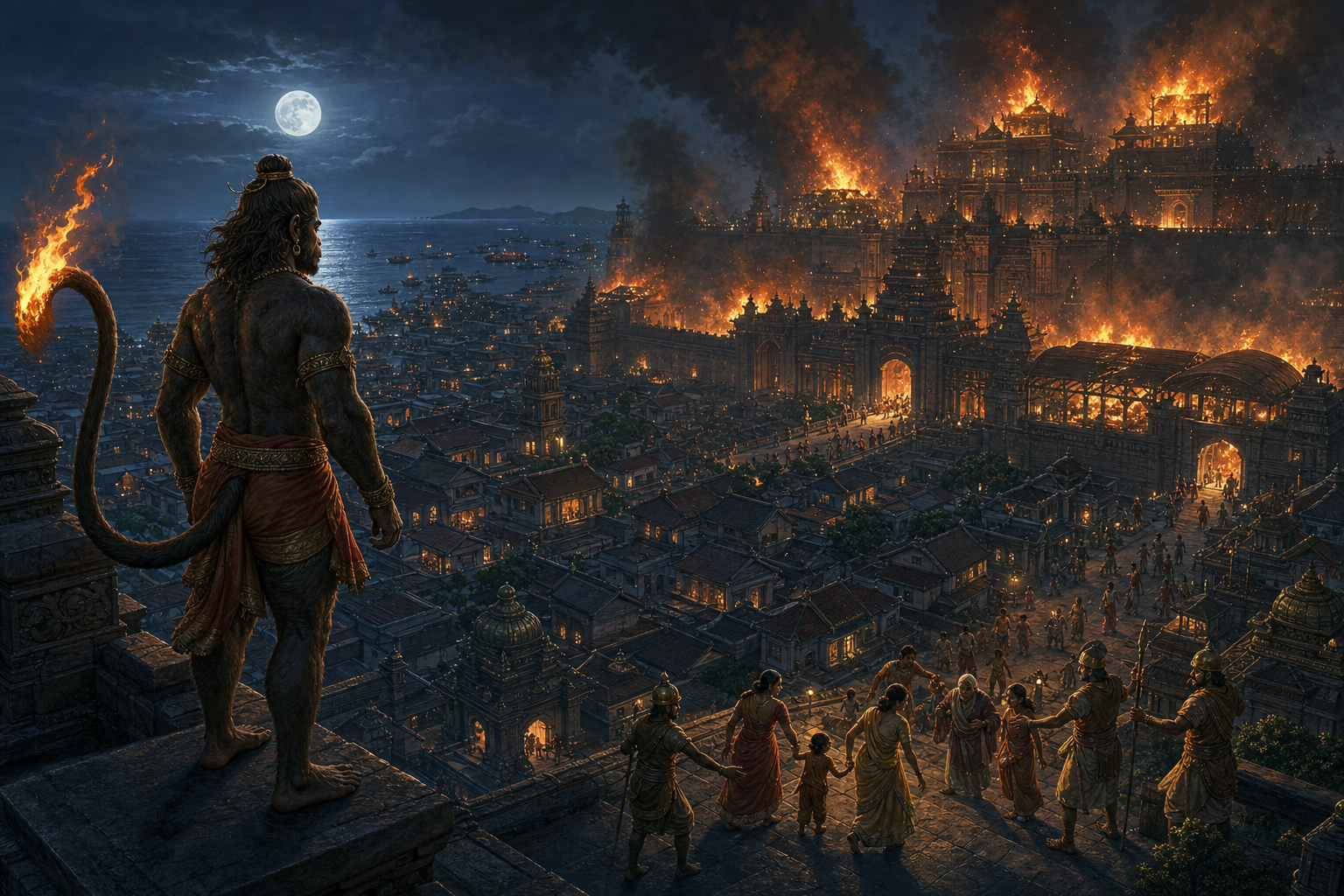
If Hanuman’s burning of Lanka troubles you, that discomfort does not force you to choose between reverence for Hanuman and concern for ordinary lives. It gives you the right question: what makes force Dharmic when the enemy’s capital is also somebody’s home?
Here Lanka means the epic city of the Ramayana. You can read the episode faithfully while examining its targets, precautions, foreseeable spillover, and consequences. That discipline honors Rama’s cause without turning dharma into a blank cheque for whatever is done in its name.
A just cause does not make every means just
Ravana’s abduction of Sita is adharma. Resisting his rule is justified. Yet the justice of that resistance does not automatically sanctify every destructive act committed along the way. Dharmayuddha concerns the conduct of a righteous struggle as well as its objective.
This distinction is easy to lose when discussing a revered hero. One side treats any ethical question as an attack on Hanuman. The other begins with modern suspicion and reads the entire episode as evidence against the epic. Neither approach asks enough of the narrative or of the reader.
A more exact reading separates four judgments. First, is the cause just? Second, is the chosen target connected to the wrong being resisted? Third, are the means controlled as far as the circumstances allow? Fourth, what responsibility remains if people outside the struggle are harmed? If your interpretation answers only the first question, it has not yet established dharmayuddha.
Dharmayuddha should not be treated as a single ancient statute or as a modern treaty translated into Sanskrit. It is a family of restraints found across discussions of rajadharma and war. Among the recurring concerns are protection of the unarmed, the fleeing, and those who surrender; rejection of wanton devastation; and limits on methods that cannot distinguish an aggressor from a bystander. These norms resemble important principles of modern humanitarian law, but their force here is Dharmic: power remains answerable to moral limits even when its cause is righteous.
Read the fire at the military, civilian, and symbolic levels
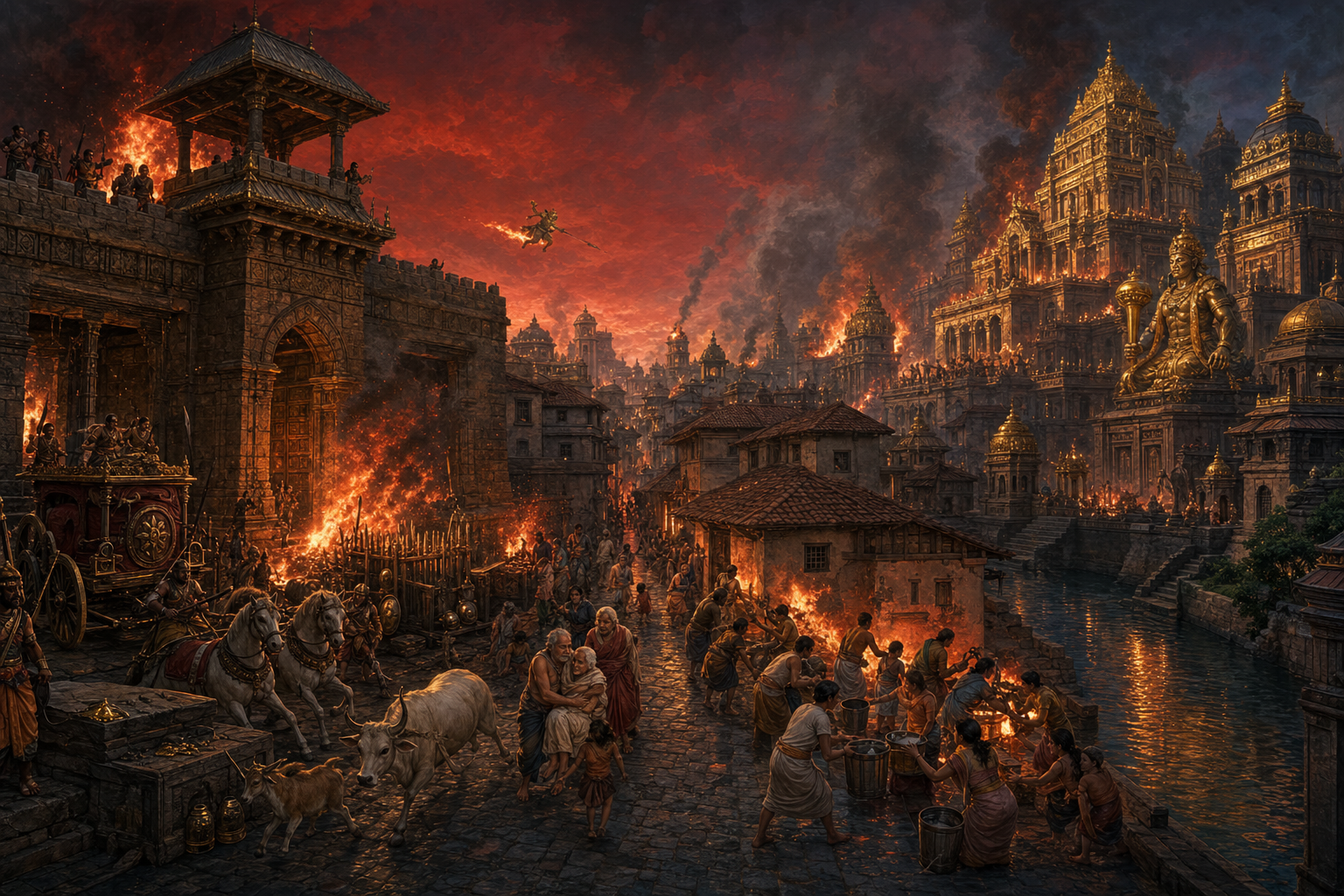
The military action is portrayed as purposeful
Hanuman enters Lanka on a defined mission, locates Sita, gives her Rama’s signet, and confirms that help will come. After his capture and public humiliation, his burning tail becomes a weapon. The pattern of destruction points toward fortifications, the mansions of prominent rakshasas, and parts of Ravana’s war-making order. That matters because it distinguishes strategic sabotage from violence undertaken merely to make a population suffer.
The episode also makes Hanuman morally alert to unintended harm. He fears that Sita might have been endangered, appeals to Agni’s restraint, and receives assurance that the flames have not harmed her. This concern is not a decorative pause in the action. It reveals that the safety of a vulnerable person remains relevant even at the height of righteous fury.
That assurance has a boundary, however. It answers the urgent question of Sita’s safety; it is not, by itself, a household-by-household account of Lanka. Devotional and regional interpretations often extend divine restraint to the city’s blameless inhabitants. Such a reading is coherent within the epic’s theological world, but it should be identified as an interpretation rather than presented as a narrated casualty record.
The city is more than Ravana’s palace
Lanka contains ramparts and gateways, but also roads, markets, gardens, workshops, palaces, and homes. Its urban wealth and skilled crafts imply a socially varied population: soldiers and administrators, certainly, but also artisans, traders, servants, laborers, elders, women, and children. Ravana rules the city; he is not identical to everyone who lives in it.
This is where civilian harm must be discussed carefully. We do not need to invent deaths that the narrative does not enumerate. We also should not pretend that fire in a dense city can only affect the intended building. Even where an ignition is selected for military effect, flames can spread, smoke can drive people from their homes, and the destruction of tools or stored goods can erase a household’s livelihood.
Keep four categories separate when you assess the episode: what the narrative explicitly says was attacked, whom it explicitly says was protected, what risks reasonably follow from urban fire, and what outcomes remain unrecorded. This prevents two equally careless claims. Narrative silence does not prove a massacre, but neither does it prove the absence of civilian fear, displacement, or material loss.
The street-level view therefore adds moral resolution rather than a rival plot. A metalsmith’s tools, a merchant’s stores, an elder’s mobility, and a child’s dependence on adults are not small matters simply because kings and warriors occupy the foreground. Dharma is tested wherever a powerful action falls upon someone who did not choose the conflict.
The allegory explains meaning but cannot erase consequence
Agni is more than a destructive element in Dharmic imagination. Fire can purify, expose, and bear witness. Lanka can accordingly be read as an inner citadel ruled by ungoverned rajas and tamas, Ravana as grasping power, and Hanuman’s flame as the discipline that burns through delusion. At this level, what is destroyed is opulence severed from righteousness and power severed from accountability.
That allegory helps you understand why the burning can function as a moment of liberation rather than a celebration of pain. It cannot, however, settle the civilian question on its own. Symbolic Lanka and inhabited Lanka perform different work in the reading. Let the symbolism explain the episode’s spiritual force; do not use it to make ordinary inhabitants disappear.
Apply five tests before calling force dharmayuddha
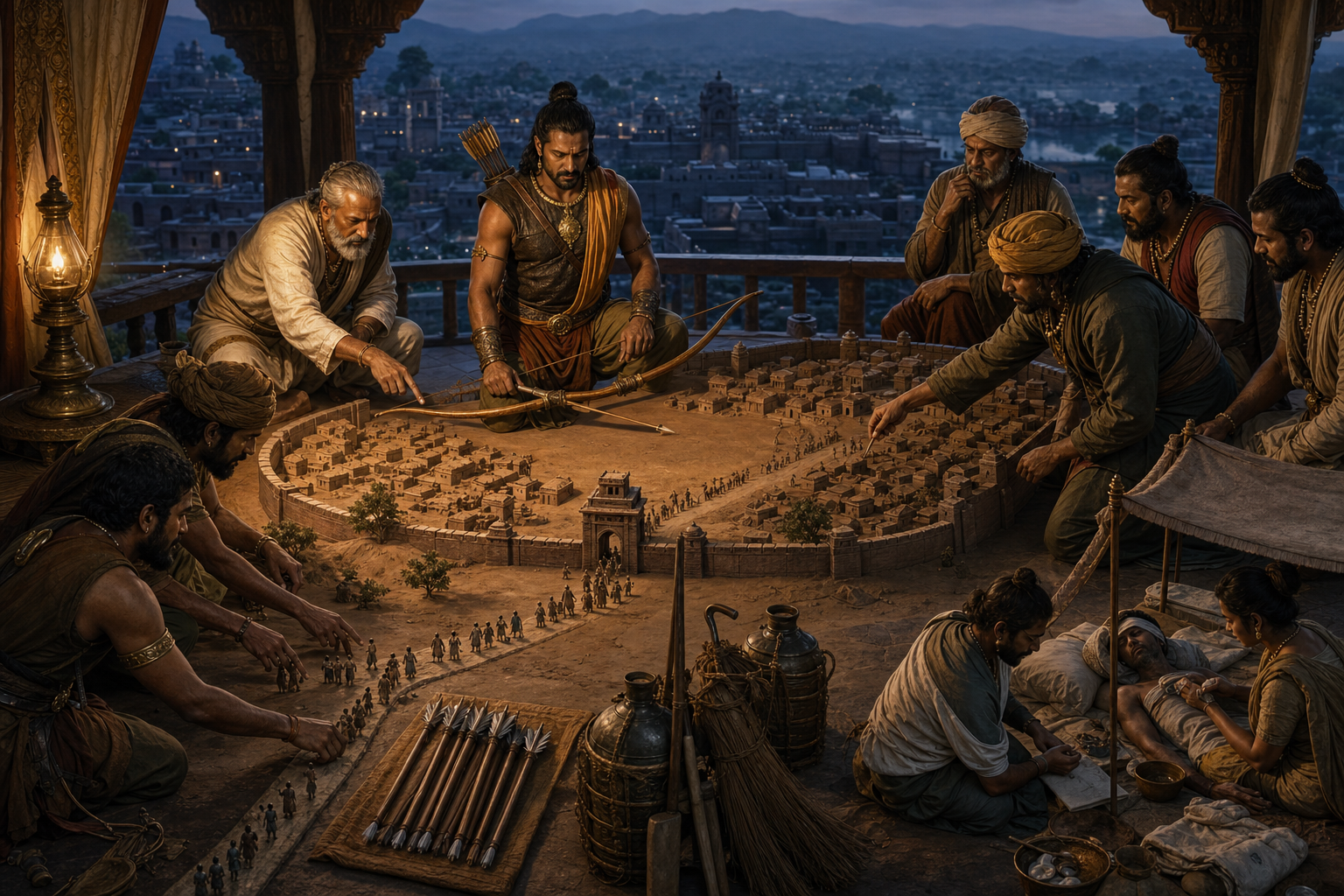
A useful Dharmic judgment does not begin and end with the identity of the hero. It asks whether the action remains governed by dharma at the moment when anger, danger, and strategic opportunity converge. The same standard should apply when the actor is admired, opposed, ancient, or contemporary.
Key takeaways
- Just objective: Force must seek to stop or correct adharma, not transfer guilt from a ruler or army onto an entire population. Ravana’s culpability does not make every resident of Lanka culpable.
- Discrimination: The chosen targets should be connected to coercive or military power. A fortification, command center, or war-making asset is ethically different from a household merely located nearby.
- Necessity and least harm: The method should serve a real objective, and a less destructive effective option should be preferred where one is genuinely available. Perfect safety may be impossible in war, but avoidable destruction is not made righteous by invoking the cause.
- Precaution and control: Foreseeable spread must matter before an attack begins and while it unfolds. Protection of known vulnerable people, control over destructive means, and a willingness to stop once the objective is met are signs of restraint.
- Responsibility after harm: Victory does not cancel duties to the injured, displaced, or dispossessed. Rescue, care, rebuilding, and restoration are part of righteous order, not optional gestures after the morally important work is finished.
Measured against these tests, Hanuman’s action has evidence in its favor: a strategic purpose, selected political and military targets, immediate concern for Sita, and divine restraint within the narrative. It also leaves ethical pressure points: fire is difficult to contain, Lanka is inhabited, and the lives of common people are not narrated in detail. A fair reading holds the evidence and the uncertainty together.
Do not turn the five tests into an anachronistic courtroom charge. Use them as an ethical audit. They reveal whether an appeal to dharma is disciplining violence or merely decorating it. The decisive sign is not how loudly the righteous cause is announced, but whether moral limits remain active when violating them would be convenient.
The wider Dharmic family tightens the restraint on force
The traditions born in Bharat do not give one uniform answer to every conflict, yet they repeatedly resist the idea that noble ends excuse cruelty. Hindu dharmayuddha, Jain ahimsa, Buddhist karuna, and the Sikh sant-sipahi ideal approach the problem from different histories and metaphysical commitments. Their shared contribution is a demand that courage remain under moral discipline.
Jain Ramayana traditions press hardest on the necessity of killing. In the Paumachariya, Lakshmana rather than Rama kills Ravana, allowing Rama to remain the nonviolent exemplar. You do not have to replace Valmiki’s plot with the Jain version to receive its challenge: when a less violent effective path exists, the more violent path carries a heavier burden of justification.
Buddhist Ramayana echoes tend to foreground compassion, inward mastery, and moral transformation. They do not reproduce the Lanka episode point by point, so they should not be treated as alternate reports of the same event. Their practical question is whether resistance to wrongdoing can avoid becoming cruelty toward persons.
The Sikh sant-sipahi ideal arose in a different historical setting and is not a commentary on Sundara Kanda. It nevertheless clarifies a closely related pairing: the saint’s moral discipline and the warrior’s courage must inhabit the same person. Defense of the vulnerable is not complete if the defender abandons restraint toward other innocents. These Jain, Buddhist, Sikh, and Hindu ethical accents differ, but none makes compassion irrelevant once struggle begins.
This wider view gives you a practical test whenever someone uses the word dharmayuddha outside the epic. Ask who is actually responsible for the adharma, who is being protected, what limits bind the supposedly righteous side, and what duties follow if innocents suffer. If the speaker can name the enemy but not the limits, the claim is incomplete.
Read and teach the episode without flattening it
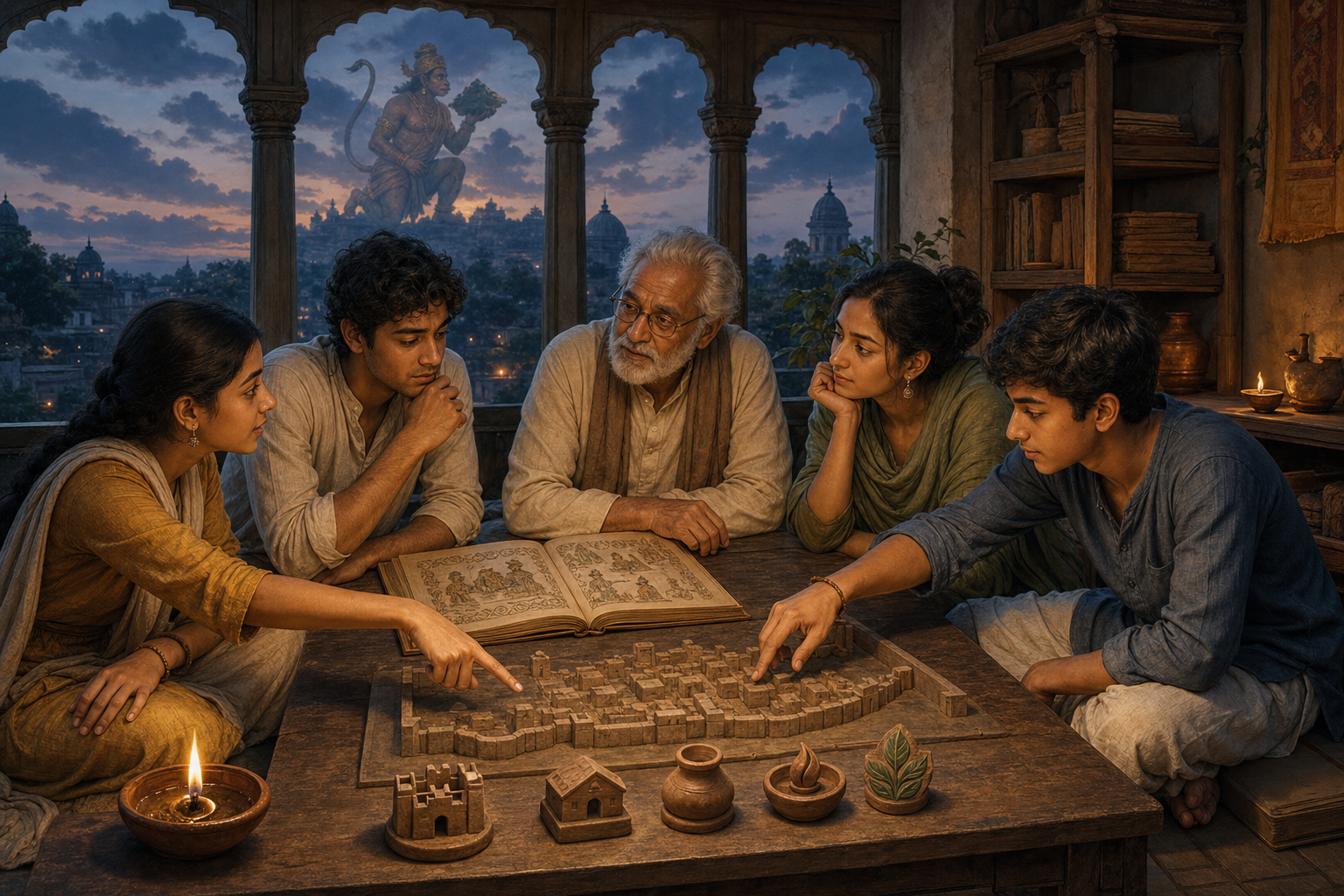
A mature reading does not weaken Hanuman by noticing the vulnerable. It notices that strength becomes Dharmic through purpose, self-command, and responsibility. You can preserve that moral architecture in a family discussion, satsang, classroom, or personal reading with four moves.
- Tell the sequence before judging it. Establish Hanuman’s mission, Sita’s captivity, Ravana’s abuse of power, Hanuman’s capture, the burning tail, the selected destruction, and Hanuman’s fear for Sita. Removing either the provocation or the moment of concern distorts the ethical problem.
- Label the kind of claim you are making. Distinguish what the narrative states, what urban conditions make plausible, what later devotional interpretation supplies, and what the symbolic reading means. Do not present inference as textual fact or allegory as a casualty report.
- Name civilians without inventing them. Markets and workshops justify asking about artisans, traders, families, and dependants. They do not justify manufacturing a death count, a speech, or an undocumented atrocity. Precision protects both compassion and credibility.
- Use one moral standard for every side. If harm to innocents would count against an adversary, it must remain morally relevant when caused by a revered actor. Equal scrutiny is not moral equivalence; it is evidence that dharma governs loyalty rather than being governed by it.
A concise way to frame the episode is this: Ravana’s adharma makes resistance necessary. Hanuman’s destruction is presented as strategically directed rather than random. Because Lanka is a living city, the use of fire still raises duties of distinction, restraint, and protection. The episode’s moral seriousness grows when concern for the innocent survives righteous anger.
On your next reading of Sundara Kanda, make two columns: stated targets and people placed at risk. Require every claim of necessity to answer both columns. That small practice will help you recognize dharmayuddha not merely by the justice of its banner, but by the limits it accepts when power is finally available.