
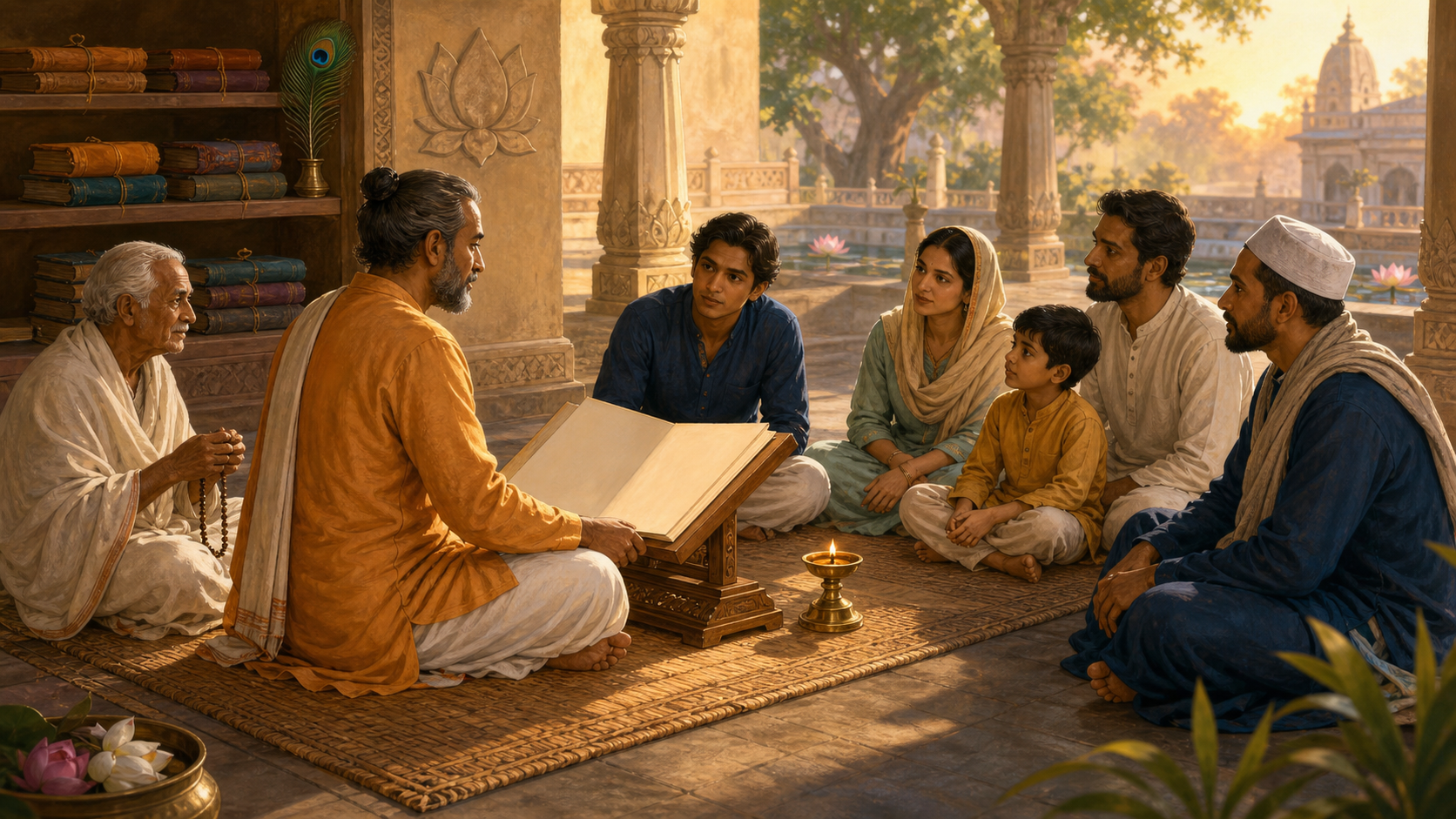
You have been asked to teach the Srimad Bhagavatam, but the people before you do not all arrive at the same place. One may know the narrative by heart. Another may be hearing Krishna’s name for the first time. A third may respect Dharma while belonging to a different tradition. If you speak to all of them as though they share the same vocabulary, either the newcomer gets lost or the experienced listener receives little nourishment.
The answer is not to dilute the text. It is to separate what must remain fixed from what may be adapted. The passage, its context and its theological claim remain the centre. The opening question, explanatory language, illustrations and next step can change. That distinction lets you present the Bhagavatam to different audiences without turning it into either a specialist lecture or generic self-help.
Adapt the doorway, not the teaching
Fidelity does not require identical delivery. A temple class, a family gathering, a university discussion and an inter-Dharmic forum have different purposes. The mistake is to make the doctrine flexible while treating the presentation as fixed. Reverse that arrangement.
Keep these elements stable:
- The identity and immediate context of the passage.
- Who is speaking, who is listening and what situation has prompted the exchange.
- The central claim you believe the passage makes.
- The words, actions or narrative movement that support your interpretation.
- The distinction between the text, a received commentary and your present application.
Adapt these elements to the people before you:
- The question with which you begin.
- How much narrative background you supply.
- How many Sanskrit terms you introduce and how you explain them.
- Whether an illustration comes from household life, professional duty, devotional practice or comparative philosophy.
- The kind of reflection, discussion or practice you invite at the end.
This protects you from two common failures. Over-adaptation reduces the Bhagavatam to agreeable advice that could have come from anywhere. Under-adaptation surrounds a profound passage with so much unexplained vocabulary that only insiders can enter it. A good teacher preserves the shrine and opens an appropriate door.
This discipline matters especially in a mixed Dharmic setting. Hindu, Buddhist, Jain and Sikh traditions can meet around questions of Dharma, discipline, attachment, compassion, self-mastery and liberation without being declared doctrinally identical. When the Bhagavatam makes a distinctively Bhagavata or Vaishnava claim, name that location plainly. Shared civilizational vocabulary can begin a conversation; it should not erase real differences concerning authority, the self, liberation, grace or the nature of the Divine.
Build a textual spine before planning illustrations

A Bhagavatam class may be anchored in a single numbered text, such as 1.2.9, 1.7.23, 4.24.73 or 3.28.3. That narrow anchor is a useful discipline. It prevents a familiar theme from swallowing the actual passage.
Before preparing stories, analogies or slides, complete a passage card with the following fields:
- Reference: Record the canto, chapter and verse, as well as the edition and translation you are using.
- Location: Write the minimum narrative background a listener needs in order to understand why these words appear here.
- Voices: Identify the speaker, the immediate listener and any audience hearing the speech within the larger narration.
- Claim: State the central teaching in a single complete sentence.
- Evidence: Mark the word, phrase, contrast, action or narrative turn that supports that sentence.
- Interpretive line: Identify the commentary or sampradaya through which you are explaining the passage.
- Audience bridge: Choose the question or experience that gives this particular group an honest point of entry.
- Response: Decide what the listener should be able to notice, explain or practise after the class.
- Open question: Record what the passage card does not settle, so that uncertainty is not concealed by confident delivery.
The claim and evidence fields are the heart of the card. If you cannot connect your main point to the passage, you have prepared a talk near the Bhagavatam rather than a teaching from it. Remove attractive anecdotes until the textual connection becomes visible.
Let the kind of passage determine the method
Not every part of the Bhagavatam should be taught in the same way. Literary form tells you what kind of attention the passage requires.
- Narrative: Trace the situation, the knowledge available to each person, the decision made and its consequences. Do not extract a moral slogan before the listener understands the tension in the story.
- Prayer or praise: Identify the speaker and addressee. Follow the movement of thought, such as praise, confession, petition, dependence or surrender, rather than treating isolated phrases as interchangeable quotations.
- Philosophical dialogue: Reconstruct the question, define the key terms and show how the answer follows. An analogy can illuminate the reasoning, but it cannot replace it.
- Cosmological or descriptive material: distinguish what the text depicts, the theological work the depiction performs and any modern comparison you choose to introduce. Do not announce harmony or conflict with a modern category unless you have actually explained the terms on both sides.
- Genealogy or extended list: Show what the sequence establishes within the lineage, narrative or sacred memory. Reading unfamiliar names without explaining their function leaves the audience with sound but little orientation.
Public usage also varies between spellings such as Srimad, Shrimad and Śrīmad. Choose a transliteration system and use it consistently. If your audience is unfamiliar with diacritics, explain the alternate spelling once and then continue. Diacritics can support pronunciation, but they do not substitute for context or understanding.
For a continuing series, keep a short continuity ledger after every class. Record the passage taught, the question inherited from the previous session, the new claim established and the textual link to the next session. This stops a verse-by-verse series from becoming a collection of unrelated speeches.
Match the entry point to the audience’s starting distance
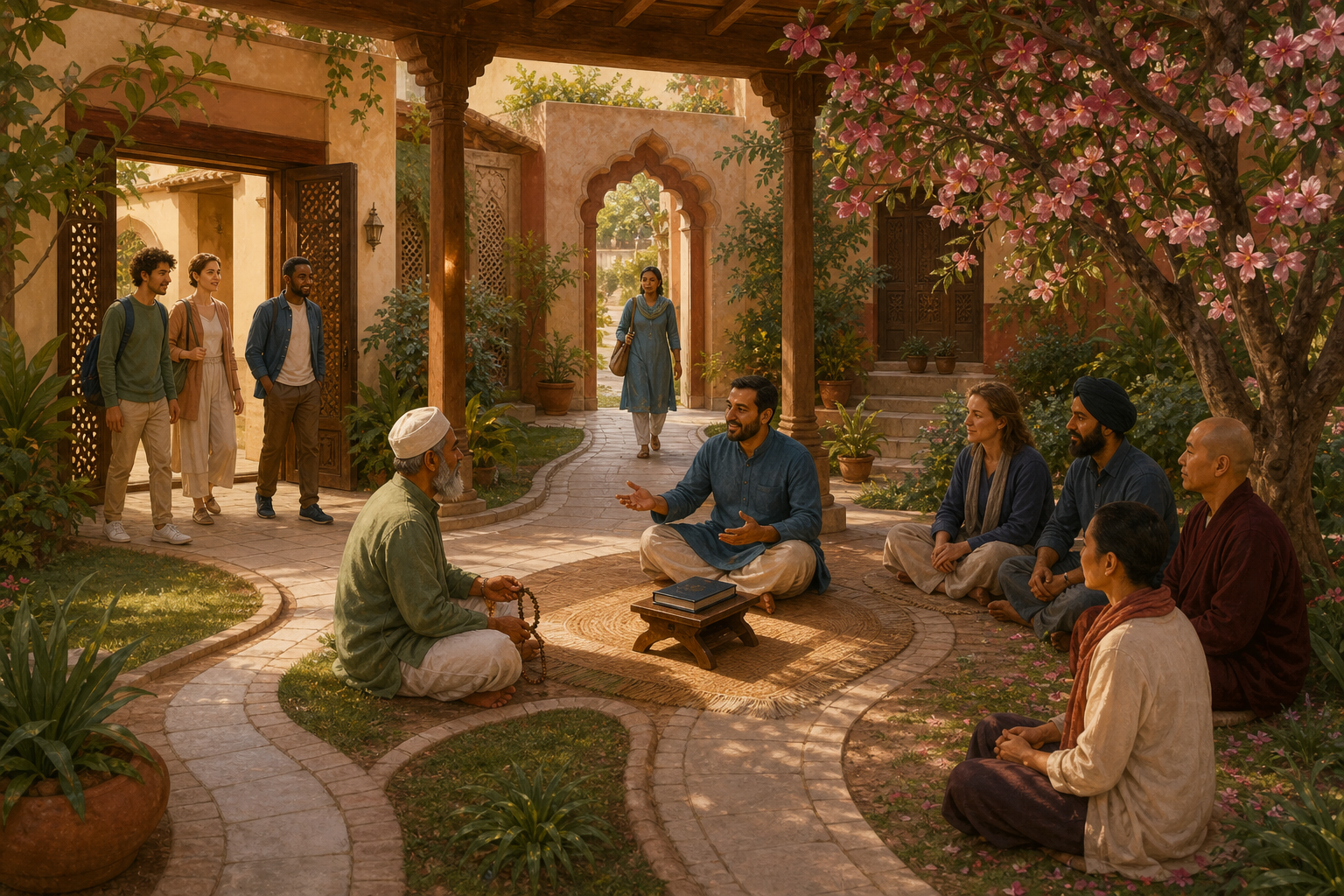
Audience labels are only working hypotheses. Do not assume that every temple attendee understands Sanskrit or that every secular listener is hostile to devotion. Ask the organiser what people have read, which language they follow comfortably, why they are gathering and what kind of participation is expected. Then use the following map to choose an entry point.
| Audience | Likely starting need | Useful first move | What to avoid |
|---|---|---|---|
| Established practitioners | Deeper understanding that sharpens hearing and sadhana | Begin with the textual problem, a key term or a meaningful relationship with received commentary | Repeating familiar conclusions without showing how this passage reaches them |
| First-time Hindu listeners | A map of the people, setting and significance | Give the narrative location before introducing theological vocabulary | A procession of names and Sanskrit terms with no explanation of their role |
| Mixed Dharmic audience | Clarity about both common ground and genuine difference | Begin with a shared human or ethical question, then locate the Bhagavatam’s answer within its own devotional framework | Claiming that every Dharmic tradition teaches an identical metaphysics |
| Academic or secular group | A fair account of what the passage claims and how it reasons | Distinguish textual observation, internal theology, historical framing and personal application | Demanding devotional assent as the price of understanding, or reducing devotion to sociology |
| Children and families | A concrete grasp of action, motive and consequence | Tell the relevant scene clearly, pause at the decisive choice and ask what each person could do next | Long abstractions, unexplained names or a moral detached from the story |
| Mixed or sceptical public | Evidence that difficult questions will be heard rather than dismissed | State the strongest version of the objection and answer only as far as the passage and your interpretive tradition permit | Caricaturing doubt, claiming certainty you do not possess or changing the subject |
The same passage can therefore begin in different places. With practitioners, you might begin inside the verse and ask what a familiar term demands of practice. With newcomers, begin one step earlier by locating the scene. With a comparative group, begin with a shared question but preserve the text’s distinctive answer. With children, let an action or decision carry the opening. The destination remains governed by the passage; only the approach changes.
Vocabulary should follow the same rule. Introduce a Sanskrit term when the original word carries a distinction that an English substitute would blur. Pronounce it, translate it in context and use it consistently. Do not introduce technical language merely to display proximity to the tradition. Accessibility is not the removal of Sanskrit; it is the removal of avoidable confusion.
Move from hearing to action without reducing scripture to self-help

A useful class moves in a deliberate sequence. Each stage answers a different listener need, so do not rush to application before establishing what the passage means.
- Open with a real question. Use a tension the audience can recognise, but do not embed your conclusion in the question.
- Read the passage. Let listeners hear the text or translation before they hear your interpretation of it.
- Map the setting. Supply only the context needed to understand the present exchange, action or prayer.
- State the interpretive claim. Give the central teaching in a sentence clear enough for the audience to examine.
- Demonstrate the claim. Return to the wording, structure or narrative movement that supports it. This is where teaching differs from assertion.
- Identify the layer of each statement. Signal whether you are explaining the verse, following a commentary, conveying your sampradaya’s teaching or proposing a present-day application.
- Offer a proportionate response. Invite a practice, reflection or change of attention that genuinely follows from the passage. Do not use a single class to pressure listeners into a major personal decision.
- Check understanding. Ask listeners to locate the claim in the passage and describe the connection in their own words.
The distinction between layers is especially important. A listener should be able to tell when the Sanskrit text is being translated, when a commentator is interpreting it and when you are drawing an application for this room. You can mark the transitions in plain language: the verse states; the commentary explains; within this lineage the teaching is understood as; for our situation this may ask us to. Such labels do not weaken authority. They prevent your illustration from being mistaken for the only possible wording of the text.
Application should preserve the devotional direction of the Bhagavatam. A passage about devotion cannot be reduced to productivity. A passage about detachment should not become an excuse for neglecting duties. A narrative about a grave moral choice should not be compressed into a cheerful slogan. Ask what transformation the passage itself seeks, then choose a response equal to the listener’s present capacity.
Use questions that send the listener back to the text
A polite nod tells you little about whether the class has landed. Ask questions that reveal comprehension rather than rewarding agreement:
- What changes when we remember who is speaking and who is listening?
- Which word, action or contrast supports the main interpretation?
- Is this conclusion stated in the passage, supplied by commentary or drawn as an application?
- What would be lost if we removed the passage from its narrative setting?
- How would you explain the teaching to someone who does not know our vocabulary?
- What small practice or act of attention follows from this teaching without going beyond it?
When an objection arises, first determine its level. The listener may be confused by a word, unconvinced by an argument, troubled by an action in the narrative, questioning the theology or asking a historical question that the present verse does not resolve. Restate the concern fairly. Answer at the level you can support. If the question requires another passage, commentary or specialist knowledge, name that boundary and return with a considered answer later. Pretended certainty teaches the audience to distrust both teacher and tradition.
Key takeaways
- Keep the passage, context, central claim and interpretive lineage fixed; adapt the entry question, vocabulary, illustration and response.
- Prepare a textual spine before collecting stories. Every major point should connect to a word, action, contrast or narrative turn in the chosen passage.
- Let narrative, prayer, philosophical dialogue, description and genealogy call for different teaching methods.
- In a mixed Dharmic setting, make room for shared questions without erasing doctrinal differences.
- Tell listeners when you move from text to translation, commentary, lineage teaching and present application.
- Measure understanding by whether people can locate, explain and respond to the teaching, not merely by whether they agree with you.
For your next class, fill out the passage card before writing the opening. Remove any illustration that does not serve the central claim. Add the missing sentence of context. Choose one question that sends the audience back to the text and one response that can be practised without exaggerating what the verse demands. When a newcomer can enter the teaching and an experienced listener can still point to its exact scriptural root, adaptation has served transmission.
References
- Dandavats — Srimad Bhagavatam 1.2.9 with Kalakantha Prabhu!
- Dandavats — SB 1 7.23 HG Bhava Sindu Prabhu
- Dandavats — Ananda Krsna Prabhu – Shrimad-Bhagavatam 4.24.73
- Dandavats — How to Present the Śrīmad Bhāgavatam to Different Audiences
- Dandavats — Srimad Bhagavatam Text 3.28.3 Speaker – H.G Raghupati Das
